Not all ghosts are scary. Some are rather sad, because they mark the passage
of time. Sir Simon de Canterville is definitely like that, but he also shares a
kinship with Captain Gregg, Mrs. Muir’s ghost. He was once a holy terror, but
he meets his match in a thoroughly modern American family in Kim Burdon’s animated
adaptation of The Canterville Ghost, co-directed by Robert Chandler,
which opens Friday in theaters.
For
three hundred years, Sir Simon scared the willies out of everyone who tried to
inhabit Canterville Chase. Unfortunately, Yanks like the Otis family are far
too materialistic for ghosts. Virginia’s father Hiram considers himself a man
of science, whose electric lights frazzle the ghost’s nerves. Her bratty twin
brother torment poor Sir Simon with practical jokes. Of course, she is not
scared of him either, but as the late 19th Century equivalent of a
moody goth teen, she is drawn to Sir Simon’s tragic romanticism.
Alas,
the ghost would much prefer to be dead, so he can finally be reunited with his
beloved wife. Death played a mean trick on him, which made him onery. Otis
would like to break his curse, but that will be a complicated and dangerous
proposition.
Screenwriters
Cory Edwards, Giles New, and Keiron Self collectively did a nice job adapting
Oscar Wilde’s novella, retaining his major themes, while punching up some of
the dark and stormy bits, for Halloween. Wilde scholars might take issue with Hugh
Laurie’s Angel of Death character, but he helps stir the pot and raise the
stakes. There is plenty of animated mayhem, but deep down, this film is sadder
and wiser than Casper or Topper.
Canterville
is indeed a tragic figure, given Shakespearean dimensions (and references) by
Stephen Fry’s hammy voice. Emily Carey makes Virginia Otis appealingly smart
and sensitive, despite her teen angst. Freddie Highmore sounds appropriately
young and befuddled as the Duke of Cheshire, but his voice works surprisingly
well in conversation with Carey’s.
One of the only cool things about the 1970s was all the great made-for-TV
horror movies that were released. That was also true in the UK, where they
produced one of the best. Nigel Kneale is now considered one of the great
television writers and this Lovecraftian-themed original definitely helped
solidify his standing. Fittingly, Peter Sasdy’s The Stone Tape, written
by Kneale, screens as part of the Lovecraftian horror series at Anthology Film Archives.
If
this story were happening today, Ryan Electric Products would be battling competition
(and possibly state-sponsored corporate espionage) from China. In 1972, R&D
head Peter Brock is obsessed with beating Japan. To that end, he launches a
massive “pure research” endeavor, hoping his team’s unrestrained brilliance
will produce a providential breakthrough. To house his project, Ryan Electric
acquired the “Taskerlands,” an ancient manor built above even more ancient
ruins. The place has a dark and stormy reputation. It even had an exorcism that
reportedly did not take, according to the research of Roy Collinson, Ryan’s
facility manager and an old mate of Brock’s.
Somewhat
awkwardly, Brock’s former mistress, Jill Greeley, has been assigned to
Taskerlands as his computer programming. Apparently, she has heightened susceptibility
to the building’s bad supernatural mojo. She feels it so acutely, she nearly
crashes her car when first approaching. Initially, Brock condescendingly
dismisses the strange sights and sounds of a ghostly woman she reports, until
they are corroborated by others. As a stubborn materialist, Brock directs his
team to devote their entire powers of computer-driven analysis to the “haunting.”
He hopes the sinister stones of the chamber where the presumed spirit of a long
dead maid appears will hold the secret of a radical new recording technology.
Of course, their investigation will take a decidedly Lovecraftian turn.
Kneale’s
screenplay gave rise to an entire paranormal hypothesis known as “The Stone
Tape Theory” that posits supposed hauntings are actually the recordings of viscerally
traumatic events. Few horror movies have that sort of lasting legacy, but its
reputation really endures, because it is so darned creepy.
In
addition to being one of Kneale’s best scripts, Stone Tape represents some
of Sasdy’s best work (along with his episodes of Hammer House of Horror).
Using vintage Doctor Who-level special effects, he creates a sense of
dread that is truly Lovecraftian. He and the design team made Taskerlands a
very distinctive place that exudes massively bad vibes.
The IRA could pretend their members were motivated by their Marxist ideology,
but they were usually moved by much more personal considerations, like
religion, revenge, or the approval of an abusive father. For Michael O’Hara, it
is all about revenge. He is determined to find and kill the soldier who
accidentally shot his pregnant wife, but his quest for vengeance is disillusioning
rather than radicalizing in Tom Guard & Charles Guard’s Dead Shot,
which releases in theaters and on-demand this Friday.
O’Hara
had retired into exile, but he returned to Northern Ireland for his pregnant
wife Carol’s delivery. Unfortunately, Tempest’s unit had the drop on him, but
during the heat of the moment, he sees movement in the backseat of O’Hara’s car
and squeezes off three rounds right between Carol’s eyes. It is a propaganda
disaster, but Holland, the mysterious deep-state scary guy, promises to protect
Tempest from prosecution if he joins his new task force. They will be chasing
IRA terrorists in London, using the weapons and tactics of the battlefield.
They will need them, because Keenan, a highly placed IRA leader, plans to
escalate violent attacks on British civilians.
Although
presumed dead, O’Hara is itching to find Tempest. Keenan dangles intel on the
reassigned soldier as bait, forcing him to reluctantly assist a campaign of
terror increasing directed at civilian targets. It does not sit well with O’Hara
or “Catherine the Courier,” who has particularly personal history with Keenan.
The
poster for Dead Shot makes it look like a run-of-the-mill VOD action
movie, but it rather more thoughtful than that. In many ways, it is a lot like
the Dutch series The Spectacular, except it is set in London rather than
the Benelux countries. It is a grim and gritty revenge thriller that critiques
the ruthlessness of both Holland and Keenan, but the latter probably gets it
somewhat worse than the MI-666 shark. Think what you will, but on some level,
Holland is a professional, who makes decisions unclouded by emotions.
They are partially inspired by the Mitford Sisters (especially Diana, the one
who married Oswald Mosley), but initially their ideologies are not so extreme—just
their personalities. When Thomasina Hanbury invents a device to view the future
in 1941, the sisters duly try to use it to serve the British war effort.
Unfortunately, hubris brings the downfall of the arrogant, even when they can see
the future in Andrew Legge’s Lola, which releases in theaters and on VOD
this Friday.
“Thom”
is the socially awkward genius, who invented the “Lola” device. Martha is her
hard-partying sister, who becomes a fan of Dylan, Bowie, and the 1960’s
counter-culture through the Lola. She is not a scientist, but she does the leg
work for their “Angel of Portobello” radio broadcasts, giving advance warning
of the next day’s air raids. Martha also “handles” Lt. Sebastian, the ambitious
intelligence officer, who traces their signal. Unfortunately, Thom starts to
resent both Sebastian’s unwelcome oversight and her sister’s romantic interest
in him.
Lola
is
not exactly a time-travel film, but it is a very clever, low-fi sf film that
twists the time continuum into knots. It is also one of the more inventive “found
footage” movies in years. Initially, found footage seems like a strange choice to
tell the tale, but it makes sense at the end.
Legge
incorporates archival newsreel footage for a Zelig-like effect, but that
is really the least of it. The most intriguing aspects of the screenplay,
co-written by Legge and Angeli Macfarlane, are the ways in which the Hanbury
Sisters use their device to re-shape the war. At first, they very successfully
mitigate the impact of the London Blitz. However, as they get more ambitious,
they start causing unintended consequences.
These Eastenders lived gritty working-class lives not unlike those of the long-running
British soap opera, but their story is much more noir. Ealing Studios put
themselves on the map with this slice-of-life story that explored the aspirations
and regrets of a wide circle of characters, tangentially related to an escaped
prison inmate currently at-large. Post-war life is hard, even for the criminals
in Robert Hamer’s It Always Rains on Sunday, which screens as part of MoMA’s
Rialto at 25 film series.
Tommy
Swann once swept Rose Sandigate off her feet, but went he was sentenced to
prison, she settled down with her current husband George Sandigate—with the
emphasis on “settle.” Her relationship with her step-daughters is strained, to
put it mildly. To the annoyance of Vi and Doris Sandigate, their good-natured
father largely defers to his second wife. He knows she used to run with a fast
crowd, but news of Swann’s escape means nothing to him.
Inevitably,
Swann will approach his old flame for help, which she cannot deny him. Initially,
she hides him in their old air raid shelter, as she waits for the rest of the
family to leave for their Sunday recreation. Meanwhile, the police launch a
citywide dragnet, while also searching for a gang of three burglars, who are
desperately trying to fence the shipment of roller-skates they mistakenly
boosted.
In
some ways, Sunday is Robert Altman-esque film, introducing viewers to a
large cast of characters, revealing the unexpected ways they are
interconnected. Yet, it also has some gorgeously moody noir sequences (shot by
legendary cinematographer Douglas Slocombe) that would not look out of place in
classic Carol Reed film noirs, like Odd Man Out or The Third Man.
Indeed,
the last thirty minutes are as good as noir gets. Hamer definitely down-shifts into
the third act, but the way the everyday desperations of the first hour builds
into the life-and-death conflict of the finale makes perfect emotional and
dramatic sense.
This is a very Cornish film, but at least it was not produced in the Cornish
language, which would have been a “performative” gimmick. Yet, in a way, it
hardly would have mattered considering how little dialogue there is in this 16mm
exercise in isolation and dread. The lonely landscape and Cornwall’s tragic
history contribute to a woman’s descent into madness during the deliberate course
of Mark Jenkin’s Enys Men, which opens Friday in New York.
We
only know the woman as “The Volunteer,” who has come to the deserted isle of
Enys Men (which translates to “Stone Island”) to observe the wildlife,
particularly a patch of wildflowers. It is a methodical routine, with little
variation, at least initially, but that appears to be what the Volunteer wants.
At night, she still maintains her personal rituals, including reading A
Blueprint for Survival, a 1970s environmental tract that may have directly
contributed to her impending doom. Her only company comes from the occasional
scheduled supply runs from the “Boatman,” who seems to mean more to her than a
mere deliveryman.
Jenkins
repeats this pattern over and over again, so the audience can pick up small
deviations when they first start to develop. It begins with small lichen appearing
on the Volunteer’s wildflowers. Then the fungi starts growing on her long-healed
scar. Here and there, we see ever-so brief flashes of visions or
hallucinations, harkening back to the Bal Maidens and the isle’s long-deserted
mines.
A
pat description of Enys Men might be “experimental folk horror.” As a
filmmaker, Jenkins clearly exhibits avant-garde and ethnographic sensibilities.
The film has a remarkably vivid sense of place—nearly to the exclusion of
everything else. Yet, he milks a palpable sense of mounting dread from the
eerie standing stones and abandoned monuments, quite skillfully.
Except for a few poems also published, Emily Bronte is basically a one-hit
wonder, but as part of the Bronte Sisters, she doesn’t seem like one. Of
course, the Brontes wouldn’t be the same Brontes without Wuthering Heights.
Her short but appropriately melodramatic life is somewhat speculatively
dramatized in director-screenwriter Frances O’Connor’s Emily, which opens
tomorrow in New York.
Emily
is always considered the flaky Bronte sister, especially her father, Patrick. The
stern minister expected all his surviving daughters to be educated and find
employment as teachers, but Emily fell apart whenever she left the Bronte
ancestral home. If it was any consolation, her ne-er-do-well brother Branwell is
an even greater disappointment, so naturally they bond over their love of
poetry and mischievous pranks.
Initially,
the middle Bronte sister think very little of the new curate, William
Weightman, who shares her father’s faith-above-reason approach to theology. At
first, she resents his moralizing, especially when tutoring her in French.
However, their bickering eventually melts into an ill-fated romance.
Bronte’s
relationship with Weightman is almost entirely fictionalized, as are some of
the colorful gothic episodes O’Connor cooks up, but they all fit with the
Bronte legend. In fact, there are some sequences with a creepy mask that are
surprisingly cool and effective.
It looks like we can also blame Richard Nixon for the alien invasion of Earth. He is the
one who agreed to fund the Voyager probe, which the Gu’un just followed its
trajectory back to us. If only he hadn’t been such a liberal big-spender. They
are here regardless and they intend to stay. Poor Stewart is the junior
bureaucrat recruited to help communicate the new overlords message in Fergal
Costello’s We Are Not Alone, which premieres tomorrow on the Roku
Channel.
The alien
invasion was especially traumatic for Stewart, because their advance capsule
landed on his best friend Robbie when they were leaving the pub. The Gu’un
really don’t get how things work here, so the regional commander decides to
govern the UK from Clitheroe, because it is in the dead center of the country.
She adopts the inappropriate name of Trater, due to an equally iffy grasp of
the language. The Gu’un all chose odd new “earthly monikers, because the sound
of their real names cause humans to void their bowels.
Stewart
lacks ambition under the best of circumstances, so he is very conflicted about
working for the alien occupiers. However, he likes the generous new salary and
the swanky new pad. Unfortunately, he will have to share it with his alien
minder, the dim-witted Greggs. Even more awkwardly, the resistance pressures
him to be their inside saboteur. Most of the Anti-Alien Alliance (AAA) does not
inspire much confidence, except for Elodie, the pub owner he has long carried a
torch for.
Laurence
Rickard and Ben Willbond (known for writing and appearing in the original Ghosts)
have a knack for penning “stupid” sounding dialogue, in a smart way. They also
make a drolly amusing Heckle and Jeckle pair as Cirsch and Darrenth, two
flat-footed Gu’un sentries. Their soft science fiction is not groundbreaking,
but they and Costello really keep the dialogue consistently snappy.
This is the sort of film that makes you wonder what kid of elevator pitch the
filmmakers developed. Basically, it is a mockumentary creating the fictional
backstory of a semi-real internet hoax. It probably sounds exploitative, but it
tries to make all the right points about representation and agency of little
people. How well that works is debatable throughout screenwriter-director
Raphael Warner’s Lion vs the Little
People, which is now available on VOD.
At the end of Lion, the closing titles admit the expose the audience just watched is
fictional, but they maintain the pretense up to that point. Apparently, a phony
BBC news item really did go viral claiming 42 little people were killed in a
mysterious battle with a lion. Technically, it used the “M” word, which Warner
always scrupulously bleeps. The story (and it is a story) goes a dodgy FOB cardboard
magnate named Larry Vincent Ross created an underground little people fight
circuit in Macau, in partnership with a Chinese gangster with high-ranking CCP
connections. That part is pretty believable, especially the photoshopped
pictures of him with Bill Clinton. The TV ads he supposedly cut for his
ill-fated chain of dojos are less credible.
When the illegal fight circuit took off, Ross and
his associates escalated the action, pitting his little people fighters against
animals. Inevitably, things got a little too hot, so they decided to cash-out
with a big finale, but they had to lure legit little actors from Hollywood for
their battle royale against a lion.
Let me repeat: I am not making this up—but Warner
is. The film goes out of its way to use the right terms and criticize
stereotypes, but the fundamental premise is just about the most exploitative
thing you could imagine—and that is inevitably (if maybe unintentionally)
reflected in the one-sheet.
Yet, it has to be stipulated this is a work of
great chutzpah from Warner. Seriously, you have to wonder how he pitched this
film. Somehow, he even managed to recruit Linda Thorson (fondly remembered as
Tara King, Emma Peel’s successor on The Avengers) to play Gayle Bennet, the Hollywood casting director duped by Ross.
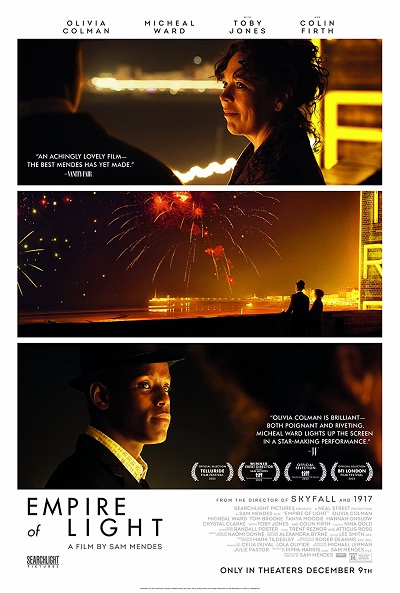
The Empire Theatre is troubled, but the movies it books are not part of the
problem. During the course of this film, we will see it screening Chariots
of Fire, The Blues Brothers, Smoky and the Bandit, and Being There. Unfortunately,
this release is not nearly as good as those that it references in passing. It
is presented as a tribute to the movie-going experience, but like a bad projectionist,
focus is a problem for Sam Mendes’ Empire of Light, which opens
tomorrow.
Hilary
Small is the one who keeps things running at the Empire, in the coastal town of
Margate. However, she is easily dominated by her exploitative boss, Mr. Ellis, who
also uses her for quickies in his office, much to the disgust of the other
employees. Her life of quiet desperation leads to a breakdown, but after her brief
hospitalization, she returns for more of the same, just with more medication.
Things only start to change when Stephen joins the staff. The smart teen aging
into adulthood should be going to university, but he lacks sufficient funds and
the proper skin color (according to Mendes’ didactic screenplay).
He
and Small are drawn together, as fellow outsiders. Their rapport will take a
turn towards the romantic, despite vast differences between them. However,
Stephen will eventually figure out Small’s emotional issues have only been
masked, rather than cured.
If
you want to watch the great cinematographer Roger Deakins paint pretty pictures
with light, then Empire will certainly deliver. However, the melodrama
reeks of sentimentality and the periodic attacks on Thatcherism (which reversed
the UK’s decline into economic stagnation and international insignificance) are
gratingly unnecessary distractions.
Frankly,
despite some rather lovely scenes of projectors streaming down on the movie palace’s
screen, Empire could have just as easily been set in a fish & chips
shop, without losing much beyond Deakin’s visuals. Small’s relationship with her
co-worker stays on the right (legal) side of Summer of ’42, but it is
hard to buy them as a romantic couple. At times, Stephen gets lost in the film,
overshadowed by Small’s angst and resentments. Focus really is an issue here.
The best caper-heist movies are meticulously detailed. It’s that little stuff,
like the umbrella catching the debris in Rififi that makes them fun.
This film isn’t like that at all. In large measure, both the cast and
characters seem to be making it up as they go along. However, if you adjust
your expectations and settle in for some double- and triple-crossing trickery,
there might be something to Sam Bradford’s The Pay Day, which releases
today in theaters and on VOD.
Jennifer
just got sacked from her London IT job, because her [former] boss is an exploitative
shark. She already has an offer of sorts, but it is somewhat non-traditional.
The mysterious mastermind calling himself Gates wants her to sneak into a big “City”
bank’s corporate office to steal a list of dodgy accounts and their passwords.
The source of the dirty funds is a bit vague and it seems to keep shifting from
conversation to conversation, but she could certainly use her multi-million-Pound
cut.
However,
Jennifer has a harder time infiltrating the building than anticipated because
of Gates’ junky intel. She also has to con her way around George, whom she
assumes is an investment banker, but viewers can tell from his entrance, he is actually
another thief trying to make the same big score. Yet, despite the
circumstances, they have a weird flirty thing going on, even after she
accidently shoots him.
As
co-screenwriters, Kyla Frye and Sam Benjamin are more successful fooling the lead
characters they play than the audience watching it pan out. However, it is
rather lively. They made three previous short films together, so there is at
least a pre-existing professional relationship there. Regardless, their
chemistry in Pay Day works surprisingly well.
If the UK hadn’t banned fox hunting, it might have saved these working-class
thieves a lot of trouble. Naturally, these upper crust hunters turn to hunting
people as a way to keep their traditions alive. That might sound extreme, but
the Manhattan DA wouldn’t even prosecute them for it, as long as they kept
their hunt to the subway platform, forcing them down to the level of tacky proletariat
killers. Indeed, the hunters find there is a lot of fight in their prey during the
course of Tommy Boulding’s Hunted (a.k.a. Hounded, a more
descriptive title), which opens tomorrow in Los Angeles.
Leon
thought he was done burgling high-class estates after raising enough money for
his brother Chaz’s uni tuition, but he agrees to one more job. They were
supposed to pilfer a ceremonial hunting knife, but it was a set-up. Suddenly,
they wake up in a field with a pack of hounds baying after them. Katherine Redwick,
her distinguished father Remington, and her hot-blooded brother Hugo intend to introduce
her twit nephew Mallory to the hunt, using them as a substitute for the fox.
It
seems like just illegally hunting foxes would be easier and cheaper to cover-up
than hunting people, but apparently this is a long-standing Redwick tradition.
It keeps the uppity lower classes in their place, as the loaded,
class-conscious dialogue makes ridiculously obvious. Listening to the Redwicks
will make any reasonably grounded viewer roll their eyes, but the rest of the
film is competently executed. It just lacks style, originality, and
inspiration. Frankly, it deserves a non-descript title like Hunted.
So much for all that bogus double-talk about the “patriarchy.” Of course, it
never had any place in folk horror. All those weirdo villagers who secretly
held to “the old ways” were often enthralled to some sort of a pagan earth
goddess. It turns out Laura Birch was not wrong to stay so-long estranged from
her mother Celia, because the older woman made a Faustian bargain with the evil
power controlling her village in Ben Steiner’s Matriarch, which premieres
Friday on Hulu.
Birch
was going through a rough patch in London that culminated in a coke overdose.
She probably should have died, but he felt like something pulled her back. She
also feels compelled to finally visit her old mother, who strangely looks like
she has not aged a day since they last met. Birch hardly gets much of a welcome
from the tight little village, but folk horror fans know they never take kindly
to outsiders. Only Birch’s old friend Abi still greats her warmly. However, Birch
is a little put off by the way Abi’s father, the village Pastor, condemns the
town for turning its back on Christianity and everything else decent.
Matriarch
takes
a little time to get going, but once Steiner gets into the folk horror, the
film gets seriously sinister. There is a palpable atmosphere of Pagan-wrongness
to the village. Kate Dickie (who is becoming an established horror star, thanks
to Raven’s Hollow, Shepherd, and The Green Knight) is
satisfyingly creepy as Mother Birch. Jemima Rooper (who was also weirdly compelling
in Flowers in the Attic: The Origin) effectively portrays Birch’s cynical
urban materialist skepticism as it slowly gives way to the shock and horror of
her Pagan legacy.
Wars are like the old Knicks-Pacers games, in that they aren’t over until they
are truly, officially over. Jack Wallace understands that only too well. Even
though everyone knows WWII is down to its final days, he is still recruited for
a potential-suicide mission in Giles Alderson’s Wolves of War, which releases
tomorrow on VOD.
Wallace
is the only parent his little girl has left, but he worries his success as a
commando might have profoundly changed him as a person. Regardless, there is no
guarantee he will survive this mission to see her again. Under the command of
Captain Norwood, Wallace and his hodge-podge squad must parachute into no man’s
land Bavaria, to rescue expat Professor Hopper from the National Socialist “Werewolves,”
the fanatical remnants of the SS engaging in scorched earth guerilla warfare.
Supposedly,
Hopper and his daughter Hannah were trapped in Germany when the war broke out,
but he was never a regime sympathizer. Obviously, he is not a political science
genius. As it happens, he is a physicist, who has developed a rival atomic bomb.
If Wallace’s team can secure the professor and his notes, they can call in an
airlift. Otherwise, it will become a carpet-bombing airstrike.
In
some ways, Wolves of War is a throwback to old fashioned WWII films, but
Wallace’s existential angst definitely feels contemporary. However, its stiff-upper-lip
Britishness is appealing. The action is respectably gritty, but it lacks a big
set-piece crescendo.
Arthur Kipps' assignment sounds like a nightmare from Hell: one solid week of
paperwork. He is supposed to organize the ratty old papers of the late Alice
Drabow, the former owner of Eel Marsh House. Frankly, the visitation of a vengeful
ghostly woman sounds like a welcome distraction from such drudgery, but
unfortunately, her appearances are a harbinger for yet another child dying in
the beleaguered local village. Despite the tragedies, poor Kipps still has to
get all those blasted papers in order in James Watkins’ Hammer-produced The
Woman in Black, which airs Thursday on Comet.
Kipps’
beloved wife died in childbirth, leaving him to raise their son Joseph on his own.
The senior partner of his proper Edwardian firm says he is sympathetic to Kipps’
situation, which means he really isn’t. Regardless, Kipps must sort out the
Drabow estate if he is to have a future with the firm. Unfortunately, the local
solicitor has been decidedly uncooperative, so Kipps must go to Eel Marsh House
and process all the paperwork, so they can clear the title for the prospective
heirs.
Of
course, he receives a nasty welcome from all the locals, except the wealthy and
skeptical Sam Daily. Yet, he too lost his young son in an incident attributed
to the Woman in Black. According to legend, whenever she is seen, a child dies through
an act of self-destruction. As a result, Kipps only makes things worse for
himself in the village when he asks about the strange woman he has seen around the
Eel Marsh grounds. Children do indeed start dying, which is especially alarming
to him, since Joseph and his nanny are scheduled to visit over the weekend.
Woman
in Black is
an entertaining gothic throwback, which made it an altogether fitting
production for the relaunched Hammer Films. As well as channeling vintage
Hammer, Watkins also picked up a step or two from films like Bayona’s The Orphanage,
using the full frame to tease viewers with shadowy figures, half-seen from down
long hallways. Yet, the wonderfully lush and decaying set designs are pure
vintage Hammer. Plus, the isolation of Eel Marsh House, built atop a rise in
tidal basin that is inaccessible during high tide, lends the film additional
claustrophobic creepiness.
Since
Daniel Radcliffe now shuns J.K. Rowling as a heretic who should be burned at
the stake, this could be his new favorite film. It is the second screen
adaptation of Hill’s novel, following a 1989 BBC production, and the first to
spawn an original sequel. It is refreshingly atmospheric and suggestive, rather
than bluntly gory.
Robert Freegard is a lot like the slimy “stolen valor” imposters, who pass
themselves off as veterans, even though they never served in uniform—but this
British con man was especially predatory. Freegard never had any connection to
MI5, but he certainly sounded convincing. The master manipulator finally picks
the wrong woman to swindle in Declan Lawn & Adam Patterson’s Rogue Agent,
which opens Friday in New York.
A
luxury car sales man was not exactly the sort of man a solicitor like Alice
Archer was looking for, but Freegard (using the name Hansen) was charming and
not easily deterred. Archer fell for him despite her early reluctance and the
occasional red flags that kept popping up. When she finally confronts him with
his mysterious lack of a paper trail, Freegard pretends to come clean, claiming
to be an undercover MI5 agent.
Ironically,
this fiction provides cover for a lot of events that would otherwise raise suspicions.
Regardless, Archer lets him into her life and finances, getting burned badly.
Yet, she understands she got off easy compared to some of his other victims,
some of whom he continues to brainwash and control.
James
Norton’s portrayal of Freegard defines the meaning of the word sociopathic more
vivid cinematic terms, more than any film of recent memory. As Phil, Archer’s
investigator explains, Freegard is the sort nasty cuss, who is just rotten to
the core and won’t ever change (it is a great scene, in which Julian Barratt
makes the most of a small role). Indeed, the case of Freegard is quite disturbing,
especially since he is now apparently at liberty (due to events transpiring
after the film).
This is a documentary about an imposter, starring an imposter. Alan Cumming
is not really trying to convince us he is Brandon Lee. He is just lip-synching
the part, since the “real” Lee only agreed to faceless audio interviews. That
prompts the question whether Lee is really Lee. Turns out he wasn’t, as Jono
McLeod reveals in his game-playing documentary, My Old School, which opens
today in New York.
The
case of “Brandon Lee,” who enrolled in Glasgow’s academically well-regarded,
middle class Bearsden Academy in 1993 would eventually be widely covered by the
British tabloid press. However, if you do not know his secret, McLeod teases it
out slowly, so you better appreciate how the revelations hit Bearsden students,
including McLeod, himself. In some ways, the awkward Lee was conspicuously at
odds with his classmates. Even his name was suspicious, since the actor Brandon
Lee had just died on the set of The Crow a few months prior to his
arrival at school.
Yet,
Lee thrived academically and managed to make a number of friends at Bearsden.
He even starred in a school production of South Pacific, which raises
further ethical questions once the truth is established. Yet, McLeod maximizes
the twists and turns getting, reflecting the confusion he and his classmates
shared at the time, and to some extent still feel.
As
docu-hybrids go, My Old School is about as hybrid as they get. In
addition to employing lip-synched interviews (a rare documentary technique, most
notably used previously in Clio Barnard’s The Arbor), McLeod also
integrates extensive Daria-style animated sequences to recreate incidents
from Lee’s time at Bearsden. They have some charm and fit the 1990s vibe. As
for the lip-synching, Cumming matches the subject’s audio well-enough, but his presence
does not add much to enrich the film.
Maurice Flitcroft wanted to be the real-life version of Kevin Costner’s “Tin
Cup,” but he just never played the game very well. Nevertheless, his record-setting
high-score at the 1976 British Open made him something of a cult hero to
frustrated duffers everywhere. After that, the British Open was very much done
with Flitcroft, but Flitcroft was not done with them. His unlikely career gets
the underdog movie treatment in Craig Roberts’ The Phantom of the Open,
which opens this Friday in theaters.
Having
always provided for his wife Jean, their twin sons Gene and James, and his older
step-son Michael, Maurice is not sure what he wants to do with himself as
retirement approaches for the working-class crane operator. Somehow, he gets it
into his head golf will be his thing. He has the ugly clothes, but his swing is
even uglier.
Naturally,
he figures he will enter the British Open, because it looks like a nice tournament
on the telly and because he can. That is why it is called an “Open.” It turns
out there is a lot less paperwork to enter as a professional rather than an
amateur, so that is what he does. Stodgy Keith Mackenzie of the R&A is scandalized
by Flitcroft record high score, so he bans him from future tournaments.
However, loyal Jean encourages Flitcroft to persevere, so he starts devising
ways to enter subsequent Opens under assumed names.
Without
question, Phantom is most entertaining when it revels in the subversive
farce of Flitcroft’s Open capers. His disguise as French golfer “Gerald Hoppy”
is a sequence worthy of Peter Sellars. (It even comes with a Clouseau
moustache.) However, Roberts somewhat loses his way, indulging in some painfully
maudlin family melodrama during the third act. Flitcroft was born to burst
pretensions, rather than be elevated to some kind of tragic hero.
Here is an odd-sounding couple: T.S. Eliot, the unofficial poet laureate of conservatism
and Father John Groser, a leader in the Anglican socialist movement. Yet, somehow,
they came together to bring to the screen Eliot’s passion-like verse play depicting
Archbishop Thomas Becket’s final days. It is not for mass-market tastes, but there
are great insights to be found when George Hoellering’s long unavailable Murder
in the Cathedral starts streaming this Thursday on OVID.tv.
Essentially,
Becket’s dispute with Henry II boiled down to how much the Church could render
unto Caesar while still maintaining its institutional integrity. Frankly, this
is not an academic debate. One could argue the current Pope has conceded far
more authority to the CCP in China than Becket could ever accept. He routinely
pledged his loyalty to his King and country, but he steadfastly insisted
nothing could supersede his vows to his God and Church.
Essentially,
the film consists of Henry’s inquisition, Backet’s departure and return from
exile, and his murder by four knights loyal to the King. That last part should
not be a spoiler. Even if you do not know the history, you should know how the
Peter O’Toole-Richard Burton film Becket ended. (If you don’t, it’s a
minor miracle you got past “Eliot’s verse play.”)
Hoellering’s approach to Eliot’s play is uncompromisingly faithful and rigorously
Spartan, with extensive passages for choruses, either speaking in turn or in
unison. Canterbury Cathedral looks cold and drafty, but also hallowed and holy.
Arguably, this might be the most authentically medieval-looking film that does
not wallow in the muck, mire, and pestilence.
In
fact, the austerity of Hoellering’s vision is partly why it is so arresting. Indeed,
the film reminds us that some of the most visually arresting films have had
religious themes. In terms of look and tone, Cathedral can easily sit
next to Dreyer’s The Passion of Joan of Arc and Tarkovsky’s Andrei Rublev. The three films would make an inspired but exhausting triple
feature.
It
is demanding material, but it is never dry, thanks in large measure to Groser’s
riveting performance. He carries the weight of the world with equal parts
compassion and conviction. He certainly looks more like a saint in the making
than Burton ever did. Eliot himself is perfectly cast as the voice the unseen
fourth “Tempter,” who tries to appeal to Becket’s vanity with the glory of martyrdom.
(Viewers should also be on the lookout for Leo McKern, the future Rumpole, who
plays the Third murderous Knight.)
If there is one thing we get from movies, if we use them as our counselors
and therapists, it is getting out of the apartment is always a healthy part of
the recovery process. Unfortunately, Cordelia Russell apparently hasn’t watched
a lot of films, even though she is an actress. (She certainly hasn’t seen Repulsion.)
Nevertheless, an upstairs neighbor tries to reach out for her, but his motives
are a big question mark in Adrian Shergold’s Cordelia, which releases
Friday in theaters and on-demand.
The
withdrawn Russell is still suffering from acute post-traumatic stress, but
somehow, she can still perform in a stage production of King Lear (as
her namesake, ironically). Fortunately, she lives with her identical twin Caroline,
who handles most of the practical business of life. Then one afternoon, Frank
Ryan, the professional cellist renting the flat above her, approaches Russell
at a coffee shop.
It
turns out he is attracted to Russell, but it is really probably Caroline who he
probably saw on the streets. Regardless, he does his best to charm her, even
convincing Russell to accompany him on the Metro, which brings back painful
memories for her. However, as he continues to court the twin, things start to
get weird.
Eventually,
Shergold and co-screenwriter Antonia Campbell-Hughes (who also stars as both
Russell sisters) try to raise all sorts of is-she-or-isn’t-she and is-he-or-isn’t-he
doubts about the main characters. It is a mixed bag in terms of its effectiveness
playing minds games, but it is a bit troubling to learn Russell is a survivor
of the 7/7 terrorist attack. Using a very real tragedy like 9/11 or 7/7 is a
risky proposition that can easily descend into exploitation. Cordelia is
not sleazy in the way it addresses the attack, but it is a bit jarring
nonetheless.