Showing posts with label Denzel Washington. Show all posts

Thursday, April 03, 2025

Denzel Washington as Othello, on Broadway


The prospect of a European nation waging war against Turkey on the island of Cypress ought to be unthinkable in the near future. Yet, given Erdogan’s increasing authoritarian oppression and his open hostility towards his supposed NATO allies, it is not so outlandish anymore. Consequently, the mildly dystopian setting for Broadway’s latest Shakespearean production sort of makes sense—not that anyone cares. The real story is the casting. As even people outside New York have heard, Denzel Washington plays the tragic Moor and Jake Gyllenhaal plays Iago in Othello, directed by Kenny Leon, which is now playing on Broadway.

Washington assumes the role so famously associated with Orson Welles, Sir Laurence Olivier, Placido Domingo, and William Marshall—and for most readers that is all they need to know to have confidence in this production. Frankly, they are not wrong. Leon and company emphasize Othello’s military status, which plays to the strengths of Washington, who can still don fatigues with complete conviction and a ram-rod straight bearing.

You really ought to know the basic plot of
Othello, but if you are a Gen-Z’er who was failed by your woke schooling, Othello was an outsider who rose to become one of Renaissance Venice’s top generals. However, he passed over Iago for promotion, in favor of the more refined but less experienced Michael Cassio. Despite his ostensive loyalty, Iago also bears nativist sentiments of some sort towards the Moor. As a result, resentful Iago resolves to ruin Othello, exploiting his insecurities regarding his much younger wife, Desdemona, while both are summoned to Cypress to fight the Ottoman Turks.

If you have seen Washington in
The Tragedy of Macbeth, there is question he can swagger through the first act and then rage and wail through the second. He is perfectly cast and he never disappoints. However, the surprisingly good news is Gyllenhaal’s comparable performance as Iago. Think of him as the Gyllenhaal of Nightcrawler, but at a higher, more devious, and sarcastically calculating level.

So yes, the two reasons everyone is interested in this production are as good as you expect, or even substantially more so. Take that George Clooney and your extended movie monologue. In fact, the chemistry (from Othello’s perspective) or tension (as Iago sees it) shared by the two co-leads is totally electric.

Leon’s director well serves the two thesps and their fans. He stages most of the action front and center, so it is easy to follow from any seat in the house. The imposing yet minimalist set designs harkens back to classical architecture through its massive concrete-looking columns, while also evoking the dehumanizing brutalism of its Orwellian setting.

Sunday, November 17, 2024

Gladiator II, Ridley Scott Returns to the Colosseum

The Romans built some astounding aqueducts, but nobody cares. We’re just interested in the bloodsport of the Colosseum and the hedonism of their bacchanals. Viewers should be happy to hear Ridley Scott’s sequel to his Oscar-winning Gladiator is an aqueduct-free zone, but it has plenty of the other stuff. Politically, Rome has gone from bad to worse, but it retains its military might. However, an enslaved warrior like Lucius could prove Rome’s downfall in Scott’s Gladiator II, which opens Friday pretty much everywhere.

Marcus Acacius is a loyal general of Rome, so he conquers the North African kingdom of Numidia as his twin Emperors ordered, even though the carnage sickens him. Of course, the captured Lucius cannot see his inner turmoil, just his commanding presence, so he vows vengeance against Acacius as his proxy for the Roman Empire.

Macrinus happily promises Lucius the opportunity for payback sometime in the future. The former slave turned powerbroker recognizes the value of Lucius’s anger as the star attraction of his stable of gladiators. He also has his own reasons for wishing misfortune on Acacius.

As fate would have it, Acacius is the current lover of Lucilla, the daughter of the late Marcus Aurelius, Rome’s last decent emperor. Her former lover, Maximus Decimus Meridius (a.k.a. Russell Crowe) sacrificed himself to protect her son Lucius Verus from her brother, the tyrannical Emperor Commodus. Of course, as soon as Lucilla sees Macrinus’s Lucius, she knows he is her Lucius.

As bad as Commodus (Joaquin Phoenix) was, the mad co-emperors Geta and Caracalla are even worse. Rome would be much better off if Acacius, Lucilla, and distinguished elder statesmen like Senator Gracchus (Derek Jacobi, the only other holdover from the first film) plot a successful revolt, but Macrinus conspires against them for his own perverse reasons, using Lucius as a pawn.

Thanks to Connie Nielsen’s return as Lucilla,
Gladiator II should satisfy fans of the original film, by fulfilling the destiny of the child she gave up so much to protect. Ironically, those who have not seen the first film recently, might instead be struck by the similarities to Peacock’s Those About to Die. Both feature social climbers using their control of a gladiator faction to gain the trust of unhinged emperors, but in the streaming series, viewers are expected to root for the roguish Tanax, while Macrinus is flamboyantly but irredeemably villainous. (Coincidently, both productions also flood the Colosseum, forcing the gladiators to face off against sharks in special naval-themed spectacles.)

Frankly, Paul Mescal does a nice job filling Crowe’s sandals, but the real stars of
Gladiator II are Nielsen and Denzel Washington as Lady Lucilla and devious Macrinus. She provides the apostolic connection to the first film, while conveying the classically tragic dimensions to her maternal woe, whereas Washington is just fun to watch.

Wednesday, January 12, 2022

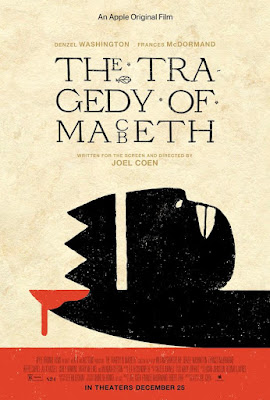
The Tragedy of Macbeth, on Apple TV+

It has witches, a ghost, and “something wicked this way comes.” “The Scottish Play” is not exactly horror, but it was probably as close as you could get in Elizabethan times. This still is not exactly a “Horror Macbeth,” but the Thane exists in a landscape not unlike that roamed by the Knight in The Seventh Seal, residing in a castle worthy of vintage German expressionism. Joel (without Ethan) Coen mines considerable fresh inspiration from Shakespeare in his visually striking adaption of The Tragedy of Macbeth, which starts streaming Friday on Apple TV+.

It’s
Macbeth, so you should know the story by now. This time around the Thane and Lady Macbeth are maybe a little older and a little more jaded, but the story remains the same (and wisely so). However, the variations are particularly interesting this time around, especially the three witches. In fact, it might just be one witch, with three fractured personas or maybe she is a demonic spirit. The way Coen presents her and Kathryn Hunter plays her/them leaves her true nature open to interpretation, but whatever she might be, she is profoundly sinister.

In contrast, Coen largely de-emphasizes the ghost, rendering it a fleeting illusion of Macbeth’s fevered mind. Of course, there are plenty of killings that Coen stages with visceral intimacy. There is nothing more personal than betrayal and murder, which Coen rubs Macbeth’s nose in—and immerses the viewer. However, what really distinguishes the film is the starkly stylized set design that suggests vintage 1930s Universal gothic monster films, by way of M.C. Escher. This film looks amazing, in a cold, severe, drafty, imposing kind of way. Living in Macbeth’s castle is almost unimaginable, but it makes for great cinema.

Running an hour and forty-five minutes, Coen’s
Macbeth is about equal in length to Orson Welle’s adaption, and a bit shorter than the Michael Fassbender Macbeth, and considerably briefer than Polanski’s take. It is briskly paced, but the Thane’s transition from loyal vassal to murderous sociopath is more noticeably abrupt. Of course, viewers know he is Macbeth, so they should be able to fill in the gaps themselves.

Denzel Washington fulfills our expectations in the notorious role and even manages to surprise with the degree to which his Macbeth is tormented by his own crimes. It is a massively moody and angsty performance, but also a very legitimate spin on the character that we do not often see. In contrast, Frances McDormand’s Lady Macbeth lives up to her reputation and then some.

Monday, April 10, 2017

Chasing Trane: The John Coltrane Documentary

As a statement of faith, John Coltrane’s liner notes for A Love Supreme rank alongside The Confessions of St. Augustine, but as meaningful as his words are, they still can’t compare to the music waxed within. Decades after his tragically early death, Coltrane is still influencing musicians and listeners, both musically and spiritually. Indeed, how many musicians of any category have inspired a church dedicated to their music? The significance of Coltrane’s life and gifts are explored by his family, colleagues, and admirers in John Scheinfeld’s Chasing Trane: The John Coltrane (trailer here), which opens this Friday in New York.

Before we proceed, let us invoke Coltrane’s own words: “ALL PRAISE BE TO GOD TO WHOM ALL PRAISE IS DUE.” It is a prayer of great humility, yet it makes the hair stand up on the back of your neck.

John Coltrane’s childhood was filled with struggle and tragedy but he became one of the few jazz musicians who “crossed over” to mainstream audiences. He first gained prominence as a member of Miles Davis’s first “Classic Quintet” (the trumpeter had two), playing on the mother of all jazz bestsellers, Kind of Blue. Coltrane notched his own legit hit with his modal exotic sounding rendition of “My Favorite Things,” but A Love Supreme serves as the centerpiece of the film—and rightly so. The suite of sacred music had a depth of feeling that remains astonishing, but it also served as a summation of all Coltrane’s musical experimentation up to that point, while even hinting at the avant-garde journey he was about to embark on.

Trane is the first Coltrane documentary produced with the cooperation of his family. As a result, we get a fuller perspective of Coltrane as a family man. The memories of Antonia Andrews, Coltrane’s stepdaughter from his first wife Naima, are especially touching. We also hear from real deal colleagues like Sonny Rollins (Coltrane’s media-made rival for tenor saxophone supremacy), former Dizzy Gillespie band-mate Jimmy “Little Bird” Heath, childhood friend Benny Golson, Wayne Shorter (tenor player in Davis’s second “Classic Quintet”), and McCoy Tyner, the last surviving member of Coltrane’s iconic quartet. We also hear from Coltrane’s son Ravi, who rather remarkably became a first-rate tenor and soprano player in his own right, braving inevitable comparisons to his father.

It is fine to also include commentary from experts like Wynton Marsalis, and biographers Ashley Kahn and Lewis Porter, who truly know their stuff, but the talking head sequences with Bill Clinton add nothing (and risk needlessly alienating viewers). However, when the film sticks to the music, it is always on solid ground. There are indeed a lot of Coltrane recordings incorporated into the film. Granted, selecting from his towering musical legacy surely must have been a daunting task (yet, we still have to ask how they could leave out the arrestingly beautiful “Dear Lord?”). Happily, everyone assembled readily acknowledges the contributions made by Coltrane’s signature quartet sidemen: Tyner on piano, Elvin Jones on drums, and Jimmy Garrison on bass. Frankly, it is just as hard to imagine “My Favorite Things” without Tyner’s cascading solo as it would be without the leader himself.

For years, jazz fans have wanted to see Denzel Washington play Coltrane. He may have waited too long, but at least we can get a taste of what could have been through Washington’s narration of Trane’s notes and letters. Most importantly, Scheinfeld and his collaborators understand the deep connection between Coltrane’s faith in God and his music. In truth, performing music is in itself a spiritual act. The more attuned a musician is to that fact, the more resonant their music will be. Nobody was more keyed-in than John Coltrane. Those who are new to his music should acquire a thorough appreciation from Scheinfeld’s film, while established listeners will gain a further, deeper perspective. Highly recommended for jazz fans and audiences of faith, Chasing Trane opens this Friday (4/14) in New York, at the IFC Center.