Showing posts with label Christopher Doyle. Show all posts

Tuesday, March 15, 2022

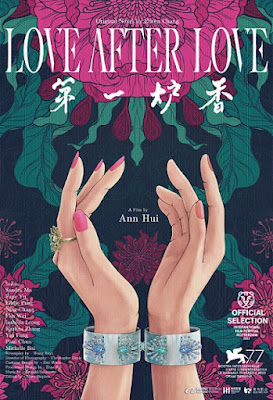
Ann Hui’s Love After Love

The CCP refuses to admit Hong Kong was once a colony, because that would entitle it to special consideration under the rules of the United Nations. Of course, the UN is compliant, asking “how high” when the CCP says “jump.” Yet, the era recreated in Ann Hui’s latest film is as decadent and colonial as the bad behavior of British settlers dramatized in White Mischief. The main characters are not even British, but the scandalous Hongkongers definitely believe in doing things “the British way” in Hui’s Love After Love, which premieres Friday on MUBi.

Ge Weilong is bright, pretty, but not the least bit worldly. Nevertheless, the Shanghai native will approach her disgraced and disgraceful Aunt Liang, requesting shelter in her stately home, so she can finish her studies in Hong Kong. Essentially, Liang is a self-styled courtesan, who inherited the wealth of her late lover. She is still a player in colonial society, mostly for her own amusement (the carnal kind, first and foremost).

Recognizing Ge could be useful, Liang takes her in and slowly starts grooming her in the indulgent customs of colonial society. Ge is a better translator than her, but she is slow to pick up on all the gameplaying around her. In fact, she even falls in love with George Chiao, a playboy, who stands to inherit little from his wealthy father, due to the many other heirs in-line ahead of him, both legitimate and illegitimate.

The film looks lovely and the cast is all very pretty, including Eddie Peng as the caddish Chiao, but it is mostly surface beauty. Although adapted from an Eileen Chang novella,
Love After Love was probably envisioned as a film in the tradition of Dangerous Liaisons, but as a Chinese-approved production, it is never able to generate sufficient sexual heat. It is also problematically low on the scheming and manipulation. If you want to see a Republican Era take on Valmont and company, check out Hur Jin-ho’s Dangerous Liaisons instead.

Saturday, April 14, 2018

SFFILM ’18: The White Girl


This unnamed teenager is a lot like Japanese singer-songwriter Yui’s character in Taiyou no Uta (Midnight Sun) and whoever in the lame American remake. She too is allergic to the sun’s ultraviolet rays—or so she has always been told. However, she is not a singer, but perhaps her mother was—and maybe still is—or not. She is an outsider in Pearl Village, Hong Kong’s last surviving fishing hamlet, but in some ways that helps her appreciate what it represents in Jenny Suen & (co-director) Christopher Doyle’s The White Girl (trailer here), which screens during the 2018 San Francisco International Film Festival.

All her life, the “White Girl” has hid beneath floppy hats, sunglasses, and protective clothing, because her controlling fisherman father assured her she must. Given her resulting pale skin and shy manner, the villagers dubbed her “White Girl” or even “Ghost” and have become convinced she can contaminate their nets with bad mojo with a hard stare. Her only friend is Ho Zai, a scampish little boy living with an eccentric Buddhist monk, at least until Sakamoto, an emotionally damaged Japanese expat fleeing his troubles, starts squatting in the decrepit colonial mansion overlooking the bay.

For the most part, the White Girl and Sakamoto are drawn to each other, because they sense the shared empathy and comradery of a fellow wounded spirit. However, there is also an element of creepy sexual attraction that Sakamoto scrupulously represses. Yet, she will still lose much of her innocence for other reasons, as she comes to doubt the validity of everything her father ever told her. Meanwhile, the resourceful Ho Zai uncovers evidence of the mayor’s plan to sell out the village to a consortium of Mainland investors.

White Girl is a more focused and conventional film than Doyle’s Hong Kong Trilogy, which Suen produced, but it is still much more concerned with mood and vibe than crass plot points. Without doubt, we can see its aesthetic kinship with some of the classic Wong Kar-wai films he shot. It is a quiet, lulling film, but fortunately Angela Yuen and Joe Odagiri can emote though the humid languor as the girl and the squatter. Jeff Yiu is also unusually charismatic for a young thesp as Ho Zai, while Rayna Lee adds some unlikely sympathetic glamor as the village school teacher, Miss Wong. However, Leung Kin-ping probably scores the most points for dramatics with his poignant turn as the girl’s clueless father.

Honestly, nobody would have accused Suen & Doyle of selling out if they had cranked up the narrative a little. Clearly, they believe meandering is part of the journey. Of course, the symbolism of the hyper-connected Mainland developers out to obliterate Pearl Village’s way of life is tough to miss, but that doesn’t mean the message isn’t still needed. Regardless, the mostly attractive and uniformly expressive ensemble redeems the stylistic excesses. Recommended as an evocative and elegiac coming of age film, The White Girl screens again this Monday (4/16), as part of this year’s SFFILM.

Sunday, December 18, 2016

Maggie Cheung at Metrograph: 2046

It is the sequel to end all sequels. Frankly, it is hard to imagine they were conceived together, yet Wong Kar-wai reportedly was already planning it while he was filming the masterful In the Mood for Love. They might sound radically different on paper, but the same longing and regret is present throughout Wong’s 2046 (trailer here), which screens as part of the Metrograph’s retrospective series Maggie Cheung: Center Stage.

In one sense, 2046 might seem like a ringer in the Cheung series, because she only appears in brief flashback scenes, but her absence thoroughly dominates the film. Chow Mo-wan has returned from Singapore and Cambodia, picking up his literary and journalistic career as best he can. He never saw Cheung’s Su Li-zhen again, but her memory clearly haunts. In fact, his unresolved feelings make him incapable of maintaining a healthy relationship.

Chow and Su used to meet in room #2046 of his residency hotel, so he requests the same number in Mr. Wang’s seedy, but assignation friendly Oriental Hotel (we are still in the mid-1960s here). However, he will settle for #2047. At first, #2046 is occupied by Lulu, a.k.a. Mimi, a callback from Wong’s Days of Being Wild. When she precipitously moves out (a not-so uncommon practice in Wang’s establishment), Bai Ling moves in. Chow definitely notices her and can often hear her entertaining through the thin walls (and vice versa).

For a while, they carry on an ambiguous something, but he can never give her what she needs. He also assumes the role of a flirtatious Cyrano figure for Wang Jing-wen, the owner’s eldest daughter, who conducts a secret long distance love affair with a Japanese man her father disapproves of, due to national prejudice. Chow cannot even make things work with the second Su Li-zhen, a mysterious professional gambler who saves his skin in Singapore.

Yet, Chow himself duly notes, the women who lose patience and exit his life often turn up in his fiction, particularly his science fiction stories, “2046” and “2047.” In this dystopia universe, 2046 is ambiguously both a time and a place of stasis, reachable by a train staffed with sexually compliant automatons (two of whom look like Wang Jing-wen and Lulu). Heartsick lovers often travel there to revisit past memories, but nobody ever came back, until Tak (a dead ringer for Wang’s Japanese lover) embarks on a return trip.

When seen in close succession, Mood and 2046 pack a mean one-two combination punch. We definitely miss Cheung’s Su, but that is the whole point. We also fall hard for Bai Ling, Wang Jing-wen, and the second Su, yet we understand exactly why Chow is so emotionally hobbled.

Even with his Errol Flynn mustache, “Little” Tony Leung Chiu Wai just radiates broken-hearted weariness. He has panache, but he cuts a rather gloomy, existential figure. However, it is Zhang Ziyi who really gives viewers a kick in the teeth as the radiate but heart-rending Bai Ling. Arguably, Faye Wong covers an even greater spectrum as the more upbeat Wang Jing-wen and the exquisitely tragic gynoid. Carina Lau makes the most of her diva turn as Lulu, but Gong Li is an outright showstopper as the Singapore Su. Nobody else could wring so much intrigue and dark romance out of such limited screen time.

Production on 2046 was inconveniently interrupted by the SARS outbreak, but you would not know it from the finished film. It is seductively sad in a way that flows naturally from Mood, even during its flights of fantastical speculation. Without question, it features some of the best screen thesps of our time, working with one of the most distinctive international auteurs and accomplished cinematographers (Christopher Doyle, with an assist from the skilled Kwan Pung-leung), all of whom are working at the peaks of their creative powers. Very highly recommended, 2046 screens twice today (12/18) at the Metrograph, as part of Maggie Cheung: Center Stage.
Wednesday, December 14, 2016

Maggie Cheung at Metrograph—Comrades: Almost a Love Story

Early last year, the Mainland Communist government finally lifted its strict censorship of this ostensibly nonpolitical award-winning romantic vehicle for Maggie Cheung. The prohibition never really made sense, so it was often chalked up to Hong Kong-Mainland differences. However, it is easy to suspect the characters’ sentimental affection for Taiwanese Mandarin singer Teresa Teng, who was quite outspoken in her support for the Tiananmen Square democracy protestors, had a direct bearing on the decision. As usual, the government denied its people something good. Without question, Maggie Cheung gives a career-defining performance in Peter Chan’s Comrades: Almost a Love Story (trailer here), which screens as part of the Metrograph’s retrospective series Maggie Cheung: Center Stage.

Li Xiao-jun has come to Hong Kong from the northern provinces to earn money, so he can marry his hometown sweetheart. However, in 1986, the go-go mega-city is a hard place for a guileless Mandarin speaker. It seems a bit easier for Li Qiao, a brash, Cantonese fluent scammer from Guangzhou. Yet, life seems to be in the habit of disappointing her. Initially, she assumes she will just make a quick buck off the rube, referring him to an English tutorial school for a commission, but somehow he sticks in her life.

They start out as almost frienemies, but soon evolve into friends with benefits, which causes the engaged Xiao-jun considerable guilt (and Li Qiao as well). When Li’s intended finally joins him, Li Qiao duly befriends her. Of course, fate, timing, and chaos involving her aging Triad sugar daddy constantly conspire to keep the almost lovers separated.

You just haven’t seen bittersweet until you have seen Comrades (a term used with some irony). The pseudo-couple experiences dozens of near-misses, but Ivy Ho’s elegant screenplay never feels contrived. Frankly, that really is how the world works when you are a marginalized economic migrant. Yet, there is always something admirable about the Lis and their friends, because they are so doggedly working to better their lives.

If you have ever considered Cheung an icy screen presence, this is also the film to melt your preconceptions. She just basically rips viewers hearts out as the exponentially-more-vulnerable-than-she-lets-on Li Xiao. The chemistry she shares with Leon Lai (as Xiao-jun) is absolutely devastating. Frankly, the same can be said of her rapport with Eric Tsang as the mobbed-up Pao Au-yeung, which is another reason why the film packs such a sustained emotional wallop. For comic relief that naturally takes a melancholy turn, noted cinematographer Christopher Doyle (working solely in front of the camera) steals several scenes as Jeremy, the foul-mouthed English teacher.

The kicker is the lyrically romantic soundtrack, featuring dozens of Teresa Teng’s fan favorite love songs and the dreamily jazzy themes composed by Chiu Jun-fun and Chiu Tsang-hei. In a way, Comrades is a sweeping tale, encompassing the Chinese immigrant experience in mid-1980s Hong Kong and mid-1990s New York, but it also feels intoxicatingly hushed and intimate, thanks to Chan’s sensitive but assured hand on the helm. It is a modern classic that is almost mandatory for any Cheung retrospective (the same is probably true for Lai and Tsang). Very highly recommended, Comrades: Almost a Love Story screens this Saturday (12/18) at the Metrograph, as part of Maggie Cheung: Center Stage.

Wednesday, April 20, 2016

SFFS ’16: Hong Kong Trilogy

Hong Kong is not just a business district. People really live there, as well as work there, but they still do not vote there, at least not in a meaningful way. Inspired by the 2014 Umbrella Protests, acclaimed expatriate cinematographer Christopher Doyle explores the hopes and anxieties of three generations of Hongkongers, through their own voice-over words in Hong Kong Trilogy: Preschooled Preoccupied Preposterous (trailer here), which screens during the 2016 San Francisco International Film Festival.

All three generations are defined by a common central conflict in their lives. Obviously, for twentysomething college students, it was the democracy demonstrations that were broken up with tear gas at the behest of the Mainland Communist Party, inadvertently proving the lack of political freedom in Hong Kong. However, the young grade schoolers are nearly as frazzled by the constant barrage of tutors and cram schools pushed on them by their parents. In contrast, many Hong Kong seniors still live with the repercussions of the long standoff with the Mainland that often separated lovers and family members. A diverse cross-section of average citizens will explain their perspectives to Doyle, in disembodied interviews, synched-up to match the speakers in-the-flesh, as they navigate the bustling city.

It is indeed tough to be a kid in Hong Kong, especially if you are bullied like the husky Vodka. Yet, somehow Little Red Cap (or Lip Ching-man as her parents named her) seems to make her own rules. Much to the astonishment of her photogenic teacher, Selena Cheung, Little Red Cap has indiscriminately adopted just about every major religion and regularly proselytizes for them all at school with equal fervor. It is hard to know what to make of her. She seems to come from a reasonably dysfunctional family of modest means that lives on a houseboat and appears willing to indulge her evangelical inclinations.

As a cinematographer, Doyle obviously notices when someone absolutely lights up the screen, because he often has the weird but charming Little Red Cap reappear in later sequences. Naturally, that is her making holy water deliveries to the Umbrella Square. The tent city was laid out in such an orderly fashion on the Admiralty plaza, mail was reportedly delivered to protestors’ tents. We meet the graphic artists documenting the movement and the one-generation-older hipster who opened an informal open mic club to showcase musicians affiliated with the movement. Unfortunately, its lack of proper licensing allows the cops to confiscate their beer whenever justice gets thirsty.

By far, the weakest and most self-consciously stylized segment focuses on the “preposterous” seniors who take speed-dating tours, in some cases hoping to fill a void in their lives that have been open for years. Even with the support of Little Red Cap, Teacher Selena, and her dead beat rapper boyfriend, “Preposterous” cannot match the energy and focus of “Preschooled” and “Preoccupied.” At least it starts strong with the former and devotes the most time to the latter.

Doyle’s approach is unnecessarily artificial, but many of his subjects are so compelling, they command our attention nonetheless. Even with the spotty third act, Doyle’s directly stated goal—that the world should start listening to Hong Kong’s marginalized younger and older generations—is quite laudable. What they have to say is absolutely worth hearing. Sometimes inspiring and sometimes a little strange, Hong Kong Trilogy is still highly recommended as a decidedly pointed yet idiosyncratic response to the harsh crackdown on the Umbrella Protests. It screens this Friday (4/22) and Monday (4/25), as part of this year’s SFIFF.

Monday, June 29, 2015

NYAFF ’15: Ruined Heart

When you are a lowlife criminal type, you are likely to meet similar kinds of folk. That doesn’t mean love is impossible, but happily-ever-afters are highly unlikely. Filipino digital micro-cinema legend Khavn [de la Cruz] will graphically illustrate the perils of underworld romance in Ruined Heart: Another Love Story Between a Criminal & a Whore (trailer here), which screens during the 2015 New York Asian Film Festival.

Neither “The Criminal” nor “The Whore” are what you might call Chatty Cathies, but when they get together they have better ways to spend time than with small talk. They met when he comes to whack one of her clients and they apparently just hit it off. Frankly, we never hear them exchange a single word, so we just have to infer from their actions. Of course, such employee fraternization is strongly discouraged by the “God Father,” a strange New Age evangelist who controls all the vice in the Metro Manila slums. Eventually, they will have to take their love on the lam, but not before they guide the audience through a tour of the back alleys and private sex clubs of their world.

If you know Khavn’s work you probably either love it or hate it. With Ruined Heart, he doubles down on his extreme aesthetic. It is a hard film to have mixed feelings about, unless you are taken with the soundtrack. Truly, it is like a monster party mix on MDMA. Many of the groove-friendly tracks are collaborations between Khavn and the Euro Electropop duo Stereo Total, but it also features steel guitarist Buddy Emmons’ rendition of Pachelbel’s Canon.

So yes, Ruined sounds awesome and it looks . . . distinctive. Frankly, Khavn is not shy about showing bodily fluids, in especially gross contexts. He also revels in the grunginess of the slum environment. Yet, he also has an eye for the beautifully surreal. Celebrated cinematographer Christopher Doyle (best known for his work with Wong Kar Wai) frames everything for maximum effect, whether it be grotesque or seductive.

Japanese actor Tadanobu Asano and Mexican actress Nathalia Acevedo do rather remarkable work, considering they must rely solely on body language rather than dialogue. They are undeniably electric together. Someone will surely say the Manila slum also serves as a character in the film, but Khavn is really going for the immersive sensation of life in such desperate close quarters rather than a particular sense of place, per se.


Obviously, we know the general arc Khavn’s narrative will take right from the opening credits. So do the sub-title characters, yet they still make their inevitably tragic choices anyway, which is quite compelling. Recommended for the elite few, who look where grubby exploitation movies overlap with experimental art cinema to find their sort of films, Ruined Heart screens this Thursday (7/2) at the Walter Reade and next Saturday (7/11) at the SVA Theatre, as part of this year’s NYAFF.

Sunday, April 20, 2014

ContemporAsian ’14: Bends

Anna Li is a lady who lunches. She is not Marie Antoinette. She simply is unprepared for the speed at which fortunes can reverse in Hong Kong. Her Mainland chauffeur is not a revolutionary. He simply wants a safe delivery for his pregnant wife, but they cannot afford the punitive second child fee. Each will face an economic crisis, but Fai’s will be exacerbated by geography in Flora Lau’s Bends (more sensibly known as “Crossing the Border” in Chinese language territories, trailer here), which launches the new season of ContemporAsian at MoMA.

Li organizes charity events and looks good on her husband’s arm at business functions. She seems quite satisfied with how things have turned out, even if her spouse is a bit of a shark and a player. The fact that he has not been home for several days does not seem to raise any red flags for her, but she definitely takes notice when her credit cards are declined. Finding their accounts drained or frozen, Li starts hocking the family art collection to keep up appearances in her social circle.

Meanwhile, Fai has his own problems. Although he has been granted HK citizenship, his wife Ting is still Mainland PRC. To hide her advanced pregnancy, she becomes a veritable prisoner in their Shenzhen flat. It is all very confusing for their little girl Haihai. Fai needs money to smuggle her across the border and a hospital admission letter to secure her a bed for delivery, but both are hard to come by for a man of his position.

Bends sounds about as hot-button as it gets, indicting HK’s laissez-faire economy on the right and the Communist Party’s unforgiving family planning on the left. Yet, the execution is decidedly quiet and intimate. Happily, Lau offers viewers character studies rather than white papers, but the first time director’s sense of pacing is still a bit flat. However, she gets a key assist from superstar cinematographer Christopher Doyle, who makes it all look coolly elegant.

Yet, it is unquestionably Carina Lau who makes the film. Approaching legendary status, Lau still makes a convincing trophy wife, but it is her chops that truly impress in Bends. Despite Li’s outward reserve, Lau clearly expresses her mounting confusion and anxiety. At the risk of belaboring the point, Lau brilliantly pulls viewers into Li’s inner turmoil rather than resorting to the sort of bug-eyed arm-flailing Meryl Streep over-indulged in throughout Osage. What can we say? Lau is simply much better at their craft.

Understatement is all very well and good, but Chen Kun nearly wilts into the background as Fai. Nevertheless, a strong supporting cast keeps him propped up in key scenes. Even with limited screen time, Stephanie Che makes a lasting impression as Lulu, Fai’s old HK flame, who now works as a maternity nurse. As Ting and Haihai, Tian Yuan and young Tu Jiamen also humanize the story rather compellingly.

There is no denying the wider issues raised by Bends, but it is only zeitgeisty after the fact. In the moment, it is unflinchingly intimate in its focus. Recommended for fans of Lau and those who appreciate films helmed by women, with great roles for women, Bends screens Monday through Sunday (4/21-4/27) as part of MoMA’s regular ContemporAsian film series.