Showing posts with label Sam Mendes. Show all posts

Thursday, December 08, 2022

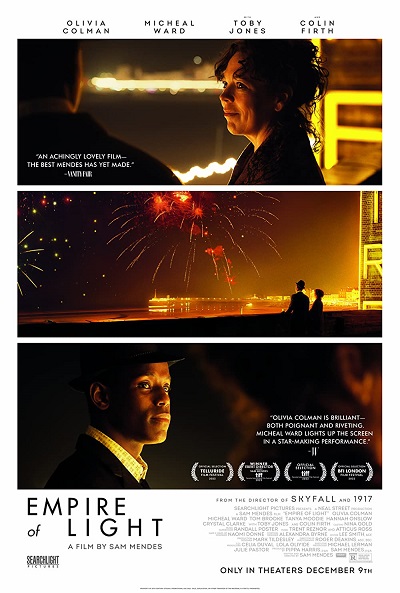
Sam Mendes’ Empire of Light

The Empire Theatre is troubled, but the movies it books are not part of the problem. During the course of this film, we will see it screening Chariots of Fire, The Blues Brothers, Smoky and the Bandit, and Being There. Unfortunately, this release is not nearly as good as those that it references in passing. It is presented as a tribute to the movie-going experience, but like a bad projectionist, focus is a problem for Sam Mendes’ Empire of Light, which opens tomorrow.

Hilary Small is the one who keeps things running at the Empire, in the coastal town of Margate. However, she is easily dominated by her exploitative boss, Mr. Ellis, who also uses her for quickies in his office, much to the disgust of the other employees. Her life of quiet desperation leads to a breakdown, but after her brief hospitalization, she returns for more of the same, just with more medication. Things only start to change when Stephen joins the staff. The smart teen aging into adulthood should be going to university, but he lacks sufficient funds and the proper skin color (according to Mendes’ didactic screenplay).

He and Small are drawn together, as fellow outsiders. Their rapport will take a turn towards the romantic, despite vast differences between them. However, Stephen will eventually figure out Small’s emotional issues have only been masked, rather than cured.

If you want to watch the great cinematographer Roger Deakins paint pretty pictures with light, then
Empire will certainly deliver. However, the melodrama reeks of sentimentality and the periodic attacks on Thatcherism (which reversed the UK’s decline into economic stagnation and international insignificance) are gratingly unnecessary distractions.

Frankly, despite some rather lovely scenes of projectors streaming down on the movie palace’s screen,
Empire could have just as easily been set in a fish & chips shop, without losing much beyond Deakin’s visuals. Small’s relationship with her co-worker stays on the right (legal) side of Summer of ’42, but it is hard to buy them as a romantic couple. At times, Stephen gets lost in the film, overshadowed by Small’s angst and resentments. Focus really is an issue here.

Wednesday, January 08, 2020

1917: Oscar Contender


Operation Alberich was a German retreat, but it was a strategic retreat. It was conducted about a month and a half before America entered WWI, so there was obviously a lot of fighting left to do. The war seems endless for two lance corporals, but time is decidedly short for the completion of their fateful mission in Sam Mendes’s Golden Globe-winning 1917, which opens nationwide this Friday.

Cpl. Tom Blake has been recruited to send a message from Gen. Erinmore to the Devonshire Regiment near the Hindenburg Line, for very personal reasons. His brother, Lt. Joseph Blake serves with the Devonshires and stands to die alongside his men unless he and his mate, Cpl. William Schofield, can reach them before they charge into a certain German ambush. The General has written orders canceling the doomed attack, but reaching them in time will be no easy feat. First, Blake and his mate Cpl. William Schofield must traverse No Man’s Land, the German front line, and several active battle sights.

Superficially, 1917 might sound similar to Saving Private Ryan, but Mendes and co-screenwriter Krysty Wilson-Cairns quickly break the mold of the prior film and turn audience expectations on their ears. Once the film really shows its true colors, the only real kinship it shares with Spielberg’s film are the equally intense battle scenes. In fact, 1917’s incidents of warfighting are sometimes even more visceral, in ways that will have viewers seeking a tetanus shot afterward.

Frankly, 1917 is not easily pigeon-holed as an anti-war film or a celebration of patriotism. It is really just about two young kids trying to survive a war they do not fully comprehend. Mendes & Wilson-Cairns’ narrative, based on the reminiscences of the former’s grandfather Alfred Mendes, is a case of the epic becoming acutely personal. The tone is almost Homeric, but without any pretentious baggage.