Showing posts with label Artificial intelligence. Show all posts

Saturday, July 12, 2025

Japan Cuts ’25: The Real You

In the future, AI will take a huge bite out of psychics’ séance business. If you have unresolved questions for your late loved ones, like emotionally stunted Sakuya Ishikawa, just download their data and ask the resulting AI construct. Of course, more input results in a better model, so Ishikawa requests the data from the close friend he never knew his mother had. Ironically, the mystery woman might (or might not) also be his tragic high school crush. Consequently, Ishikawa will have a lot to process himself in Yuya Ishii’s The Real You, which had its North American premiere at the 2025 Japan Cuts.

There was something Akiko wanted to tell Ishikawa, but he was too busy to listen. Then she died, apparently throwing herself into the swelling river one stormy night. Ishikawa tried to save her, but instead, he suffered a year-long coma. When he woke up, the government cut him a check, because unbeknownst to Ishikawa, his mother enrolled in a voluntary euthanasia program, much like that depicted in
Plan 75.

Tormented by guilt and uncertainty, Ishikawa uses his savings to commission a virtual figure (VF) of his mother. It is through the company’s research that he learns of Ayaka Miyoshi. Strangely, she bears an unlikely resemblance to a high school classmate, whose misfortune indirectly led to Ishikawa’s downfall (through circumstances that Ishii teases out agonizingly slowly).

Regardless, Ishikawa invites the homeless Miyoshi to temporarily move into the apartment he shared with his mother, out of filial loyalty (and perhaps other reasons). He starts to get some kernels of truth from Akiko’s VF, but it is unclear whether he can handle the truth.

Awkwardly,
The Real You consists of two thematically-distinct halves, one of which is much more compelling than the other. Ishikawa’s halting attempts to better understand his late mother are often poignant and fascinating, even though they revisit some of the terrain explored in the vastly superior Marjorie Prime.

Unfortunately, Ishii devotes equal or greater time to Ishikawa’s travails as a “real avatar,” essentially a live-streaming gig-worker, who are regularly forced to humiliate themselves and possibly even commit crimes, to satisfy the whims of their clients. Frankly, these sequences violate existing laws and any remaining remnant of common sense. They are also blatantly manipulative and cringe-inducingly didactic.

Friday, February 07, 2025

Renner: A Man and his Creepy AI

AI is creepy enough. We do not need one spewing a bunch of self-help doubletalk. There ought to be regulation preventing this questionable artificial intelligence “life coach.” Instead, her code is coveted. Frankly, she does not seem to work very well, because her inventor allows himself to get involved with the wrong woman in Robert Rippberger’s Renner, which opens today in theaters.

Renner is a genius with code, but an idiot when it comes to human relations. He is emotionally stunted, introverted, and obsessive compulsive. His invention, Salenus, coaches him to be more confident and assertive, but it will take a lot of work. However, the process gets a jump-start when Jamie moves in across the hall. Despite his awkward social skills, she is friendly and patient with Renner.

Her deadbeat brother Chad is a different matter. His passive aggression grows increasingly aggressive. Salenus is less than supportive of Renner’s courtship as well. She becomes downright rude and insulting when addressing Jamie and even starts to lie and deceive Renner.

Arguably, Frankie Muniz delivers one of the best performances of his career in a film that never comes close to deserving it. Every twist is blatantly obvious. In fact, just about every plot-point requires appalling levels of stupidity and negligence.

Nevertheless, Muniz really delves into Renner’s neurotic self-loathing, taking viewers to some very dark places. Sometimes, he is painful to watch, for the right reasons. The rest of the film can be painful for the wrong reasons.

Thursday, September 12, 2024

Subservience: an AI Scorned

This futuristic family is sort of like the Brady Bunch. They also have a housekeeper named Alice, but as a lifelike AI-driven android, she has vastly different packaging and programming. Their Alice looks older than M3gan, but she has the same bad habits in S.K. Dale’s Subservience, which releases tomorrow on EST in the UK and on VOD in America.

Sadly, Nick’s hospitalized wife Maggie desperately needs a transplant, because she is fading fast. He could also use a hand with their elementary school aged daughter Isla and nine- or ten-month-old son. Apparently, even a construction foreman can afford a SIM servant in the future, but rather unwisely, he buys one that looks like Megan Fox rather than Mrs. Doubtfire. Nevertheless, she seems to handle Isla well.

Soon, Alice also offers Nick her full services. He tries to resist, but her ability to mimic Maggie’s voice breaks down his resistance. Unfortunately, her programming is a little wonky, which allows Allice to take questionable initiatives. As her prime user, Alice is hard-wired to protect Nick, but she starts interpreting his best interests for him.

Obviously,
Subservience follows relatively closely on the heels of M3gan, but it manages to develop some original themes. To a considerable degree, the chaos that erupts is partially Maggie’s fault, when she instructs Alice to hide Nick’s liquor, even though he will not like it, because sometimes we know better than other people what is best for them. As always, that is a very dangerous proposition. Sure enough, like so many horrific socialist regimes, Alice uses her judgment of what Nick needs to justify murder.

Monday, April 24, 2023

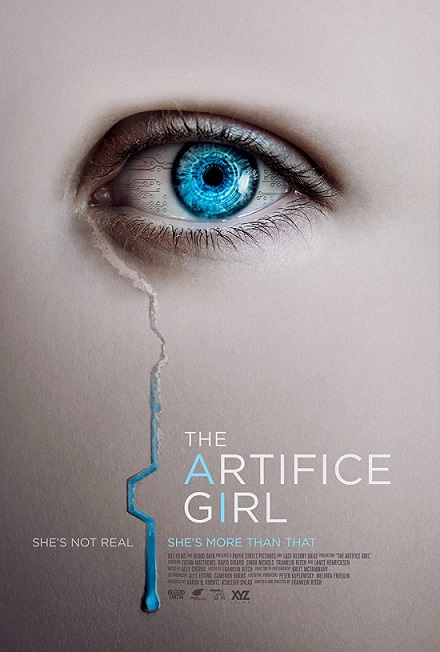
The Artifice Girl, Co-Starring Lance Henriksen

Beyond the supposed jobs “Americans just won’t do” there are some jobs no human being should ever do. “Cherry” has one of those. She lures in and gathers evidence against pedophiles. Fortunately, she is not a real little girl. She is a groundbreaking artificial intelligence. Yet, as she smashes the Turing Test and skips across the Uncanny Valley, her growing self-awareness raises all sorts of ethical questions in screenwriter-director Franklin Ritch’s The Artifice Girl, which releases Thursday on-demand and in theaters.

Initially, it looks like Gareth is big trouble with Deena Helms and Amos McCollough, two agents working for an investigative agency specializing in child exploitation. They have directly benefited from the information he and Cherry have gathered, but they still fear he is abusing a child, by forcing her to conduct undercover work in internet chatrooms. Reluctantly, he reveals the truth about her.

Technically, she has no feelings, but as she learns to simulate feelings based on outside stimuli, her synthesized emotions become more and more like the real thing. In fact, as Cherry’s behavior secretly grows more human-like, Agent McCollough experiences a crisis of conscience regarding the agency’s long-term plans for her in the film’s second act. Her development will continue, leading to all sorts of third act guilt for Gareth, as he faces up to his obligations to his creation, in the twilight of his life.

Artifice Girl
might be the best science fiction film since Beyond the Infinite Two Minutes and the best non-time-travel sf film since Little Joe. It is highly provocative on many levels, including its unique take, focusing on humanity’s responsibilities towards AI, rather than AI’s duties and dangers towards humanity.

Ritch takes a risky gambit by so forthrightly addressing issues of abuse. For long stretches of the film, the themes regarding the nature of awareness and the narrowing of the Uncanny Valley are much more prominent. However, the traumatic effects of past abuse are a critical factor, influencing everything that unfolds.

Stylistically, Ritch’s screenplay could have just as easily been produced as a stage play. That is a really a reflection of its intelligence, because it is all about characters and ideas rather than sound and fury. In fact, he and the small ensemble make viewers care for these characters, despite their extremes and the rapid passage of time (Cherry the AI most definitely included).

Friday, June 17, 2022

Guidance: The Destructive Impact of AI, from China

A Chinese inventor’s new AI implant is a lot like socialism and every other utopian scheme. The pitch might sound appealing, but as soon as you experience it first-hand, you realize it is a nightmare. Two lovers are manipulated into taking the nano-operating system that detects lies, but the reality of its usage is predictably more likely to split them apart rather than bond them together in Neysan Sobhani’s Guidance, which releases today on VOD.

Ten years before the start of the film, there was a catastrophic war that left Han Maio deeply scarred emotionally. Before the war, she was ambiguously involved with her childhood sweetheart, Su Jie, the heir to a big tech empire. Now, she is in a relationship with Mai Zi Xuan, whom she suspects has been unfaithful. He also has reason to suspect her.

Rather fatefully, she happened to visit Su Jie the very day Luddite terrorists launched an attack on his company. Consequently, she spent six hours alone with him in a safe room. Of course, Mai understands that gave them more than enough time to revisit old times. As a parting gift, Su Jie gave her two pre-release doses of NIS, for her and Mai, so they can get a jump on the Brave New World before everyone else. They literally get red-pilled together, during a romantic getaway that gets much less romantic once the new computer voices in their heads call them out each time they bend the truth and point out signs of deception in their partner.

As a Chinese language film,
Guidance is particularly interesting (and timely), given it presents a cautionary tale of artificial intelligence over-reach, at a time when AI surveillance software is identifying Uyghurs to be rounded-up and incarcerated. Arguably, what the CCP is doing now in Xinjiang and Tibet is even more dystopian than anything portrayed in the film.

Nevertheless, Sobhani and co-screenwriters Anders R. Fransson and Daniel Wang vividly illustrate the perils of the utopian temptation and its unintended consequences. This is largely character and idea-driven sf, but Sobhani still offers up an intriguing looking future world.

Saturday, January 22, 2022

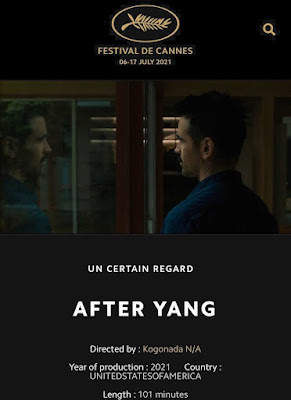
Sundance ’22: After Yang

Yang is a way more advanced AI than Alexa. When you ask him to turn off a light, he does it. In fact, he is truly a part of Jake and Kyra’s family, so when he goes on the fritz, it is very distressing for them—and especially so for their young adopted daughter Mika. They will have to prepare her to experience grief for the first time, while learning there was more to their “techno-sapien” “son” than they realized in Kogonada’s After Yang, which premiered (online) as part of this year’s Sundance Film Festival.

When Kyra and Jake adopted Mika from China, so they also purchased Yang, a life-like AI-cyborg to serve as her big brother and help keep her connected to her Chinese culture. However, they bought him certified-refurbished from a licensed re-seller that apparently is no longer in business. Unfortunately, that means when he breaks down, he most likely can’t be repaired.

Suddenly, the two parents realize how much they had delegated their parenting responsibilities to Yang. They also must come to terms with their own sense of loss. However, the discovery of a cache of Yang’s saved memories leads Jake to the discovery of Yang’s secret relationship with a clone and his previous lives with other families, before they acquired him.

After Yang
is a sensitive, character-driven science fiction story, in the tradition of films like Marjorie Prime that happily does not involve terminally ill people cloning themselves (as in Swan Song and half a dozen films before it). Kogonada’s adaptation of an Alexander Weinstein short story still has clones and it very definitely challenges viewers to reconsider what it means to be human. This near future world features humanity living and working together with its sentient creations in reasonable harmony, but the way people relate to AIs and clones is clearly still developing.

Kogonada de-emphasizes the flashy futuristic trappings, focusing instead on big ideas and big emotions (although self-driving cars are already a staple of the world). Indeed, the way he and actor Justin H. Min tease out intriguing new dimensions to Yang’s character is one of the most successful aspects of the film.

Wednesday, August 15, 2018

Do You Trust This Computer? The Singularity is Right Around the Corner

First it was Deep Blue, then it was AlphaGo. The next step is Skynet and the rise of the machines. That is pretty much how all the experts see the future, according to this doom-and-gloom documentary. It is too late to close the barn door, but we can still make the futile gesture according to Chris Paine’s Do You Trust This Computer? (trailer here), which opens this Friday in New York.

Yes, the Singularity is pretty darned scary and yes, it is closer than we would like to think. As is usually the case, it is mostly Google’s fault. They have spent gazillions on artificial intelligence to generate those annoying “smart search” suggestions. Of course, we have no idea what other applications they might have in mind. One thing everyone seems to agree on is the inevitability of AI-driven battle drones that can attack at will, sort of like self-driving cars, but with machine guns and light projectile explosives.

So, isn’t that all very unsettling? Basically, that vague sentiment is the general thesis of Paine’s scattershot film. There are a lot of frightening predictions in DYTTC, but it is presented like a buffet of singularity horror stories—a little bit from here and a little bit from there and before you know it, humanity is toast. Tellingly, one talking head informs us with all due seriousness that no government regulations have ever been applied to the research and development of artificial intelligence, but he never suggests what those regulations ought to be, so what’s the point?

The question “now what?” definitely hangs over the film, rather distractingly, but it also lacks a consistent through-line or driving concept. Essentially, this film is a collection of people Paine likes (such as Elon Musk, who also appeared in his far superior Revenge of the Electric Car). Granted, if the concept of the Singularity is new to viewers than Paine’s film will probably strike them like a revelation of Biblical proportions. However, anyone who is well-versed in A.I. futurism, especially those like Ray Kurzweil (also heard from briefly) who take a more optimistic view of things, will find the film rather stitched-together, shallow, and not particularly cinematic looking.

At least Paine and company think the extinction of mankind would be a bad thing. That might sound like faint praise, but the increasing number of end-of-the-world-Singularity films arguing mankind had it coming and was no great loss anyway has been downright disturbing. Can we still save ourselves? Any ideas are welcome at this point. Maybe next time, Paine could ask for some. Despite the timeliness of its message, Do You Trust This Computer? simply is not sufficiently well-put-together to recommend (AlphaGo is a much better film that addresses the future of AI far more engagingly and comparatively more optimistically). For those with a deep interest in the subject matter (cheers for them), it opens this Friday (8/17) in New York, at the Cinema Village.

Monday, September 25, 2017

AlphaGo: Artificial Intelligence’s Grudge Match with Humanity

Forget Billie Jean King and Bobby Riggs. The stakes were much higher in the grudge match between DeepMind’s Go-playing artificial intelligence and Go master Lee Seedol. You can probably blame science fiction publishers for that. We’ve rarely published novels that feature a thinking program saving the day. Scientists can envision a world where A.I.’s help clean the dishes, but the Singularity remains a pretty scary proposition, so it was more than just professional Go players who were rooting for Lee. The epic five-game match is documented move-by-move in Greg Kohs’ AlphaGo (trailer here), which opens this Friday in New York.

There are so many potential variations in Go, it is considered more of an artform than a mere board game. It represents a far more complex programming challenge than chess. The AlphaGo program would also be far more legitimate measure of the state of the technology than the A.I. that defeated Kasparov. That program had the benefit of the experience of several chess masters, who helped teach it. AlphaGo would have to learn the game all on its own.

It learned pretty quickly, easily dispatching Chinese-born European Go champion Fan Hui in straight sets. It was a tough loss, especially his treatment in the Go press, but it put Fan in a unique position to understand the significance of the project. He subsequently signed on as a technical advisor to the program. However, Lee Sidol would be a different matter. Recognized as one of the most brilliant and unconventional players ever, everyone assumed he would cruise to victory. However, the real suspense will come from Lee’s valiant effort to scratch out a split.

Kohs clearly had unfettered access to the DeepMind team throughout its matches with Fan and Lee. While he did not have the same entrée to Team Lee, the Korean world champion still becomes the film’s genuinely heroic figure. We understand in no uncertain terms the pressure he endures as he carries the hopes of his country, the Go playing community, and basically the entire human race. The film also benefits greatly from Fan’s insider insights from serving as a player, coach, and judge in the AlphaGo story.

Kohs captures a lot of humanity in a film about artificial intelligence. The doc also might help alleviate some of our worst HAL-9000-esque fears regarding A.I. Yet, in moments of candor, even committed members of the DeepMind team admit a part of them was rooting for Lee out of human solidarity—so maybe we should go back to being paranoid after all. Highly recommended for viewers who enjoy popular science and games of strategy, AlphaGo opens this Friday (9/29) at the Village East.

Friday, September 15, 2017

Infinity Chamber: Dystopian Prison Break

Frank Lerner is in prison, but perhaps his mind can set him free. In this case, that is not a New Age platitude. His fully automated, near future dystopian prison is forcing him to relive his final day of relative freedom within his own subconscious. However, he is also looking for clues that would explain his increasingly desperate situation in Travis Milloy’s Infinity Chamber (trailer here), which opens today in Los Angeles.

After a long day of drudgery, Lerner was blasted by secret intelligence agents just as he was ordering java in Gabby’s inviting coffee shop. He next wakes up in a granite and steel prison cell, with only Howard, his AI minder, for company. Howard’s primary responsibility is to keep Lerner alive, but he is also programmed to defend himself if the prisoner gets destructive. Aside from maintenance requests, he is firewalled from the outside network, but Howard can still tell there was something dodgy about Lerner’s processing.

After breakfast, Lerner is zapped back into his head, but he has a reasonable degree of autonomy to change his actions and investigate his environment. It doesn’t always make sense that all this information would be imprinted on his subconscious, but it is such a heady head-trip, we just go with it anyway. There are elements of the coffee shop Lerner obsesses over, including Gabby, with whom he starts to carry on an unlikely romantic relationship. With her help, he will develop an escape plan, which will take on urgency when Lerner starts to suspect he has been abandoned to die in his cell.

Chamber is a really nifty science fiction chess game that dexterously exploits the claustrophobic nature of its limited sets and locations. As one of the smarter dystopian films in recent years, it is largely character driven, even though two of its three characters are not, in the strictest sense, human. In terms of motifs, it even bears some comparison to Nozim Tolahojayev’s animated short film adaptation of Bradbury’s There Will Come Soft Rains.

As Lerner, Christopher Soren Kelly makes a refreshingly smart and humanistic everyman. He also forges some really terrific chemistry with Cassandra Clark, who is surprisingly poignant as Gabby. The circumstances are almost incredible, but their relationship feels real.

Milloy addresses some deep, sophisticated themes, but he always keeps viewers keenly aware of the ticking clock. Arguably, it represents the best sort of speculative fiction that does not require extravagant special effects to realize its vision. Very highly recommended, Infinity Chamber opens today (9/15) in Los Angeles, at the Arena Cinema.

Friday, August 04, 2017

Fantasia ’17: Breaker (short)

Here is a scary thought—when humanity starts to integrate itself with digital systems, it will become susceptible to both physical and computer-borne viruses. Just ask the hacker (or so-called breaker) Mach1. When she accidentally downloads a weaponized artificial intelligence, it takes over her body, but they will have to work together to survive the nefarious agents that want to control it in Philippe McKie’s short film, Breaker (trailer here), which screened during the 2017 Fantasia International Film Festival.

Blame the junky. Whether she intended harm or not, she is the one who hired Mach1 to break the encrypted file containing the A.I. Much to her panic, the A.I. immediately started deleting files to make room for itself. However, when the program convinces the Breaker bad guys really are following her/them, they start to work together. If Mach1 can get to a port to download the A.I. into the wild internet, it will repay the favor. To survive that long, Mach1 will let her digital parasite control her body when they face-off against the sinister hunter tracking them. It is sort of like Neo’s kung fu sequences in The Matrix, but McKie’s emphasis is on grit rather than razzle dazzle.

Breaker is smart and briskly paced film that makes you think about cerebral topics like the Singularity, earthly issues, such as drug addiction, and the general state of humanity. He creates a world that owes a debt to Bladerunner and most subsequent cyberpunk films, but he makes it feel grungier and more dope-infested. The production design is first-rate, but it is Yuka Tomatsu who makes us care. She is terrific as Mach1, no matter who happens to be controlling her body at the moment.

McKie manages to combine a lot of action with social and scientific speculation in a mere eleven minutes. It is easy to see how this narrative or another story in Mach1’s near-future Tokyo world could be expanded to feature length. Regardless, it is a very cool short in its own right, showcasing the impressive range of Tomatsu. Highly recommended, Breaker will soon screen at the 2017 Action on Film Festival, following its Canadian premiere at this year’s Fantasia.

Armed Response: Wesley Snipes and Anne Heche Fight an A.I. Program

It is probably always a bad idea to give artificial intelligence programs nicknames with religious connotations. This immersive biometric truth-seeking “lie-detector” AI facility is often referred to as a “Temple.” Wesley Snipes and his team of commandos might just get some religion when they are trapped inside it in John Stockwell’s Armed Response (trailer here), which opens today in New York.

Gabe Arcona designed the Temple systems (too well), but he has been on a boozy extended leave after the horrible death of his daughter. He is not over it, but team leader Isaac needs to pull him back in anyway. A team guarding a Temple has gone dark, so Arcona will have to figure out what happened. Of course, they find the entire detachment has been murdered, under baffling circumstances.

The only survivor is a known terrorist discovered in the isolation chamber, but he is just as clueless as they are. Given he is driven more by opportunism than religion, freelance warlord might be a more apt description, but terrorism is the crime he is wanted for. Yet, for some reason, the Temple interfered with the TSA facial recognition programs, paving his way to the secret installation.

Before too long, strange goings-on start to rattle Isaac and his team. Arcona also begins to suspect something not so on the up-and-up transpired with the squad during his absence. His ill-concealed suspicions cause friction, particularly with the knuckle-dragging Brett, played by professional wrestler Seth Rollins, which gives you an idea of his persona.

John Stockwell is a slickly competent genre director who has helmed legitimately entertaining but not exactly prestigious films like Kid Cannabis, In the Blood, and the body-slamming reboot, Kickboxer: Vengeance. He most likely brought the film in on-time and under-budget, but even he has trouble balancing the films guns-and-brawn action with its uncanny elements, especially as the latter become increasingly illogical and nonsensical.

It is a good thing Snipes is on the one-sheet or else we might forget he is in this movie. Apparently, he is the Picard of swaggering, testosterone-charged commandos instead of a Kirk. For what it’s worth, Dave Annable is surprisingly grounded and convincing as the grief-stricken Arcona. That really is Anne Heche portraying Riley, the sensitive commando, but she plays it straight and fully committed. Snipes is in there someplace, while Rollins thugs it up, to the hilt.

Throughout the first two acts, Response is rather entertaining, in a meathead kind of way. Unfortunately, the big secret Isaac and company are hiding casts our courageous intelligence officers and military service personnel in a highly unflattering light, which is a disappointment, especially considering it was co-produced buy WWE Studios and Gene Simmons’ shingle. You would think if anyone would be sympathetic to the service and sacrifice of the CIA and U.S. military, it would be pro wrestling and the Israeli-American co-leader of KISS. Alas, the resulting film is no Kickboxer: Vengeance. Ultimately quite disappointing, Armed Response opens today (8/4) in New York, at the Cinema Village.

Tuesday, January 24, 2017

Sundance ’17: Marjorie Prime

Perhaps we can think of it as the emotional singularity: that potential juncture when our artificial intelligence constructs better understand our inner psyches than we do. It is possible humanity or at least one family reaches this point in Michael Almereyda’s adaptation of Jordan Harrison’s play, Marjorie Prime (trailer here), which screens during the 2017 Sundance Film Festival.

To help her deal with the loss of her beloved husband, Marjorie’s daughter Tess and son-in-law Jon have installed the latest in bereavement technology: an AI hologram of her late husband. They are somewhat surprised when she opts for the young, handsome Walter who proposed to her, rather than an older version that would better match Marjorie in her current advanced years. He is there to comfort her and remind her of memories that have slipped her increasingly unreliable mind. However, knowing she will not remember the truth as it happened, Marjorie will sometimes recommend alterations, to make Walter Prime’s stories better reflect reality as she would have preferred it.

Although Marjorie’s health is clearly failing in the first act, Tess is unable to resolve the issues in their strained relationship before her death. Despite her skepticism, she too will try achieve some sort of catharsis with the help of Marjorie Prime. There is a great deal of family history that has been left unspoken and even deliberately forgotten, but the primes might know more than the mortals realize.

Ironically, Marjorie Prime is a film about artificial intelligence that is deeply humanistic and insightful into the foibles and weaknesses of humankind. Almereyda embraces the stage roots of his source material, accentuating the intimacy of the chamber drama. He definitely opts for a minimalist style, but that actually heightens the elegiac tone (also thanks to a considerable assist from accomplished indie cinematographer Sean Price Williams).

Lois Smith (who originated the role on stage) anchors the film with a wide-ranging yet subtle performance as Marjorie/Marjorie Prime. Jon Hamm develops some intriguing chemistry (if we can really call it that, in this case) with her as Walter Prime. Azumi Tsutsui is terrific in her brief but pivotal scene as Tess and Jon’s granddaughter Marjorie. However, the wonderfully sensitive performances of Geena Davis Tim Robbins as the brittle Tess and achingly empathetic Jon are what really linger in the viewer’s head after it all wraps up.

Frankly, there is a lot of provocative speculation about how AI could alter the human condition that is hidden within plain sight throughout Prime. It definitely qualifies as science fiction, even though it is driven as much or more by its characters than its ideas. Very highly recommended for sf fans and those who will appreciate it as a richly textured family drama, Marjorie Prime screens again this morning (1/24) and Saturday (1/28) in Park City, tomorrow (1/25) at Sundance Resort, and Thursday (1/26) in Salt Lake, as part of this year’s Sundance.

Saturday, November 12, 2016

DOC NYC ’16: Machine of Human Dreams

As the free-spirited child of former hippies, Ben Goertzel intellect is unfettered by conventional boundaries. Awkwardly, the same might be true of his ethical judgement. His life-long passion has been to create a high-functioning Artificial General Intelligence (AGI) system through his OpenCog software. Rather problematically, he does not seem the least bit curious about the Chinese Government’s motivation for funding his research throughout Roy Cohen’s Machine of Human Dreams, which screens during DOC NYC 2016.

You need to get through the nauseating first ten minutes of Machine before things start to get interesting. Once we get past accounts of Goertzel’s precocious brilliance and his mother’s lingering contempt for America, Cohen begins to chronicle Goetzel’s rather checkered career. The genius programmer met Lisa Pazer, the venture capitalist with whom he co-founded Webmind through the online personals, even though he already had a pregnant wife at the time. According to Pazer, they burned through twenty million dollars, but only earned roughly one hundred thousand dollars in revenue, which is why Webmind is no more.

Pazer has plenty to say in the film, but one thing that stands out is Goertzel’s track record of disastrous demos. When history repeats itself with the (Beijing approved and dominated) Hong Kong government, it frankly comes as a relief. As one of the only conflicted members on Goertzel’s team points out, their work preparing for the HK government took place during the height of the 2014 Umbrella demonstrations, yet Goertzel never stopped to ask why his funders were so interested in this technology.

If burying the lede were an Olympic sport, Machine would be a gold medal contender. The relationship between Goertzel and Beijing’s hand-picked Hong Kong government raises a host of questions, but Cohen never puts any of them to Goertzel. Like his subject, he is often too enamored with the cute toy robots whom Goertzel hopes to invest with self-learning AGI.

Goertzel’s enthusiasm is infectious, but the way he keeps landing on his feet after one professional setback after another is remarkably fortuitous. Both he and the estranged Wozniak-figure from his Webmind and Simon’s Rock College days credit science fiction as an early source of inspiration, but nobody seems concerned about the potential dangers of the Singularity sf regularly explores.

Yes, there is some provocative stuff in Machine, but it is the sort of film that makes you want to watch the outtakes and possibly re-edit a different cut. Generating wildly mixed responses, Machine of Human Dreams screens tomorrow (11/13), as part of this year’s DOC NYC.

Wednesday, July 27, 2016

Fantasia ’16: Sori, Voice from the Heart

This freshly sentient AI surveillance satellite should monitor a screening of Gavin Hood’s Eye in the Sky or perhaps Johnnie To’s film of the same name. Both would give her a greater appreciation of her purpose. Instead, the satellite of love crashes to earth and teams up with a Korean father desperately looking for his long missing daughter. Short Circuit style hijinks gets a massive dose of fatalism in Lee Ho-jae’s Sori: Voice from the Heart (trailer here), which screened during the 2016 Fantasia International Film Festival.

Naturally, Kim Hae-gwan had a terrible row with his college-aged daughter Yu-joo the last time he saw her. Shortly thereafter, she presumably perished in a terrible transit fire. Yet, without a body, Kim refuses to give up hope. Following up a false lead on the Incheon Islands, Kim literally stumbles across the NSA satellite he will later dub Sori. It too is on a mission. After intercepting a cell phone call from a girl caught in the crossfire of an attack on the Taliban, Sori is determined to find her and protect. She too is wracked with guilt for facilitating the strike. However, as Alan Rickman’s Gen. Frank Benson would point out, the drone strike might very well have prevented far worse horrors in the form of a suicide bombing. (By the way, it is not too early to start talking posthumous best supporting actor for Rickman.)

Thanks to Sori’s skill set, Kim is finally able to track various cell phones associated with his daughter. Of course, a narrative of this nature faces two potential perils, a ridiculously phony happy ending or a massive downer. Instead, Lee and co-screenwriter Lee So-young try to fake some symbolic redemption, but the film just works better when it embraces the tragedy.

Lee Sung-min (awesome as the cop in Broken and the crooked prosecutor in A Violent Prosecutor) is simply devastating as Kim. Chae Soo-bin is maybe even more heartrending as Yu-joo. Their backstory will pretty much do you in. However, Sori herself rather conspicuously looks like something kit-bashed together with parts leftover from R2D2 and Number Nine. Granted, it is nice to see Lee Ha-nui play a smart, forceful character like KARI (Korea’s space agency) scientist Ji-yeon, but her dialogue is conspicuously loaded with exposition. Lee Hee-joon fares even worse as the blandly arrogant NIS working with and against the Yanks to recover Sori.

Frankly, Lee Ho-jae and So-young’s didactic criticism of the NSA gets awfully old, lightning fast. There is genuine grit and integrity to Lee Sung-min’s performance, but the film still leaves viewers feeling manipulated. Not a priority to catch up with, the greatly mixed Sori: Voice from the Heart had it Quebec premiere at this year’s Fantasia.

Tuesday, April 07, 2015

Ex Machina: Sex and the Singularity Android

He created a search engine more ubiquitous than google, but he wants his employees to call him just plain “Nathan.” Of course, he is prickly, condescending, and ethically challenged, but few people have to deal with him, because he is also reclusive. However, Caleb, a bright-eyed coder, has won the opportunity to pal around with his company’s secretive founder in his remote Bond villain villa somewhere in the Alaskan wilderness. It was not a random drawing. “Nathan” has reason to believe Caleb is the right candidate to apply a history-making Turing Test in Alex Garland’s Ex Machina (trailer here), which opens this Friday in New York.

For Nathan, the challenge of creating an artificial intelligence that can pass the Turing Test is a sufficient reason to create a thinking android like Ava. Any moral reservations are lost on the arrogant and myopic genius. Caleb is a different story, but as soon as he lays eyes on Ava, his enthusiasm increases tremendously.

In seven sessions, Caleb will conduct interviews with Ava to determine if, when, and how her responses deviate from human norms. Granted, it is not a blind Turing Test, but subtleties of meaning that can only be picked up face-to-face are what really interest Nathan and Caleb. Of course, he will be watching through surveillance cameras, except when freak power outages cut the feed (is this Alaska or California?). Ava makes sure that happens regularly during their sessions, so she can warn Caleb not to trust Nathan’s motives or intentions. Thus begins a complicated battle of natural and artificial wits, as she Turing Tests Caleb right back.

Yes, Ex Machina closely follows in the tradition of Bladerunner and Automata, suggesting if the AI apocalypse is coming, humanity probably deserves whatever it gets. Nonetheless, the brainy simplicity of Ava and Caleb’ verbal sparring sessions and the who’s-playing-who drama are intellectually heady and legitimately suspenseful. Despite Ava’s revealing circuitry, it is the notable sort of science fiction film that is far more reliant on ideas than effects.

In his directorial debut, Garland (a frequent Danny Boyle collaborator) has an eye for the slightly surreal, but he keeps the sf speculation grounded in the believable and the foreseeable. Strangely though, Nathan’s mysterious Japanese-speaking house servant Kyoko is a more alluring figure than Alicia Vikander’s Ava, but maybe the Swedish thesp is just more compatible with the Nordic severity of the interiors (shot in the high-end Norwegian hipster Juvet Landscape Hotel).

Oscar Isaac channels the dark sides of Steve Jobs, Bill Gates, and John McAfee, delighting in his bouts of manic depressive hedonism and megalomaniacal paranoia. It is a great work of on-screen villainy. In contrast, Domhnall Gleason does his usual sad sack shtick as Caleb, but it suits the film’s needs. Viklander is disconcertingly awkward, like a new born colt of an android, but she and Gleason develop strong chemistry in their interview-and-seduction sequences. Likewise, Sonoya Mizuno’s Kyoko is rather creepy and vulnerable in an enigmatic, wtf kind of way.

Thanks to cinematographer Rob Hardy and production designer Mark Digby, Ex Machina always looks great. Every surface seems to gleam, reflecting the appropriately cool and antiseptic ambiance. It is a smart film that raises a number of issues, deliberately leaving several unresolved. Recommended for fans of intelligent, character (and AI) driven science fiction, Ex Machina opens this Friday (4/10) in New York, at the AMC Loews Lincoln Square and the Regal Union Square.