Showing posts with label New Zealand cinema. Show all posts

Friday, October 01, 2021

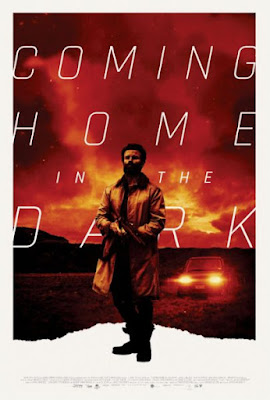
Coming Home in the Dark

It is the land where they shot The Lord of the Rings, but this ultra-violent NZ film will make you think twice about visiting as a tourist. “Hoagie” Hoaganraad thought he would take his family on a nice driving tour, but instead he finds himself in a grim abduction drama that agonizingly unfolds during James Ashcroft’s Coming Home in the Dark, which opens today in New York.

Alan’s step-kids can tell from a distance the two ominous drifters will be trouble, but the talkative Mandrake and Tubs, his socially-stunted companion, are even worse than they can imagine. They do not merely rob the family, they start inflicting real, lasting pain. “Hoagie” tries to be cooperative, but it soon becomes clear they are not to be reasoned with. Thus begins a desperate struggle to survive.

However, the psychopaths are especially motivated, because they seem to recognize Hoaganraad—and they carry a grudge against him, for some mysterious sin from the past. Even though only about nine years separate the actors portraying Hoaganraad and Mandrake, it looks more like a gap of fifteen or twenty, so we can easily guess their grudge. Instead of shocking, it is all quite predictable and frankly rather boring. That also means the audience is essentially left with only his wife Jill to root for and identify with.

The relentlessly depressing violence Ashcroft and co-screenwriter Eli Kent constantly serve up will remind horror fans of the grisly Australian grindhouse film,
Killing Ground, but at least Coming Home also incorporates some effective cat-and-mouse business for Hoaganraad and Mandrake. Nevertheless, the film is still much more focused on shock than suspense.

Friday, February 22, 2019

The Changeover

Laura Chant is a “sensitive.” That sort of means she has the “Shine.” It also means she could possibly transition into a full-fledged witch, but there is no guarantee the process will be safely completed, just like there is no guarantee obnoxious teenagers can successfully evolve into mature adults. Chant has very personal and pressing motivation for fulfilling her witchly promise, which raises the stakes considerably in Stuart McKenzie & Miranda Harcourt’s The Changeover, opening today in Brooklyn.

From time to time, Chant gets premonitions, but her over-worked, working-class mum does not want to hear about that. Instead, she just wants Chant to shut-up and take care of her little brother, Jacko. You could say she has not done so well on that score, but it is hard to be prepared for the danger represented by Carmody Braque. He happens to be a larva, a supernatural parasite that sucks the life-force out of their victims. Tragically, Braque managed to sink his hooks into Jacko, after he tricked the lad into “letting him in.”

Channt is definitely out of her depth, but she finds an ally in her brooding classmate, Sorenson Carlisle, a witch (not a warlock), from a long line of witches. His mother and grandmother could have some helpful advice for Chant, whereas her mother just nags and nags.

Based on New Zealand YA author Margaret Mahy’s 1984 Carnegie Medal-winner of the same name, The Changeover is one of the better films based on YA novels, but admittedly, its only competition is the greatly underappreciated Before I Fall. It is not saying much to argue it is much better than I Still See You, November Criminals, and Fallen, which it most definitely is. A lion’s share of the credit is due to Timothy Spall, who is jolly fun to watch chewing the scenery as Braque.

Th crafty Spall is indeed fun to watch, but Erana Janes is quite compelling as Laura Chant. Nicolas Galitzine is rather dull as Carlisle, brooding teen witch, while Lucy Lawless is frustratingly underemployed as his mother, Miryam. Still, the ensemble definitely exceeds the low expectations viewers might have for another YA movie adaptation. In this case, Changeover’s deep roots, stretching all the way back to ’84 arguably suggest this story has some staying power. In fact, there are some rather intriguing elements to Chant’s psychological and paranormal battle with Braque. Frankly, it probably deserves better than its excuse-me-once-a-day run at the Kent Theater in Brooklyn, but that’s what it has. Recommended for fans of supernatural teen fiction, Th Changeover is now playing in select cities.

Thursday, February 14, 2019

Mega Time Squad: Kiwi Time Travel


Time travel can be dangerous, especially if you have low self-worth, because you might meet yourself—and it would be super-awkward knowing what you thought of you. Lug-headed John likes most people, even including himself, so he shouldn’t have any trouble working with his other selves. Yet, somehow he still quarrels and backstabs with himself in Tim van Dammen’s Mega Time Squad (trailer here), which opens this Friday in limited release.

John is decent bloke, even though he harbors serious gangster ambitions clearly beyond his reach. Currently, he is an unglorified errand boy for Shelton, a suburban Kiwi kingpin. That certainly should not impress Shelton’s younger sister, Kelly, who has recently moved in with him, but she takes an inexplicable shine to the lad. To impress her, John uses some inside intel to try to swipe a bag full of illicit cash, but that puts him in the middle of a power struggle between Shelton’s outfit and a Chinese gang moving in of their territory.

Fortunately, along with the cash, John also makes off with an ancient Chinese bracelet that allows the wearer to jump back in time. Van Dammen never gets very Doctor Who-ish regarding the details of how this works. Instead, he is more interested in the stage-managing the growing clique of Johns, who dub themselves: “The Mega Time Squad.” We do not get any lectures on the dangers of monkeying around with the space-time continuum, because John really doesn’t need one. The ancient Chinese demon stalking him makes the point well enough on its own.

Without question, the visual effects and physical traffic-directing of the various Johns is downright inspired. Unfortunately, the characterization is not as strong. Alas, poor John lacks the charm of either Bill or Ted and has nothing that can compare to the screen presence of Mi Yang’s various doppelgangers in Reset. As played by Anton Tennet, the dude is just a dude.

Still, his earnest (if clueless) courtship of Kelly is genuinely endearing. Hetty Gaskell-Hahn strikes just the right balance between sweetness and sarcasm as the object of his affections. To be fair, Tennet also does a nice job distinguishing each John by emphasizing the quirks that surface in each iteration.

“Nice” really is the word for Mega Time Squad. It is an amusing film that over-achieves quite resourcefully when it comes to special effects, but the vibe is a little too laidback for its own good. Pleasant but not essential, Mega Time Squad opens tomorrow (2/15) in select cities, including the Gateway Film Center in Columbus, Ohio.

Tuesday, January 29, 2019

Sundance ’19: Merata


She made the Queen’s Honors List for New Zealand, so you can’t say Merata Mita wasn’t part of the establishment. The filmmaker became a mentor for many indigenous filmmakers, including many from well beyond Australia and NZ. She was also no stranger to Sundance, so it is fitting her son Heperi Mita’s documentary profile tribute Merata: How Mum Decolonised the Screen has its international premiere at the 2019 Sundance Film Festival.

Merata started from humble but politically radicalized roots. In archival footage, she often uses the word “revolution” without irony. Her start in media was modest, hosting a public affairs program and self-producing a short doc, but it was still counted as experience within her community when Mita resolved to tell their stories.

The intimacy of Mita’s film is both its main strength and its greatest weakness. Many of Merata Mita’s films were family projects that H. Mita and his siblings witnessed in production first-hand. However, this also means there is little to no critical distance to be found anywhere in the frequently hagiographic film. Certainly, none of Mita’s 1970s-era politics are ever challenged.

A good number of clips from Mita’s film are incorporated into the doc, but they mostly look very much like time capsules of their era. They might be historically significant films, but the snippets are not so enticing (lots of marching and yelling). Perhaps the best case for Mita is made by the filmmakers she mentored and championed, notably including Taika Waititi (What We Do in the Shadows and the latest Thor). The Sundance connections also continue with Sterlin Harjo. Walking Dead fans might be interested to know Cliff Curtis serves as executive producer, but does not appear on camera (which seems like a lost opportunity).

There is definitely an appealing Horatio Alger-ish up-from-mean-circumstances aspect to Mita’s story. The film is all very nice, but it often feels like a family reunion of sorts, It is definitely a small-scale affair, at times veering perilously close home movies. Heartfelt but not essential, Merata: How Mum Decolonised [Kiwi spelling] the Screen screens again today (1/29) and Friday (2/1) in Park City and Saturday (2/2) in Salt Lake, during this year’s Sundance.

Sunday, January 29, 2017

Sundance ’17: Do No Harm (short)

The Hippocratic Oath is about to get a serious workout and the surgical scalpel will become a lethal martial arts weapon. She is truly a doctor who fights for her patients, but there is a special reason for her ferocity in Roseanne Liang’s Do No Harm (trailer here), by far the best film in the Midnight Shorts Program at the 2017 Sundance Film Festival.

In a private Hongjing hospital, the unnamed doctor is quietly stitching up a gangster, until a rival gang rudely interrupts. They nearly massacre the entire surgical team, but the doctor is tough to kill. Her patient is probably just a bad a thug or maybe even worse, but she will protect him no matter what, racking up a gosh darned impressive body count of her own.

Harm is a super-charged, ultra-gritty action movie in the tradition of hospital shoot ‘em ups like John Woo’s Hard Boiled and Johnnie To’s Three, but Liang averages considerably more mayhem per minute. As the doctor, Marsha Yuen instantly establishes herself as an action figure, but also has sufficient gravitas to be a trusted medical profession. If you were going under the knife, you would want her to be the one in charge of the operation.

The large supporting ensemble of gangsters also have impressive stage-fighting skills and project the appropriate malevolence. Young Emily Tam is also quite effective in her third act appearance. In fact, she and Yuen are so good, the ambiguous ending is rather frustrating. Hopefully, Liang will fix that in the feature version—because this is exactly the sort of short that seems ripe for a longer treatment. Regardless, the butt-kicking is highly entertaining and the credible performances duly reflect the dire stakes. Enthusiastically recommended, Do No Harm should be a cinch to turn up at genre festivals like Fantasia after rocking the Midnight Shorts at this year’s Sundance.

Wednesday, March 30, 2016

The Dark Horse: Cliff Curtis Becomes Genesis Potini

If you want to know the latest developments in competitive chess or the sorry state of human rights in Russia, Garry Kasparov’s twitter feed is required reading. The witty and erudite Kasparov might be one of the few grandmasters you would actually want to have dinner with. Remember how creepy Bobby Fischer turned out? Genesis Potini struggled with even greater mental and emotional issues, but his heart was always in the right place. Potini finds the best way to stabilize his chemically unbalanced mind is by coaching a chess team of underprivileged youths in James Napier Robertson’s The Dark Horse (trailer here), which opens this Friday in New York.

There is no mistaking the extreme nature of Potini’s bipolar condition. We first meet him in the midst of a full blown episode. It is only the sight of an antique chess set that somewhat calms (or at least slows) down Potini to some extent. The rather generous reception the store offers to the furiously muttering Potini quickly demonstrates Robertson’s restraint. Marginalized even within his ethnic Maori community, Potini’s social and economic realities are crystal clear from the onset. They need no heavy-handed incidents to underscore them.

Reluctantly, Potini’s brother Ariki, a high-ranking member of a biker-gang, takes the troubled former competitive chess player into his home. However, Potini is uncomfortable with the gang’s vice and aggression. He seeks a sense of belonging in a chess club sponsored by a former mate, initially unaware it serves at-risk kids. Yet, when Noble Keelan gives him a chance, Potini shows an aptitude for coaching, particularly when he relates the game to Maori legends. He even starts to reach his standoffish nephew Mana. Unfortunately, Ariki is dead set on initiating Mana into the gang on the very same day Potini’s team, the Eastern Knights, will compete in their first tournament.

You probably think you know where this film is headed and it is true Robertson is fiercely determined to inspire viewers, no matter how cynical they are. Nevertheless, Dark Horse is light years removed from simplistic television movie terrain, nor does Robertson ever opt to take the easy way out. There is no “cure” in sight for Potini, only more effective management techniques.

What really distinguishes Dark Horse is Cliff Curtis’s remarkable portrayal of Potini. Despite his frequent descents into mania, it is not a flashy performance. Curtis pulls us into his hulking frame (for which he reportedly packed on sixty pounds), rather than engaging in cheap tics. Curtis has a background in Mau Rakau martial arts and constantly seems to be jogging as the lead in Fear the Walking Dead, but as Potini, he looks like a walking PSA for diabetes and heart disease. Yet, there is something soulful about his screen-presence, even when he is quietly careening out of control.

Wayne Hapi has a similarly powerful physical bearing, but his work as Akiri might even be more complex and subtly modulated. His parenting choices will strike viewers as tragically wrong, yet we understand exactly why he makes them. The young supporting cast is also loaded with raw, natural talent, but James Rolleston and Niwa Whatuira are standouts for their charisma and intensity, as Mana and Keelan’s promising recruit Michael Manihera.

Robertson never tries to reinvent the wheel during Dark Horse, but he tells Potini’s story with incredible honesty and sensitivity. He also guides his ensemble (of radically differing experience levels) to some highly compelling performances. Recommended for those who appreciate a little inspiration without sentimentality or beautification, The Dark Horse opens this Friday (4/1) in New York, at the Angelika Film Center.

Wednesday, September 30, 2015

Deathgasm: Heavy Metal Horror

As long as there are angst-ridden teens, there will be a market for really loud music. Punk has the advantage of its cool anarchist ideology, but there are more bikini-clad women in heavy metal videos. Of course, reality is nothing like that for bullied metalheads like Brodie. However, the satanic apocalypse could reshuffle the social order of Brodie’s white bread New Zealand high school, if he survives it. Heavy metal and demons really do go together like a horse and carriage in Jason Lei Howden’s Deathgasm (trailer here), which opens this Friday in select theaters and also releases on VOD.

After his mother is institutionalized, Brodie is forced to move in with his Ned Flanderish Uncle Albert, whose jerky jock son goes out of his way to torment him at school. Initially, the only people who will hang out with him are the D&D playing band geeks (C’mon, doesn’t Howden know Pathfinder has taken all of their marketshare?), until he meets Zakk, an older, more sociopathic metalhead. Naturally, they all form a band: Deathgasm. Through an unlikely chain of events, Brodie comes into possession of a heavy metal black mass that literally unleashes H-E-double hockey sticks when they play it.

Anyone within earshot who was not jamming on the tune turns into a bloodthirsty demon. It is all very inconvenient, but at least it gives Brodie an opportunity to kill his family in good conscience. In fact, it turns out Medina, Brodie’s out-of-his-league crush is one of the best demon killers around—and she is developing an ear for heavy metal.

So in Deathgasm you have heavy metal, demons, shadowy satanic cultists, gore with chainsaws, and gore with sex toys—basically everything that made Harry Potter popular with third and fourth graders. Yet, underneath all the blood, guts, and contempt for easy listening, Deathgasm actually has a good heart. Brodie’s halting courtship of Medina is nearly as sweet as it is unlikely. On the other hand, his frienemy antagonism with the jackastical Zakk is certainly believable enough. Still, what really sells the film is Howden’s feel for the disaffected metalhead lifestyle and the outsider appeal of the music. The short-lived character of Rikki Daggers, a legendarily reclusive former metal star is particularly spot-on.

Howden does not exactly reinvent blackly humorous carnage, but he goes about it with admirable enthusiasm. There are a number of spectacularly gruesome gags, which Howden is never afraid to double-down on. As Brodie, Milo Cawthorne sometimes gets annoyingly sad-eyed and mopey, in an Adrien Brody kind of way, but James Blake and Kimberley Crossman bring plenty of energy as Medina and Zakk, respectively.

It should be noted Deathgasm has a stinger that is arguably worth sticking out the credits for. It is a proud meathead movie that delivers the right vibe and the right attitude. Recommended for genre fans who like their films loud and rude, Deathgasm screens after midnight this Friday (10/2) and Saturday (10/3) at the Nitehawk in Brooklyn.

Saturday, September 12, 2015

TIFF ’15: Born to Dance

It is not just kiwis and hobbits in New Zealand. They also have hip hop. It speaks to working class Maori kids like Tu and his friends, who are looking for their place in society. They have all kinds of moves, but the national hip hop dance competition has long been dominated by Kane’s well-funded, widely-sponsored K-Crew. A grudge match is brewing between them in Tammy Davis’s Born to Dance (trailer here), which screens during the 2015 Toronto International Film Festival.

If Tu does not figure his post-high school life out fast, his Sergeant father will enlist him in the army. He thinks he sees his opportunity when K-Crew, the reigning dance champions, invite him to audition. This is no mere cattle call. For weeks, Tu will travel to Auckland to participate in the long term process-of-elimination tryout. Naturally, he keeps it secret from his own crew, led by his lifelong platonic pal, Vonnie. Only his semi-delinquent buddy Benjy knows the truth.

Of course, Tu has the right stuff, but all the special attention he gets from Kane’s girlfriend Sasha could be a problem. Frankly, she knows he is pretty scummy, but her snobby, absentee parents only let her stay in New Zealand to dance as she wishes as long as she is still part of a winning squad. She therefore needs Kane.

BTD features a ridiculously charismatic cast in a total Arthur Murray dance-by-numbers screenplay. It is a lead pipe cinch Tu and Kane will eventually face each other. Yet, that hardly matters as long as Davis and choreographer Parris Goebel keeps the energy cranked up. There are some cool dance sequences distributed throughout BTD, but nothing tops the wildly inventive moves Tu’s crew uncorks during the first round of the nationals. On the other hand, it is hard to take K-Crew seriously, because most of their routines bring to mind Mike Myers doing Dieter on Sprockets.

Former So You Think You Can Dance contestant Kherington Payne shows more presence than you would expect from Sasha. In contrast, Tia-Taharoa Maipi is likable enough, but a bit of a dramatic lightweight as Tu. However, Stan Walker is the real breakout discovery, demonstrating considerable range and all kinds of dance floor cred as the sensitive bad boy Benjy.


Yes, there are some real moments, but Goebels’ choreography is still not as distinctive as Yako Miyamoto’s taiko drumming and dancing that so distinguished Make Your Move. Nevertheless, BTD has more fire and grit than an army of Step Up clones. The fact that Tu, Benjy, and Vonnie are Maori is very important to the narrative, but it is not belabored to the point of distraction. This is a dance film not a social issue drama. In fact, it is a rather enjoyable one, in an underdog-Horatio Alger-kids from Fame kind of way. Recommended for dance movie fans, Born to Dance screens again tomorrow (9/13) and Friday (9/18) as part of this year’s TIFF.

Wednesday, August 05, 2015

I Survived a Zombie Holocaust: Kiwi Zombie Mash-Up

It is a case of life imitating schlock. Of all days for the zombie apocalypse to dawn, it happens during an aspiring Kiwi screenwriter’s first day working on the set of a grade Z zombie movie. Naturally, it takes the crew time to realize just what is happening and where all those extra zombies came from. Needless to say, it is tough being an extra in Guy Pigden’s I Survived a Zombie Holocaust (trailer here), which just released on iTunes.

Somehow Wesley Pennington’s naïve idealism survived film school, but a few humiliating hours working as the runner on this derivative micro-budget zombie flick might just grind him into submission. The production is helmed—quite poorly—by the arrogant martinet Stanley Martin Patrick, who insists the crew refer to him by his initials, “SMP.” His bullied assistant director Richard Driver makes sure the abuse steadily flows downhill. Tane Henare, the location manager is not a bad bloke, but he won’t stop boring people with glory stories from his rugby days. The real bright spot for Pennington is the location caterer, Susan Ford, but she will not give him the time of day. Her food is also a minor horror show. However, Ford will start to warm to him when they are running for their lives from the zombie hordes.

ISAZH starts with a pretty promising concept and develops some clever gags poking fun at indie genre filmmaking. The way they make the meathead lead actor’s voice sound weirdly mixed, even under ordinary circumstances is a particularly nice touch. However, the gun-nut Yank obsessed with Islamist terrorism is a distracting detour into political point-scoring that does not pay-off with laughs. Frankly, a film like ISAZH tells us we can never be too paranoid, about anything.

On the other hand, SMP and Adam “The Body” Harrison, the closeted, waning-in-popularity action star, are big, over-the-top characters that land some darkly outrageous bits of comedic business. To their, Andrew Laing and Mike Edward, as SMP and the Body respectively, go big and bold. As Pennington and Ford, Harley Neville and Jocelyn Christian develop some convincingly awkward chemistry, while Ben Baker’s Henare is the closest thing to normal on the set, while being just sarcastic enough to be a good audience surrogate as Henare.

Evidently, zombies tend to be the fleet of foot in Oceania rather than the slow shufflers. Like the Australian Wyrmwood, the crew in ISAZH must contend with some pretty fast zombies. Pigden also keeps the film moving along at a good clip, even though he takes a scatter-gun approach to the comedy. An amusing distraction for zombie fans, I Survived a Zombie Holocaust is now available from The Orchard on iTunes.

Monday, April 13, 2015

The Dead Lands: The Deadly Maori Art of Mau Rakau

You may not be familiar with the Maori martial arts discipline of Mau Rakau, but there is a reason it translates as “to bear a weapon.” Viewers will see just how lethal paddle-shaped Patus and assorted traditional spears can be when a teenage Maori follows his father’s killer through a shunned stretch forest in Toa Fraser’s The Dead Lands (trailer here), which opens this Friday in New York.

This is New Zealand before contact with Europeans, but it is not necessarily unspoiled. Something so horrific happened in the so-called Dead Lands, the various Maori tribes avoid it at all costs. The exact details remain hazy, but everyone believes the old, ferocious figure known simply as “the Warrior” was intimately involved in the atrocity. Just about everyone will travel days out of their way to avoid his territory, not Wirepa, who just barges through.

The arrogant young son of tribal chief has just manufactured a grievance against their rival tribe. His subsequent sneak attack nearly wiped out all of Hongi’s people and killed his father, the peace-loving chief. Nobody ever thought the clumsy Hongi would ever amount to much of a warrior, but he will have to develop his skills quickly to avenge his people. With the encouragement of his grandmother’s aggrieved spirit, Hongi forges an alliance with the fearsome Warrior (with a capital “W”), who does not appreciate the entitled Wirepa traipsing through his territory. Despite his profoundly antisocial nature, The Warrior will take Hongi under his wing, teaching him the deadly art of Mau Rakau.

Dead Lands is bound to offend some viewers because its vision of pre-contact Maori is all about fighting. Yet that is not such a bad strategy, since it allows the film to sidestep the awkward melodrama of a Rapa Nui. It certainly makes viewers reluctant to hassle anyone carrying a patu with authority, which is something the film can hang its hat on.

Indeed, the Mau Rakau fight scenes choreographed by cast trainer and co-star Jamus Webster are spectacularly cinematic. The imposing Lawrence Makoare (a veteran of The Lord of the Rings franchise and Marco Polo) is an especially effective action figure, who seems ripe for a cult following after all the glowering and hacking-and-slashing he does as “The Warrior.” James Rolleston and Te Kohe Tuhaka also go at it with admirable vigor as Hongi and Wirepa, respectively. Frustratingly, Raukura Turei displays impressive Mau Rakau chops and real screen presence as Mehe, a lady warrior and potential love interest, but she is forced to make a rough entrance all too quickly after the film introduces her.

There is probably plenty of ethnographic hand-wringing to do over Dead Lands, but the action scenes are cool and it provided a lot of work for Maori actors and craftsmen. In its way, it should inspire widespread fanboy appreciation for the time honored practice of Mau Rakau. Fraser gives it all a strong sense of place and nicely instills a mood of mystery and foreboding. Recommended for fans of Seediq Bale, The Dead Lands opens this Friday (4/17) in New York, at the Village East.

Wednesday, February 11, 2015

What We Do in the Shadows: When You Can’t Kill Your Roommates, Because They’re Already Undead

Viago definitely needs a laundry detergent that gets out blood stains. Even though his housemates are just as apt to cause them, he is the only one who is really good about doing the chores. Mundane Real World-ish conflicts get bloody in Taika Waititi & Jemaine Clement’s sly spoof What We Do in the Shadows (trailer here), which opens this Friday in New York.

With a firm agreement and the traditional protections against vampires in place, a crew from the New Zealand Documentary Board will produce a vérité record of the goings-on inside a vampire house somewhere in the suburbs of Wellington. Viago, a natty Eighteenth Century gentleman, will be the most welcoming and loquacious. We will also get to know Vladislav, an eight hundred year-old torturer and impaler, who has mellowed and recent years, and the relatively young Deacon, who is still trying to forget an ill-advised dalliance with the occult-obsessed National Socialists. They also live with the 8,000 year-undead Petyr, who has pretty much gone the full Nosferatu by now. He doesn’t do chores—and nobody hassles him over it.

Deacon has a human familiar who periodically brings over prospective victims, but when Petyr accidentally turns Nick, they reluctantly welcome him into their lair. They quickly tire of his crass and obnoxious behavior, but continue to cut him slack for the sake of his human Stu. They all grow quite fond of the computer-consultant human, even though it was strictly against the rules to tell him about the whole vampire thing.

Although Waititi and Clement worked from a broad outline, the film is essentially improvised. It is entirely understandable if that puts you on your guard, but Shadows is consistently funny, probably because it never feels like it is trying too hard. They just let the humor flow naturally from the vampire Big Brother house situation. Whenever it starts to slacken, Waititi & Clement splatter about some blood and the film is back in business.

Waititi (a.k.a. Taika Cohen) perfectly sets the tone as the guileless and old-fashioned Viago. Despite his ghoulishly predatory nature, he is strangely likable, as is the entire film. Clement appropriately hams it up as the gothy Vlad and Ben Fransham’s desiccated Petyr is creepy as heck, but the film is really about friendship and acceptance of others’ differences.

Eventually, Wellington’s zombie population turns up, but it is really the pack of werewolves who steal the show. Just about every monster movie convention gets tweaked here and there, but it never feels like Shadows is forcing the issue to tick off another box. It is relaxed filmmaking in a way that really works. Highly recommended for vampire fans. What We Do in the Shadows opens this Friday (2/13) in New York, at the Landmark Sunshine, just in time for Valentine’s Day.

Monday, November 24, 2014

Antarctica: A Year on Ice—They Do the Jobs Penguins Just Won’t Do

With about 1,200 residents at peak capacity, McMurdo Station is the New York City of Antarctica. It is by far the largest of the small research facilities scattered throughout the frozen continent. A satellite communications engineer by trade, New Zealander Anthony Powell became an accomplished photographer and budding filmmaker during his ten years stationed in Antarctica. He had to do something to pass the time, besides marrying an American co-worker. He documents both its vast unspoiled natural beauty as well as the hardy but diverse people who make some kind of a home there in Antarctica: a Year on Ice (trailer here), which opens this Friday in New York.

Yes, it gets cold down there. In fact, Year would not be possible were it not for the inventive new techniques Powell developed and his general talent for jury-rigging cameras. Nature lovers will oh-and-awe at his time lapse photography, but the film is even more interested in Powell’s colleagues and neighbors, making it a close cinematic cousin of Werner Herzog’s Encounters at the End of the World. Yet, Powell is more egalitarian, focusing on the accountants, firemen, and shopkeepers who perform “conventional” jobs in one of the most remote corners of the world.

Through his footage and their anecdotes, Powell gives viewers a vivid sense of life in the extreme southern latitudes. Again, it sure gets cold, but it is the wind that really gets to you. Stir craziness is a fact of life, but everyone seems to pull together into an easygoing community. Tellingly, it is things like rain and avocadoes that people really look forward to during their visits home.

Frankly, Powell’s film is much more impressive visually than Herzog’s tourist look-see. However, there are no grand themes to Year, just a bemused fascination with the everyday adventurism of his colleagues. There is a sense they all belong to a gender-neutral fraternal order of ice dwellers, whose shared experiences brings them back season after season. Fear not, Powell also films plenty of penguins, which just about anyone going to an Antarctica documentary will want to see.

Even though the elements added a significant degree of chance into the equation, Powell still captures some amazing images. Arguably, he should win best cinematographer awards across the board, because who else can claim shots like these? Technically, it is far superior to an average installment of PBS’s Nature, but it has the same general niceness and similar tacked-on messages regarding conservation and climate variance. Recommended for fans of nature docs and History Channel extreme jobs reality programming, Antarctica: a Year on Ice opens this Friday (11/28) in New York at the Village East.

Monday, October 13, 2014

Housebound: Grounded in New Zealand

Kylie Bucknell is in for the mother of all grounding. She is a bad kid, but she discovers there is something downright evil lurking about her mother’s home. Unfortunately, that is where she must serve her sentence of court-mandated house arrest in writer-director-editor Gerard Johnstone’s Housebound (trailer here), which opens this Friday in select cities.

Bucknell fell in with the criminal element at its dumbest. After her last escapade, she and her ankle bracelet have been confined to her estranged mother’s house. Miriam Bucknell always told her it was a former bed & breakfast, but as things start going bump in the night, she soon discovers it had been a halfway house for disturbed youths that was shuttered after some sort of ominous scandal.

Is she in fact being haunted? To answer this question, she enlists the help of Amos, the security contractor monitoring her bracelet signal, who conveniently lives in the neighborhood. At first, he is a willing accomplice, but they soon encounter more mayhem than he bargained for.

While there is nothing awe-inspiringly original about Housebound, its horror movie mechanics are uncommonly good. Johnstone dexterously juggles a succession of clever red herrings and shows a knack for attitude-heavy Kevin Williamson-esque dialogue. It is not compulsively jokey, but there is humor in all the appropriate spots. Nor is it as gory as horror fans might expect, but it still pushes all the right buttons.

The real key to the film is evolving rapport between Morgana O’Reilly and Glen-Paul Waru, as Bucknell and Amos, respectively. Their bickering has an edge but it is not overwritten. It is also a relatively fresh basis for cinematic relationship on paper that works quite well in practice. Frankly, they seem to bring out the best in each other, because O’Reilly’s scenes with her mother and head-shrinker do not have the same zip. However, Ross Harper has some nice moments with her as the taciturn step-dad, Graeme.


Along with Danny Mulheron’s Fresh Meat, Housebound proves New Zealand should hold more interest for genre fans beyond providing the backdrop for Peter Jackson’s Tolkien movies. Although not as pure “horror” as it sounds, Housebound provides a nifty macabre fix. Recommended rather enthusiastically for cult movie patrons, Housebound opens this Friday (10/17) in select markets.

Sunday, August 24, 2014

The Man Who Lost His Head: Repatriation Rom-Com

The town of Otakataka on New Zealand’s rugged west coast is economically depressed and it is all Britain’s fault. Years ago, the dastardly imperialists lured Chief Takataka into a life of debauchery and captivity. Before shuffling off his mortal coil, the once promising leader left his wood carved mask to his people, prophesying its arrival would herald better times. Unfortunately, it has yet to leave England—and it is repressed Ian Bennett’s job to see that it stays there in Terry Johnson’s The Man Who Lost his Head, which might be turning up on select PBS stations anytime in the coming months.

Bennett’s entire professional life has been spent at the British Museum of Imperial Plunder, or whatever screenwriter Mark Wallington calls it. He is not very politically adept, but his engagement to the director’s daughter ought to give him a leg up over his showbiz oriented rival, Adrian Minter. Bizarrely, the museum has opted for Minter’s South Pacific exhibition over Bennett’s Egyptian proposal. That seems counter-intuitive for anyone with a layman’s understanding of museum attendance, but the fictional soon-to-be released Captain Cook film starring Brad Pitt partly explains it away.

Regardless, unforeseen complications arise when the museum takes Takataka’s mask out of mothballs. Tightly wound Maori activist Zac promptly files a claim, which the museum has no intention of honoring, but they have to put on a show of due consideration for appearances sake. To seal the deal for his promotion, Bennett is dispatched to Otakataka for some glad-handing and fact-finding that should all culminate in a summary rejection of their claim. Yet, despite his reserved demeanor and social awkwardness, a halting romantic attraction develops between him and Lollie, the local school teacher.

Essentially, Lost Head is like a Hugh Grant rom-com from the early 1990s, except the principals are ten or fifteen years older. It is a cinch that fuddy-duddy Bennett will learn some late life lessons and British imperialism will swiffered into the dustbin of history. Still, it is appealing to see middle-aged romance blossom on screen. As Bennett and Lollie, Martin Clunes (a.k.a. Doc Martin) and Nicola Kawana duly forge some pleasant chemistry.

Nevertheless, the narrative is such a by-the-numbers affair, it gives viewers plenty of time to pedantically pick apart the raggedy details. For instance, the precipitating claim to Takataka’s mask seems especially weak considering it has never been out of British possession or traveled off England’s green and pleasant land. The supporting Otakataka villagers are also predictably quirky, beyond all reason. Most frustratingly, Johnson rarely capitalizes on the surrounding natural beauty of the North Island locale.

This is a television movie that never exceeds the expectations for television movies. Fans of Hallmark productions that enjoy watching soulmates discover each other under unlikely circumstances should find it is safe and reassuring, but the rest of us will consider it a decaffeinated time-waster, at best. For Clunes fans, it is now available for participating PBS stations, including Kentucky’s KET, where it is scheduled for this coming Saturday night (8/30).

Monday, June 30, 2014

Beyond the Edge: Himalayan Heroics in 3D

The conquest of Mt. Everest is considered the final crowning achievement of the British Empire, but it was successfully completed by a New Zealander and a Nepali (or possibly Tibetan) Sherpa. It was a nearly impossible climb with early 1950s gear that was further complicated by the odd logistical error here and there. However, Sir Edmund Hillary and Tenzing Norgay were part of a generation that refused to substitute excuses for success. The story of their summiting is recounted and recreated in Leanne Pooley’s 3D documentary Beyond the Edge (trailer here), which opens this Friday at the IFC Center.

Before Hillary joined Colonel John Hunt’s 1953 expedition, the Everest statistics told a grim tale: “thirteen deaths and no summits.” Hillary, an unassuming bee-keeper was one of only two New Zealanders in Hunt’s party, but he truly looked like a mountaineer. He also had the skills and the drive to for the final push. Unlike most of his Sherpa colleagues, Tenzing Norgay also had a climber’s ambition to summit—and summit first. Like good Survivor contestants, they sized each other up, recognized their compatibilities, and formed an alliance. Soon they were a team, hustling to establish a path through the dreaded icefall to impress Hunt.

Yes, there will be setbacks and complications. One of the strangest aspects of Beyond is the way its vocabulary more often evokes horror films than National Geographic specials. There are references to the “Death Zone” immediately below the summit and the “stench of death” asserting itself even before that stage. Nevertheless, Beyond is visually awe-inspiring. The 3D adds depth, but is not absolutely necessary—the spectacle of the Himalayas does not need punching-up. For her hybrid approach, Pooley seamlessly integrated restored 16mm color footage shot by the Hunt expedition with dramatic recreations mostly filmed in New Zealand’s Southern Alps. Just watching the immersive visuals will make viewers feel chilly and light-headed.

There is also plenty of expert commentary in Beyond, but Pooley eschews the traditional talking head approach, opting instead for disembodied voice-overs, sort of like Room 237, except her professionals are insightful and experienced Everest veterans rather than cracked eccentrics. The enthusiastic participation of Hillary’s mountaineering son Peter and Tenzing Norgay’s son Norbu Tenzing also adds apostolic credibility.

Mountain climbing sequences used to be where movies went to die (MST3K’s “rock climbing” riffs for Lost Continent pretty much said it all), but documentaries somehow managed to crack that nut. Like Nick Ryan’s K2 doc The Summit before it, Beyond is tight, tense, and very cinematic. Yet, instead of a tragic cautionary tale of reckless overreach, Pooley’s film celebrates courage, ambition, and sheer will power. No mere Discovery Channel special, it is much more dramatic and entertaining than you would expect. Highly recommended for sporty audiences, Beyond the Edge opens this Friday (7/4) in New York at the IFC Center.

Wednesday, April 24, 2013

Tribeca ’13: Fresh Meat


Insert your own family dinner joke here.  Or don’t bother.  New Zealander Danny Mulheron’s fearless cannibal comedy will make them all for us.  Questions of good taste will entirely depend on the viewer’s palate when Fresh Meat (trailer here) screens as a Midnight selection of the 2013 Tribeca Film Festival.

Rina Crane is a very proper young Maori lady who has come home from boarding school.  She is thinking it is about time to drop the lesbian bomb with her family, but they beat her to the punch, revealing the new family diet.  In hopes of finally achieving tenure, her academic father Hemi Crane has revived an ancient mystical cannibal cult.  Eating will flesh will give them supernatural powers or so the theory goes.  His new faith is about to be put to the test when a reckless gang of fugitives invades the Crane home.

For the freaked out Rina, this sudden turn of events is not all bad, largely because of Gigi, the ringleader’s less than enthusiastic girlfriend.  She happens to bear a strong resemblance to the fetish superhero character Rina created as a focus for her fantasies.  Clearly, the two share an instant attraction, at a time when Rina’s family loyalties are somewhat fraying.

Basically, Fresh combines elements of Desperate Hours with We Are What We Are, adding all kinds of politically incorrect humor.  At one point Hemi Crane declares: “we are not Maori cannibals, we are cannibals who happen to be Maori.”  Whew, feel better everybody?  The treatment of Lesbian themes is about as sensitive, with scenes clearly included for maximum leer value.  Oh right, there’s plenty of gore too.

You have to give Briar Grace-Smith’s screenplay credit for jumping on every third rail it could find.  Likewise, Temuera Morrison embraces the gleeful mayhem wholeheartedly as Hemi Crane.  As Rina, Hanna Tevita keeps her head above water amid all the bedlam, even conveying a measure of sensitive teen alienation.

If you don’t know by now whether this blood-splattered teen lesbian cannibal comedy is your cup of tea or not, I really can’t help you.  For what it’s worth, Mulheron maintains a brisk pace, allowing little time for the wrongness of it all to sink in.  Recommended for anyone out for some good clean fun at the movies, Fresh Meat screens again this Friday (4/26) and Saturday (4/27) as part of this year’s Tribeca Film Festival.

Saturday, January 19, 2013

Sundance ’13: Shopping


Willie is a quiet kind of kid.  The patriarch of a roving band of thieves can envision useful roles for him.  The allure of their outlaw lifestyle will test his bond with his younger brother in Mark Albiston & Louis Sutherland’s Shopping, which screens during the 2013 Sundance Film Festival in Park City.

With a wave of race riots still fresh in New Zealand's public memory, half-Samoan Willie’s domineering Anglo father insists he keep his head down and nose to the grindstone.  Working part-time in the local department store, the young man confronts Bennie, a flagrant shoplifter, who somehow still slips away like the old pro he clearly is.  Later outside, he offers Willie a bit of consideration the honest lad duly refuses.  Not so the next time.  After a few parties and few capers, Willie is definitely considering throwing in his lot with the “shoppers.”  Yes, Bennie also has a daughter who makes a strong impression on Willie.  Unfortunately, showing interest in her can be a dicey proposition.

In addition to the Oliver Twisty story, Albiston & Sutherland also depict the unusual close relationship between Willie and his sibling.  Instead of resenting all the time he must spend with the physically and socially awkward Solomon, Willie is a genuinely protective and indulgent older brother, to an extent not often seen on film.

For a young actor, Kevin Paulo is a surprisingly effective slow burner.  As Willie, he dramatically conveys how tightly wound and conflicted the pre-teen is.  Likewise, Jacek Koman is both roguishly charming and downright menacing as Bennie.  Unfortunately, Willie’s erratic father and passive mother are essentially stock figures.

Basically, Shopping is three parts coming-of-age story and one part crime drama.  Albiston & Sutherland handle the material with great sensitivity, but a bit more humor in the mix would have helped counter-balance the heavy, naturalistic atmosphere.  Recommended for those who appreciate sibling stories with a thin layer of social commentary, Shopping screens again in Park City today (1/19), Thursday (1/24), and Friday (1/25), as well as in Salt Lake on Sunday (1/20) as part of this year’s Sundance.

Saturday, June 16, 2012

HRWFF ’12: Brother Number One


For one New Zealander, a Canadian, and a British subject sailing through Asia, straying off course became a capital crime.  It was their profound misfortune to anchor within the territorial waters of Cambodia while the country was held in the inhuman grip of the Communist Party of Kampuchea, or the Khmer Rouge as they would subsequently be known.  In 2007, Rob Hamill had the opportunity to testify on behalf of his late brother in the first trial of a Khmer Rouge official for crimes against humanity.  Annie Goldson followed Hamill’s quest for justice, or at least a measure of closure, in Brother Number One (trailer here), one of a handful of must see films at this year’s typically uneven 2012 Human Rights Watch Film Festival in New York.

The film’s title carries a rather odd double meaning.  Pol Pot, the Robespierre of the nationwide genocide, was dubbed “Brother Number One” in Communist propaganda, whereas Kerry Hamill was the first of three brothers.  Charismatic and athletic, the elder Hamill brother left New Zealand in search of seafaring adventure.  The 1970’s still felt like the 1960’s for him and his mates, who were largely oblivious to the horrors underway in Cambodia.

Canadian Stuart Glass was killed during the attack on their small yacht, which was probably a small mercy.  Hamill and the British John Dewhirst were captured and transferred to the notorious Tuol Sleng prison, commanded by Kaing Guek Eav, a.k.a. “Comrade Duch.”  In his own words, Duch’s prisoners were to be “smashed.”  This entailed torture, the extraction of a false confession, and an agonizingly slow execution.

As he prepares his “Civil Party” statement, Hamill visits the Tuol Sleng Genocide Museum and talks to the handful of survivors, getting a painful sense of his brother’s final months.  He also interviews several former Khmer Rouge officials, who are not exactly forthcoming.  More satisfying are his meetings with Dewhirst’s sister and his brother’s girlfriend, bonding through their shared grief.

Though it is an intensely personal story, Brother vividly establishes the scale and ferocity of the Khmer Rouge’s reign of terror.  The walls of victim photographs at Tuol Sleng speak for themselves. We do learn a bit about Duch, the subject of The Bookkeeper of Death (recently seen on PBS World), but Rob Hamill is appropriately granted the floor throughout the documentary.  Frankly, it is quite amazing how well he keeps it together as he confronts the ghosts haunting his family.

An Olympic rower at the Atlanta games, Rob Hamill is indeed a compelling POV figure.  He certainly puts a human face on the nearly inconceivable tragedy of so-called “Democratic Kampuchea.”  Yet, the documentary never feels manipulative or exploitative.  Goldson wisely stays out of the picture, resisting the temptation of putting any sort of explicitly personal stamp on the film.  Nor are there moments of quiet observational slack.  Brother has a compelling narrative, which Goldson and her co-director-dp Peter Gilbert and co-editor James Brown hew to quite tightly.

Brother Number One clearly illustrates how vicious ideology can be.  It also reminds viewers how one murder can devastate an entire family.  As for resolution, that is another matter entirely.  That is indeed why Brother Number One is a timely and important film.  One of three highly recommended films at this year’s New York edition of HRWFF, along with Salaam Dunk and Ai Weiwei: Never Sorry, it screens this coming Tuesday, Wednesday, and Thursday (6/19-6/21) at the Walter Reade Theater, with Goldson and Hamill in attendance all three nights.

Monday, March 05, 2012

Kiwi Western: Good for Nothing

For many, New Zealand’s wide vistas will bring to mind Monument Valley, as immortalized by John Ford. There were not a lot of women to be found in such an environment during the late Nineteenth Century, so when an outlaw sees one, he takes her in Mike Wallis’s “Kiwi Western,” Good for Nothing (trailer here), which opens this Friday in New York.

After the death of her father, the British Isabella Montgomery has journeyed west to live on her uncle’s ranch. Unfortunately, an unnamed outlaw takes her on a bit of a detour after gunning down her escorts. He has definite ideas of what to do with her, but while the desire is there, the mechanics are malfunctioning, so to speak.

What follows is sort of a bodice-ripper, in which Montgomery’s bodice is never ripped. Saving her from a sheriff worse them himself, the nameless man drags Montgomery across the Southwest (by way of Central Otago on New Zealand’s South Island) as he seeks herbal remedies from Chinese mining camps and Native American shaman, while the Old West’s least distinguished posse follows erratically behind them.

Granted, Montgomery’s relationship with “The Man” is inherently problematic, but Wallis deals with it rather nimbly. Unlike scores of romance novels, Montgomery is never waiting for her captor to ravish her. Instead, she more-or-less forges an uneasy peace with him for survival’s sake, made possible by his performance issues. Yet, she persists in looking for getaway opportunities until quite late in the game.

Wallis further leavens the hovering specter of nearly all the men’s intentions with some inventively outrageous sequences that approach the downright slapstick. Cohen Holloway and Inge Rademeyer also share some convincing not-chemistry as their not-romance develops. The latter nicely expresses Montgomery’s fear and resourcefulness, but the former’s screen presence is a bit light, especially compared to the Spaghetti Western protagonists he is trying to pay homage to.

Cinematographer Matthew Knight masters the big lonesome look of the more brooding westerns from days past, whereas Wallis keeps it all moving along at a healthy clip. (Indeed, it compares quite well to the sluggish Quigley Down Under, an obvious but imperfect comparison). Mostly avoiding pitfalls and fulfilling its ambitions, Good for Nothing is recommended for those who appreciate a gritty revisionist western. It opens this Friday (3/9) in New York at the Quad Cinema.