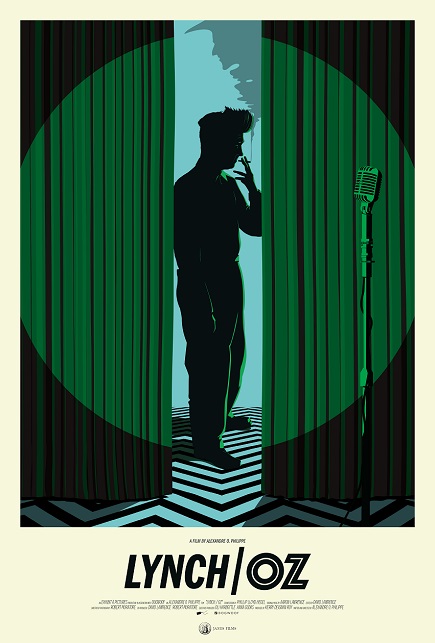
The line "I’ve a feeling we’re not in Kansas anymore” has become an easy
shorthand quote to suggest a character’s old assumptions about how the world
works have just been turned on their head. It is the sort of thing David Lynch’s
protagonists might say. Maybe they did. I honestly don’t remember if that
precise line was included in the super-cuts of Wizard of Oz allusions seen
throughout Alexandre O. Philippe’s latest cinematically-themed documentary.
However, it should be reasonably safe to conclude Lynch has seen the 1939
classic fantasy and it made some kind of impression on the auteur after watching
Lynch/Oz, which opens this Friday in New York.
Evidently,
film critic Amy Nicolson and genre filmmakers Rodney Ascher, John Waters, Karyn
Kusama, Justin Benson & Aaron Moorhead, and David Lowery having been thinking
about Oz as an important source of Lynch’s inspiration for some time, because
they each get one section of the film to draw their connections.
Frankly,
they all make a very compelling case—so much so that Lynch/Oz will have
most viewers completely convinced after the first part. However, there are five
more sections, which largely repeat the same points. After a while, all the Oz-like
motifs in Lynch’s oeuvre, such as the red shoes, mysterious curtains,
doppelgangers, and the porous boundaries between dreams and reality, become repetitive.
We get it. Lynch definitely alludes to Oz in many of his films. Case closed.
Indeed,
Lynch/Oz shares the prime fault of Philippe’s previous documentary, The Taking, in that all his participating commentators share the same opinions
and make the same arguments. There are no crazy outliers (as there were in
Ascher’s Room 237) or dissenting opinions (as in Mark Hartley’s Not Quite Hollywood). It is just the same talking points, repeated five times
over. Waters gives it more of a personal spin and Ascher takes a more macro
perspective on Oz’s overall influence on American cinema in general, but
there are no conflicts in the six analyses Philippe presents.
If Elon Musk and Plato agree something might be a possibility, you have to
take it seriously, but lemming Robin Hood users can’t invest in the “Matrix.”
The idea that our world is a pre-programmed illusion goes back to Plato’s Cave,
but it gained major new currency with the releasee of the Wachowskis’ The
Matrix. Rodney Ascher explores the philosophical underpinnings of “simulation
theory” through the lens of The Matrix and other science fiction films
in A Glitch in the Matrix, which releases tomorrow on VOD and in select
theaters, following its Sundance premiere.
There
are a lot of people out there who suspect we might be living in a simulated
construct, several of whom discuss their theories at length with Ascher, or
rather their avatars do. Yet, the most important voice in the film is Philip K.
Dick, seen in archival footage giving a speech to a bewildered French science
fiction convention about his experiences perceiving alternate realities. It
really was a keynote for the ages.
Ascher
covers heady concepts, like Plato’s Cave (illustrated by Sam Weiss’s animated
short, narrated by Orson Welles), Descartes’ “Solipsism,” Nick Bostrum’s “Simulation
Hypothesis,” and the old “Brain in a jar” thought experiment. Ascher uses ample
clips from science fiction films to exemplify their points, obviously including
the Matrix trilogy and just about every PKD adaptation, but there is one
conspicuous omission. Rainer Werner Fassbinder’s World on a Wire (streaming on Kanopy) anticipated
the themes of The Matrix and Tron way back in 1973, when it was produced
for Western German television.
There
is a lot of egg-headery in Glitch and some cool visuals. However, Ascher
maintains an agnostic tone, fully exploring the dark side and shortcomings of
the theory as well. On the plus side, media critic Emily Pothast compellingly reminds
us of the tangible emotional benefits of human connections, very definitely
including the physical kind. Conversely, Joshua Cooke provides a harrowing account
of the murders he committed while in throes of extreme Matrix-fandom, allegedly
believing his adopted parents were constructs of the Matrix.