According to Gene Roddenberry, it wasn’t official franchise canon, yet many devotees
have tried to sneak it in through back doors, like licensed novels. Regardless,
fans were thrilled to have new Star Trek, especially during the desert
years of the 1970s. In fact, real deal Trekkers welcomed the Trekness of the
animated episodes, thanks to the original cast-members and executive producer-story
editor D.C. Fontana, who wrote several previous and future Star Trek episodes.
The animated format also allowed them to present big, cosmic science fiction
elements that would have been poorly served by the quality of 1973 TV special
effects. That was especially true of the pilot, “Beyond the Farthest Star,” which
airs tonight as a new addition to the ME-TV Tunes line-up.
“Beyond
the Farthest Star” is indeed the first animated episode, but some Southern California
stations jumped ahead to the second episode, to avoid “equal time” complaints
during George Takei’s campaign for LA City Council. Ironically, this episode does
not prominently feature Sulu. Arguably, exploring the familiar characters’
personas in general takes a backseat this time around to portraying the kind of
teamwork that made the original such a classic.
During a
far-distant stretch of their exploration mission, the Enterprise falls into the
gravitational pull of a weird alien spacecraft that looks more like a system of
branching vegetation than a conventional rocket or flying saucer. According to
the warning message left behind by the centuries-dead insectoid crew, they fell
victim to an invasive parasitic entity that operates very much like an AI
virus.
Admittedly,
Filmation’s animation looks dated by contemporary standards, but many of the
visuals, especially the vine-like spaceship are still really cool. In fact, the
retro vibe is nostalgically charming, Yet, hearing the voices of William
Shatner and Leonard Nimoy doing their thing as Kirk and Spock is pure joy. The additions
of James Doohan and Nichelle Nichols as Scotty and Uhuru, who also have
considerable bridge roles to play in this episode, should seal the deal for
skeptical fans.
Sadly,
Walter Koenig’s Chekhov was cut from the animated series for financial reasons,
but he wrote two later episodes. His replacement, the three-armed Arex, also
voiced by Doohan, became a cult-favorite within the Trekker community. (His
unidentified alien race, differed in various novelizations, either Edosian or
Triexian.) This isn’t a spotlight-showcase for him either, but it represents his
introduction to the fanbase.
As a proud geek, Mark Critch has a passion for Star Trek and trivia.
He is also interested in two girls who actually talk to him. They all collide
when he and his sort-of-ex Fox compete against his current flirt-more-than-girlfriend
on a TV quiz show in “Reach for the Top,” the next episode of Son of a
Critch, which airs tomorrow on CW.
Critch
and Fox are in a just-friends phase, which is still a real step up from when
she used to bully him. Somehow, he convinced her to be a member of his trivia
team when they represent St. Bridget’s on Reach for the Top, a TV quiz
show for kids. Of course, Critch is a know-it-all, but his pseudo-girlfriend
Cara, who captains the team from their Protestant rivals is better at handling
pressure. She might also have a talent for mind-games.
As
Critch crumbles under the studio lights, he imagines what Kirk would do, in a
fantasy sequence set on the Enterprise bridge, with him in the captain’s conn.
It looks quite true to the original Trek, as Paramount required, when
they granted their permission. Conveniently, the production designer for this
episode, Mark Steel, has worked as the art or production designer on six Star
Trek: Discovery installments.
Frankly,
some fans will be disappointed the fantasy segment wraps up so quickly, because
of Steel’s eye for authenticity. Young Mark Critch also definitely has an
affinity for Shatner-esque histrionics. Captain Benjamin Sisko is a strong
runner-up, but in Star Trek, “Captain” means “Kirk” first and
foremost.
Sadly, there are very few cast and crew members left to discuss Star Trek in
documentaries. Just recently, we learned of the passing of Laurel Goodwin, the
final surviving co-star of the original pilot, “The Cage,” with Jeffrey Hunter
playing Captain Christopher Pike. Still, there will always be plenty of
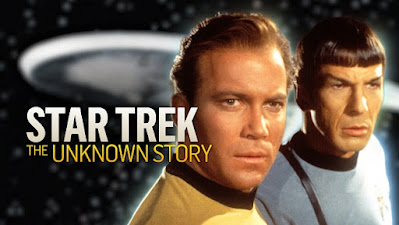
commentators and fans to serve as talking heads in programs like Star Trek:
The Untold Story, which premieres Saturday night on Reelz.
Real
fans know Lucille Ball, the owner of Desilu Productions, saved Star Trek
when she agreed to pay for an unusual second pilot. Frankly, the early genesis
of the classic series is probably explored in greater depth during the first
episode of History Channel’s The Center Seat. It also boasts relatively
fresh interview footage with Walter Koenig (a.k.a. Chekhov). There is also a
good deal of time devoted to the initial rivalry between William Shatner, the ostensible
star, and Leonard Nimoy, who was getting all the publicity as Mr. Spock, but
that Trek history is more fully explored in the documentary, For the
Love of Spock.
At
least Untold gives Paul Fix his due as the second doctor, Dr. Piper, in
the second pilot, “Where No Man Has Gone Before,” after John Hoyt in “The Cage”
and before DeForest Kelley took over as Dr. McCoy. It also gives more time to
the letter-writing campaign than Center Seat. Unfortunately, discussion
of all subsequent series and films is just a blur of titles and dates.
The Desilu production studio founded by Lucille Ball and Desi Arnaz holds
several notable distinctions. It even won a Peabody Award for Orson Welles’ The
Fountain of Youth, the only time an unsold pilot to have been so honored.
However, they will always be best known for two series that became cash-cow
franchises. Mission: Impossible was one. Star Trek was the other
(and the more profitable, in the long run). By the time Desilu was producing
both shows, it was entirely Lucille Ball’s company, so she gets well deserved
credit for her support in “Lucy Loves Trek,” the first episode of History
Channel’s 10-episode The Center Seat: 55 Years of Star Trek, which
premieres this Friday.
Ball
and Arnaz were remarkably savvy and even prophetic with regards to the
television business. They bought the old RKO studio for their own productions,
but started making money by leasing space to other productions. They also
understood and secured re-run rights before anyone else, including the
networks. When Ball and Arnaz divorced, he also divorced himself from the
studio, so it was Ball herself who greenlit Star Trek.
Trek
fans
know it still almost didn’t happen. The network rejected the original pilot,
but took the unusual step of ordering a second one, with an entirely new cast.
The rejected pilot, “The Cage,” is now quite well-known, since it incorporated
into the two-parter “The Menagerie” and has since been restored and released in
its own right.
“Lucy
Loves Trek” does a nice job of chronicling Trek’s development at Desilu,
but it then mostly glosses over the entire run of the original series, focusing
on the letter-writing campaign that saved the show at the end of its second
season, the final cancelation, and its surprising success in rerun syndication.
Subsequent episodes will focus on the animated show, films, and successive
series, which must surely be leaving a lot original series lore and history on
the table. Sadly, many original cast/crew members are no longer with us, but we
do hear from Walter Koenig, Nichelle Nichols, and the late Leonard Nimoy (in archival
video).