Showing posts with label Tiananmen Square Massacre. Show all posts

Sunday, June 05, 2022

Tiananmen Square on TV: Old Wounds

You would think film and television writers would often "rip-from-the-headlines" reference some of the biggest stories of late 1980s and early 1990s, like say the First Gulf War, the Fall of the Berlin Wall, and the dissolution of the Soviet Bloc. Yet, you will find precious few dramas addressing the Tiananmen Square Massacre, despite audiences’ familiarity of the iconic images of Tank Man and the Goddess of Democracy statue. It is slim pickings, but the Canadian X-Files knock-off PSI Factor joined MacGyver and Touched by an Angel, by producing the Tiananmen-themed episode “Old Wounds” (S3E13), which currently streams on multiple sites.

Honestly, this show wasn’t very good, but the premise of “Old Wounds” is somewhat interesting. Matt Prager’s paranormal investigative team has been summoned to look into an incident at a tech firm with shady government connections. Adia Carling was testing an immersive VR game when she suffered real world injuries during the in-game battle. Weirder still, wounds spontaneously healed.

The team quickly sleuths out Carling is not from Hong Kong. She is, in fact, an illegal alien living under an assumed name, who was imprisoned and tortured in China for her role in the Democracy protests. Somehow, the VR game reopened the old wounds she suffered while in custody, including the horrific burning of her left arm. She has the psychic powers to physically heal them, but the team’s good Dr. Anton Hendricks must hypnotize her, to help her heal her emotional wounds.

Ideally, one would prefer to see a serious subject like the Tiananmen Square Massacre addressed in a more reflective, less exploitative manner, but there are not a lot of examples out there. Anyone who knows of a Tiananmen Square-themed TV episode, beyond this
MacGyver, or Angel, please shoot me an email. Writers Jim Purdy & Paula J. Smith treatment of the Massacre and the subsequent brutal crackdown are not exactly inspired, but director Luc Chalifour manages to convey the cruelty of CCP torture techniques, while adhering to commercial broadcast standards.

Saturday, June 04, 2022

The Tank Man, on the Anniversary of the Tiananmen Square Massacre

As a result of the CCP’s draconian “National Security” Law, Hong Kong residents can no longer safely watch this Frontline documentary, commemorate the events it chronicles, or search on-line for the image it focuses on. We must remember for them. In fact, the image of the lone man standing in front of a column of tanks has become an iconic image of courageous defiance in the face of overwhelming state oppression. Writer-producer-director Antony Thomas investigates who he was and how the crackdown on the 1989 democracy protests drove him to do what he did in Frontline: The Tank Man, which is available on-line.

Unlike other vital Tiananmen Massacre documentaries (like
Tiananmen: The People vs.The Party and Moving the Mountain), Tank Man largely focuses on events outside the Square, but that rather makes sense, considering the Tank Man was blocking tanks on the Boulevard leading out of the Square. In fact, one of the eye-opening aspects of Thomas’s report is the carnage that resulted when the PLA strafed apartment buildings around Muxidi Bridge with combat-grade ammunition.

Consequently, Thomas’s talking heads suggest the majority of killings happened at barricades set up by average working-class citizens to protect the students in the Square. Yet, the most senseless murders were those of groups of parents mowed down by the PLA, who had come to the Square desperate to find their children.

Thomas and company fully explain the circumstances surrounding the historic film of Tank Man and how determined the state security apparatus was to prevent it airing in the international media. They also establish how thoroughly blocked all images of the protests are on the Chinese internet—as well as the culpability of Western tech firms like Microsoft, Cisco, and Yahoo in aiding and abetting the CCP’s censorship.

Thomas also spends a good deal of time examining the vast economic disparities between the urban super-rich and the rural underclass. They make valid points regarding the inequality of China’s economic growth, which has been used to justify the Party’s ironclad grip on power post-Massacre, but it sort of distracts from sheer courage and abject horror of the events of 1989.

Sunday, February 13, 2022

Tiananmen Square on TV: Children of Light

Everyone knew Angus MacGyver had guts, because he was willing to take on any villain with a roll of duct tape and an acetylene torch. His show had guts too, because it was one of the few that was willing to directly address the Tiananmen Square Massacre. You might assume Hollywood in the 1990s was as cowardly as it is now, but if you know of any examples besides this, Touched by an Angel, and Psi Factor, please shoot us a message. MacGyver couldn’t do anything to prevent the massacre, but he will try to protect a survivor hoping to expose the truth in the “Children of Light” episode of the original MacGyver, airing Tuesday evening on Heroes and Icons.

MacGyver is surprised, but delighted when Sue Ling, the now fully-grown Chinese orphan he sponsored, turns up unannounced at his houseboat. However, she really isn’t Sue Ling. She is Mei Jan, a former student activist, who used Su Ling’s visa to travel to America. Tragically, her friend was murdered by the PLA during the Tiananmen protests—and she has the videotape to prove it.

Of course, the local CCP embassy spies will do anything to keep that tape out of circulation. They also want the numbers of the fax machine network Mei Jan is trying to rebuild. Naturally, they will exploit any weakness, including threatening the mother of her local contact with the underground student organization. Fortunately, MacGyver is resourceful as ever. He still has his usual aversion to guns, but trying to break into the Chinese embassy is impressively Jack Bauer-ish, especially by his standards.

Director Bill Corcoran nicely integrates genuine historical footage of the Tiananmen Square Massacre, while leaving the killing of Sue Ling to our imagination. This episode definitely confronted the crimes the CCP committed and called out their efforts to erase all historical records. Honestly, “Children of Light” is just as topical today as when it was first broadcast, but its optimism for the prospects of democracy activists like Mei Jan to reboot their movement now seems heartbreakingly naïve.

Sunday, January 02, 2022

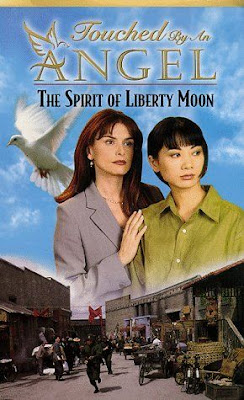
Tiananmen Square on TV: The Spirit of Liberty Moon

Lately, Hollywood has been roundly and justifiably criticized for self-censoring to pander to China, but the major studios and networks have never been especially bold addressing the CCP’s human rights abuses. The Tiananmen Square massacre was a huge international story, but you will be hard-pressed to find it turn up as an element in dramatic storylines. As far as we can tell, there have only been Tiananmen-themed episodes of MacGyver (the 1980s one), Psi Factor (technically Canadian), and Touched by an Angel. The latter is not exactly our cup of tea, but fair is fair and credit is due where its deserved. A survivor of the Massacre returns with the show’s three angels in search of her missing daughter in the two-part episode “The Spirit of Liberty Moon,” which airs this Monday and Tuesday mornings on Start TV (whatever that is).

If you’ve never seen this show before, apparently Monica is an angel who takes an active role helping people in need. Tess is her boss, who turns up periodically to give them a nudge and Andrew is the utility angel. In this episode, Jean Chang is a former Chinese dissident living modestly in America, who yearns to reunite with her daughter Liberty Moon, but it is her boss at the toy company, Edward Tanner, whose soul needs saving. Frankly, his obnoxious partner Alex Stella is probably a lost cause.

Tanner and Stella are determined to move their manufacturing to China, for obvious cost reasons. Magically, Monic appears as their Chinese management consultant. Chang happens to be the only Chinese speaker on staff, but she is reluctant to join their trip. With the angel’s coaxing, she explains her story to her bosses. It turns out, both of her parents died as a result of the Cultural Revolution. As an orphan, she took inspiration from what she eventually learned was a picture of the Statue of Liberty.

Eventually, Chang moved to Beijing and married “Gus” Gang, a poet and democracy activist. Unfortunately, he was presumed murdered while conducting a hunger strike on Tiananmen Square. Their friend “George” was caring for their infant daughter during the protests, but they both disappeared by the time Chang returned to their home. Somehow, Monica thinks she can slip Chang through Chinese immigration, which seems like a tall order even for the Archangel Michael, but it is a dramatic necessity to get Chang back to Beijing.

The first episode of this two-parter does a fantastic job integrating flashback and archival footage into the narrative. Referencing the Cultural Revolution as well as the Tiananmen Square massacre earns it bonus points. However, the most pointed material is the brutal depiction of China’s so-called justice system. Viewers should be warned writer Martha Williamson never cops out regarding the CCP’s ruthlessness, which gives the episodes a tragic edge.

She also really leans into the religious aspects of the show’s premise. There is some heavy God talk down the stretch, but you have to respect it for having the courage of its convictions.

Thursday, July 01, 2021

Moving the Mountain: Documenting the Tiananmen Square Massacre

Today, the CCP celebrates one hundred years of censorship, religious repression, mass murder, and genocide. It is a grim anniversary. June 4th was also always a day for sad memorials in Hong Kong, but this year, the CCP-controlled government completely banned the annual commemorations of the Tiananmen Square Massacre. The world remembers anyway. We should also remember the great filmmaker Michael Apted (best-known for the 7-Up documentary series, the Oscar-winning Coal Miner’s Daughter, and the Bond film, The World is Not Enough), who passed away earlier this year. Unlike his peers who sold-out to the CCP’s influence, Apted documented the Massacre and its aftermath in Moving the Mountain, which is not on any streaming service (funny that), but it is “findable” online.

In 1994, the Massacre was still vividly raw in the memories of the student leaders who survived. Li Lu serves as Apted’s focal figure, because his life so perfectly encapsulates Chinese history. He was born one month before the start of the Cultural Revolution that eventually rendered him an orphan. He was then the only member of his adopted family to survive the Tangshan Earthquake, enduring the government’s notoriously indifferent and incompetent response. Perhaps understandably, he took inspiration from dissident Wei Jingsheng, who was imprisoned by Deng’s supposedly liberalized regime.

Apted largely chronicles the events from Li’s perspective, but he also incorporates the testimony of his surviving colleagues, Wang Chaohua, Wu’er Kaixi, and Chai Ling. At the time,
Moving was mildly controversial for its short dramatizations (mainly from Li’s childhood and his escape from Mainland China as part of Operation Yellowbird), but these passages look pretty conventional today.

Perhaps what
Moving does better than other films chronicling Tiananmen is the way Apted fully contextualizes the Massacre in China’s historical timeline. He and Li show how the tragedy of June 4th was shaped by the Cultural Revolution and the short-lived Democracy Wall under Deng. Conceived as an equivalent of Khrushchev’s De-Stalinization campaign, Deng quickly cracked down on the Democracy Wall when Wei and other activists posted more than mere cosmetic criticism of the government. Apted and the former student leaders he interviewed also convey a vivid sense of the reign of terror that followed the Massacre. In fact, they speculate more students were probably killed during the round-up.

Saturday, September 19, 2020

Back to School: I Was There—Kate Adie on Tiananmen Square


BBC reporter Kate Adie filed eye-witness reports of the Tiananmen Square Massacre directly from the scene, but she won’t be returning anytime soon, because the CCP has banned her from re-entering the country. You would be correct to take that as a testimonial to the accuracy and integrity of her reports. Decades later Adie remains justifiably proud of her reporting. Now retired from the Beeb, Adie returned to the network to look back at the fateful events of 1989, adding personal and historical context in I Was There: Kate Adie on Tiananmen Square, directed and edited by Andy Webb, which would be a suitable video supplement to your pandemic-home-schooling lesson plans.

Hope was in the air during the year of 1989, unless you were a hardline Communist apparatchik. Gorbachev’s Glasnost reforms had spun out of his control. Ordinary citizens of Eastern Europe were demanding (and taking) greater freedoms. The same seemed poised to happen in China, but Deng and the CCP were more determined to maintain their hold on power and much less concerned with world opinion. Tragically, this became much more obvious in retrospect.

For a step-by-step chronicle of the demonstrations and subsequent brutal crackdown on Tiananmen Square, the definitive
Tiananmen: The People vs. the Party is probably your best option. However, I Was There provides a good hour-long overview (the perfect length if you need to play a video for while you take a meeting). Adie also adds the perspective of a journalist who had to work around CCP censorship. Frankly, the mass killings at Tiananmen Square might be considered the stuff of rumor had Adie’s colleague not been able to successfully smuggle her footage out of China (they made five copies, four of which were intercepted at customs).

In fact,
I Was There is better than most Tiananmen Square documentaries at covering the wider scope of the pro-democracy protests outside Beijing. Shortly after the massacre, Adie traveled to Xian in Shaanxi Province, where she found lingering physical signs similar protests had met a similarly violent fate, but people were only willing to talk about it in whispers, off camera.

Saturday, June 22, 2019

Tiananmen: The People Versus the Party


Ironically, the 1980s are largely remembered as a progressive era of openness in China, but it came to a sudden, violent end in 1989, on the bloody grounds of Tiananmen Square. The death toll remains unknown, but no serious historian doubts it numbers in the thousands. The Chinese Communist Party has scrubbed it from the public consciousness as best they can, but the images of the peaceful protests and violent crack down remain indelibly etched in the memories of everyone who watched the live Western television broadcasts. Yet, there is considerably more to the story. A comprehensive picture of the epochal events emerges through eye-witness testimony and leaked documents now known as the “Tiananmen Papers” in Tiananmen: The People Versus The Party¸ directed by Ian MacMillan and co-written by MacMillan and Audrey Maurion, which premieres this Tuesday on most PBS outlets.

In early 1989, people could reasonably assume democracy would eventually come to Mainland China. It was starting to break out nearly everywhere else. After all, Deng Xiaping was a survivor of the Cultural Revolution, whose son was paralyzed as a result of Mao’s madness. Yet, several of the on-screen commentators explain how Deng’s experience led him to be wary of mass movements, such as the students’ Tiananmen demonstrations. Buzz words like “turmoil” held great significance for him.

Hopefully, most viewers already understand how the demonstrations were ignited by the death and subsequent state funeral for Hu Yaobang, a reformer unceremoniously purged by the Party. However, the extent to which every day Beijingers adopted the students will be a revelation to some Westerners. Essentially, the assault was not just an action on the Square, but an invasion of the entire city, conducted by troops dispatched from the provinces, who had to first fight their way through the barricades erected by the common citizenry to protect the beloved students. It truly was the People versus the Party.

There is also a popular conception that the protestors over-played their hand, which is true to an extent, which became tragically obvious. However, many of the original protest organizers had a better read on the local situation and advocated greater caution and eventually evacuation. In fact, those massacred on the Square disproportionately hailed from the provinces (just like the troops firing on them).

What happened was truly a “war crime” as one of the editors of The Tiananmen Papers points out (with great emotion), but it was even costlier over the long term. The students who were murdered or imprisoned were the best and brightest of their generation. Those who took their places are the ones who toady to power. Deng wanted to crush every last remnant of democratic reformist dissent and he effectively succeeded. Younger generations have no idea what happened in Tiananmen Square and their parents are too frightened or too ashamed to tell them. Yet, the truth is out there.

MacMillan and Maurion give a gripping, step-by-step account of what happened, conveying a dramatic sense of the pre-Tiananmen optimism, the euphoric promise of the protests’ early days, and the shock and terror of the PLA’s assault on the Square. People Versus Party is an important historical document in its own right, because it incorporates a great deal of on-camera testimony from surviving student leaders, including Wuer Kaixi, Shen Tong, Wang Dan, Rose Tang (who is especially moving and damning in her commentary).

People Versus Party would be a significant television event at any time, but it is eerily timely in light of the recent democracy protests in Hong Kong. Thirty years later, the Party is arguably even more oppressive and corrupt. Nobody participating in the Tiananmen Square protests or the Umbrella Protests wanted a revolution, but that might be the only way to bring democratic reform and transparent governance to the Chinas.

Regardless, People Versus Party is an authoritative and sobering work of television history and journalism. It will bring clarity to most viewers’ understanding of events thirty years ago, chilling their souls in the process. Very highly recommended, Tiananmen: The People Versus the Party airs this Tuesday (6/25) on most PBS stations nationwide.