Showing posts with label German Television. Show all posts

Sunday, November 24, 2024

Herrhausen: The Banker and the Bomb, on MHz Choice


Lenin infamously wrote: “the capitalists will sell us the rope with which we will hang them.” Alfred Herrhausen wanted to loan the Soviets the money to pay for the rope. How very German of him, as Angela Merkel would surely agree. For his efforts, he was assassinated by the Red Army Faction (RAF). The banker’s final two years leading up to the assassination are dramatized in the four-part secular passion play, Herrhausen: The Banker and the Bomb, which premieres Tuesday on MHz Choice.

Herrhausen loved to be the banker people hate bankers loved. He first alarmed American banks by calling for international forgiveness of third world debt. He then alarmed American and British intelligence services with his plan to float billions in loans to the Soviet Union.

The banker saw it as an opportunity to secure a stranglehold on the Soviet market, once Perestroika reforms were successfully enacted. He also saw it as an opportunity to propel Germany into a leadership position in the EU, building it into an economic and diplomatic force that would upset the bipolar world order, at America’s expense.

Apparently, according to series writer Thomas Wendrich, Helmut Kohl shared this vision. Of course, the CIA Officer caricatures (like David Hunt, played by the very British Harry Michell) were losing control of their bladder control functions. Yet, despite his “progressive” concern for the Third World, the RAF still marked him for death, because he was still a capitalist. Despite their grisly history, the RAF found themselves down on their luck in the late 1980s. However, their Palestinian hosts in Syria slowly help hatch a plan to get them back to committing violent atrocities again.

As Herrhausen helps Kohl navigate American and NATO resistance to their Soviet overtures, he battles his Deutsch Bank board to pass a plan giving him greater centralized command over branches. Evidently progressivism was fine everywhere but his boardroom.

Wendrich essentially presents Herrhausen as a prophet, but his record is rather spotty. For one thing, he never anticipated the fall of the USSR. He just assumed Perestroika would work and Gorbachev would be their guy. He also argued the 1989 Stock Market crash would lead to the de-dollarization of the world economy. Perhaps the one thing he got right was his skepticism of unified European currency, arguing the persistent economic dysfunction of countries like Italy would lead to monetary headaches for all member states. He had a point there. Remember Greece and the other PIIGS?

Given the subtitle, Wendrich does not allow series Pia Strietmann much room to build suspense, since we know right from the beginning how it will all end. However, it certainly offers proof of lead actor Olive Masucci’s versatility. In recent years he has convincingly portrayed both Herrhausen and hedonistic filmmaker Rainer Werner Fassbinder in
Enfant Terrible, two extremely dissimilar Germans.

Tuesday, October 22, 2024

Miss Merkel, on MHz Choice


Angela Merkel has blood on her hands. By making Germany energy-dependent on Russia, she enriched and empowered Putin—even after he annexed Crimea and invaded the Donetsk region. Her perverse insistence on including Huawei in Germany’s telecom network, despite her own security services’ contrary advice, did more to weaken the NATO alliance than anything Trump would ever dare. If the 21st Century is dominated by Xi and Putin, Merkel will deserve a good portion of the credit, but she would probably argue it was all worth it to sell a few thousand more Volkswagens in China. It will take a lot to level her karma (just ask the citizens of Mariupol), but maybe solving a handful of murders will be a start in the first two TV-movie length installments of Miss Merkel, which premieres today on MHz Choice.

Merkel has retired to the Uckermark countryside, without any visible guilt or shame. She just wants to walk her pub, Helmut, and bask in the gratitude of the world’s dictators. However, dead bodies start to turn up around her, which is why her husband Joachim Sauer and her “Guarding Tess” protection agent, Mike start calling her “Miss Merkel,” in honor of Miss Marple.

In “Murder in the Castle,” Merkel is just starting to adjust to retirement and life as a local celebrity. As such, she reluctantly agrees to attend the local lord’s restaging of his ancestor’s murder—and wouldn’t you know it, history repeats itself. Somehow, he was poisoned in the wine cellar, which was locked from the inside, lazy Inspector Hannemann writes it off as a suicide. Of course, Merkel knows better.

The surviving family, an ex, the sort of ex-step-daughter, and the resentful current trophy wife are all suspects, as is Marie Hortsmann, who carries the victim’s unborn baby and his ironclad non-disclosure agreement.
  At least Stefan Cantz’s adaptation of David Safier’s novel winnows down to a full two suspects, which is one more than you usually get from detective shows.

Katharina Thalberg definitely strives for Jessica Fletcher vibes, but her Merkel carries a lot of baggage. Her chemistry never quite clicks with Thorsten Merten as “Achim” Sauer, either. His performance is the wrong kind of sour, depicting the former camera-shy spouse-of-state as rather pompous and socially awkward. Frankly, Thalberg develops better rapport with Tim Kalkhof as her constantly stressed-out bodyguard.

Frankly, the second mystery, “Murder in the Graveyard,” features better supporting work, especially including Sven Martinek, playing mortician Kurt Kunkel, who is called to collect a murder victim from the cemetery, which obviously seems somewhat ironic. Naturally, Hannemann decides the victim just got drunk and accidentally buried himself, after smacking the back of his head with a shovel.

Merkel and Mike quickly discover the deceased had been blackmailing Charu Borscht, the unfaithful wife of Kunkel’s rival undertaker. Her secret lover happens to be Peter Kunkel, the mortician’s son, who also happens to lead the local Satanic cult.

Wednesday, October 02, 2024

Where’s Wanda, on Apple TV+

It probably wasn’t the Nuppelwocken, the legendary minotaur beast that supposedly lives in the forest surrounding Wanda Klatt’s sleepy German village. Unfortunately, her abductor was most likely human. She has been missing for 70 days. Her parents are keenly aware of the significance of the 100-day-mark. Therefore, they decide to take matters into their own hands, but they are still the same goofballs they’ve always been in creators Oliver Lansley and Zoltan Spirandelli’s eight-episode Where’s Wanda, which premieres today on Apple TV+.

Just so everyone is clear, this is a comedy about two parents desperately searching for their missing daughter. It is probably a moderately-sized miracle that the series is not completely hobbled by tonal issues. To their credit, Lansley and directors Christian Ditter, Tobi Baumann, and Facundo Scalerandi never shy away from the fear, pain, and guilt felt by Carlotta and Dedo Klatt. Even in a dark comedy, their situation is a nightmare.

Nevertheless, they are who they are. Schlubby Dedo was also laid off, but he has yet to tell his wife, because he fears her fits of rage. Ironically, they have both largely neglected Wanda’s younger brother, Ole, during their extended family crisis.

Wanda disappeared on the day of the Nuppelwocken festival, leaving no trace until the recent discovery of her shirt in a neighbor clothing donation bin. Since the police have done little but act condescendingly, the Klatts hatch their own plan. Focusing on the homes within a reasonable radius of the donation kiosk, the Klatts devise pretexts to enter, so they can plant spy cameras. As a bonus, this desperate and technically illegal plan helps them reconnect with nerdy ole, who acquires the hardware on the dark web and helps monitor their feeds.

Each episode focuses on a suspicious house, interspersed with flashbacks to Wanda’s kidnapping and eventful moments of her captivity.
 Even though she is missing, Wanda is a constant presence throughout the series.

That would be a provocative set-up for a serious drama, but there is also a great deal of slapstick physical humor.
Where’s Wanda probably ought to carry a whiplash warning. Yet, the way Lansley and company depict the Klatts coming together as a family and reconciling as a couple are definitely the show’s saving graces. There is so much heart in Where’s Wanda, it never feels offensive or exploitative.

Heike Makatsch is also pretty incredible as Carlotta. When she rages against cruel fate, the useless cops, and her stupid husband, you can feel her pain. Her verbal lacerations are also often brutally funny. However, Axel Stein delivers a very familiar-feeling goofy husband performance, which stylistically is not nearly far enough from Ralph Kramden.

Thursday, June 06, 2024

Kafka, on ChaiFlicks

Franz Kaflka was such a distinctive writer, his name became an adjective—probably more so than any other author before or since. Nobody describes any book or film as Maileresque or Kingian. We just assume Kafka’s life was as Kafkaesque as his books, especially since he perversely asked his literary executor to burn his entire body of work while on his deathbed. The real Kafka might have been eccentric and socially awkward, he was not the sad, beaten down figure we might assume. At least that is the portrait that emerges in creator-director David Schalko’s six-part Kafka, which premieres today on Chai Flicks.

Yes, Kafka’s Bohemian (pre-Czechoslovakian) family could be difficult, especially his over-bearing father, who inspired “The Judgement,” one of his son’s stories that he never saw much value in. Kafka’s best friend and future executor Max Brod was different. Even though he attained much greater literary fame within his own lifetime, Brod always recognized Kafka’s brilliance. That is why he carries Kafka’s papers with him while fleeing the German occupation of Prague, at the close of the first episode.

Schalko and series co-writer Daniel Kehlmann often skip forwards and backwards along the historically-grounded timeline. Their non-traditional approach incorporates elements of the mockumentary, with characters often ironically breaking the fourth wall.

Just as the people in Kafka’s life have ample opportunity to discuss him, he also is allowed to address his relationship with them. The first episode, “Max,” focuses on Kafka and his literary friends, including Franz Werfel, whom Brod (and pretty much only Brod) referred to as “The Prague Circle.” Admittedly, Kafka was never Thomas Mann during his lifetime, but Schalko and Kehlmann suggest he was not a completely anonymous outsider artist either (indeed, the famous Kurt Wolf was his publisher).

Kafka was not Warren Beatty either, but his personal life was much more complicated and sometimes scandalous than anyone would expect from a “Kafkaesque” figure. The second episode, “Felice,” focuses on his on-again-off-again engagement to Felice Bauer and his affair with her best friend, Grete Bloch. The conclusion examines the caretaker role Dora Dymant assumed with the ailing Kafka. Yet, the fifth episode, “Milena,” is probably the most satisfying, because it breaks format, devoted all fortysome minutes to a pivotal meeting between Kafka and his then lover, married journalist Milena Jensenska.

Along the way, shows us Kafka at work in his insurance office, where he was somewhat appreciated. In fact, Schalko and Kehlmann present him almost like a Bohemian equivalent of Anthony Trollope and Wallace Stevens, middleclass businessmen who wrote classic literature when home from the office.

Just so we remember what it means to be “Kafkaesque,” the six-part series periodically dramatizes excerpts from Kafka’s work that relate to periods of his life. Notably, these include
The Trial, The Castle, “The Metamorphosis” and “The Judgement.” It would not be accurate to describe Kafka as “revisionist,” even though Joel Basman’s lead performance humanizes him to a surprising extent. Instead, it shows how his somewhat morbid creativity refracted through his idiosyncratic and somewhat off-kilter personality resulted in such darkly absurdist visions.

Sunday, April 28, 2024

The Roots of Evil, on MHz Choice

Many American serial killer movies predictably depict the serial killer as a Jesus-freak. In this German thriller, the serial murderer was warped by Norse mythology. It is a case that involves two seemingly contradictory yet intertwined toxic belief systems: one is old and pagan, while the other is the recently discredited Communism of the bad but not so old GDR. Two cops, one from the East and one from the West, investigate the pre- and post-Unification killings in the six-episode The Roots of Evil, directed by Stephan Rick, which premieres Tuesday on MHz Choice.

The Cold War was not kind to Ulrike Bandow, because of her mother’s unsuccessful escape attempt to the West. She and her younger brother Marc largely survived thanks to her father, an honest cop, who was killed under mysterious circumstances. That left her to largely raise Marc on her own, when their mother’s second attempt succeeded.

Not surprisingly, she followed in her father’s footsteps, serving under his old partner, Jurgen Dubbe. She prefers to do her own lone wolf thing, but she must accept a new partner from Hamburg, Koray Larssen. Maybe she should be more suspicious regarding his willingness to work in the provincial former GDR, but she has issues distracting her. Marc has fallen in with band nativist thugs, to ingratiate himself with the stepfather of his new girlfriend, Sabrina. To make things even more awkward, Sabrina’s mother, Chista Schreiber, is Bandow’s estranged childhood friend.

When a ritualistic murder victim is discovered, Bandow is alarmed by the resemblance of her wounds to some marks found on Schreiber decades earlier. At the time, she claimed to be abused by a mysterious group of men somehow related to her state orphanage. Bandow’s father and Dubbe discredited her story. Not surprisingly, Bandow’s friendship was collateral damage. However, the disappearance of a second girl quickly convinces Bandow and Larssen they have a serial killer on their hands, one possibly related to Schreiber’s orphanage.

At least Ingrid Heisler, the weird girl from the prologue, probably will not be his next victim, even though she found the first victim. Her family’s rustic lifestyle and her knowledge of runes and “the old way” apparently creates a feeling of kinship for her heavy-breathing observer. Being weird probably does not hurt either.

Many of the themes and plot elements of
Roots of Evil are very much like those previously developed in Divided We Stand. Both series focus an odd couple pair of cops from West and East Germany, investigating a crime that dates back to the recently fallen Communist regime. However, Roots has a darker tone that sometimes borders on serial killer horror. It is also less preoccupied with the politics of post-Unification and culture clashes between East and West—it is still there, but it is not as fully explored. The killer’s sinister paganism is the series’ driving engine.

Regardless, Henriette Confurius and Fahri Yardim are both quite good as Bandow and Larssen. They are rock-solid handling the procedural business, but as Brother Marc, Filip Schnack’s teen angst is abrasively annoying. Cloe Heinrich is excellent as peculiar Ingrid, but Rick just cannot find the handle for her scene stalking or being stalked by the killer. Instead of building terror, these sequences are confusing and uncomfortable, in a “what am I watching?” kind of way. That is somewhat surprising, because Rick rather deftly helmed the not-classic, but still impressively overachieving Val Kilmer B-movie,
The Super.

Wednesday, April 26, 2023

Sam—a Saxon, on Hulu

The racism Sam Meffire faced in his own native country was so bad, he joined the riot police, for the protection conferred by their reputation. Then the Berlin Wall fell. Yes, he was an East German, but he wasn’t always treated like one. Things were even more complicated after Reunification. Meffire’s story is told, with a don’t-take-it-as-gospel disclaimer in creators Jorg Winger, Christoph Silber, and Tyron Ricketts’ seven-part Sam—a Saxon, which premieres today on Hulu.

For Meffire (the son of a Marxist Cameroonian exchange student, who died under mysterious circumstances), the GDR could be a pretty racist place. His wife Antje and her democracy activist friends understood that, but their first priorities were democratic reforms, like free speech. Consequently, they are shocked when Meffire enrolls in the riot police’s exam, having been inspired by a chance encounter with Major Shreier. As an athlete, Meffire easily passes the physical requirements and Shreier is honest enough to recognize his qualifications.

Of course, the Wall will soon fall, which will force Meffire to start over, but without his estranged wife and their young son. He gets another shot at a law enforcement career with the Dresden police, but it all seems futile when his corrupt superiors keep him sidelined with clerical tasks. However, everything changes with the rise of racist extremism in the former GDR. First, Meffire achieves some personal notoriety as the literal face of an ad campaign for racial tolerance in Saxony. Then he is tapped by the state’s justice minister to put together a task-force targeting the growing National Socialist revival.

Based (somewhat loosely, according to the opening credits) on Meffire’s memoir,
Sam, a Saxon tells a tragic rise-and-fall story. Technically, Meffire is usually right on the issues, but his intransigence and his temper inevitably cause his downfall. In fact, he becomes a violent outlaw, not unlike the criminals he was trying to arrest. Yet, Winger, Silnber, and Ricketts never fully delve into the he-who-fights-monsters-becomes-a-monster irony of his story. Not surprisingly, identity (of the racial, national, East vs. West regional, and social-tribal varieties) overshadows everything.

Nonetheless, there are a lot of historical ironies in
Sam, a Saxon, as when Meffire gets jumped by Nazi-identified thugs in the Workers’ Paradise or when former riot police recruits convert to far-right enforcers. This is an epic story, but the flow is a little clunky. The start of each episode tends to skip ahead a few months (or years), with little transitionary exposition, to explain how Meffire got there. It also shows him making the same mistakes over and over. Every episode we see Meffire alienate someone important in his life, because he is so consumed with his work. That might be true to how people are in real life, but the repetitiveness is a problem on-screen.

Regardless, Malick Bauer is terrific as Meffire. He nearly spontaneously combusts from his nuclear brooding, while his charisma truly pops out of the screen. It is easy to understand why he was chosen to be the face of the “I am a Saxon” campaign.

Saturday, November 27, 2021

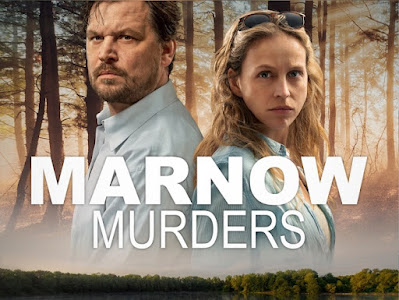
The Marnow Murders, on MHz


These bad guys represent an unholy alliance everyone can root against. Two German cops will stumble across a GDR conspiracy involving the Stasi from the East and a Big Pharma company from the West. Unfortunately, their dealings followed according to the Stasi’s code of ethics—and inevitably it was average East German citizens who paid the price. Someone wants to keep their dirty business safely buried in writer Holger Karsten Schmidt’s eight-episode The Marnow Murders, which is now streaming on MHz.

Initially, Frank Elling and Lona Mendt assumed their first victim was killed as revenge for his crimes as a pedophile, based on evidence found at the scene. Then they are called to another crime-scene with a body murdered in an identical manner. Shortly thereafter, forensics informs them all incriminating material found on the first victim’s computer was planted post-mortem. Clearly, something fishy is afoot, but a strange woman claiming to represent a group of sexual-abuse survivors offers the financially-strapped Elling a sizable bribe to bury the case.

Elling suspects there is something wrong with her, but he takes the down-payment anyway. Rather inconveniently, the shadowy cabal uses video and audio recordings of the transaction to blackmail him. Even though he was an idiot, Mendt loyally agrees to help him deal with the extortioners. However, they will have to keep everything secret from Soren Jasper, their third subordinate team member, even though Mendt has been sleeping with the younger (and very much engaged) junior cop. Meanwhile, the killer continues to pile up more bodies.

Things get extremely messy incredibly quickly in
Marnow, named for a former GDR lake resort town, which all of the victims were somehow connected to. There is also a hospital there that has long been the subject of rumors. In terms of ideology, this series is scornful of anything big, including the big business of the West, the big oppressive government of the former East, and even the big dumb bureaucracy of the cops’ provincial police district.

Elling and Mendt probably have more narrow escapes than Dexter Morgan and end up with nearly as much blood on their hands, accidentally, metaphorical, and sometimes through very direct blundering. This case is just physically and emotionally exhausting just to watch, but Schmidt masterfully manages to cook up one-gosh-darned-thing-after-another to throw at them.

As Elling, Sascha Alexander Gersak often looks like a homeless derelict on the verge of cardiac arrest, but viewers sure can believe he is the cynical screw-up of the force. Petra Schmidt-Schaller also makes Mendt quite a self-destructive hot mess. Honestly, their department needs much better psych screening, but it is highly compelling to see them work a case with such grave stakes.

Sunday, May 16, 2021

The Fox, on MHz


She was trained to do evil, but now she uses her skills to solve crimes. That is not exactly how Anna Marie Fuchs saw it, while she was blinded by her Socialist ideology, but her relationship to her former Stasi masters is definitely complicated. There is a new murder for each episode, but Fuchs keeps wrestling with the same historical baggage throughout the first season of The Fox, which premieres Tuesday on MHz.

Fuchs is somewhat unusual amongst former Stasi agents. She was both tried and acquitted of treason. Her earning power is still limited, but she keeps rejecting job offers from her former boss, Olaf Ruhleben, now the powerful president of a dodgy private security company. Suspecting (with good reason) Ruhleben was behind the abduction and forced adoption of her presumed-late son, Fuchs distrusts her old colleague, but she still keeps trying to pump him for information.

Almost by accident, Fuchs teams up with naturalized Youssef El Kilali, the husband of Simone Pabst, the pregnant proprietress of her favorite coffee shop. Suspiciously, Pabst’s wastrel brother has disappeared, following the murder of his squatter mate. The couple contracts Fuchs’ services with a decidedly low stakes deal, but she and El Kilali work so well together, they decide to open a detective agency.

Their first case with a proper retainer is a bit of a family affair. At first, they are hired by a provincial anti-development activist, but when she is murdered, her daughter maintains their services, even though the son-in-law is a leading suspect. Meanwhile, Fuchs uncovers clues that suggest her son Florian might not have died in a GDR orphanage, as she was told.

Things really come to a head in the fourth episode, when Fuchs intends to confront her ex-husband regarding their son, only to watch as he is gunned down by a mystery assassin. Their family history was about as complicated as it gets. She was assigned to spy on him, but Fuchs only recently learned she was also his snitch assignment as well. Fuchs continues to deal with family issues in the fourth episode, while a new case hits close to home for El Kalili’s family.
 Frankly, the fifth installment, a murder set within the fashion world, is a bit anticlimactic in comparison to the previous two episodes.

Each of the episodic mysteries are okay, but not remarkable. The chemistry between Lina Wendel and Karim Cherif is also pretty good, but not extraordinary. What really distinguishes the show is the murky but fascinated intrigue derived from Fuchs’ Stasi service. Clearly, the oppressive group remains a source of mystery and fear for average Germans. You really get a sense of how the crimes of the Socialist era continue corrupt and warp German society.

Sunday, June 16, 2019

Das Boot: The Series


It was a case of what went around, came around. German U-boats were notoriously feared by the Allies during World War II, but the mortality rate for U-boat crews was also perilously high. Anyone who saw Wolfgang Peterson’s Das Boot (still the record-holder for German language films when it comes to Oscar nominations and American box office) has a visceral understanding of the watery deaths resulting from submarine warfare. That might seem like an impossible film to sequelize, but German TV went back to Lothar-Gunther Buchheim’s original source novel and his follow-up, Die Festung as the basis for the eight-part sequel series treatment, directed by Andreas Prochaska. It is a new crew, but war is still an ugly, dehumanizing business in Das Boot, which starts streaming tomorrow on Hulu.

This is U-162. U-96 went to its submerged grave in the movie and U-113 joins it in Davy Jones locker during the prologue, just in case we forgot the dangers U-boat crews risked. Just as in the film, the crew of U-162 are far removed from the genocidal crimes of the National Socialist war machine, but they are definitely not heroes. In fact, their cruise will be marred by incidents of hazing, dereliction of duty, accidental maiming, accusations of cowardice, and outright insurrection.

The problem starts at the top of U-162’s command. Despite his inexperience, Klaus Hoffman will be captaining the U-boot, presumably because he is the son of a legendary naval officer. His veteran 1st Watch Officer Karl Tennstedt was already resentful to be passed over for promotion again, but Hoffman’s alleged timidity pushes him to undercut the captain among the crew. Their differing approaches will come to a head when the U-boat is assigned a secret mission, of questionable strategic value.

Meanwhile, Simone Strasser, an Alsace-German working as a civilian interpreter in the German navy’s La Rochelle base finds herself up to her neck in intrigue. Initially, she considers herself a loyal German, but her faith will be shaken after her brother Frank is summoned to serve aboard U-162 at the last minute. She subsequently learns he had agreed to trade sensitive U-boat schematics to the resistance, in exchange for forged papers for himself and the secret Jewish wife his sister never knew he had. However, things really get awkward when SS Kriminalrat Hagen Forster takes a personal and professional interest in her, while she develops a romantic attraction to British resistance firebrand, Carla Monroe.

Unlike the film, Das Boot the series spends a lot of time above water, but the submarine storyline remains dramatically superior. The rivalry between Hoffman and Tennstedt resonates on a primal level, with Rick Okon and August Wittgenstein generating considerable sparks as the antagonistic officers. Plus, things really get tense when a surprise guest, played with cool, clammy menace by Stefan Konarske, makes a surprise guest appearance on U-162 (it’s complicated).

In contrast, the energy level noticeably flags when the series cuts back to the lust and espionage in La Rochelle. Vicky Krieps’ deer-in-the-headlights portrayal of Strasser simply is not sufficiently engaging to carry her story arc. Lizzy Caplan is more interesting as the reckless and cynical Monroe, but they are never credible as a couple. However, James D’Arcy nearly saves the land-based storyline as the dashing British operative Philip Sinclair, but he arrives way too late in the series.

Das Boot the series has its merits and weaknesses, but it ends with a massively intriguing cliff-hanger that will have viewers coming back for the already announced second season, even if they have mixed feelings about the first eight episodes (as they could very well). It is not perfect, but the unnervingly claustrophobic battle scenes and the work of Konarske, Okon, and D’Arcy are definitely worth seeing. Recommended (when its underwater), for fans of military dramas, Das Boot the series premieres tomorrow (6/17) on Hulu.

Sunday, May 26, 2019

Graf at Anthology: The Invisible Girl


This provincial Bavarian town has a picturesque Medieval festival, but it is a border town, with border town kind of establishments. It is also a divided town. One faction believes young Sina Kolb really was murdered by the mentally challenged convicted of the crime, whereas the larger faction suspects he was railroaded by the cops. A recent transfer from the Berlin police department will start digging up the past when investigating a potentially related murder in Dominik Graf’s The Invisible Girl, which screens during the Graf retrospective at Anthology Film Archives.

Niklas Tanner wanted a fresh start after he was erroneously accused of acting improperly with a witness. Rather inconveniently, he immediately has a one-night stand with a woman who will factor prominently in his first case in the fictional burg of Eisenstein. It turns out Inge-Marie Kolb was Sina’s mother. She also happened to meet Eva Lorant shortly before her death. Lorant claimed to have seen the missing Sina after her presumed murder, according to the cops’ bogus timeline. Obsessed with the case, she came to Kolb again, believing she saw the grown Sina in the red-light district supermarket, where she worked.

Of course, these are exactly the sort of details senior inspector Wilhelm Michel is supposed to sweep under the carpet. He assumes the semi-disgraced Tanner will be a perfect fall guy, if need be. Granted, the Berliner might not be too smart, but he is tenacious. He will also find an ally in Joseph (with a “ph”) Altendorf, the original detective investigating the Kolb disappearance, until Michel replaced him.

For German viewers in the know, Invisible Girl probably slanders Bavarian politicians left-and-right, but for Americans coming in without baggage, it is a pretty tightly constructed little police procedural-political thriller combo. Ronald Zehrfeld (whom we hope you recognize from Christian Petzold’s masterful Barbara) is solid as Tanner, in a believably beefy, non-superhuman kind of way. Elmar Wepper also nicely grounds the film in cynical morality as the prickly, not-letting-it-go Altendorf.

Weirdly, Anja Schiffel is terrific as Michel’s right-hand lieutenant Evelin Fink, even though the sexual nature of some of her scenes with him are a little creepy and off-putting (remember, this is for German television). More appropriately, Ulrich Noethen is spectacularly slimy as the snake-like Michel.

Despite a few excesses, Invisible Girl is a highly credible mystery-thriller, with a keen sense of the Czech-Bavarian border region. It also clearly demonstrates Graf’s professionalism. If it is your stein of beer, you had better see it when it plays during the Graf retrospective. Recommended for fans of ripped-from-the-headlines crime dramas, The Invisible Girl screens Monday (5/27) and next Saturday (6/1) at Anthology Film Archives.

Saturday, May 25, 2019

Graf at Anthology: Twilight Eternal


For obvious reasons, art collections with iffy provenances acquired during the early to mid-Twentieth in Germany will arouse suspicions. Such is the case with the Magnus Dutt collection. The elderly eccentric is quite secretive regarding his holdings, but Philipp Keyser’s employers are convinced he has a rare painting only recorded in rumor and vague second-hand reports. They will retain him to acquire the painting, by hook or by crook, However, he will get more than he bargained for when he tries to get to Dutt through his artistically tempered niece in Dominik Graf’s Twilight Eternal (a.k.a. At the End of Time), which screens during the Graf retrospective at Anthology Film Archives.

Keyser is told acquiring the painting in question is a matter of justice for the firm’s client. He is not wildly concerned about such matters. For him, it is a potentially chance to return full time to the Grisham-sounding “firm.” The idea is to cozy up to his great-niece Alma, a defiantly unmarketable artist in her own right, who will then introduce him to the old man. Maybe she will and maybe she won’t. Regardless, she does not seem very put off when she learns their romance is based on mercenary motives. Their relationship might not be the healthiest, but on the other hand, these two could really be perfect for each other.

Eternal (or End of Time, or Am Abend Aller Tage) is another Graf TV movie that has garnered more than typical screenings and ancillary interest outside Germany. Most likely it is due to its wink-wink source material: the notorious case of the real-life Gurlitt Collection, as refracted through Henry James’ The Aspern Papers. It also happens to have some interesting things to say about the nature of art and its appreciation.

However, the presumed charms of Friedrrich Mucke’s Keyser are rather lost on this reviewer. Whereas Victoria Sordo’s Alma, the Miss Tina analog, is a far cry from a Plain Jane, she certainly has issues. They definitely have convincing sexual tension and dysfunctional (but still potent) chemistry together on-screen, Yet, Ernst Jacobi frequently steals the show as Dutt, whose connection to his collection runs deeper than mere investments.

Again, Graf helms with greater style than viewers usually expect from the term “TV movie.” It is more engaging intellectually than on an emotional level, but that is not necessarily a bad thing. Frankly, anyone intrigued by its literate but cynical take on the gallery business and of-the-moment contemporary art should see it during the Graf retrospective, because it probably will not be back around anytime soon. Recommended accordingly, Twilight Eternal screens today (5/25) and Wednesday (5/29), at Anthology Film Archives.

Wednesday, May 22, 2019

Graf at Anthology: Tatort—The Red Shadow


Decades after their demise, the German Red Army Faction is still generating bad karma—and crime scenes. Of course, the later is the name of the game for the long-running German police procedural television show Tatort (translation: “crime scene”). It is such an institution it periodically produces stand-alone TV movies that often tackle more ambitious subject matter. In this case, the RAF conspiracy theories garnered unusual fest play for Tatort: The Red Shadow, which screens during Anthology Film Archives’ retrospective of leading German film and TV director Dominik Graf.

For Detective Chief Superintendent Thorsten Lannert, this case will hit close to home, because he was once a terrorist-sympathizing leftist himself. It starts out like a tabloid story when Christoph Heider is arrested for trying to smuggle his ex-wife’s body to France for an autopsy. He is convinced her current lover, Wilhelm Jordan murdered her. After some cursory investigation, Lannert and his junior partner Sebastian Bootz start to suspect there might be something to Heider’s suspicions.

Jordan is definitely a creep, but he seems to be protected by a high-ranking state prosecutor and the Witness Protection service. They soon more-or-less confirm Jordan served as an informer on RAF activities. Suddenly, questions about the Baader-Meinhof gang start percolating when Jordan’s old lover, Astrid Fruhwein returns to her violent, gun-toting criminal ways. Lannert will even start to doubt the official version of the suicide of the Baader suicides.

There is a lot of conspiratorial smoke-and-mirrors in Red Shadow, which kicked up quite a fuss in German, but does not amount to much for viewers not steeped in the extremism of the “German Autumn.” Even if the FRG went a bit extracurricular on the RAF, it is hard to have sympathy for them. Just ask the families of Dr. Heinz Hillegaart, Andreas von Mirbach, Fritz Sippel (age 22), Jürgen Ponto, Dionysius de Jong (age 19), Johannes Goemanns and the dozens of other policemen, diplomats, customs officers, and U.S. servicemen the RAF murdered.

In fact, the murkiness of the conspiratorial speculation turns into a big “eh.” What works best in Red Shadow is the Law & Order-style chemistry shared by Richy Muller and Felix Klare, as Lannert and Bootz, respectively. Muller is especially watchable as the crusty Lannert. Hannes Jaenicke is also thoroughly loathsome and intensely creepy as Jordan. Regardless of your ideological convictions, he is definitely a very bad guy.

Graf conveys a sense of the overheated vibe of the German Autumn and how it continues to exert a corrosive influence several decades later. He helms with a surprising degree of flair and maintains a brisk pace throughout. It is a solid procedural outing for the warhorse franchise, but it just doesn’t add up to as much as it thinks it does. Recommended for procedural fans and conspiracy nuts, Tatort: The Red Shadow screens this Friday (5/24) and June 1st, during the Graf retrospective at Anthology Film Archives.

Tuesday, April 03, 2018

Kino! ’18: Bad Banks (series)


Jana Liekam’s new employer is too big to like. Deutsche Global is one of Germany’s largest investment banks, but they have recently been thrown off-stride by scandals and bad investments. It represents a second chance for Liekam, who might just save the bank, so she can help destroy it later in the German limited series Bad Banks (trailer here), directed by Christian Schwochow, the first two episodes of which screen during this year’s KINO!: Festival of German Films in New York.

Liekam has just been fired from Luxembourg-based Credit International for making her boss, Luc Jacoby, the chairman’s coked-up, entitled son look bad. Christelle Leblanc, the firm’s director agrees this is unfair, but cautions Liekam she must learn to play the game better. Thanks to her secret string-pulling, she gets Liekam a tryout at Deutsche Global working for their hotshot investment manager Gabriel Fenger. From time to time, Lebanc will supply Liekam with timely “insider” information, but she makes it clear she wants highly compromising information on Credit International in return.

Judging from the in media res opening, the junk bonds will eventually hit the fan in a big, panic-inducing way. Presumably, Liekam will play a major role in the meltdown. Obviously, there is a lot of intrigue building behind the scenes, but the first two episodes are relatively self-contained, thereby making a good festival showcase.

Paula Beer (so terrific in Ozon’s Frantz) is well cast as Liekam. She can be quite forceful and even cynical, but it is clear from her early breakdown, she probably has issues that will later come to the fore. Barry Atsma is also wonderfully flamboyant as Fenger, a true child of Gordon Gekko. May Duong Kieu also makes quite an impression as Thao Hoang, Liekam’s new team-member, who will either be her uneasy ally or a femme fatale rival, or something in between (just how their relationship shakes out will be one of the series’ intriguing uncertainties). Marc Limpach is a clammy mess as Jacoby the younger, but Jean Marc Barr promises plenty of steely skullduggery as Deutsche Global’s chairman, Robert Khano.

Schwochow, a veteran of both film and television, helms with style, hooking viewers right from the start. He lays a good deal of groundwork in the first two episodes, yet still manages to end each one in quite a satisfying manner. Hopefully, MHz or someone will pick up Bad Banks, because it is really smart and addictive television. Until then, the first two episodes are highly recommended when they screen this Saturday (4/7) and next Thursday (4/12), as part of KINO! 2018 in New York City.

Saturday, April 01, 2017

KINO! ’17: The Verdict

When the German Supreme Court nullified a law allowing the Luftwaffe to shoot down hijacked planes that had been weaponized, many predicted it would provide an incentive for future terrorists to do exactly that. The waters were further muddied when then Defense Minister Franz Josef Jung announced he would still probably give the order to shoot down airliners seized for terrorist purposes. He ignited a media firestorm, but it was probably prudent to increase the uncertainty amongst the al-Qaedas, Daeshes, and Hammases of the world. That uncertainty also extends to German public opinion as well, judging from the enormous ratings and social media response to Lars Kraume’s The Verdict (trailer here), a television feature adaptation of Ferdinand von Schirach’s play dramatizing exactly such an extra-legal shootdown, which screens during the 2017 KINO! festival of German Cinema in New York.

As an extra added hook, German viewers were invited to cast their vote to help determine the verdict of the Federal Republic of Germany vs. Major Lars Koch, updating the gimmick of Ayn Rand’s Broadway hit, The Night of January 16th. Most of the evidence in the case is not in dispute. A commercial airliner was indeed hijacked by Islamist terrorists (a fact conveniently confirmed by their own gloating broadcasts). They did indeed point the plane towards a football stadium packed with 70,000 fans, nearly all of whom would have likely died, had Maj. Koch not shot the plane, still carrying 164 innocent passengers and crew, out of the sky. He did so against the orders of the ranking duty officer, yet it is clear his superior was greatly relieved when Maj. Koch engaged the airliner anyway.

Perhaps it is partly due to our proximity to Ground Zero, but the moral case for Maj. Koch’s actions, 70,000 vs. 164 who are essentially doomed anyway, seems nearly impossible to question. The prosecutor’s concerns for the dignity of life denied to the hijacking victims by denying them another five minutes of terror approach the absurd. Yet, perversely, the guilty verdict scene sounds much more in accordance with German law, whereas the innocent verdict is more interesting from a dramatic perspective, but the legal rationale definitely sounds forced.

Regardless, as a courtroom drama, The Verdict is tight, tense, and often fascinating. As Maj. Koch, Florian David Fitz so adroitly balances personal anguish and moral conviction, it almost fatally tilts the film in his favor. Lars Eidinger is terrific as his sharp-tongued attorney Herr Biegler. Martina Gedeck is also quite commanding as prosecutor Nelson, almost managing to sell an argument that could just as logically support the most extreme anti-abortion prohibitions.


Hopefully, the huge ratings Verdict has scored all over Europe will spur the German government to better resolve what looks like a rather awkward constitutional and national security conundrum. To put it in colloquial American legal terms, the facts seem to be on Koch’s side and the law seems to be on Nelson’s side, but since this is a German legal proceeding, nobody resorts to cheap table-pounding. In fact, the German setting (the glass and steel courtroom, the powder blue uniforms) is rather cinematic and makes it easier to believe an officer in Koch’s position would face a very public criminal trial for his actions. It just seems like a very Euro thing to do. Highly recommended, The Verdict screens this Tuesday (4/4) as part of this year’s KINO! in New York.

Monday, June 15, 2015

Deutschland ’83: Undercover in the West, On the Wrong Side of History

It must be a weird full circle experience for an East German defector like Sylvester Groth to now play a Stasi agent, but it is a role he would understand better than most. Groth’s Walter Schweppenstette is in fact the sort of spymaster who can dislodge poor Martin Rauch’s finger with perfect casualness. As a result, the shocked East German will now have an excuse for avoiding the piano while impersonating a West German General’s new aide-de-camp. Rauch did not ask for this assignment, but he will obey as best he can during the course of Deutschland ‘83 (promo here), which premieres this Wednesday on SundanceTV.

Rauch was a loyal Communist border guard serving on the Wall Pres. Reagan will soon challenge Gorbachev to tear down. His aunt Lenora is a high-ranking Stasi strategist, who is pretty freaked out by Reagan’s “Evil Empire” speech and his decision to deploy Pershing missiles in West Germany. Rather cold-bloodedly, she picks her nephew to impersonate Moritz Stamm, an orphaned junior officer loner who will soon report for duty under Gen. Wolfgang Edel, a prominent NATO liaison. Of course, Rauch is reluctant to leave his almost-fiancée Annett and his ailing mother Ingrid, but Lenora promises to arrange a transplant for her if he agrees, not that he has a choice.

The first two episodes of D83 screened at the Berlin Film Festival and they hang together as an initial arc pretty well. We can see perhaps hints of doubt being sown when Rauch, the ardent Marxist first encounters a western supermarket. His superiors and colleagues are not exactly the reassuring types either, especially Aunt Lenora. However, it might be the freedom exercised by young West Germans that ultimately shakes Rauch’s convictions. After all, the peacenik chart-topper “99 Luftballoons” is a constant presence throughout the first two episodes.

As Lenora Rauch, Maria Schrader could well surpass Kevin Spacey’s Frank Underwood for stone cold Machiavellian villainy. Right from the start, she makes the show. Jonas Nay also shows promise as Rauch/Stamm, convincingly portraying his early overwhelmed naivety, while hinting at the resourcefulness and moral confliction to come. As Schweppenstette, Groth (best known for playing Goebbels not once, but twice in Inglorious Basterds and My Fuhrer) appropriately exudes malevolence and Ulrich Noethen quickly establishes Gen. Edel’s contradictory human dimensions. Unfortunately, Errol Trotman-Harewood seems to be trying for the cringiest ugly American stereotypes as blustery Gen. Arnold Jackson.

The period details of D83 are spot on, extending far beyond the music. Even in the early going, helmer Edward Berger keeps it tight and tense. The limited series also boasts a wealth of memorable performances from smaller but key supporting players, such as Lena Lauzemis as Rauch’s shadowy hotel contact. However, it is unclear how writer-co-creator Anna Winger will ultimately treat Pres. Reagan. There do seem to be indications we are supposed to sympathize with the resistance to his Pershing deployment. Still, there is no denying he shook things up.

Overall, Deutschland ’83 shows considerable potential judging from the first two episodes. It must be the first German programming to air directly in America since the History Channel broadcast Dresden so it is nice to see SundanceTV taking chances. Espionage fans should be advised, it commences this Wednesday (6/17) on SundanceTV.

Monday, January 13, 2014

Generation War: Remembrance and Disillusionment

They would have been Germany’s best and brightest.  Instead, a generation of future leaders was ground-up and consumed by the National Socialist war machine.  It was not a war of their making, but they bought in nonetheless.  Like the rest of their contemporaries, five friends expect it all to end quickly, so they vow to reunite in Berlin for Christmas.  Of course, WWII will turn out to be much more protracted, painful, and futile than anyone bargains for in Philipp Kadelbach & Stefan Kolditz’s Generation War (trailer here), a popular but controversial German television mini-series, which screens theatrically in its entirety, starting this Wednesday at Film Forum.

Lt. Wilhelm Winter has already had a taste of war, returning home decorated. His disappointing brother Friedhelm is not cut from the same soldier cloth.  Unfortunately, the younger Winter’s skepticism regarding the war will be vindicated in spades. Before they leave for the Eastern Front, both brothers will spend a final evening with their three closest friends. 

Charlotte (or “Charlie”) will also soon leave for the east to serve as a Red Cross nurse, but she is ill prepared to face the grisliness of war, even during the optimistic early months.  She not so secretly carries of torch for Wilhelm Winter, but has never found the right moment to confess her ardor.  Lt. Winter shares her feelings, but refuses to act on them, believing it would be unfair to her should he fall in battle.  In contrast, Gretta Müller and Viktor Goldstein are clearly an item, but they try to keep their affair secret outside their small band of friends.  After all, Goldstein is Jewish and Mueller is an aspiring torch singer.

Obviously, all five friends are in serious denial regarding the National Socialist’s racial policies, especially Goldstein.  Unfortunately, reality will become inescapable. For mercenary reasons, Müller, now known as Greta DelTorres also takes up with Dorn, a senior SS officer who guides her career as a Reich approved songstress.  He also promises to arrange safe passage for Goldstein out of the country, but that is not how the SS dealt with romantic rivals.  Instead, Goldstein heads east as well, under radically different circumstances.

Screening in two separate parts totally 319 minutes, Generation is a five headed epic that encompasses roughly five years of tumultuous history. Yet, despite all its characters’ regret and longing, it is hardly a romance in the Doctor Zhivago tradition. First and foremost, it is a gritty war movie, emphasizing naturalistic misery over Saving Private Ryan style spectacle. It certainly makes the Eastern Front look like the colossally bad idea it was.  Tellingly, during the first half, each shift in location is identified by its distance from Moscow, while Berlin becomes the reference point for the second half.

Of course, from an American perspective, the Eastern Front is a convenient location, because none of the primary characters ever fires a shot at a Yankee GI. To their credit, director Kolditz and screenwriter Kadelbach (who also wrote the Dresden miniseries, which is worth revisiting in conjunction with Generation) deal forthrightly with National Socialist war crimes.  They never take viewers all the way inside a concentration camp, but they spend time in the trains transporting prisoners there.  When the Soviets appear, it is rarely flattering.  However, the portrayal of the Polish Home Army is sometimes questionable, never showing the extent to which they were targeted by Stalin’s forces.

Regardless, Generation is significant for the extent it engages with complicity of Germans of diverse social positions in the crimes of the Third Reich (far more so than Dresden).  This is considerably closer to a 12 Years a Slave soul search than a whitewash. Terrible things happen during the course of the film for reasons of ideological intolerance and cruelty.

Still, it is also an engaging narrative that balances the circle of friends remarkable well. The five principles completely pull viewers in, convincing even the most resistant to invest in their characters.  As Wilhelm Winter (who also serves as narrator), Volker Bruch is arguably the strongest of the ensemble due to the commanding presence and anguished conscience he projects. Tom Shilling nicely plays with and against him as the resentful younger Winter. 

Initially, Katharina Schüttler and Miriam Stein seem comparatively light weight as Müller and Nurse Charlie, respectively, but they each have surprisingly powerful moments of disillusionment and emotional defeat throughout part two.  Ludwig Trepte slow burns well enough as the naturally withdrawn Goldstein, but Aline Levshin is downright bracing as the Polish fugitive he forms an alliance with.

As befitting a sweeping saga, there are plenty of coincidences and near misses in Generation, but they never feel forced.  Throughout, Kadelbach and Kolditz maintain their focus on the war and its dire consequences for the five friends, as well as the wider society.  It is a completely involving military drama that trots along briskly.  However, Film Forum’s two-for-one admissions for parts one and two can conveniently be applied to different screening dates.  Highly recommended, Generation War opens this Wednesday (1/15) in New York.

Wednesday, April 25, 2012

Kino! ’12: The Man with the Bassoon


How did an Austrian wearing a bathrobe conquer Germany?  It had something to do with a Russian bassoon player.  Based on crooner Udo Jürgens’ hybrid memoir-family saga novel, Miguel Alexandre’s two-part mini-series The Man with the Bassoon (trailer here) screens in its entirety tomorrow at MoMA as part of Kino!, their annual celebration of contemporary German cinema.

After completing the expected encore in his traditional white bathrobe, modern day Jürgens (playing himself) receives word from Moscow.  A long lost family retainer has a significant heirloom he wishes to return to Jürgens.  It is a statue of a man playing a bassoon.  Thus begins the first of many flashes.

Jürgens’ grandfather Heinrich Bockelmann decides to immigrate to Russia after hearing the beautiful lamenting Russian melodies of street musician.  Amassing great wealth as the Czar’s family banker, Bockelmann credits his success to that bassoon player.  For their anniversary, his wife gives him a statuette of the bassoon player, which quickly becomes the guardian of the family’s good fortune.  However, dark clouds are on the horizon.  With socialist revolutionaries campaigning against the German economic elite, the Czarist government dispossesses and imprisons Bockelmann and his aristocratic countrymen, soon after Russia’s entry into WWI.

Escaping Russia with their children, Bockelmann’s wife eventually re-establishes the family dynasty in Austria.  As viewers know from several flashbacks, Bockelmann’s son Rudi eventually becomes a provincial burgomaster and National Socialist Party member.  Yet, as the war drags on, Rudi Bockelmann runs afoul of his more zealous colleagues.  We know he will survive though, because in yet another flashback story-arc, we see Rudi Bockelmann is the only member of the elite Austrian family to encourage his aimless son Udo to pursue his musical ambitions.

Spanning over one hundred years, Bassoon is definitely an epic don’t-make-them-like-they-used-to miniseries.  While many consider the boundary fact and fiction therein to be somewhat porous, the bassoon must be true.  Anyone making this story up would have chosen a different instrument.  Though the Bockelmann family’s dark days are mostly caused by the Nazis and the Czarists, the depiction of the xenophobic and anti-Semitic Russian revolutionary factions is also an intriguing footnote within the Bassoon.  In fact, the historical episodes featuring Jürgens’ father and grandfather are considerably stronger than his own raise-to-fame story.  Frankly, a lot of viewers will want to see Jürgens (as he comes to be known) suffer more for his art.

Still, Jürgens’ music may surprise some viewers.  His rendition of “There Will Never Be Another You” heard several times in Bassoon swings politely enough.  Starting very squarely in a jazz bag, he became something like a cross between Sinatra and Czech vocalist Karel Gott (if that name means anything to you).  Although he never really caught on here, he had his admirers, including Sammy Davis, Jr., who covered a few of his tunes.

Jürgens is also sufficiently convincing playing himself, but Christian Berkel carries the heaviest load as the Bockelmann patriarch, Heinrich.  Fittingly, he somewhat resembles miniseries king Richard Chamberlain, aging decades while exuding an aura of integrity. In contrast, David Rott is a rather weak screen presence as the young Jürgens on the brink of superstardom.

A large-scale, richly detailed period production, Bassoon covers quite a bit of ground.  Anyone at all intrigued by Jürgens’ sweeping family story should definitely watch it at MoMA, because it is hard to imagine there will be lot of opportunities catch up with it in the future.  Both parts one and two screen back-to-back tomorrow (4/26), with Jürgens and Alexandre appearing afterward for a session of Q&A, as well as this Saturday (4/28), as part of this year’s Kino! at MoMA.

Monday, September 26, 2011

NYFF ’11: Dreileben

There is a fugitive in the woods. He might be an innocent man or a dangerous psychopath. Determining the truth is a tricky proposition in Dreileben, a trilogy of interlocking films produced for German television in the tradition of Red Riding, which screens in its entirety this coming Saturday as part of the 49th New York Film Festival.

Christian Petzold’s Beats Being Dead, begins the cycle, but keeps most of the crime drama off-screen. While visiting his dying mother in hospital, the convicted murderer Molesch essentially walks away from his police guard. A manhunt ensues. To shield him from inquiries, Dr. Drier gives some time off to Johannes, the nursing intern on duty that fateful night. It allows the pre-med student time to pursue a passionate in-the-moment romance with the tempestuous Ana, a Bosnian refugee working as a maid in the hotel that will eventually factor into the police investigation. He might even forget Sarah Drier, the head doctor’s daughter, who dumped Johannes in no uncertain terms.

Petzold’s Dead and Dominik Graf’s subsequent Don’t Follow Me Around are like some of Claude Chabrol’s craftier late films, presenting the nefarious business obliquely, while ostensibly focusing on the workaday lives of those seemingly on its margins. Yet, Petzold creates a palpable undercurrent of menace that carries over for his filmmaker colleagues. He also presents an unusually dark and intense vision of young love (or lust) that sometimes borders on the unsettling.

Luna Mijovic burns up the screen as Ana, viscerally projecting her raw self-destructive impulses and insecurities. Jacob Matschenz is also quite effective keeping the audience off-balance as the everyman Johannes, while Vijessna Ferkic is appropriately hot and shallow as Sarah Drier. Indeed, not only is Dead the strongest film of the trilogy, it also (quite conveniently) stands alone better than its companion films.

Still, for those willing to buy into Dreileben, Graf’s Follow is also quite clever, nicely explaining a few of the confusing moments in Dead. Johanna is a single-mother police psychologist in the tradition of the old Profiler show, sent to help the corrupt and incompetent local constabulary capture Molesch. Yet, she is considerably more interested in revisiting some important episodes from her past with her old friend Vera, with whom she is staying. We also briefly meet Marcus Kreil, the one competent copper who will be featured prominently in the final film.

While Graf shows bits and pieces of the investigative process, he keeps the mood lighter, centering his film on themes of friendship and family more often encountered in women’s fiction than police procedurals. Though the tonal ringer of the trilogy, it still keeps viewers intrigued in the macro story.

Though arguably the most visually stylish of the three, Christoph Hochhäusler’s One Minute of Darkness unfortunately fails to tie everything together, leaving a rat’s nest of loose ends unresolved, even adding several of its own. Molesch finally comes front-and-center, but in a way this is a mistake. Granted, it is something of a pay-off to finally understand his escape and strange sojourn through Ana’s hotel. Yet, as evidently something of a man-child, Molesch is better represented as the wolf in the woods than a figure we come to know on intimate terms. To be fair though, Stefan Kurt nicely conveys the ambiguity of his character keeping open the possibility Molesch may either be a naïf or a maniac.

Darkness works best when focusing on Kreil, played with haggard gravitas by Eberhard Kirchberg. In addition to juggling family issues (like Johanna), the honest copper is responsible for some of Dreileben’s smartest police work, more of which would have strengthened Darkness.

Like Red Riding, Carlos, Mesrine, and Mysteries of Lisbon, Dreileben is the sort of sprawling canvas worth spending time with, just to appreciate its ambition. Naturally somewhat uneven as the product of three directors, Dreileben also peaks with its first film. Yet, there is something insidiously compelling about this shared world, like a more grounded German Twin Peaks, that holds true for all three installments.

If festival patrons only see one part of Dreileben, it should be Petzold’s film. If time and interest allow for two, Follow is readily recommended as well. Though the concluding Darkness is a bit of a letdown, it is ultimately worth seeing for Kirchberg’s work and the partial closure it provides. Altogether, it is a genuine screening event and one of the highlights of the 2011 New York Film Festival. The full trilogy screens this coming Saturday (10/1) at the Walter Reade Theater, while the constituent parts screen on successive nights the following Tuesday through Thursday (10/4/10/6) at the Francesca Beale Theater.