Showing posts with label Jeremy Irons. Show all posts

Saturday, March 21, 2026

The Count of Monte Cristo, on PBS

Many people say living well is the best revenge. Edmond Dantes is not one of them. That is too bad for him, because he could live quite nicely on his newfound fortune. It is also too bad for the three French rats who did him dirty. Dantes will have his revenge, served as cold as possible. Unlike the recent French film, series director Billie August and adaptation co-writers Sandro Petraglia & Greg Latter lean more into the novel’s tragedy than its swashbuckling throughout the eight episodes of the new The Count of Monte Cristo, which premieres tomorrow night on PBS.

Dantes is blessed with a beautiful fiancée, Mercedes Herrera, and a supporting boss, Pierre Morel, the owner of his merchant vessel. Unfortunately, he is also cursed with two scummy rivals. Fernand Mondego, the future Count de Morcerf, covets Herrera’s hand in marriage, while Danglars resents Morel promoting Dantes above him. Out of spite, they falsely denounce Dantes as a Bonapartist agent. Initially, the local prosecutor, Gerard Villefort sees through their deception. However, he consigns innocent Dantes to the notorious Chateau d’If prison to coverup his late captain’s involvement Villefort’s Bonapartist father.

During his fifteen years of confinement, Dantes is erroneously reported dead to the outside world. Subsequently, Herrera reluctantly marries Mondego, who ascends to the French senate after a checkered military career. Danglars also finds wealth and a title in Parisian finance, while Villefort becomes one of the top national prosecutors.

Dantes also stays busy, befriending the heretical Abbe Faria, who schools the sailor on all the social graces a proper gentleman should know, as they painstakingly prepare their escape. He also informs Dantes of the location of a fabulous cache of secret treasure hidden on the uninhabited isle of Monte Cristo.

Petraglia and Latter follow Dumas reasonably closely, but their adaptation takes explicit inspiration from the Chinese proverb: “those who seek revenge, should first dig two graves.” In fact, they paraphrase it on multiple occasions. Not surprisingly, that gives this
Monte Cristo a distinctly dark hue.

Unlike Pierre Niney in the recent French film, Sam Claflin never crosses swords with any of his sworn enemies. However, he broods harder than a diamond. Weirdly, the tall, bearded Claflin also bears an ironically distracting resemblance to Joel McHale. However, the facial hair helps explain why nobody recognizes Dantes, at least to an extent.

Regardless, you have to respect the sheer seething bile Claflin projects throughout the series. Michele Riondino and Lino Guanciale are also both roguishly charismatic as Dantes’ allies, Jacopo the fisherman and Vampa, the former bandit. Plus, the great Jeremy Irons perfectly personifies the Abbe’s learned fatalism.

Friday, December 31, 2021

Schwochow’s Munich: The Edge of War

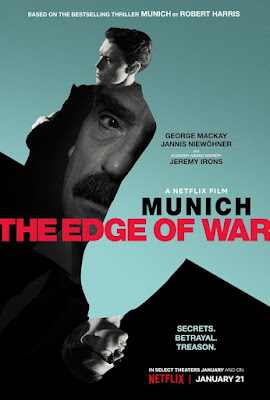
If we let the CCP blatantly violate the Sino-British Joint Declaration, openly turn Hong Kong into a police state, and engage in hostile militarism throughout the South China Sea, maybe they will be satisfied and start acting nice. After all, appeasement was a smashing success when Hitler was given the Sudetenland, right? Actually, it was Neville Chamberlain’s agreement that gave appeasement the bad name it deserves. Young British foreign office bureaucrat Hugh Legat sees that infamous history unfold as an aide to Chamberlain in Christian Schwochow’s Munich: The Edge of War, based on Robert Harris’s novel, which opens today in New York, in advance of its January 21st premiere on Netflix.

Initially, Legat is more concerned with helping Chamberlain prevent a European war than resolving the Cold War brewing between him and his wife. It is really bad timing when he is attached to the Prime Minister’s Munich delegation and also quite a surprise. It turns out Paul von Hartman, a German government interpreter, pulled some strings with his military contacts to request Legat’s presence. They were friends at Oxford, but had a falling out over Hitler. At the time, von Hartman was an enthusiastic supporter, but now that he knows the Fuhrer’s true intentions, he is profoundly alarmed.

Von Hartman believes elements in the military will turn against Hitler Valkyrie-style if the British hold firm on their commitments to Czechoslovakia. He also has a damning document that spells out Hitler’s expansionist military plans in detail. He needs Legat to help him convince Chamberlain, but even if his old friend agrees to help, it is highly questionable whether the war-averse PM will listen.

Ben Powers’ adaptation of Harris is a really smart thriller of espionage, politics, and bureaucratic in-fighting. However, some of its implications are highly debatable.
Mild Spoiler: Edge ultimately presents an extremely revisionist defense of Chamberlain, arguing he bought time with his non-agreement for England to rebuild its military. Yet, on the other hand, it also posits a potential resistance to Hitler that was undercut by Chamberlain’s appeasement and obliquely implies Hitler’s also needed time to steel the resolve of the German people.

In any event, Schwochow (who has previously helmed sensitive historical dramas, like
The German Lesson, West, and The Tower) mines a good deal of suspense from the brainy material and maintains even more tension regarding the fates of Legat and von Hartman. George Mackay and Jannis Niewohner nicely humanize the cerebral main characters and portray their complicated friendship with surprising poignancy down the stretch.

Friday, April 22, 2016

Tribeca ’16: High-Rise

Architecture is often destiny. Take for instance Ralph Rapson’s explicitly utopian project, Cedar Square West (now called Riverside Plaza) in Minneapolis. It was conceived to house city residents across the entire economic spectrum (Mary Richards moved on up to the building in the final two seasons of The Mary Tyler Moore Show), but as CSW developed maintenance problems, it became exclusively low income housing, marked by decidedly short-term residencies (suggesting people move out as soon as they can afford to). The imposing complex designed by Anthony Royal is sort of the British retro-Brutalist leftist dystopian version of Cedar Square West. Despite its initial prestige, Royal’s building is even less livable for tenants in Ben Wheatley’s J.G. Ballard adaptation, High-Rise (trailer here), which screens during this year’s Tribeca Film Festival.

As he looks back on his relatively short time as a High-Rise resident, Dr. Robert Laing grills up a leg of one of the last formerly surviving pet canines, so we know he is a survivor. Moving into the building is quite a coup at the time. The fact that the terrace of attractive single mother Charlotte Melville overlooks his own is a nice bonus. He quickly recognizes her status as the alpha queen of the middle floors’ social scene.

Rather surprisingly, Laing is summoned to the penthouse for a personal welcome from Royal. Even though Melville’s hedonistic bashes look like much more fun than the Versailles-style shindigs thrown by Royal’s wife, Laing craves acceptance from the upper floors. However, the ruthless Pangbourne and his claque keep kicking the doctor back down to where he belongs. Meanwhile, documentarian and lower floor resident Richard Wilder craves Melville, but she will never willingly lower herself to his level. Her rejection will partly fuel the rage that transforms him into a class warrior—and a rapist. (Names are also destiny in the High-Rise.)

As any sort of coherent ideological, socio-economic satire, Wheatley’s High-Rise is a complete mess. Unfortunately, every departure from Ballard’s source novel (and its themes of tribalism and over-crowding) muddles the narrative rather than simplifying it. What was conceived more as a Malthusian parable Wheatley tries to fit into a Marxian box, but it simply does not fit. In fact, he largely loses control of the film’s political implications.

Let’s be frank, there is no capitalism going on in High-Rise. Instead, it is the very model of a modern major socialist state. Inside the building, the distribution of resources is rigidly controlled by the paternalistic Royal. It is a closed system that breeds dependency. As far as we know, there is no reason residents could not shop outside the building, yet they resort to eating dogs when the social order breaks down.

Arguably, High-Rise better illustrates the Burkean defense of class structure as a necessary bulwark against anarchy, causing the lower classes to suffer just as much as the rich, if not more so. Perhaps realizing the disconnect, Wheatley tacks on a risibly didactic epilogue featuring the audio of Margaret Thatcher speaking on the benefits of capitalism while his roving camera takes in the wreckage wrought by the preceding bedlam, but it makes no sense considering the events in question still take place in the 1975 of Ballard’s novel, four years before the green grocer’s daughter dispatched the ineffectual James Callaghan.

In some ways, High-Rise’s merits perversely work against it, particularly Jeremy Iron’s wry, multi-dimensional performance as Royal, which manages to humanize the very tippy-top of the one percent. Similarly, Luke Evans brings brutish menace to bear as Wilder, the Che-like Wilder. Tom Hiddleston’s Laing is fittingly passive, but much like Equals, the real star of High-Rise are the striking concrete and steel architectural backdrops, incorporating the work of production designer Mark Tildesley’s team and the era-appropriate locations, most notably including the Bangor Leisure Centre. It truly looks like a building that will have maintenance issues.

Ultimately, the internal logic of High-Rise is thinner than its characterization. Wheatley and screenwriter Amy Jump give absolutely no explanation why the more vulnerable residents do not simply leave the building’s chaos, presumably hoping viewers will fill in the holes with their pre-existing familiarity with Ballard’s novel. This is a rather sketchy filmmaking strategy that is reflected in the haphazard final product. Not recommended, High-Rise screens again today (4/22) at the 2016 Tribeca Film Festival and also April 30th at the San Francisco International Film Festival.

Sunday, April 17, 2016

Tribeca ’16: The Man Who Knew Infinity

In retrospect, it is rather ironic some of Indian mathematician Srinivasa Ramanujan best known work involved the area of number theory known as partitions. Of course, during his lifetime, the subcontinent remained whole and largely under British governance. That is why Ramanujan’s supporters eagerly encouraged his study at Cambridge, hoping his prestige would inspire Indians and generate greater national respect from the British. Ramanujan’s Cambridge years and his relationship with mentor G.H. Hardy are chronicled in Matt Brown’s The Man Who Knew Infinity (trailer here), which screens during the 2016 Tribeca Film Festival.

Ramanujan was of Brahmin caste, but he still came from mean circumstances. Despite his mind for figures, the self-taught prodigy remained unemployed, forcing him to live apart from his young arranged bride. While scuffling, Ramanujan filled several notebooks with radical, game-changing equations. However, Ramanujan was not so keen on the plug-and-chug work of proofs. They seemed so unnecessary to him, because it was all so obvious. This inevitably leads to friction with his patron, Hardy.

How can you not appreciate a film in which Ramanujan, Hardy, J.E. Littlewood, and Bertrand Russell are allotted considerable screen time? Brown’s adaptation of Robert Kanigel’s surprise hit biography manages to shoehorn a good deal of real Ramanujanalia, including the “cab number” business. Unfortunately, Brown’s narrative arc touches every predictable base, most definitely including the resistance Ramanujan faces from Hardy’s ridiculously racist colleagues. They might have felt that way, but it is hard to imagine Cambridge mathematicians expressing themselves in such crude terms, even in the 1910’s.

As you would expect from the star of The Last Airbender, Dev Patel is solid enough as the sniffling, consumptive Ramanujan. Not so surprisingly, Jeremy Irons essentially commandeers the film as Hardy. He is one of the best in the business and the prickly but sentimental-on-the-inside Hardy is totally in his wheel house. Toby Jones has some nice scenes humanizing the film as Littlewood (who is the only Cambridge faculty member we see serving during WWI). Devika Bhise is also rather touching as Ramanujan’s long-suffering wife Srimathi Janaki, but Sir Francis Spring is exactly the sort of silly upper-class buffoon cameos that are turning Stephen Fry into a caricature of himself.

Infinity is a sturdy, respectable film, but it never takes chances or ventures outside viewers’ biopic comfort zones. Even if you know nothing about Ramanujan or Hardy, you will predict every step of the film. Still, it should be happily conceded Irons rocks Hardy, especially in the third act. Recommended on balance, The Man Who Knew Infinity screens again tonight (4/17), as part of this year’s Tribeca.

Sunday, September 15, 2013

Hollow Crown: Shakespeare’s Henriad

The House of Plantagenet had a good run, but their dynasty would not last forever.  You can blame Richard II.  His fall and the rise of his Lancaster cousins provided ample inspiration for Shakespeare’s three king-four play cycle known as the Henriad.  Executive producer Sam Mendes and three of Britain’s leading stage directors adapted the Richard and Henry plays for television as The Hollow Crown (promo here), which premieres on PBS this Friday as part of the current season of Great Performances.

Richard II begins with the title monarch on the throne, but that may soon change.  Callous and erratic, Richard is a sad excuse for king.  Nonetheless, the nobility has maintained their loyalty.  Richard’s own actions will drive many lords into rebellion, starting with the precipitous banishment of Henry Bolingbroke.  When the King confiscates the estate of his late uncle, Bolingbroke’s father, John of Gaunt, he pushes the Earl of Northumberland and his associates into rebellious conspiracy.

A bit of a slow starter, Richard II might be the weakest link of the Crown.  However, it exceeds viewer expectations for one of the marquee Henriad highlights, when Patrick Stewart knocks John of Gaunt’s “This England” soliloquy out of the park.  The stout Rory Kinnear and David Morrissey also bring an appropriately Shakespearean physicality to Bolingbroke and Northumberland, respectively.  Unfortunately, Ben Whishaw’s sickly, petulant presence poorly serves the villainous Richard.  Even more problematic is Richard II director Rupert Goold’s depiction of the deposed tyrant through Christ-like imagery.

Bolingbroke is now Henry IV, but he plays more of a supporting role in the two plays that bear his name: Henry IV Parts 1 and 2.  The King has an heir to succeed him, but has little confidence in the free-spirited Prince Hal.  The future Henry V would rather carouse with the disreputable Sir John Falstaff than worry about affairs of state.

Succeeding Kinnear as Henry IV, Jeremy Irons gives one of his best performances in years, acutely conveying the burdens of guilt, command, and fatherhood.  Likewise, Tom Hiddleston relishes the roguishness of Prince Hal, while also convincingly growing in stature once Henry V ascends the throne.  As director of both parts of Henry IV, Richard Eyre makes amends for misfiring with The Other Man.  He seems to love Falstaff even more than Welles did, but Simon Russell Beale looks so haggard and dissipated as the jolly fellow, viewers will fear he might keel over, well before his character’s spirit is broken.

Renouncing his wild past, Henry V turns his attention towards France in the Henriad’s conclusion, which should particularly interest Francophiles because of the presence of Lambert Wilson as the King of France and Mélanie Thierry as his daughter, Princess Katherine.  Hiddleston’s courtship scene with Thierry has considerable charm, but Henry V director Thea Sharrock strangely underplays the St. Crispin’s Day speech, perhaps hoping to avoid comparison with Branagh’s rendition.

Shot on some notably picturesque locations, Hollow Crown opens up Shakespeare quite cinematically.  While there is a considerable editorial hand at work, the language is never dumbed down.  It is a smart way to present the Bard on television, with discrete productions that still have the continuity of a mini-series.  The all-star cast should be of particular interest to fans of Downton Abbey (due to the too briefly seen Michelle Dockery and Glen).  It is a great looking period piece, buttressed by a number of fine performances.  Recommended for patrons of classical theater and fans of British television, The Hollow begins this Friday (9/20) and continues for the next three Fridays on most PBS outlets nationwide.