This titular teenaged girl is a budding Dr. Frankenstein of botany. She has a talent
for splicing together partially sentient plant-things. Apparently, that is a
good thing, because her post-apocalyptic world is not dangerous enough already.
Unfortunately, the world-building is solely concerned with visuals and has no
regard for logic in Kristina Buozyte & Bruno Samper’s Vesper, which
opens this Friday in New York.
In
the dystopian future, people no longer act out of logical motives or
incentives. They just behave the way screenwriters need them to. The elites in
the mega-city “citadels” are going to be evil and Vesper, the plucky
bio-engineering teen caring for her paralyzed father Darius, will be impossibly
noble. He lost his mobility while serving in the Citadel’s army, so they fitted
him out with a hovering drone to serve as his real-world avatar—and then cut
him loose.
Father
and daughter live in the no man’s land surrounding the Citadel. They even spurned
the grubby survivalist community led by Vesper’s gangster-like uncle Jonas, but
they are still forced to trade with him for the bacteria that powers her father’s
life-support system. Vesper hopes deliverance might finally be at-hand when she
gives shelter to a Citadel resident who crashed in the wasteland. She hopes her
talents for bio-engineering will earn her a place in the mega-city, with a
referral from Camelia. However, it quickly becomes clear the mysterious woman
is in fact not the potentially helpful power-broker she made herself out to be.
Vesper
is
an amazing looking film, but the social systems it posits are simplistic at
best. Why would the Citadel create these revolutionary potent seeds and then
just keep them locked up, awaiting a dissident to steal them? What exactly is
their end game? Being mean is not a sufficient answer. Yet, Buozyte and Samper
clearly expect critics will reflexively accept and praise their crude class warfare,
which has indeed been the case so far.
In
a way, those awesome visuals are a bit of a tease, because we only see those
striking behemoths featured on the poster from a distance and therefore are
never allowed to explore their mysteries. Weirdly, there is also a crazy cult
compulsively stacking objects, sort of like the zombies in Cell, but you
have to admit lifting from one of the least prestigious Stephen King movies is
an unconventionally original proposition.
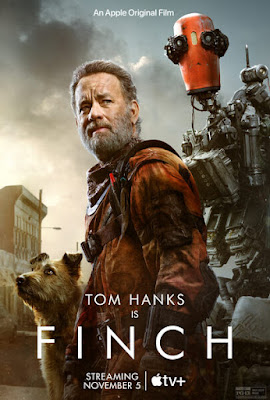
In the not too distant future, next Sunday A.D. There was a man named Finch
Weinberg, not so different from you and me. To keep his sanity, he built some
robot friends, but they never got to riff on any cheesy movies, even though Jeff,
his newest invention, shares similar coloring with Crow T. Robot. Instead, they
are preoccupied with survival—that of Finch and his dog Goodyear—in Miguel
Sapochnik’s post-apocalyptic Finch, which premieres today on Apple TV+.
The
world is pretty much over and only a few survivors like Weinberg remain holed
up in their hiding places. In his soul-scarring experience, nobody works
together anymore. Weinberg’s scientific background has served him well,
allowing him to hole-up in a power plant he manages to keep in limited
operation. Unfortunately, his health is deteriorating, so he created Jeff to
help him care for Goodyear. His service drone Dewey just does not have
sufficient functionality.
Not
long after he is powered up, Jeff helps Weinberg detect an incoming mega-storm.
They must flee the entire Midwest region, so Weinberg decides to head towards
San Francisco, for sentimental reasons, even though he has never left St. Louis
before. Thus begins a road trip across the desolate wasteland ravaged by the
vague cosmic disaster that is never fully spelled out. For Jeff there will be
growing pains, but even crusty Weinberg will learn late life lessons too.
Craig
Luck & Ivor Powell’s screenplay definitely leans into sentimentality, but
the ever-reliable Tom Hanks bails out the film’s more indulgent moments with
his haunted and world-weary performance as Weinberg. The comparisons with Castaway
are obvious, but we come to understand he retreated to his own island long
before Armageddon came crashing down. It is a smartly calibrated performance
and Hanks truly looks gaunt and grizzled—you almost have to wonder if he shot
the film while he was recovering from Covid.