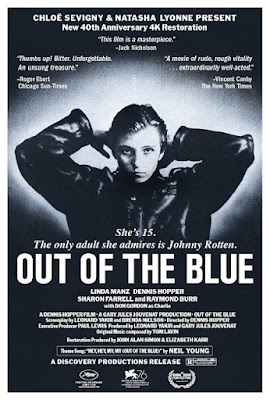
Cindy “CeBe” Barnes is a hard kid to love, but frankly, she is her parents’ daughter. She pines for the parole of her former trucker father Don, who is doing time for an accident with a school bus—or at least she pretends she does. Meanwhile, her waitress mother Kathy is openly seeing her boss at the diner, while trying to cover up her drug addiction. Embracing her alienation, CeBe styles herself as a punker, but she still loves Elvis. On the other hand, she hates disco with a passion, as she explains to other truckers on the CB radio of her father’s wrecked truck.
Her father is due to be released soon, but rather than settling CeBe down, she seems to be acting out more than ever. In fact, she runs away to Vancouver, diving into the punk scene, where she inevitable runs into trouble with the law. Dr. Brean, her court appointed counselor would like to help, but she refuses to cooperate.
Had Out of the Blue premiered six or seven years later at Sundance, it could have scored a boffo Miramax distro-deal. Watching it now, it is easy to see it as an early forerunner to the films of Larry Clark and Harmony Korine. This is a very personal and uncompromising film. In fact, Hopper spares us absolutely nothing in the extraordinarily disturbing third act.
Of course, Blue (as rewritten by Hopper) is a perfect vehicle for his persona. As Don Barnes, he seethes with rage, but also projects all kinds of pain and contrition. In a way, the deeply flawed trucker could be a missing link connecting the characters he would later play in Blue Velvet and Hoosiers. At the time, Linda Manz generated most of the film’s buzz at Cannes with her uncomfortably frank performance as CeBe. She is terrific, but like the film itself, she largely disappeared from the public eye, after her career got off to a quick start in Days of Heaven and The Wanderers.
