Showing posts with label Shia LaBeouf. Show all posts

Thursday, June 01, 2023

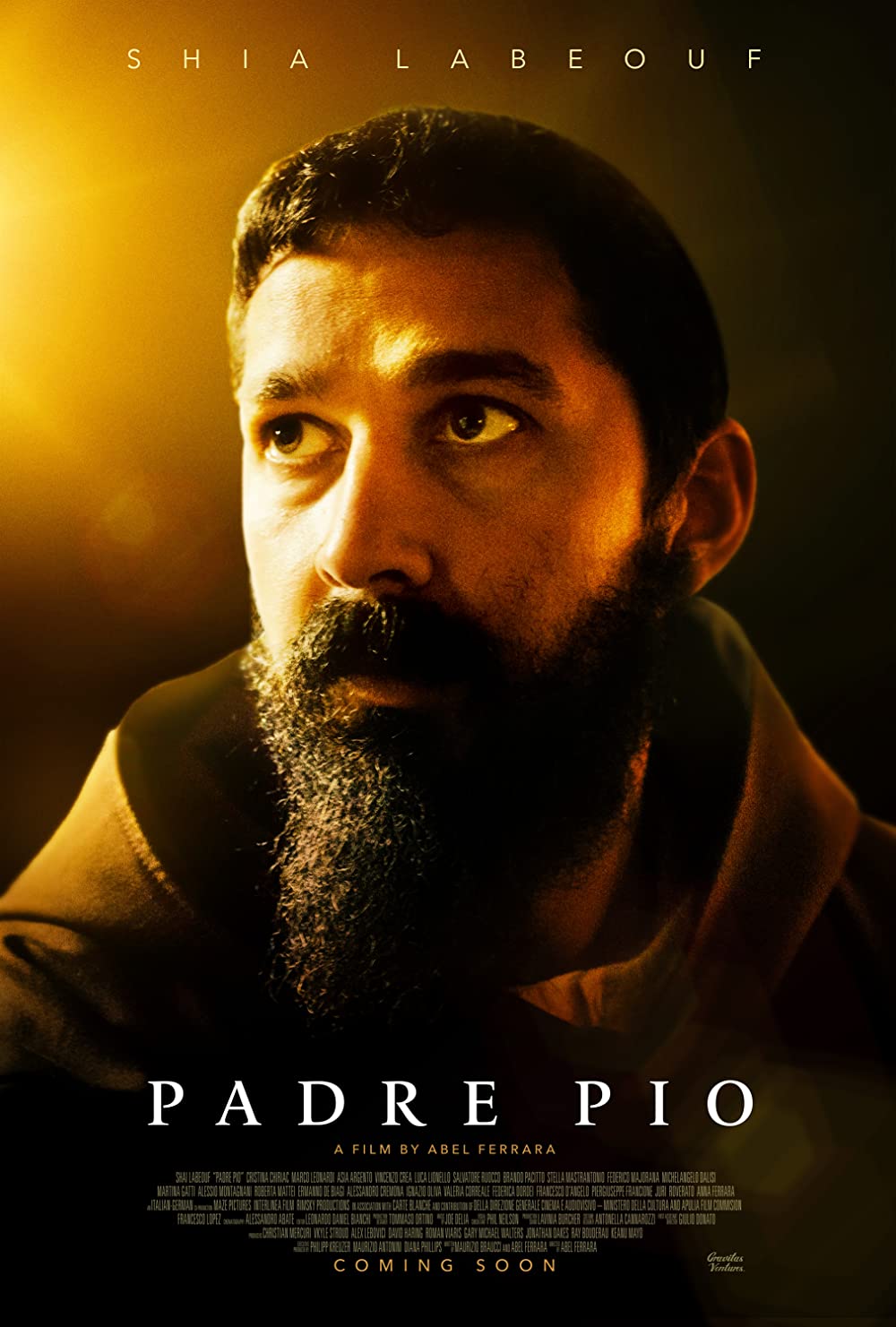
Abel Ferrara’s Padre Pio

According to reports, Padre Pio (a.k.a. St. Pio of Pietrelcina) exhibited the stigmata, healed the sick, bi-located, and faced multiple investigations from the Vatican that were intended to discredit him. However, none of those things are in this film, because why would they interest Abel Ferrara? Instead, viewers will witness many of the future saint’s long dark nights of the soul. If you thought he was tortured and tormented before, wait till you see him get the Abel Ferrara-treatment in Padre Pio, which opens tomorrow in New York.

WWI has ended and the men of San Giovanni Rotondo are making their triumphant homecoming—but not all of them. This is the first example of how capricious and unfair fate can be to the villagers. After the armistice, the land-owners expect life to return to normal, but socialist rabble-rousers are organizing to defeat the elite’s hand-picked candidate for mayor. Where is Padre Pio in all this? Back at the monastery, wrestling with the Devil and his personal demons.

Is that disconnection Ferrara’s whole point? Is this a statement on the Church’s divorce from average people’s struggle to survive. That is certainly a valid interpretation, but it feels somewhat at odds with the genuine (if somewhat eccentric) Catholic spirituality of his best religiously themed film,
Mary.

Even by Ferrara’s raggedy standards,
Padre Pio is a rather disjointed film. There are moments of brilliant cinema, such as opening scene of the soldiers’ homecoming. You can see Ferrara’s operatic fervor in all the secular passion play sequences. However, whenever Padre Pio rages against the darkness, you half expect Shia Labeouf to start baring his bottom, like Harvey Keitel in Bad Lieutenant. Evidently, Ferrara was struck by the coincidence Padre Pio started experiencing the stigmata around the time of the San Giovanni Rotondo massacre, but the connection he makes in his mind is not reflected on screen.

Ferrara also picked a heck of a time to stop working with Willem Dafoe. Labeouf makes a poor substitute, even though it was Dafoe who recommended him to Ferrara. There are some nice performances in
Padre Pio, especially Cristina Chiriac, as a recent war widow who refuses to grieve, and Salvatore Ruocco as the veteran, whose advances she spurns, because he works as a foreman for the town’s noble family. However, Labeouf just cannot find the right key or pitch for Padre Pio, which is a big problem, since the film is ostensibly about him.

Wednesday, April 11, 2018

Borg vs. McEnroe

Even tennis was better in the eighties, but as was often the case, we just didn’t appreciate it at the time. Frankly, many sports fans were rather embarrassed by John McEnroe’s slightly argumentative demeanor on the court, but once he resigned from the tour, everyone started to miss his passion for the game. In contrast, Bjorn Borg was the perfect model of a gentleman tennis champion, but he did not have a catch-phrase, so it is harder to remember him. Fortunately, we can now relive their defining meeting at the 1980 Wimbledon finals in Janus Metz’s Borg vs. McEnroe (trailer here), which opens this Friday in New York.

Borg had already won four Wimbledon titles. A record setting fifth would guarantee his place in tennis Valhalla, but that also raised the media’s expectations to a fever pitch. McEnroe was the second-ranked player behind Borg and widely acknowledged as the only real threat to five-peat. However, he was also known for expressing his disappoint from time to time when a line judge called a ball in a manner McEnroe disagreed with. The other players also thought he was a jerk. As a result, just about everyone in the stadium was rooting against McEnroe, except his father.

In some ways, Metz and screenwriter Ronnie Sandahl cast Borg and McEnroe as a perfectly matched pair of personality hang-ups, with the sullen and neurotic Borg on one side of the net and the obnoxious and immature McEnroe on the other. Yet, they still manage to make the film highly compelling and consistently fun. Although it is not as sly and subversive as I,Tonya, B vs. M still bears many similarities in the way it seamlessly recreates an era and then forces viewers to re-examine our assumptions and biases from those times. One thing comes through clearly, McEnroe might have been many things, but he cared about the game and always gave it his all.

There is no question Sverrir Gudnason is a spooky dead-ringer for Borg, but he is such an angsty cold fish, his long-suffering coach Lennart Bergelin becomes our primary POV figure in the Team Borg scenes. Not surprisingly, the eternally reliable Stellan Skarsgård becomes the film’s rock of dignity as Bergelin. However, the real surprise is how far Shia LaBeouf finally comes into his own as McEnroe. Although there is not a lot of natural resemblance between the actor and the mercurial athlete, LaBeouf so completely nails the mannerisms and persona, he just starts to look like McEnroe in our mind’s eye.

Metz also deserves credit for maintaining the suspense and drama of their 1980 finals match-up. Obviously, it had to be a barnburner, or nobody would have bothered making this movie (just like there will never be a film about the Yankees 4-0 victory over the Padres in the 1998 World Series, even though it was a lot of fun to watch at the time). Yet, Metz really stages it with cinematic flair.

Even if you are not a tennis fan, B vs. M still holds plenty of entertainment value as a carefully crafted time capsule from 1980. Needless to say, it is vastly superior to the 2004 rom-com Wimbledon (which, for what its worth, is actually not terrible). Highly recommended, Borg vs. McEnroe opens this Friday (4/13) in New York, at the IFC Center.

Thursday, March 20, 2014

Lars Volume One

When Lars von Trier and the increasingly controversial Shia LaBeouf collaborate on a film, it creates a certain level of expectations. Add in a generous helping of explicit sexual content and you would anticipate of perfect storm of provocation. Instead, it will be fans of the Dogma 95 co-founder who will feel vindicated by his latest bout of risk-taking. Far from a source of joy, sex is an act of existential alienation in von Trier’s Nymphomaniac, Volume One (trailer here), which opens tomorrow in New York.

Seligman is a good Samaritan, who offers to take Joe to a hospital when he finds her battered in the street. She firmly demurs, only reluctantly allowing the older man to patch her wounds in his nearby flat. Joe not only blames herself for her alarming state, she rather seems to think she had it coming. She will explain why over a hot cup of tea.

Joe discovered her power turn men into animals at a young age. Like a playboy notching his belt, she regularly challenges her chum B to a contest of who can score the most men in a given period. However, B starts breaking one of their cardinal rules, allowing affection (or worse still, love) to influence her erotic pursuits. As a result, Joe becomes a solitary seducer, who deliberately leaves broken lives in her wake. Yet, Seligman insists on finding redemptive elements in each of her tales—or so he tries, in between fishing analogies and literary allusions.

Nevertheless, Joe’s self-indictment is consistently and cumulatively damning. In a particularly memorable episode, Mrs. H outdoes Medea, shaming her wayward husband and the trampy Joe by crashing their vice-pad with her shockingly young sons. Yet, Joe really is not shamed. She is already hollow inside, desensitized by her carnal compulsions.

Yes, there is a lot of sex and nudity in Volume One, but it is not the least bit seductive or titillating. Instead, this is an unrated morality tale, which explicitly cautions viewers of the dire consequences wrought by divorcing sex from love (or least like to a reasonable extent).

It should be noted, this all applies solely to Volume One seen independently of Volume Two. Based on the teaser that runs during the closing credits, von Trier apparently cranks up the lurid content of the concluding installment. Whether or not this anticipated foray into Shades of Grey territory will come with a disingenuous claim of “empowerment” remains to be seen. Nonetheless, Volume One ends at an oddly logical and unsettling point.

Frankly, it is not the naughty business that is interesting, but the conversations between the not-as-young-as-she-used-to-be Joe and Seligman. Von Trier’s language is highly literate and rich with meaning. Past von Trier alumni Charlotte Gainsbourg and Stellan Skarsgård quickly develop the darnedest screen chemistry, encompassing morbid fascination and humanist compassion. Despite the film’s explicit content, von Trier assembled quite a cast, including Uma Thurman, who knocks the wind out of viewers as the ferocious Mrs. H.

In a case of trial by fire, Stacy Martin makes a bold screen debut as the twenty-something Joe, but her character is so glacially reserved, the role better demonstrates her willingness to serve the needs of a film rather than her emotional range, per se. On the other hand, Christian Slater cannot shake off his snarky b-list persona as Joe’s henpecked father. (By the way, if any von Trier fans are wondering, Udo Kier will duly appear in Volume Two.)

With Volume One, von Trier stakes a claim to being a truly subversive contrarian. He makes sex look like no fun whatsoever. In fact, hedonism takes a toll on the soul and inextricably leads to some very dark places. Better to go fishing instead. Recommended for mature, fully informed audiences as a film in its own right, Nymphomaniac Volume One opens this Friday (3/21) in New York downtown at the Landmark Sunshine and uptown at the Elinor Bunin Munroe Film Center.
Wednesday, November 13, 2013

Charlie Countryman: Next Time, Budapest

A grieving man-child is in for a heavy dose of fear and loathing in Bucharest.  It should have been fear and loathing in Budapest, or so everyone tells him as part of the film’s running refrain.  Viewers will wish they were there too, since the Hungarian city has nothing to do with Fredrik Bond’s ambitious but disappointing Charlie Countryman (trailer here), which opens Friday in New York.

When Countryman’s comatose mother is taken off life support, he does not handle the rush of reality well, but her ghost (or his mental projection) forgives him.  As therapy or to broaden his narrow horizons, she makes him promise to visit Bucharest before going on her spirit way.  You might think he would develop a complex when the old fellow sitting next to him on the flight also shuffles off the mortal coil and gives Countryman a few ghostly parting words.  However, when Countryman meets Victor Ibanescu’s daughter Gabi in the airport, he does his best to comfort her with his dopey presence.

As a professional cellist, Gabi Ibanescu is way out of his league, but Countryman falls for her hard.  Further complicating matters, her ex is the sociopathic gangster, Nigel.  It seems Victor had some incriminating evidence he had used to keep the Euro crime boss at bay.  With the stakes and MacGuffin clearly identified, Countryman and his youth hostel cronies proceed to get really high and run afoul a mobbed-up strip club.  At least it advances the plot.

Shia LaBeouf seems to have a knack for getting Alec Baldwin’s goat, so hats off to him.  In fact, he deserves credit for taking on such an unlikable character and following through on it.  Unfortunately, he cannot single-handedly rescue this weird mishmash. Nonetheless, he is completely convincing as the whiny and immature Countryman.

On the other hand, Evan Rachel Wood as a Romanian femme fatale?  Not so much.  Mads Mikkelsen does his thing as Nigel, but we have seen this shtick before.  Probably the most colorfully assured turn comes from an actual Romanian, well regarded actor and former Minister of Culture Ion Caramitru as the ill-fated Ibanescu. Bizarrely, quite a few big names are completely wasted here, including Aubrey Plaza in a thankless walk-on cameo as Countryman’s fed-up ex-girlfriend.

Frankly, the real star of Countryman is cinematographer Roman Vasyanov, whose neon noir look is seductively ominous.  In contrast, Matt Drake’s more-holes-than-Swiss-cheese screenplay does not do anyone any favors, particular the talking dead people motif.  Whether intended as magical realism or psychological expressionism, it comes off as a clumsy affectation.  There are some wonderfully evocative shots of Bucharest by night, but the vivid sense of place is not enough to recommended Countryman.  Never really coming together, Charlie Countryman opens this Friday (11/15) in New York at the AMC Empire.