The stories of Tiananmen Square Massacre survivors needed to be told. Years after Christine Choy filmed student leaders like Wu'er Kaixi regrouping in America, her footage finally sees the light of day in Violet Columbus & Ben Klein's documentary, The Exiles, which premiered at this year's Sundance. You can find my review exclusively at The Epoch Times here.
Anna Politkovskaya. Boris Nemtsov. Alexander Litvinenko. Alexei Navalny was
supposed to join their names on the list of Putin critics who met conveniently
early deaths. However, he survived to expose his would-be assassins. In a
fitting irony, the Kremlin officially declared him a “terrorist” yesterday,
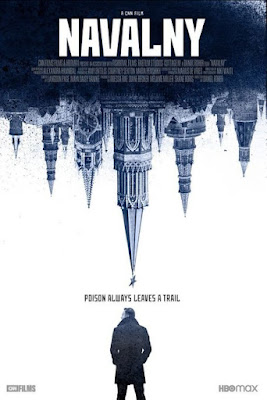
mere hours before Daniel Roher’s documentary Navalny, an up-close
chronicle of his recovery and return to Russia, premiered at the 2022 Sundance Film Festival.
Nobody
was really surprised when Navalny was arrested returning to his Russian
homeland in early 2021, least of Navalny. As viewers can see in the film’s
early scenes, Navalny was a master of social media, who built a large and enthusiastic
following throughout Russia, especially with younger generations (you can see
them in Alexandra Dalsbaek’s doc, We Are Russia). Odds are he could easily
unseat Putin in a legitimately fair election, but that is not how the
president-for-life plays the game.
Navalny
always knew he was a threat, but he assumed his prominence would protect him.
He was wrong, as he readily admits to Roher. In August of the super-fun year of
2020, agents of the FSB (what the KGB is now called) poisoned him with the nerve
agent Novichok (dubbed “LP9” by the Russians). We really do know that because
of an investigation conducted by Bellingcat journalist Christo Grozev and Maria
Pevchikh of Anti-Corruption Foundation (founded by Navalny). Viewers hear from
them a lot in the documentary and what they have to say is fascinating. Yet,
Navalny himself was able to secure independent verification in a spectacularly
dramatic fashion.
Those
who have followed Navalny’s case might already know he cold-called one of his attempted-assassins,
who basically confirmed everything over the phone. It is an absolutely electric,
jaw-dropping scene that has to be seen to be believed. Some of that footage
(that was shot by Roher and Niki Waltl, one of three cinematographers on the
project) is already in the public sphere, but the full context makes it even
more gripping.
Of
course, it was uncertain whether Navalny would even live that long. The
sequences covering his poisoning are also quite intense and profoundly
troubling. It is easy to see how scared the Navalny family was, as they fought
the suspiciously obstructionist Novosibirsk hospital for access to Navalny.
There is plenty there too that demands to be seen by the world at large. However,
Roher does his best to keep the Navalnys’ privates lives private, but it is
hard to maintain a hard-and-fast firewall for a subject that was poisoned by
Novichok and returns to Russia to face likely (and unjust) incarceration.
In the 1970s, Roger Corman started shooting films in the Philippines, because
they already had an established exploitation movie industry that worked fast,
cheap, and without excessively cumbersome safety regulations. Back in the day, Leonor
Reyes wrote the scripts. She has been retired for years, but serious trashy
movie fans still remember her. Of course, that won’t pay the bills, so she
tries to pull out her typewriter again. Unfortunately, a freak accident
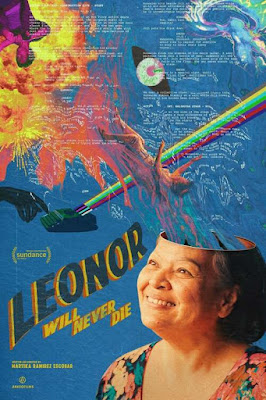
submerges her in the world of her prospective script in Martika Ramirez Escobar’s
Leonor Will Never Die, which premiered at this year’s Sundance.
Sadly,
Reyes’ golden-boy son Ronwaldo died, but he still quietly haunts (or watches
over) the family, while she is stuck living with the other one, Rudie. She and
her husband Valentin split-up, but he remains a constant presence in the
neighborhood. With their power on the verge of disconnection, Leonor dusts off
an old unfinished screenplay, but she still struggles to finish it. Then she
gets bonked on the noggin, in a suitably unlikely manner, and proceeds down the
rabbit hole into her screenplay.
Suddenly,
she befriends and mothers Ronwaldo, the vengeful hero of her film,
transparently (but not identically) based on her late namesake son, as well as
Majestika, his new stripper girlfriend, whom he saved from the corrupt mayor.
Meanwhile, Rudie desperately tries to talk her out of her coma, as the other
Ronwaldo looks on and occasionally offers some advice.
Leonor
might
sound like the Filipino exploitation equivalent of light and frothy fantasies
like Ana Maria in Novela Land and Delirious with John Candy, but
it is considerably darker and more meta. The cool thing about Escobar’s film is
that it is true to sweaty, testosterone-driven genre it portrays. That means
Reyes very definitely finds herself surrounded by violence and sleaze, which might
limit the film’s appeal.
However,
Escobar consistently finds ways to surprise the viewer in the third act,
breaking down barriers between realities and self-referring like all get-out. There
is also some brilliant work from cinematographer Carlos Mauricio and production
designer Eero Francisco recreating the look, texture, and ambiance of vintage
1970s Filipino grindhouse.
Yang is a way more advanced AI than Alexa. When you ask him to turn off a
light, he does it. In fact, he is truly a part of Jake and Kyra’s family, so
when he goes on the fritz, it is very distressing for them—and especially so for
their young adopted daughter Mika. They will have to prepare her to experience
grief for the first time, while learning there was more to their “techno-sapien”
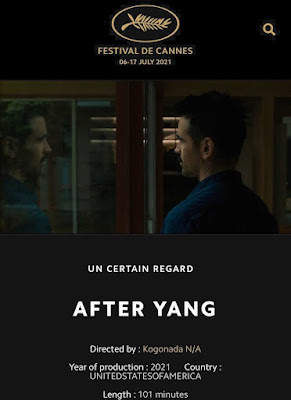
“son” than they realized in Kogonada’s After Yang, which premiered
(online) as part of this year’s Sundance Film Festival.
When
Kyra and Jake adopted Mika from China, so they also purchased Yang, a life-like
AI-cyborg to serve as her big brother and help keep her connected to her
Chinese culture. However, they bought him certified-refurbished from a licensed
re-seller that apparently is no longer in business. Unfortunately, that means
when he breaks down, he most likely can’t be repaired.
Suddenly,
the two parents realize how much they had delegated their parenting
responsibilities to Yang. They also must come to terms with their own sense of
loss. However, the discovery of a cache of Yang’s saved memories leads Jake to
the discovery of Yang’s secret relationship with a clone and his previous lives
with other families, before they acquired him.
After
Yang is
a sensitive, character-driven science fiction story, in the tradition of films
like Marjorie Prime that happily does not involve terminally ill people
cloning themselves (as in Swan Song and half a dozen films before it). Kogonada’s
adaptation of an Alexander Weinstein short story still has clones and it very
definitely challenges viewers to reconsider what it means to be human. This near
future world features humanity living and working together with its sentient
creations in reasonable harmony, but the way people relate to AIs and clones is
clearly still developing.
Kogonada
de-emphasizes the flashy futuristic trappings, focusing instead on big ideas
and big emotions (although self-driving cars are already a staple of the
world). Indeed, the way he and actor Justin H. Min tease out intriguing new
dimensions to Yang’s character is one of the most successful aspects of the
film.