Showing posts with label Hammer Films. Show all posts

Monday, May 11, 2026

Hammer: Heroes, Legends and Monsters

Its first IP deals were relatively modest, licensing British radio shows like Dick Barton and The Man in Black for extremely B-level movie treatments. However, it most famously relaunched popular franchises with the very same monsters that made Universal the home for horror in the 1930s and 1940s. Despite periods of decline and dormancy, the Hammer name still means something to fans. Director Benjamin Field and an all-star cast of genre filmmakers chronicle the studio’s history and celebrate its eccentricities in Hammer: Heroes, Legends and Monsters (oddly, no Oxford comma), which releases today on BluRay from UK specialty retailers.

Will Hinds (who performed vaudeville under his stage name, Hammer) and Enriques Carreras founded Hammer Film Productions, but they never really got filmmaking the way their sons, Tony Hinds and Michael Carreras, did. For the record, most of the oddball genre detours were Michael’s doing (fault). However, the elder Carreras definitely understood business, negotiating better American deals than were available for more prestigious British productions.

Hammer’s big opportunity came in licensing a film version of
The Quatermass Experiment, which had been a surprise hit for the BBC. They were subsequently pitched a Frankenstein screenplay that probably would have prompted a lawsuit from Universal, but they liked the idea enough to commission The Curse of Frankenstein, which was a huge hit, making stars of Peter Cushing and Chriostopher Lee. They followed it up with Horror of Dracula, featuring the same co-stars, garnering the same box office success.

Unlike many cinema history docs,
Heroes, Legends and Monsters focuses more on the behind-the-scenes business trends and the contributions of below-the-line contributors, like makeup artist Phil Leakey and art director Bernard Robinson, who had a thrifty knack for reusing and repurposing old props and sets. Thanks to Robinson, Hammer could really stretch their budget, while maintaining their signature lush, gothic look.

Of course, most of the great stars of Hammer, such as Cushing, Lee, Andre Morrell, Shane Briant, and Oliver Reed are no longer with us. However, Martine Beswick (
One Million Years B.C.), Caroline Munro (Dracula AD 1972), and Madeline Smith (The Vampire Lovers) discuss their work at Hammer (and the degree of nudity that was expected of them, during the late period of decline).

Indeed, the collected experts convincingly argue the turn towards cultural permissiveness was Hammer’s undoing, because they had developed such a knack for arguing, negotiating, and generally sneaking in suggestive material, which suddenly appeared tame compared to the genuinely explicit releases from their competitors.

The understanding of the economics of Hammer’s decisions helps differentiate
Heroes, Legends and Monsters from its many predecessors. It also features many experts with serious genre cred, including John Carpenter, Tim Burton, John Landis, and Joe Dante (the latter two seem to mostly work as documentary talking heads these days, which is sort of a shame, but their enthusiasm for Hammer sounds genuine).

Friday, August 02, 2024

The New Hammer’s New Doctor Jekyll

Is there a scarier name than Jekyll [Island], especially for gold standard advocates? Are you with me, monetary economists? Robert Louis Stevenson’s Doctor Jekyll and Mr. Hyde and its various films adaptations are also pretty frightening. The old classic Hammer made a gender-bender-ish version in 1971 with Dr. Jekyll and Sister Hyde. That tradition continues in the first film from the latest corporate relaunch of the venerable British horror studio, Joe Stephenson’s Doctor Jekyll, which opens today in theaters and on-demand.

Dr. Nina Jekyll is a brilliant research scientist, just like her beloved grandfather, Henry (fittingly portrayed in a flashback by actor Jonathan Hyde). That is right, this is technically a sequel or a re-quel, which is cool. Ordinarily, Dr. Jekyll’s solicitor and confidant Sandra Poole would never allow an ex-con former drug addict like Rob Stevenson (can you guess his middle name?) apply for the position of Jekyll’s live-in care-giver, but somehow his application slipped through the cracks and the good doctor takes a shine to him. Poole is quite adamant about Jekyll taking her meds precisely according to schedule, but the ominous significance is initially lost on Stevenson.

Suddenly, Poole stops coming around, but Jekyll assures him everything is fine, so don’t worry. Nevertheless, Stevenson grows increasingly alarmed when Jekyll’s behavior exhibits marked signs of schizophrenia. On the other hand, he also feels pressure to stay and make the best of things, for the sake of his cancer-stricken daughter Stevenson has not yet been allowed to meet.

New Hammer’s new
Doctor Jekyll has been billed as a transexual Jekyll and Hyde, but Dan Kelly-Mulhern’s screenplay so subtly establishes Nina Jekyll’s status as such, it will be lost on many viewers. However, the casting of Eddie Suzy Izzard arguably speaks directly to the point. In the past, Izzard has wisely counseled everyone to just chill out with respect to pronouns, recognizing both he and she are understandable in her case, especially when since she still plays roles of either gender, but in this case, she is indeed a she.

Regardless, Izzard is suitably creepy as both Nina and “Rachel.” She is suitably flamboyant for a modern-day gothic monster, but regardless of identification, she also still has sufficient size to tower over a skinny recovering junkie, like Stevenson. Frankly, this film probably would not work as well had someone else been cast. (That is not to say Martine Beswick was not convincingly lethal as “Sister Hyde.” She just represented a different, femme fatale kind of danger.)

Sunday, August 28, 2022

The Woman in Black: The New Hammer Adapts Susan Hill

Arthur Kipps' assignment sounds like a nightmare from Hell: one solid week of paperwork. He is supposed to organize the ratty old papers of the late Alice Drabow, the former owner of Eel Marsh House. Frankly, the visitation of a vengeful ghostly woman sounds like a welcome distraction from such drudgery, but unfortunately, her appearances are a harbinger for yet another child dying in the beleaguered local village. Despite the tragedies, poor Kipps still has to get all those blasted papers in order in James Watkins’ Hammer-produced The Woman in Black, which airs Thursday on Comet.

Kipps’ beloved wife died in childbirth, leaving him to raise their son Joseph on his own. The senior partner of his proper Edwardian firm says he is sympathetic to Kipps’ situation, which means he really isn’t. Regardless, Kipps must sort out the Drabow estate if he is to have a future with the firm. Unfortunately, the local solicitor has been decidedly uncooperative, so Kipps must go to Eel Marsh House and process all the paperwork, so they can clear the title for the prospective heirs.

Of course, he receives a nasty welcome from all the locals, except the wealthy and skeptical Sam Daily. Yet, he too lost his young son in an incident attributed to the Woman in Black. According to legend, whenever she is seen, a child dies through an act of self-destruction. As a result, Kipps only makes things worse for himself in the village when he asks about the strange woman he has seen around the Eel Marsh grounds. Children do indeed start dying, which is especially alarming to him, since Joseph and his nanny are scheduled to visit over the weekend.

Woman in Black
is an entertaining gothic throwback, which made it an altogether fitting production for the relaunched Hammer Films. As well as channeling vintage Hammer, Watkins also picked up a step or two from films like Bayona’s The Orphanage, using the full frame to tease viewers with shadowy figures, half-seen from down long hallways. Yet, the wonderfully lush and decaying set designs are pure vintage Hammer. Plus, the isolation of Eel Marsh House, built atop a rise in tidal basin that is inaccessible during high tide, lends the film additional claustrophobic creepiness.

Since Daniel Radcliffe now shuns J.K.
Rowling as a heretic who should be burned at the stake, this could be his new favorite film. It is the second screen adaptation of Hill’s novel, following a 1989 BBC production, and the first to spawn an original sequel. It is refreshingly atmospheric and suggestive, rather than bluntly gory.

Sunday, October 31, 2021

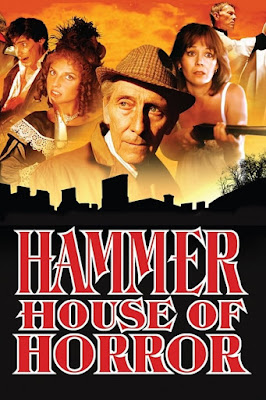
Hammer House of Horror, for Halloween

In its 1960s prime, Hammer Films did gothic horror better than anyone. However, for their most successful TV series, they leaned into folk horror. Even in episodes that do not rely on traditional folk horror tropes, bad things tend to happen to anyone who visits the countryside. Hammer had co-produced a Frankenstein pilot that failed to sell as well as a previous anthology series that came and went, but in 1980 they scored a hit with genre fans when Roy Skeggs created Hammer House of Horror, which airs today as a Halloween binge on Decades TV (hang on, this will be a long one).

Rather fortuitously, the series starts with probably its best episode, “Witching Hour” (directed by Don Leaver and written by Anthony Read), wherein viewers quickly get a taste of the series’ blend of the sinister and the sexual. Film composer David Winter rightly suspects his actress wife Mary is having an affair (as we see with absolute certainty), but Winter has no idea she is in fact sleeping with his best friend.

Unfortunately, Winter’s jealousy and resentment leaves him vulnerable to the attacks of Lucinda Jessup, a 17
th Century witch, who transported herself across time to avoid a date with the stake. Ironically, it will be his estranged wife who tries to save Winter from her sexual and spiritual domination. Jon Finch (star of Hitchcock’s Frenzy, who turned down an offer to play James Bond) is a spectacular mess as Winter. Prunella Gee (the nurse in the rogue Bond movie Never Say Never Again) is terrific, but underappreciated by horror critics for her forcefulness as his wife (probably because of her sex scene), while Patricia Quinn chews the scenery like a world champion as Jessup. The folk horror is pronounced and pretty scary.

In contrast, “The Thirteenth Reunion” (directed by Peter Sasdy and written Jeremy Burnham) is more darkly ironic than outright frightening. Yet, it is interesting in its way, because it serves up some rather mordant cultural commentary. The strange business involves a reporter infiltrating a trendy but abusive New Age weight loss clinic—definitely shades of EST here. There is also an appealing budding romance between her and another patient, because neither are typical romantic leads, but it is rudely interrupted.

While “Reunion” is a product of its day, “Rude Awakening” (directed by Sasdy and written by Gerald Savory) feels somewhat ahead of its time, because of its circular structure. Norman Shenley is an estate agent who keeps waking up from dreams in which he is repeatedly punished for a crime he has not [yet] committed—the murder of his wife. Resolving to get to the bottom of things, he keeps driving back out to the creepy old manor of his nightmare, only to befall another gruesome fate, before waking up again.

This episode really doesn’t seem fair, because it almost amounts to cosmic entrapment. However, the variations of each successive go-round are quite compelling and Denholm Elliott is perfect as the luckless Shenley.

“Growing Pains” is an underwhelming evil kid-ghost story and “Charlie Boy” we’ll skip because its too apt to become cancelation bait. “The House that Bled Death” (directed by Tom Clegg and written by David Lloyd) is not perfect television either but it became notorious in the UK for a scene of blood showering down from the ceiling on a child’s birthday party. It turns out the house a young family bought at a bargain price really wasn’t such a good deal after all. This episode appears to be inspired by the Enfield Poltergeist that was also the subject of
The Conjuring 2. The Hammer take is very different, until suddenly it isn’t.

Probably the most viewed episode is “The Silent Scream” (directed by Alan Gibson and written by Francis Essex), because it stars long-time Hammer favorite Peter Cushing. Martin Blueck looks like a kindly old man, but he is really a National Socialist war criminal (masquerading as a camp survivor), who befriends down-on-their-luck ex-cons like Chuck to lure them into his cruel Skinner-esque behavioral experiments.

“Scream” is easily the darkest, bleakest episode of the anthology. Cushing’s knack for shifting from kindly to malevolent at the drop of a hat serves the story quite well. The working-class pathos Brian Cox brings as Chuck heightens the episode’s claustrophobic discomfort. It is creepy, but a real downer.

A couple gets stranded on a country road in “Children of the Full Moon” (directed by Clegg and written by Murray Smith), as they often do in
Hammer House. The reference to a full moon is not accidental, but the payoff monster fans expect comes very late in the episode. Mostly, it is about more creepy kids and a creepy old lady.

Tuesday, April 28, 2020

Shatter: Hammer’s Second Shaw Brothers Co-Production


This would be Peter Cushing’s final feature film for Hammer, but he did not reprise any of his famous gothic characters. He only shot for four days, but they were all on-location in Hong Kong, so at least he got an exotic trip out of it. Stuart Whitman played the title character but the real stars are the gritty 1970s-era HK locations seen throughout Michael Carreras’s Shatter (a.k.a. Call Him Mr. Shatter), Hammer Film’s second not-so great co-production with the Shaw Brothers, which releases today on BluRay.

Shatter is a hitman who usually contracts out his services to the Western intelligence agencies. Unfortunately, the Hong Kong drug syndicate tricked him into executing the particularly nasty and destabilizing assassination of an African dictator. When Shatter complains to his regular HK contact, he finds he is now persona non grata. Even worse, Hans Leber, the money man for the contracting cartel, refuses to pay his fee.

Paul Rattwood, the local British station chief gives Shatter one day to leave town, but he is not going anywhere until he gets his money and some payback. Fortunately, he recruits a talented martial arts expert, Tai Pah, who can help keep him alive. However, Shatter is even more interested in Tai Pah’s sister Mai-Mee, a strictly professional masseuse working in a dodgy massage parlor.

Hammer’s first Shaw Brothers co-pro was the unfairly under-rated Legend of the 7 Golden Vampires, in which Cushing returned to the iconic role of Van Helsing. However, Shatter was sort of an additional throw-in from the start. It probably did not help that the original director, Monte Hellman, was fired early during the production, with Hammer president Carreras taking over.

Nevertheless, Lung Ti has several cool fight scenes as Tai Pah and his fellow Shaw Brothers regular Lily Li is warmly charismatic as Mai-Mee. The real problem is Stuart Whitman, who was badly miscast as the steely Shatter. Reportedly, he was physically ill during production—and he looks it. Of course, Cushing does his thing as Rattwood, but Anton Diffring (whose spotty previous Hammer tenure included their unsold 1958 pilot, Tales of Frankenstein) basically phones it in as Leber.

Tuesday, October 02, 2018

Satanic Panic: The Devil Rides Out

An old school British conservative like Dennis Wheatley understood the nature of evil, so he fought the Infernal One tooth-and-nail with his occult horror novels. Someone could do a jolly entertaining mini-retrospective of the seven films and one TV anthology episode based on his books, but this would definitely be the centerpiece. It happens to be the only Hammer film scripted by Richard Matheson and the great Sir Christopher Lee also often identified it as one of his favorites. Lee plays Wheatley’s intrepid Nicholas, Duc De Richleau in Terence Fisher’s The Devil Rides Out (a.k.a. The Devil’s Bride, trailer here), which screens as part of the Arena CineLounge’s Satanic Panic film series.

Despite the devilish goatee, De Richleau is an upstanding Christian gentleman, who has studied the occult in depth, and therefore understands the profound danger it represents. Both he and Rex Van Ryn have taken a fatherly interest in Simon Aron, the son of their late military colleague. Rather mysteriously, Aron has gone off the grid (circa 1929), so the two old friends have decided to pay him a call. Much to De Richleau’s alarm, they walk in on the pre-game for a black mass to be conducted by the villainous Mocata.

De Richleau manages to scuttle the ceremony and then returns later to whisk off Aron, whether he wants to be saved or not. At first, Van Ryn has a hard time believing De Richleau’s warnings, but he soon sees enough to make him a believer. He also starts to fall for Tanith Carlisle, another young recruit due to be initiated into Mocata’s circle.

Devil Rides Out is notably heavy on the occult imagery, particularly for 1968. There is definitely some serious Satanic panic going on in these tony British drawing rooms and on the Salisbury Plain. Somewhat surprisingly, some of the visuals seem to parallel those seen in A Dark Song (which like DRO, was also influenced by the Aleister Crowley mystique).

Regardless, Lee is terrific as De Richleau, clearly enjoying a rare turn as the hero. His De Richleau is rather a bit brusque and mysterious, not unlike his longtime friend Peter Cushing’s portrayals of Sherlock Holmes. He also has some rather engaging British upper-class bro chemistry with Leon Greene’s Van Ryn (dubbed by Patrick Allen, which seems odd, since Greene was an opera singer, as well as an actor).

Beyond the nifty Hammer-style demonic horror, DRO represents a unique assembly of talent. In addition to Lee and Matheson adapting Wheatley, it features future fine artist Niké Arrighi as Carlisle, Paul Eddington (best known as the easily befuddled James Hacker in Yes, Minister and Yes, Prime Minister) as De Richleau even more skeptical friend Richard Eaton, Charles Gray (Blofeld in Diamonds are Forever) as Mocata, and Nigerian playwright Yemi Ajibade as an African cultist.

The direction of veteran Hammer hand Fisher is tight and taut all the way through. Matheson’s adaptation keeps raising the stakes and incorporating ever more sinister occult lore. Plus, dig those vintage cars. Altogether, it is a highpoint in the Hammer filmography, even though it was not a hit in its day. Highly recommended for fans of vintage horror, The Devil Rides Out screens Thursday night (10/4) as part of Satanic Panic at the Arena CineLounge.

Thursday, July 03, 2014

NYAFF ’14: The Legend of the 7 Golden Vampires

At a time when Hollywood has contracted “co-production fever” in hopes of pandering to the Chinese market, it is worth re-visiting the granddaddy of all co-productions. The fusion of the Hong Kong-based Shaw Brothers’ kung fu and mysticism with Hammer’s gothic British horror was a true Reese’s peanut butter cup of a film. It was also a flop, but it is a highly entertaining flop. As a revered media titan well into his centenarian years, Sir Run Run Shaw (1907-2014) was more accustomed to turning out hits. Still, Roy Ward Baker’s The Legend of the 7 Golden Vampires (co-directed by the uncredited Chang Cheh) is a distinctive and only slightly eccentric choice to screen as part of the sidebar tribute to Shaw at this year’s New York Asian Film Festival.

Prof. Van Helsing is visiting early Nineteenth Century China to research the eastern variations in vampirism, armed with knowledge of the Ping Kwei legend. According to the story, the villagers were constantly terrorized by a cult of seven vampires and their minions, until one peasant finally reaches his breaking point. Heroically, he kills one of the seven, but at the cost of his life. Everyone attending Van Helsing’s lecture assumes he is a crank, except Hsi Ching. He happens to be a descendant of the brave Ping Kwei farmer, who has come to ask Van Helsing’s help in liberating his village from the remaining six.

Showing remarkable cultural sensitivity for a British colonialist in a 1970s film, Van Helsing stresses his inexperience facing China’s undead and the specific traditions and morays that make them different from the Euro-vamps. However, he cannot refuse a plea for help. Indeed, he becomes rather anxious to get out of town when his twit of a son Leyland shows up the local triad boss when putting the moves on a Scandinavian heiress. The adventurous Vanessa Buren is also eager to fund the expedition, so she joins the party over the professor’s objections.

Of course, before they can face the undead hordes, they will have to hack their way through a small army of triads, but that will not be a problem for Hsi, his six brothers (each with a specialized weapon of choice), and his sister, Mei Kwei. However, there is another European visitor to Ping Kwei, whom Van Helsing is well acquainted with—cue ominous thunderclap.

Everyone seems to love to pick on this film, just because it is admittedly an oddball concept. Yet, it deserves considerably more love. Action director Lau Kar-leung stages some very cinematic (and surprisingly bloody) martial arts sequences, presumably in collaboration with Chang. Perhaps inspired by the Hong Kong production, Peter Cushing brought his A-game as Van Helsing, as determined and authoritative as ever, but also protective of the youngsters and smart enough to know what he doesn’t know. In fact, Cushing looks quite comfortable and collegial with Shaw Brothers leading man David Chiang, who has all the right action chops for Hsi Ching and nearly makes his phonetic English dialogue sound natural.

Shih Szu (who almost broke out during her time with the Shaws, becoming more of a cult figure instead) is also impressively steely and sensitive as Mei Kwei. Former Miss Norway and Penthouse Pet Julie Ege gives Buren a bit of an edge and a backbone too. Unfortunately, Robin Stewart’s Leyland Van Helsing comes across like Hugh Grant’s ineffectual forefather. Frankly, it is hard to believe he could live through the first act.

As if that were not enough, Golden also holds the distinction of being the only Hammer Dracula film in which Christopher Lee does not play the Count. Let’s just say he was missed. However, Cushing, Chiang, Shih, some cool fight scenes, and a full dose of Hammer atmosphere make up for his absence. Recommended for Hammer Horror and Shaw Brothers fans, The Legend of the 7 Golden Vampires screens this Friday (the Fourth of July) at the Walter Reade Theater, as part of the 2014 NYAFF’s tribute to Sir Run Run Shaw.

Friday, December 24, 2010

Christmas Cheer: Vampire Circus

Ho, ho, ho, nothing says Christmas like a late period Hammer Horror film. While it is always cause for celebration when a fan favorite finally bows on DVD, the release of Robert Young’s Vampire Circus (trailer here) is particularly festive, marking the 100th release from Synapse Films. It is now available from finer online retailers, but many wage slaves might find Synapse’s own site for discerning horror cineastes nanny-blocked (as it is at my office).

In 1971, vampires were still Hammer’s bread and butter. After the success of The Vampire Lovers starring the late great Ingrid Pitt, the studio was no longer afraid of a little raciness. Perhaps more accurately, they were reluctant to release films without some crowd pleasing sexual content. With Circus, they delivered plenty just in the extended twelve minute prologue. Anna Müller, the hot wife of the local school teacher, has taken up with Count Mitterhaus, lord of the castle and undead vampire. After feasting on an innocent young girl, they grapple together in dark, evil ecstasy. Then the villagers arrive, pitchforks in hand, led by her slightly put out husband. They take care of business readily enough, but not before he curses the whole town of Schtettel, promising to return through the deaths of the children. The end, as if.

Circus flashforwards a few years to find the town dying again. This time it is a plague which superstitious townsfolk blame on the curse. Schtettel’s hopes depend on Dr. Kersch (who resembles a slightly less fat and pompous Thomas Friedman) getting through the quarantine blockade and returning with medicine. To while away the time, they enjoy the “gypsy” circus that mysteriously appeared, staging bizarre Cirque de Soleil shows, like that of the ferocious tiger woman in striped body paint. It hardly takes a genius to suspect the Circus of Nights is up to no good, but the doctor’s son Anton is a bit slow on the up-take.

While the DVD commentators somewhat overstate their case, suggesting Circus was heavily influenced by the work of Fellini and Bergman, the film certainly features some pretty trippy imagery. It was also a welcomed return to the quality production values that marked the studios early output. Though set in a remote Serbian town at an unspecified time, it also has the distinctly Victorian vibe Hammer perfected.

Although the Hammer superstars (Pitt, Peter Cushing, and Christopher Lee) are notably absent, at least one Hammer semi-regular still turns up. David Prowse, whom any movie geek worth his still-in-the-box Snaggletooth action-figure can tell you filled-in the Darth Vader body suit, appears as the circus strongman, getting about as much on-screen dialogue as he did in Star Wars. In general, the cast is pretty good, if occasionally a bit stiff, but Domini Blythe remains quite memorable as the alluring Anna Müller. Likewise, as her spurned husband, Laurence Payne nicely steps into the Cushing-esque role of anguished monster slayer.

Stylishly directed by horror novice Young, Circus is entertainingly creepy. If not quite a swan song, it is definitely a late blooming from the studio—a good reminder why so many horror fans love Hammer. Synapse also did right by its packaging too, including both DVD and Blue Ray discs (yep, that blood sure is red), with a fairly generous selection of extras, including featurettes on the making of the film and the tradition of circus and carny themed fright flicks that are a cut above average by bonus standards. A good, clean stocking stuffer, Circus is now available on DVD/Blue Ray, courtesy of Synapse Films.