Showing posts with label Peter Cushing. Show all posts

Monday, May 11, 2026

Hammer: Heroes, Legends and Monsters

Its first IP deals were relatively modest, licensing British radio shows like Dick Barton and The Man in Black for extremely B-level movie treatments. However, it most famously relaunched popular franchises with the very same monsters that made Universal the home for horror in the 1930s and 1940s. Despite periods of decline and dormancy, the Hammer name still means something to fans. Director Benjamin Field and an all-star cast of genre filmmakers chronicle the studio’s history and celebrate its eccentricities in Hammer: Heroes, Legends and Monsters (oddly, no Oxford comma), which releases today on BluRay from UK specialty retailers.

Will Hinds (who performed vaudeville under his stage name, Hammer) and Enriques Carreras founded Hammer Film Productions, but they never really got filmmaking the way their sons, Tony Hinds and Michael Carreras, did. For the record, most of the oddball genre detours were Michael’s doing (fault). However, the elder Carreras definitely understood business, negotiating better American deals than were available for more prestigious British productions.

Hammer’s big opportunity came in licensing a film version of
The Quatermass Experiment, which had been a surprise hit for the BBC. They were subsequently pitched a Frankenstein screenplay that probably would have prompted a lawsuit from Universal, but they liked the idea enough to commission The Curse of Frankenstein, which was a huge hit, making stars of Peter Cushing and Chriostopher Lee. They followed it up with Horror of Dracula, featuring the same co-stars, garnering the same box office success.

Unlike many cinema history docs,
Heroes, Legends and Monsters focuses more on the behind-the-scenes business trends and the contributions of below-the-line contributors, like makeup artist Phil Leakey and art director Bernard Robinson, who had a thrifty knack for reusing and repurposing old props and sets. Thanks to Robinson, Hammer could really stretch their budget, while maintaining their signature lush, gothic look.

Of course, most of the great stars of Hammer, such as Cushing, Lee, Andre Morrell, Shane Briant, and Oliver Reed are no longer with us. However, Martine Beswick (
One Million Years B.C.), Caroline Munro (Dracula AD 1972), and Madeline Smith (The Vampire Lovers) discuss their work at Hammer (and the degree of nudity that was expected of them, during the late period of decline).

Indeed, the collected experts convincingly argue the turn towards cultural permissiveness was Hammer’s undoing, because they had developed such a knack for arguing, negotiating, and generally sneaking in suggestive material, which suddenly appeared tame compared to the genuinely explicit releases from their competitors.

The understanding of the economics of Hammer’s decisions helps differentiate
Heroes, Legends and Monsters from its many predecessors. It also features many experts with serious genre cred, including John Carpenter, Tim Burton, John Landis, and Joe Dante (the latter two seem to mostly work as documentary talking heads these days, which is sort of a shame, but their enthusiasm for Hammer sounds genuine).

Tuesday, December 12, 2023

Sherlock Holmes: The Sign of Four


Unfortunately, Hammer never made a sequel to The Hound of the Baskervilles, but if they had, the grotesque assassins of “The Sign of Four” would have made it a logical choice. For TV, the BBC and director William Sterling played down their defining physical characteristics, which should reassure oversensitive contemporary viewers. Regardless, two colorful ruffians are up to no good in “The Sign of Four,” one of six Sherlock Holmes episodes included in the Cushing Curiosities boxset releasing today.

Ten years ago, Mary Morstan’s father disappeared under mysterious circumstances. Each year since, she has received a mysterious black pearl, apparently representing some sort of blood money. A mysterious letter promises to explain everything, but stipulates no cops. She can only bring two trusted friends. That will be Sherlock Holmes and Doctor Watson.

As fans know, Watson will become more than just a friend to Ms. Morstan. In fact, that is why “The Sign of Four” is one of the better episodes for Nigel Stock, because he finally acts like more of a man playing Watson than a befuddled fuddy-duddy.

It is also a good companion episode to “Hound of the Baskervilles,” because it features a good dog this time around. In fact, Toby, the spaniel-lurcher with a golden nose, is a very good dog and his scene on the scent is one of the episode’s best.

Sherlock Holmes: The Hound of the Baskervilles Pts 1 & 2


Terence Fisher’s Hammer-produced The Hound of the Baskervilles is the greatest Sherlock Holmes movie of all time, for two reasons: Peter Cushing as Holmes and Andre Morrel as Dr. Watson. Unfortunately, it was not a hit, so Holmes did not become a Hammer franchise. Happily, Cushing was able to return to the role nine years later for the BBC. That would be the negligent BBC that wiped most of the episode tapes. Seven full episodes survive, six of which are included in the Cushing Curiosities boxset releasing today, including “The Hound of the Baskervilles Parts 1 & 2.”

Cushing is still the perfect Holmes, but sadly Nigel Stock is much closer to Nigel Bruce than Andre Morrel. Unlike so many Watsons, the distinguished Morrel actually inspired confidence in his own right. You could believe he was a practicing medical doctor and a resourceful military veteran, whereas Stock’s Watson is silly old goat. For what its worth, Sir Christopher Lee was probably the best Sir Henry Baskerville in the movie, outshining the snide looking and sounding Gary Raymond. However, David Leland absent-minded portrayal of Dr. Mortimer is more interesting that Francis de Wolff’s pompous film turn.

Regardless, Hugh Leonard’s teleplay scrupulous follows the Conan Doyle source material. Unfortunately, that means Cushing disappears for an extended period, which wasn’t such a problem for Fisher, because he still had Morrel and Lee (and also Ewen Solon from
Maigret as Stapleton). Still, it is always fun to watch Cushing deducing with that I’m-smarter-than-you twinkle in his eye.

Sunday, October 31, 2021

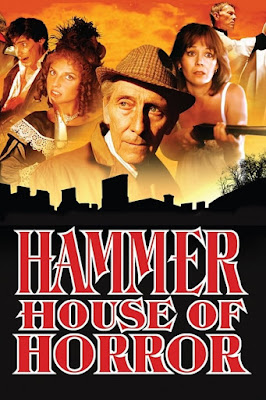
Hammer House of Horror, for Halloween

In its 1960s prime, Hammer Films did gothic horror better than anyone. However, for their most successful TV series, they leaned into folk horror. Even in episodes that do not rely on traditional folk horror tropes, bad things tend to happen to anyone who visits the countryside. Hammer had co-produced a Frankenstein pilot that failed to sell as well as a previous anthology series that came and went, but in 1980 they scored a hit with genre fans when Roy Skeggs created Hammer House of Horror, which airs today as a Halloween binge on Decades TV (hang on, this will be a long one).

Rather fortuitously, the series starts with probably its best episode, “Witching Hour” (directed by Don Leaver and written by Anthony Read), wherein viewers quickly get a taste of the series’ blend of the sinister and the sexual. Film composer David Winter rightly suspects his actress wife Mary is having an affair (as we see with absolute certainty), but Winter has no idea she is in fact sleeping with his best friend.

Unfortunately, Winter’s jealousy and resentment leaves him vulnerable to the attacks of Lucinda Jessup, a 17
th Century witch, who transported herself across time to avoid a date with the stake. Ironically, it will be his estranged wife who tries to save Winter from her sexual and spiritual domination. Jon Finch (star of Hitchcock’s Frenzy, who turned down an offer to play James Bond) is a spectacular mess as Winter. Prunella Gee (the nurse in the rogue Bond movie Never Say Never Again) is terrific, but underappreciated by horror critics for her forcefulness as his wife (probably because of her sex scene), while Patricia Quinn chews the scenery like a world champion as Jessup. The folk horror is pronounced and pretty scary.

In contrast, “The Thirteenth Reunion” (directed by Peter Sasdy and written Jeremy Burnham) is more darkly ironic than outright frightening. Yet, it is interesting in its way, because it serves up some rather mordant cultural commentary. The strange business involves a reporter infiltrating a trendy but abusive New Age weight loss clinic—definitely shades of EST here. There is also an appealing budding romance between her and another patient, because neither are typical romantic leads, but it is rudely interrupted.

While “Reunion” is a product of its day, “Rude Awakening” (directed by Sasdy and written by Gerald Savory) feels somewhat ahead of its time, because of its circular structure. Norman Shenley is an estate agent who keeps waking up from dreams in which he is repeatedly punished for a crime he has not [yet] committed—the murder of his wife. Resolving to get to the bottom of things, he keeps driving back out to the creepy old manor of his nightmare, only to befall another gruesome fate, before waking up again.

This episode really doesn’t seem fair, because it almost amounts to cosmic entrapment. However, the variations of each successive go-round are quite compelling and Denholm Elliott is perfect as the luckless Shenley.

“Growing Pains” is an underwhelming evil kid-ghost story and “Charlie Boy” we’ll skip because its too apt to become cancelation bait. “The House that Bled Death” (directed by Tom Clegg and written by David Lloyd) is not perfect television either but it became notorious in the UK for a scene of blood showering down from the ceiling on a child’s birthday party. It turns out the house a young family bought at a bargain price really wasn’t such a good deal after all. This episode appears to be inspired by the Enfield Poltergeist that was also the subject of
The Conjuring 2. The Hammer take is very different, until suddenly it isn’t.

Probably the most viewed episode is “The Silent Scream” (directed by Alan Gibson and written by Francis Essex), because it stars long-time Hammer favorite Peter Cushing. Martin Blueck looks like a kindly old man, but he is really a National Socialist war criminal (masquerading as a camp survivor), who befriends down-on-their-luck ex-cons like Chuck to lure them into his cruel Skinner-esque behavioral experiments.

“Scream” is easily the darkest, bleakest episode of the anthology. Cushing’s knack for shifting from kindly to malevolent at the drop of a hat serves the story quite well. The working-class pathos Brian Cox brings as Chuck heightens the episode’s claustrophobic discomfort. It is creepy, but a real downer.

A couple gets stranded on a country road in “Children of the Full Moon” (directed by Clegg and written by Murray Smith), as they often do in
Hammer House. The reference to a full moon is not accidental, but the payoff monster fans expect comes very late in the episode. Mostly, it is about more creepy kids and a creepy old lady.

Sunday, October 25, 2020

Madhouse, Starring Vincent Price & Peter Cushing

Old horror actors never die. They just get repackaged. Pete Cushing is a perfect example. Twenty-two years after he died, he appeared again in Rogue One, through some CGI trickery. He had seen it before, but less sophisticated. In this 1974 horror movie about horror actors, the late Boris Karloff and Basil Rathbone get special screen credits, appearing in vintage film clips that also featured Cushing’s co-star Vincent Price. Horror movies might grant immortal fame, but they are also a dangerous business in Jim Clark’s Madhouse, which airs Monday night on TCM.

Paul Toombes used to be a huge star portraying Dr. Death, the Freddy Krueger of his era. However, his career and his sanity crash-dived after the violent murder of his fiancée. Of course, they had drunkenly argued in front of half the industry before her untimely demise, so everyone assumes he did it. Frankly, Toombes doesn’t even know himself, because he blacked out. Perversely, the scandal maintains interest in Dr. Death, so when he is finally released from the sanitarium, he reluctantly agrees to star in a Dr. Death TV reboot.

As part of the agreement, Toombes must stay with his old friend, Herbert Flay, the screenwriter of the Dr. Death series, who will keep him out of trouble. At least that’s the idea. Unfortunately, Toombes is a magnetic for would-be exploiters, like Elizabeth Peters, an aspiring starlet, whose annoying attempts to seduce Toombes makes her a cinch to get murdered. Fortunately, his network publicist, Julia Wilson is good at running interference, but not good enough. Soon, bodies are piling up, inducing flashbacks of horror to the increasingly unstable Toombes.

As if Price, Cushing, and archival appearances from Karloff and Rathbone were not enough to satisfy vintage horror fans, Robert Quarry, a.k.a. Count Yorga, also appears as crass network head, Oliver Quayle. Of course, Price and Cushing are the main attraction, slyly and surprisingly poignantly playing off their own careers and images. Price is a wonderfully tragic figure, who in many ways represents a continuation of his grandly elegiac turn as Edward Lionheart in the classic
Theater of Blood. Likewise, Cushing is effortlessly sophisticated yet deeply sad as old Flay. Even though it is not exactly the most profoundly written part in cinematic history, Natasha Pynne (who also co-starred in a Hammer pirate movie) plays Wilson with appealing forcefulness and energy.

Friday, October 09, 2020

Daleks: Invasion Earth 2150 A.D., Starring Peter Cushing

Sure, there were creepy aliens inside those tin cans, but before Next Gen gave us the Borg, nothing better represented our fears of technology’s dehumanizing influence than the Daleks. Fortunately, Doctor Who was there to stop their ambitions for galactic domination, even when he wasn’t strictly speaking Gallifreyan. Evidently, the two mid-1960s Doctor Who movies have been somehow retconned into the extended universe, but they have always been considered canonically suspect, since their Doctor is an Earthling who actually calls himself “Dr. Who.” On the plus side, he was played by Peter Cushing and he reliably foiled the Daleks. Both Amicus Doctor Who films air tonight on TCM, but the second, Gordon Flemyng’s Daleks: Invasion Earth 2150 A.D. is by far the superior film.

After saving a foreign planet from the Daleks in the first film, the Doctor touches down in Swinging Sixties London just long enough to pick up police constable Tom Campbell after he is knocked cold by a gang of armed robbers. When he comes too, the Tardis has traveled forward to the year 2150, which much to the Doctor’s distress, Earth has been temporarily been conquered by the very same Daleks.

It takes some doing, but the Doctor’s niece Louise and his granddaughter Susan convince the copper they really have traveled forward in time. Of course, the metal megalomaniacal Daleks are quite persuasive. Unfortunately, the travelers become barricaded from the Tardis during a scouting trip, forcing them to take refuge with the underground human resistance. After the Doctor and Campbell are captured and escape, the time-travelers will be forced by circumstances to split up, but all roads seem to lead to a mysterious mine, where the Daleks are implementing their evil planetary scheme.

The first Peter Cushing Doctor Who (
Doctors Who and the Daleks) movie is jokier and skews much younger as a result. However, the visual impact of bombed out London in Earth 2150 is quite striking. Clearly, the look of the post-apocalyptic city was inspired by scenes of destruction wrought by the Blitz during the Battle of London, memories of which would have still been vivid for many viewers in 1966.

The narrative is also more effectively structured, breaking apart the Doctor and his companions. The paring of the protective Wyler, a crusty old resistance activist, with young Susan is especially effective. Ironically, this is something of a case of necessity being the mother of invention, since illness forced Cushing to curtail his work on
Earth 2150.

Tuesday, April 28, 2020

Shatter: Hammer’s Second Shaw Brothers Co-Production


This would be Peter Cushing’s final feature film for Hammer, but he did not reprise any of his famous gothic characters. He only shot for four days, but they were all on-location in Hong Kong, so at least he got an exotic trip out of it. Stuart Whitman played the title character but the real stars are the gritty 1970s-era HK locations seen throughout Michael Carreras’s Shatter (a.k.a. Call Him Mr. Shatter), Hammer Film’s second not-so great co-production with the Shaw Brothers, which releases today on BluRay.

Shatter is a hitman who usually contracts out his services to the Western intelligence agencies. Unfortunately, the Hong Kong drug syndicate tricked him into executing the particularly nasty and destabilizing assassination of an African dictator. When Shatter complains to his regular HK contact, he finds he is now persona non grata. Even worse, Hans Leber, the money man for the contracting cartel, refuses to pay his fee.

Paul Rattwood, the local British station chief gives Shatter one day to leave town, but he is not going anywhere until he gets his money and some payback. Fortunately, he recruits a talented martial arts expert, Tai Pah, who can help keep him alive. However, Shatter is even more interested in Tai Pah’s sister Mai-Mee, a strictly professional masseuse working in a dodgy massage parlor.

Hammer’s first Shaw Brothers co-pro was the unfairly under-rated Legend of the 7 Golden Vampires, in which Cushing returned to the iconic role of Van Helsing. However, Shatter was sort of an additional throw-in from the start. It probably did not help that the original director, Monte Hellman, was fired early during the production, with Hammer president Carreras taking over.

Nevertheless, Lung Ti has several cool fight scenes as Tai Pah and his fellow Shaw Brothers regular Lily Li is warmly charismatic as Mai-Mee. The real problem is Stuart Whitman, who was badly miscast as the steely Shatter. Reportedly, he was physically ill during production—and he looks it. Of course, Cushing does his thing as Rattwood, but Anton Diffring (whose spotty previous Hammer tenure included their unsold 1958 pilot, Tales of Frankenstein) basically phones it in as Leber.

Thursday, July 03, 2014

NYAFF ’14: The Legend of the 7 Golden Vampires

At a time when Hollywood has contracted “co-production fever” in hopes of pandering to the Chinese market, it is worth re-visiting the granddaddy of all co-productions. The fusion of the Hong Kong-based Shaw Brothers’ kung fu and mysticism with Hammer’s gothic British horror was a true Reese’s peanut butter cup of a film. It was also a flop, but it is a highly entertaining flop. As a revered media titan well into his centenarian years, Sir Run Run Shaw (1907-2014) was more accustomed to turning out hits. Still, Roy Ward Baker’s The Legend of the 7 Golden Vampires (co-directed by the uncredited Chang Cheh) is a distinctive and only slightly eccentric choice to screen as part of the sidebar tribute to Shaw at this year’s New York Asian Film Festival.

Prof. Van Helsing is visiting early Nineteenth Century China to research the eastern variations in vampirism, armed with knowledge of the Ping Kwei legend. According to the story, the villagers were constantly terrorized by a cult of seven vampires and their minions, until one peasant finally reaches his breaking point. Heroically, he kills one of the seven, but at the cost of his life. Everyone attending Van Helsing’s lecture assumes he is a crank, except Hsi Ching. He happens to be a descendant of the brave Ping Kwei farmer, who has come to ask Van Helsing’s help in liberating his village from the remaining six.

Showing remarkable cultural sensitivity for a British colonialist in a 1970s film, Van Helsing stresses his inexperience facing China’s undead and the specific traditions and morays that make them different from the Euro-vamps. However, he cannot refuse a plea for help. Indeed, he becomes rather anxious to get out of town when his twit of a son Leyland shows up the local triad boss when putting the moves on a Scandinavian heiress. The adventurous Vanessa Buren is also eager to fund the expedition, so she joins the party over the professor’s objections.

Of course, before they can face the undead hordes, they will have to hack their way through a small army of triads, but that will not be a problem for Hsi, his six brothers (each with a specialized weapon of choice), and his sister, Mei Kwei. However, there is another European visitor to Ping Kwei, whom Van Helsing is well acquainted with—cue ominous thunderclap.

Everyone seems to love to pick on this film, just because it is admittedly an oddball concept. Yet, it deserves considerably more love. Action director Lau Kar-leung stages some very cinematic (and surprisingly bloody) martial arts sequences, presumably in collaboration with Chang. Perhaps inspired by the Hong Kong production, Peter Cushing brought his A-game as Van Helsing, as determined and authoritative as ever, but also protective of the youngsters and smart enough to know what he doesn’t know. In fact, Cushing looks quite comfortable and collegial with Shaw Brothers leading man David Chiang, who has all the right action chops for Hsi Ching and nearly makes his phonetic English dialogue sound natural.

Shih Szu (who almost broke out during her time with the Shaws, becoming more of a cult figure instead) is also impressively steely and sensitive as Mei Kwei. Former Miss Norway and Penthouse Pet Julie Ege gives Buren a bit of an edge and a backbone too. Unfortunately, Robin Stewart’s Leyland Van Helsing comes across like Hugh Grant’s ineffectual forefather. Frankly, it is hard to believe he could live through the first act.

As if that were not enough, Golden also holds the distinction of being the only Hammer Dracula film in which Christopher Lee does not play the Count. Let’s just say he was missed. However, Cushing, Chiang, Shih, some cool fight scenes, and a full dose of Hammer atmosphere make up for his absence. Recommended for Hammer Horror and Shaw Brothers fans, The Legend of the 7 Golden Vampires screens this Friday (the Fourth of July) at the Walter Reade Theater, as part of the 2014 NYAFF’s tribute to Sir Run Run Shaw.