Ohm Bauman is a lot like Stephen King. He is a horror writer, who is a real jerk. It
doesn’t take long to figure that out, especially if you are one of the
employees of the Bilberry Woods Hotel, who he treats like dirt while checking
it. However, there are good reasons for his bitterness. Perhaps fittingly,
Bauman warms to the bartender Fiona, but the witch allegedly haunting the
property will be a different matter in director-screenwriter Damian McCarthy’s Hokum,
which releases this Tuesday on DVD.
Bauman
is struggling with the ending to his “Conquistador” novel and with life in
general, so he makes a reservation at the quaint Irish country inn where his
late parents honeymooned. Sadly, his mother died during Bauman’s childhood and
her death turned his father mean. He is hoping for some sort of catharsis. Of
course, the stories of the Cailleach Witch do not impress him, even though it
is somewhat ironic she was supposedly trapped in the honeymoon suite where his
parents maybe once stayed.
Initially,
Bauman had no interest in visiting the haunted suite. However, a surprise twist
McCarthy springs on viewers within the first twenty-five minutes supplies solid
motivation for the writer to investigate the locked and chained room.
Indeed,
Bauman is in for a rough time of things. Yet, what his experiences reveal will humanize
him for the audience quite considerably. McCarthy has some serious supernatural
scares up his sleeve, but the added human complications make them scarier.
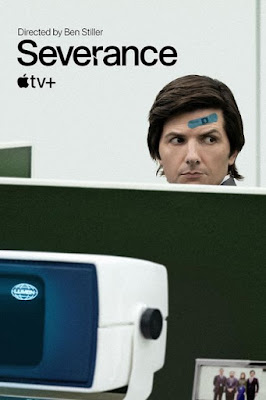
When watching this workplace series, you have to wonder how the company in
question could pivot to work-from-home during the pandemic. Lumon Industries is
not merely dysfunctional in a Dunder Mifflin-The Office kind of
way. There is something rather ominous going on there, but it is hard for
employees to act on their suspicions because they have been “severed.” During
office hours, severed employees only remember their work lives, whereas at home,
they have no recollection of the office. Things get interesting for one drone
when both his inside and outside selves start asking questions in creator Dan
Erickson’s Severance, which premieres tomorrow on Apple TV+.
It
is hard to tell what “Mark S” (severed workers do not even know their last
names) does with his three colleagues in the Macro Data Refinement (MDR) department.
Frankly, they do not even know themselves. It involves old clunky mid-1980s
looking computers, but their daily toil makes little sense. Nevertheless, he and
veterans Dylan and Irving, have largely resigned themselves to it. On the other
hand, Helly, the new arrival, is having none of it. She is determined to
resign, but her “outie” refuses all her requests. Of course, direct communication
between selves is strictly forbidden and enforced by high tech surveillance and
detection techniques.
Poor
Mark had tragic reasons for agreeing to the severance procedure, but the backstories
for the rest of his team will remain unknown for most of the show. However, we
soon learn someone from Lumon is keeping eyes on the “outie” Mark. It is easy
to see how Erickson and directors Ben Stiller and Aoife McArdle could mine this
premise for paranoia, but they have some wildly sinister twists up their
sleeves.
Season
one consists of nine episodes, which might sound a bit on the long side, but
the time is well spent in early installments carefully establishing the rules
of severed work and the creepy idiosyncrasies of the Lumon headquarters. Severance
was shot on location at the old Aero Saarinen-designed Bell Labs Holmdel
building, which is a perfect retro-dystopian setting. Frankly, the art and
design work that went into the Lumon world are amazing. Theodore Shapiro’s
eerie minimalist score nicely suits the sterile environment and enhances the mysterious
vibe (plus there some deliciously funky music in the episode titled “Defiant
Jazz,” but it would be too complicated to explain why it is there).
Yet,
Adam Scott is probably the key to Severance, because he does the best
work we’ve seen from him as Mark (obviously both of them). It is a sensitive
performance that distinguishes between innie and outie, but also shows us how
he really is the same person, in and out. If that does not convince you, then
keep in mind both Christopher Walken and John Turturro have substantial supporting
roles, often appearing together, as severed workers—and they are compulsively watchable, like you would expect.