Showing posts with label John Turturro. Show all posts

Friday, February 02, 2024

Mr. & Mrs. Smith, on Prime Video

The most dangerous weapons these two agents wield are not guns or explosives. No, their whiny, neurotic personalities are far more lethal. Weaker people will yearn for the sweet release of death after a mere five minutes listening to them bicker and kvetch. Supposedly, this series is based on the 2005 Doug Liman film about super-spy assassins, who did not realize they were in the same business, but it is hard to tell from all the changes that were made. This time, the couple knowingly agrees to work undercover together and they might also leave the clandestine service together, feet first, in creators Donald Glover & Francesca Sloane’s Mr. & Mrs. Smith, which premieres today on Prime Video.

Perhaps you would hope two rookie agents would talk to a live person before killing people for their new agency, but not “John and Jane Smith.” Admittedly, Jane has sociopathic tendencies, so there’s that. Judging from the computer-automated interviews that dominate the first half of the initial episode, “First Date,” the Smiths were matched up because they both like pasta.

Obviously, those are not their real names. It is also clear there are other Smiths out there, like the ones in the prologue, whose fate suggests Smiths have a rather short shelf-life. Regardless, the new couple meshes reasonably okay. Initially, she thinks they should keep it strictly professional, but that caution will not last long.

The Smiths get three mission failures before its curtains for them. Unfortunately, they pick up a quick fail in episode two, “Second Date,” when they are ordered to abduct Eric Shane, a shady Epstein-like real estate tycoon, played by Johnn Turturro. In fact, several of the notable guest stars are the best thing about the Glover & Sloane take on
Mr. & Mrs. Smith. Turturo is both creepy and dryly mordant as Shane. Similarly, Ron Perlman terrific in both funny and sad ways, subverting his larger-than-life image. as Toby Hellinger, a broken-down former wheeler-dealer, whom the Smiths are supposed to “save.”

Probably, Wagner Moura and Parker Posey should have been the stars of the series, because they really liven things up in their two appearances as the “Other Smiths,” who offer the new Smiths some career advice after a chance encounter. The Other Smiths do not waste our time with navel-gazing or pseudo-hip jargon-laden banter, because life is too short, particularly for their targets.

If you thought the Pitt-Jolie movie needed more talky examination of gender-based relationship expectations and less action, than maybe this
Mr. & Mrs. Smith is for you. Everyone else will probably put their hands over their ears and start yelling “Shut up! Shut up!” They say the sign of good relationship is an ability to be silent together. Regrettably, the new Smiths never get there.

Fittingly, Perlman’s episode, “Do You Want Kids,” features the best action sequences of the series, wherein the Smiths drag the degenerate Hellinger huffing and wheezing his way through the picturesque towns surrounding Lake Como. Over the course of the series, there are a further three or four well-executed fight scenes interspersed amid the overwritten dialogue, but the talking never stops for long.

Thursday, February 17, 2022

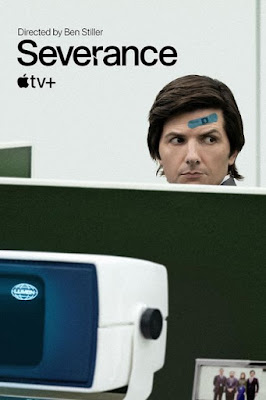
Severance, on Apple TV+

When watching this workplace series, you have to wonder how the company in question could pivot to work-from-home during the pandemic. Lumon Industries is not merely dysfunctional in a Dunder Mifflin-The Office kind of way. There is something rather ominous going on there, but it is hard for employees to act on their suspicions because they have been “severed.” During office hours, severed employees only remember their work lives, whereas at home, they have no recollection of the office. Things get interesting for one drone when both his inside and outside selves start asking questions in creator Dan Erickson’s Severance, which premieres tomorrow on Apple TV+.

It is hard to tell what “Mark S” (severed workers do not even know their last names) does with his three colleagues in the Macro Data Refinement (MDR) department. Frankly, they do not even know themselves. It involves old clunky mid-1980s looking computers, but their daily toil makes little sense. Nevertheless, he and veterans Dylan and Irving, have largely resigned themselves to it. On the other hand, Helly, the new arrival, is having none of it. She is determined to resign, but her “outie” refuses all her requests. Of course, direct communication between selves is strictly forbidden and enforced by high tech surveillance and detection techniques.

Poor Mark had tragic reasons for agreeing to the severance procedure, but the backstories for the rest of his team will remain unknown for most of the show. However, we soon learn someone from Lumon is keeping eyes on the “outie” Mark. It is easy to see how Erickson and directors Ben Stiller and Aoife McArdle could mine this premise for paranoia, but they have some wildly sinister twists up their sleeves.

Season one consists of nine episodes, which might sound a bit on the long side, but the time is well spent in early installments carefully establishing the rules of severed work and the creepy idiosyncrasies of the Lumon headquarters.
Severance was shot on location at the old Aero Saarinen-designed Bell Labs Holmdel building, which is a perfect retro-dystopian setting. Frankly, the art and design work that went into the Lumon world are amazing. Theodore Shapiro’s eerie minimalist score nicely suits the sterile environment and enhances the mysterious vibe (plus there some deliciously funky music in the episode titled “Defiant Jazz,” but it would be too complicated to explain why it is there).

Yet, Adam Scott is probably the key to
Severance, because he does the best work we’ve seen from him as Mark (obviously both of them). It is a sensitive performance that distinguishes between innie and outie, but also shows us how he really is the same person, in and out. If that does not convince you, then keep in mind both Christopher Walken and John Turturro have substantial supporting roles, often appearing together, as severed workers—and they are compulsively watchable, like you would expect.

Wednesday, August 24, 2016

Moretti’s Mia Madre

Film directors are usually control freaks. It just goes with the territory. That’s great for their auteurist visions, but not so hot for personal relationships. Margherita’s mother still loves her anyway, even in periods of ill health and maybe not quite 100% sound mind. The headstrong daughter should probably start preparing for the inevitable, but she has a didactic art film to finish first in Nanni Moretti’s Mia Madre (trailer here), which opens this Friday in New York.

Vittorio was the closest thing Margherita had to a muse, but that did not stop her from dumping him midway through their latest shoot. Barry Huggins, a famous American character actor supposedly fluent in Italian will soon be joining the production, but he most definitely will not be taking Vittorio’s place. Frankly, she is far too preoccupied with her mother Ada’s health, but so far she has left most of the hard work to her older brother Giovanni. She is also trying to be a reasonably responsible mother to her Latin-flunking, Vespa-yearning daughter Livia, but it does not come natural to her.

Unfortunately, developments on the set push Margherita to the verge of a nervous breakdown. The high maintenance Huggins might understand Italian, but his fluency is iffy and his memorization of lines is even more suspect. Plus, just about every technical problem imaginable threatens to rob the world of another overwrought melodrama about unionized strikers.

Mia Madre’s acute attention to personal crises definitely makes it feel like a Nanni Moretti film, but it is hard not to hear Georges Delerue’s soaring themes from Truffaut’s Day for Night welling up in the back of your head. Considering the ways the two films parallel each other (socially awkward, semi-autobiographical filmmakers whose sanity and latest productions are nearly undermined by untimely tragedy), it is hard to imagine Moretti wasn’t engaging with the Oscar winner on some level.

Be that as it may, Mia Madre is a fine work with an unusually high quotient of emotional truth. Margherita Buy takes another slyly subtle star turn as Margherita the namesake director, proving she is one of the best in the business. John Turturro is quite a good sport hamming it up as Huggins (who else could he be lampooning, but himself?), yet when we least expect it, he and Moretti will irreversibly humanize the Yankee prima donna. Moretti the helmer-thesp (who has not infrequently been cast in other people’s movies) oozes dignity as the wise, soul-weary Giovanni. He just can’t help being charismatic on-screen. However, Giulia Lazzarini is doing standard TV movie-central casting stuff as the spirited but slowly fading Ada.

Mia Madre is a very nice film, but Day for Night is a masterwork. That is an unfair comparison, but Moretti seems to invite it. Nevertheless, Buy follows up her wonderfully understated turn in the grossly underappreciated A Five Star Life with another notably smart and mature performance. Recommended for patrons of Italian cinema and fans of Turturro, Mia Madre opens this Friday (8/26) in New York, at the Lincoln Plaza uptown and the Angelika Film Center downtown.

Monday, April 11, 2016

Rio, I Love You—But I Know You Can Do Better

Rio de Janeiro has the world’s coolest sidewalks. You can also hear terrific and wonderfully diverse music performed throughout the city. With that many musicians, there must be a million stories in the Naked Rio. That is why the sketchy, fragmentary nature of the latest installment of the “Cities of Love” anthology franchise is so frustrating. Even the romance is under-quota in a bunch of people’s Rio, I Love (trailer here), which opens this Friday in New York.

Despite the Rio setting, most of the characters are American, British, or Australian, so do not waste time looking for a Seu Jorge walk-on. It isn’t there. However, the opening “Dona Fulana” is a bit of an unfortunate outlier, featuring a Brazilian cast in the dubious tale of a plucky old woman who explains to her respectable grandson who much happier she is on the streets than living a life of hypocrisy. Remember that next time the UHO scam artists hit you up for money on the subway.

Paolo Sorrentino’s “La Fortuna” sort of works as a mordant little twist noir, but it never really establishes why the wheelchair bound husband has reason to believe things will work out as they do. Still, it shows off a side of Emily Mortimer we rarely get to see. Arguably, Fernando Meirelles’ “A Musa” is the most successful segment. It also happens to be entirely dialogue free. Stephen Elliott’s “Acho que Estou Apaixonado,” a tale of an Australian movie star recklessly climbing Sugarloaf Mountain is less accomplished, but at least it is fully developed and provides some lovely scenery, along with a bizarre Bebel Gilberto cameo.

John Turturro’s deliberately overwrought “Quando não há Mais Amor” just doesn’t work, even with the French retro-pop stylings of Vanessa Paradis. Guillermo Arriaga’s “Texas” falls nearly as flat, but throws in an element of exploitation for additional discomfort. Im Sang-soo’s “O Vampiro do Rio” has tons of style and promises great potential, but it is over practically as soon as it starts, as if the producers could only secure him a twenty-four-hour visa. Likewise, Carlos Saldanha’s “Pas de Deux” is lovely to look at, but maddeningly fragmentary. Dittos for José Padilha’s “Inútil Paisagem,” which has some nice looking shots Wagner Moura hang-gliding and not much else.

At least, Nadine Labaki closes the film on a relative high note, perhaps because there is actually a concept behind “O Milagre.” Of course, the notion of Harvey Keitel appearing as himself is a strong foundation. While in Rio filming a ridiculously melodramatic Thorn Birds rip-off with Labaki, Kietel is convinced to literally play God over the phone with a terminally ill boy. As usual, Keitel is highly watchable and he develops good chemistry with Labaki and the rest of the cast and crew of the film-within-the-film.


This is the third of producer Emmanuel Benbihy’s city anthologies, following Paris and New York, with Tbilisi already on deck. Frankly, the Georgian capital seems like an unlikely setting for the frothy series, but maybe that is a good thing. Hopefully, all the contributing filmmakers came with fully conceived concepts ready to go. In contrast, after watching Rio, we can only guess many of the constituent directors assumed the city would inspire them and just decided to wing it. Still, it all sounds great, thanks to the music of Gilberto Gil, Chico Buarque, Celso Fonseca, Bebel Gilberto, Cartola, Maucha Adnet, and masters like Jobim and Villa-Lobos. Seriously, you might try watching it with your eyes closed. The soundtrack is highly recommended, but the film is way too inconsistent and patchy. For diehard Brazilophiles, Rio, I Love You opens this Friday (4/15) in New York, at the Landmark Sunshine.

Thursday, May 08, 2014

God’s Pocket: South Philly at its South Philliest

Mickey Scarpato was not born-and-bred in this grim working class neighborhood. He married into it. That makes the locals dismiss Scarpato as an outsider. He also stands out because he has what passes for a regular job—boosting trucks for the local syndicate. Unfortunately, his modestly connected life will be completely upended in John Slattery’s God’s Pocket (trailer here), which opens tomorrow in New York.

Scarpato dotes on his wife Jeanie and gamely tolerates her thuggish grown son, Leon. When the knuckle-dragging Leon makes one racist joke too many at his warehouse job, Scarpato finds himself short of funds to cover a proper funeral. Determined to protect the wrench-wielding Lucien “Old Lucy” Edwards, the foreman attributes Leon’s less than tragic death to a workplace accident. However, for reasons that remain obscure, Scarpato’s grieving wife is convinced there is more to the story (maybe she has what they used to call the shine).

Of course, oily funeral parlor proprietor Smilin’ Jack Moran is not about to cut Scarpato a break. The small-timer’s partner, Arthur “Bird” Capezio also needs an infusion of fast cash to pay-off his loan shark. However, instead of pursuing caperish high jinks, Pocket is far too preoccupied with the boozy ruminations of local columnist Richard Shellburn, who will be writing a story on Leon to make up for the newspaper’s slipshod handling of his death notice.

Frankly, there are times Richard Jenkins’ in-character narration sounds like it might be intended as a parody of the PBS NewsHour’s pretentious video essayists. The fact that it is hard to tell whether the film is going for laughs or not is obviously problematic. Slattery often deliberately aims for absurdist humor (involving Leon’s corpse), but consistently falls short. Only John Turturro reliably hits his comedic marks as Capezio, a role he could probably play in his sleep.

Yes, the late Philip Seymour Hoffman completely transforms himself into the sad hound dog Scarpato, but the character is so dull on the page, it hardly seems worth his efforts. Likewise, Christina Hendricks, Slattery’s Mad Men associate, really has nothing to do as Mother Scarpato except cry and jut. At least Eddie Marsan does his weaselly shtick as Smilin’ Jack.

There are two or three truly electric scenes in Pocket (keep your eye on that foreman), but they are surrounded by a whole lot of blah. We have been to movie neighborhoods like the Pocket before and we have certainly seen them done better. Considering how undistinguished this petty gangster morality tale is and the galloping awfulness of Lee Daniels’ The Paperboy, perhaps it is time to declare a temporary moratorium on Pete Dexter adaptations. Sure to disappoint Hoffman’s fans hoping for something heavier and more significant, God’s Pocket opens tomorrow (5/9) in New York at the IFC Center.

Monday, April 14, 2014

Fading Gigolo: John Turturro, Ladies Man

You cannot get by in New York with part-time floral arrangement work. Yet, as a vocation, it probably means poor struggling Fioravante is a sensitive soul, who is good with his hands. His cash-strapped former boss hatches an unlikely scheme to capitalize on those talents in John Turturro’s Fading Gigolo (trailer here), which opens this Friday in New York.

Murray Schwartz’s antiquarian bookstore had been in his family for years, but it did not survive the neurotic Upper Eastsider’s mismanagement. Fortunately, Schwartz’s wife still has a job, but his longtime clerk Fioravante is scuffling to make ends meets. A trip to his dermatologist gives Schwartz an idea so crazy, it just might work. Evidently, the cougarish Dr. Parker and her BFF Selima are looking for a man’s services. Frankly, they would prefer someone who is mature and less intimidating than the stereotypical boy toy type. Reluctantly (and rather skeptically), Fioravante agrees to let Schwartz pimp him out to his high class clientele.

Naturally, Fioravante is a hit with the well heeled ladies, because what woman wouldn’t lust after John Turturro? However, things will get complicated when Schwartz seeks the delousing services of a widow in the Brooklyn Hasidic community. Picking up on Avigal’s loneliness as she picks through his step-child’s hair, Schwartz convinces her to try Fioravante’s services. While their meeting is downright chaste by his recent standards, it would still be considered scandalous within her community. Further complicating matters, Fioravante and his new client start developing confusing feelings for each other. Her out-of-character trips to Manhattan also attract the suspicions of Dovi, the Orthodox neighborhood patrolman, who has long carried a torch for her.

Frankly, Fading is the sort of Woody Allen movie Allen ought to be making, but isn’t. It is a wistfully mature film, deeply steeped in an elegant sadness. The notion of writer-director Turturro casting himself as the illicit lover of Sharon Stone and Sofia Vergara might seem self-serving, but the aging average Joe-ness of Fioravante is part of the point. It is his comfort with intimacy that makes Fioravante desirable. If anything, Fading is old school Alan Alda sensitivity porn rather than a vehicle for people doing it like rabbits.

Turturro shows a remarkable deft touch as a director, patiently letting his scenes unfold. He gets a key assist from the jazz soundtrack, which includes several seductions from boss tenor Gene Ammons. Jug had a seductive sound that could get anyone to say “yes,” but it also perfectly suits the sophisticated New York milieu.

Allen does his shtick as Schwartz, but it is funny more often than not. Yet, it is Turturro who quietly commands the screen as Fioravante, a sad clown incapable of acting less than chivalrous. He develops some achingly powerful chemistry with Vanessa Paradis in her first English language role as Avigal. Their scenes together are a reminder how dramatically potent denial and yearning can be on-screen.

Likewise, Liev Schreiber could not possibly be any more earnest as the lovesick Dovi. Stone and Vergara certainly look the parts of Fioravante’s clients, but never come close to exposing the inner depths of their souls. In a small supporting role, Bob Balaban nearly steals the show as Schwartz’s lawyer, Sol. In fact, Fading is well stocked with brief but neatly turned performances, including Loan Chabanol as a French expat who makes a strong impression late in the game.

Absolutely never smarmy, Fading is an emotionally intelligent film intended for an adult audience. It should satisfy all of Woody Allen’s fans, but Turturro gives it his own distinctive stamp. Highly recommended, Fading Gigolo opens this Friday (4/18) in New York at the Angelika Film Center and the UES’s City Cinemas 1, 2, 3.

Friday, January 04, 2013

STF: Rehearsal for a Sicilian Tragedy


They know something about rivalry in Sicily.  For years, Orlando and Rinaldo have both vied for the affections of Angelica in Sicily’s puppet theaters.  It is a tradition that partly inspires Italian-American actor John Turturro’s return to his ancestral roots.  Puppeteer-filmmaker Roman Paska documents Turturro’s combination sentimental journey and spec research tour in Rehearsal for a Sicilian Tragedy (trailer here).  Now available on DVD from First Run Features, Paska’s film also kicks off the Winter 2013 season of Stranger Than Fiction this coming Tuesday at the IFC Center.

The first generation Turturro has an understandable affinity with his family’s homeland.  Off and on, he has developed a project about a traditional Sicilian puppeteer, finding a mentor in Mimmo Cuticchio, who is widely considered the greatest living practitioner of the art (and can also be seen in a straight acting role in the forthcoming Terraferma).  While Turturro’s prospective film has yet to come to fruition, he will indeed collaborate with Cuticchio on a production of Orlando’s tragic story.

Paska makes his wandering focus a virtue, leisurely alternating between Cuticchio’s Opera deo Pupi, Turturro’s emotional pilgrimage to sites of great family significance, dramatic readings, and talking head interviews on Sicilian culture.  Not what you might call a tight film, it is rather pleasantly discursive.  As a result, one gets an impressionist sense of the region’s rhythms and eccentricities instead of an information dump of names and dates.

Cuticchio and his pupi are ridiculously cinematic.  Paska simply cannot miss when he has them in a scene.  Likewise, Turturro comes across as a mostly likable, down to earth fellow, in touch with his familial legacy.  Even scholar Gioacchino Lanza Tomasi looks interesting on camera, making some intriguing points on the shifting roles the Day of the Dead and Christmas have played in Sicilian culture.

Unhurried and disorganized in appropriately enjoyable ways, Rehearsal’s spirit fits its subjects.  It offers considerable insights into art and tradition, capturing a few surprisingly touching moments along the way.  Warmly recommended for fans of Italian cinema and puppetry, Rehearsal for a Sicilian Tragedy is now available on DVD and screens in New York this coming Tuesday (1/8) at the IFC Center, with both Turturro and Paska scheduled to participate in a Q&A.