Showing posts with label John Malkovich. Show all posts

Wednesday, June 24, 2026

In the Hand of Dante, On Netflix

In Arturo Perez-Reverte’s The Club Dumas (but weirdly, not the inferior film adaptation, The Ninth Gate), a seedy bookseller searches for a rare early draft of The Three Musketeers. In this literary adaptation, the Macguffin is Dante Alighieri’s only surviving handwritten copy of The Divine Comedy. Originally, Johnny Depp also optioned Nick Tosches’ novel, featuring an unflatteringly fictionalized version of the author. The meta-Tosches will be spared demons and fallen angels, but the gangsters who hire him supply plenty of high stakes in Julian Schnabel’s In the Hand of Dante, which premieres today on Netflix.

We know from the prologue, Tosches once killed in self-defense as a pre-teen boy. Presumably, that means he can do it again. Also, this scene showcases Al Pacino, doing some of his most memorable work since
Once Upon a Time in Hollywood. Perhaps he should become king of the significant cameo.

Forty or so hard years later, Tosches boasts to gangster pal Lefty about how his long-in-the-works translation of Dante’s
Comedy convinced him how he could edit it to make it better—after contemptuously dismissing his own editor. As it happens, Lefty’s boss Joe Black needs a Dante expert, to authenticate the rare handwritten manuscript. Technically, it is in the possession of the aging Don Lecco. That is why his chief enforcer, Louie Brunellesches will accompany Tosches to Italy.

Italy often brings out the déjà vu in Tosches. It should, since Oscar Isaac portrays both him and Dante Alighieri. In fact, it might not be simply a case of dramatic dual casting. Tosches might just have been Dante, like in
Dead Again. Plus, Brunellesches would have been Pope Boniface VIII and Lefty was Italian nobleman Guido da Polenta. Apparently, Black wasn’t anybody famous—or John Malkovich wasn’t available for the scenes in Italy. However, Tosches’ new lover Giulietta might have been Dante’s neglected wife Gemma Donati. This time around, Tosches hopes to do better by her, because he truly loves her passionately.

Perhaps Tosches’ novel would better suit a full series adaptation, because even at two and a half hours, it is riddled with detours and sub-plots that simply dead-end and wither away. Ironically, the black-and-white contemporary Tosches timeline delivers all the really potent scenes, definitely starting with Pacino’s appearance as Uncle Carmine. Also, Gerard Butler will absolutely shock many viewers during his first scene as the thuggish, mean-spirited Brunellesches. Yet, it could honestly be the greatest performance of his career.

Wednesday, December 14, 2022

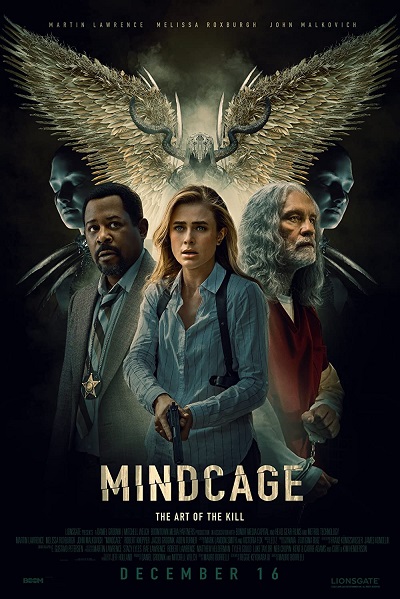
Mindcage: Martin Lawrence Gets Dramatic

Thanks to Silence of the Lambs, dozens of subsequent movies and books featured cops seeking the advice of convicted serial killers to catch newer psychopaths. In real life, this sounds like an incredibly bad strategy, with little up-side. Regardless, people still assume serial killers are all geniuses and the killers themselves style themselves as transgressive artistes, when they are really just cruel, anti-social murderers. The serial killer known as “The Artist” took it to extreme levels. A frighteningly consistent copycat has adopted his M.O., but seeking his insight turns out to be about as dangerous as a rational person would suspect in Mauro Borrelli’s Mindcage, which releases Friday in theaters and on VOD.

Before he was captured and convicted,
The Artist would pose his victims in elaborate art installations that he called his “masterpieces.” Det. Jake Doyle was part of the team that caught him, but his late partner was killed that fateful night, in a bizarre, almost spoilery kind of way. Now he is working the copycat case with Det. Mary Kelly, who will be the one visiting The Artist in prison, because she has a psych degree and no prior history with The Artist that he could use against her.

Of course, he can miraculously tell Kelly where to find clues hidden within the bodies and crime scenes. As the spectacular killings continue, the reluctant authorities even start to consider cutting a deal with The Artist, but that most definitely does not sit well with Doyle.

Mindcage
has been billed as Martin Lawrence’s first role outside of comedy (assuming you do not count Do the Right Thing, which would probably be his most borderline previous film). The truth is, his performance as Doyle is the best thing going for Mindcage. There is a big twist involving his character that maybe you might guess or maybe you won’t, but he does a nice job reflecting it on-screen.

Friday, April 15, 2022

Chariot, with John Malkovich

Everyone who lives at The Lafayette has their thing. Harrison Hardy’s oddity is a recurring dream that his childhood home had an attic, when it really didn’t. It sounds pretty minor, but after dreaming it over 4,000 times, it is starting to bother him. Dr. Karn, his new sleep specialist, shouldn’t inspire confidence, but Hardy goes to him for treatment anyway in screenwriter-director Adam Sigal’s Chariot, which opens today in New York.

Nobody Hardy previously consulted with could figure out his subconscious hang-up, but Karn immediately believes he has a handle on it. He just needs Hardy to come back for a little more counseling, before moving forward with the treatment. He really ought to know, since we are clearly led to suspect the strange doctor is somehow involved in whatever is going on. A lot of the film’s publicity and marketing materials totally give the big secret away, so google
Chariot carefully.

While waiting for his cure, Hardy starts to meet the other residents of the Lafayette, including Maria Deschaines, an actress with whom he feels an immediate connection. In fact, after he starts seeing her, his dream starts to progress a little further, up into the nonexistent attic.

Chariot
either needed to be simpler or considerably more complex. Instead, we just get a handful of people trying desperately to act mysterious and weird. For instance, Scout-Taylor Compton plays a pretty young resident, who supposedly also has the spirit of a crass fiftysomething Englishman coexisting inside her. She has a lot of screentime, but her character[s] have little bearing on the narrative.

Saturday, November 28, 2020

Holiday Gift Guide: Valley of the Gods

This film is like a clown car loaded with symbolism. No matter how hard you try, you will probably never finish unpacking it. It also has some striking natural scenery and a really interesting supporting cast packed in there. Lech Majewski is probably best known in North America for the wonderous “cinematic painting” The Mill and the Cross and he brings the same genre-defiance and distinctive visual sensibility to bear in the fabulistic Valley of the Gods, which is now available on DVD. It would indeed make quite a memorable gift for any fan of Jodorowsky-ish auteurs on your shopping list (but be warned, they will keep talking about it for months to come).

Either a lot happens in
Valley, or maybe not that much. Engineering titan Wes Tauros is about to secure the uranium mining rights for the Navajo Nation’s Valley of Gods (near Monument Valley), where the spirits of their ancestors are thought to reside. The deal has split the community, largely but not entirely along generational lines, between those who value the spiritual over the material concerns and those desperate for greater opportunities.

John Ecas was a copywriter with the Tauros company, but he is now concentrating on his midlife crisis and pining for his wife, who left him for her hang-gliding instructor. On the advice of his unconventional shrink, Ecas has embraced absurdity as a means of therapy. It was during his resulting misadventures that he crossed paths with Tauros, in his incognito homeless avatar. Ostensibly, Ecas is summoned to Tauros’s grand castle in the sky to serve as his Boswell, but the weirdness that unfolds could just be the novel he is finally writing.

There are a lot of visual references going on in
Valley—so much so, astute viewers may start to second-guess how much they are projecting themselves. Regardless, cineastes will inevitably see echoes from dozens of films, starting with the grand vistas of John Ford’s classic Monument Valley westerns. Ecas’ trippy spirit walk brings to mind John Cassavetes dropping-out in Paul Mazursky’s Tempest. Tauros is frequently likened to Howard Hughes within the film, but his Xanadu is also reminiscent of Hearst Castle, while his statue garden is shrewdly compared to the Medusa’s lair. Fittingly, the great Keir Dullea appears as Ulim, Tauros’s trusted butler and confidant, because there are elements of the wildly over-the-top climax that bring to mind 2001.

So, basically whatever you might want to see, you can find in
Valley, maybe even kaiju. Of course, John Malkovich is perfectly cast as the eccentric and arbitrary Tauros. Dullea is aptly mysterious and a little bit unnerving as Ulim. Plus, the great John Rhys-Davies is wonderfully sly as Dr. Hermann, Ecas’s erudite analyst, who we can’t be absolutely sure truly exists. These are three of our favorite thesps, whom Majewski shrewdly uses in ways that play to their strengths.

Thursday, January 24, 2019

Agatha Christie’s The ABC Murders (Still, More or Less), on Prime Video


England wasn’t so merry in the 1930s. The economy was depressed, nativism was on the rise, and war was brewing. Worst of all, the world’s most famous detective had lost his mojo. However, a game-playing serial killer just might get Hercule Poirot back in his groove. The Belgian sleuth must solve his most personal case yet in Prime Video’s three-part miniseries, The ABC Murders (trailer here), directed by Alex Gabassi, which debuts next week.

Poirot has suffered some bad press and his old comrade at Scotland Yard, Inspector Japp, has retired. Young Inspector Crome resents Poirot for making the Yard look stupid—and he isn’t shy about expressing his feelings. Consequently, Poirot’s reception is decidedly chilly when he tries to report the mocking poison pen letters he has been receiving from a psychopath simply calling himself “ABC.”

It turns out alphabetization is a thing for this killer. He is sequentially working his way through the alphabet, killing a victim whose initials match the first letter of the town or municipality where they reside, leaving behind a copy of the ABC railway guide book. The killer also seems to have a thing for Poirot, because each murder is committed in a town Poirot visited.

Gone are the days of Peter Ustinov jovially munching truffles and escargot as the Belgian detective. John Malkovich’s Poirot is guilt ridden and angsty. He also has a tragic backstory no fan ever cared to ask for. Poirot should glide through life enjoying all the finer things, not waste time wallowing in self-pity.

Malkovich is excellent as the dour, depressed Poirot. This is some of his best work in years, but, ironically, he is much more entertaining preening and chewing the scenery in crummy movies like Unlocked than when offers up a rigorously disciplined performance, like his Poirot. Regardless, it is a pleasant surprise to see Rupert Grint looking and sounding like an adult as the stressed out Crome. Eamon Farren is suitably twitch and clammy as the ominous Cust, but it is just doesn’t feel right to see Tara Fitzgerald (Sirens, Hear My Song) playing her fifty-ish age as ailing matriarch Lady Hermione Clarke, Poirot’s greatest fan.

Gabassi and the design team seamlessly recreate thirties England, but fans do no want a dark and moody Poirot. They want sly elegance and a chance to vicariously enjoy the sleuth’s luxurious lifestyle. Frankly, screenwriter Sarah Phelps vastly overstates the popular following of Oswald Mosley and his fellow black shirted demagogues during the 1930s in the UK, but at least she refrains from rewriting Dame Agatha’s original ending, unlike what she did with Ordeal by Innocence. It is compelling to watch Malkovich wrestle with Poirot’s inner demons, but ABC is just too dark and didactic to satisfy admirers of Agatha Christie. Recommended only as a quick fix for British mystery addicts, The ABC Murders starts streaming next Friday (2/1), on Amazon Prime.

Friday, August 17, 2018

Mile 22: Peter Berg Directs Iko Uwais


Unfortunately, Congress will probably have to apply the Magnitsky Act to more Russian officials after this explosive kerfuffle. The Russians has compromised the coms of the CIA’s double-secret tactical unit, to feed real-time intel to the terror-supporting security service of a country not completely dissimilar from Indonesia. Their mission is to extract a source who can pin-point large quantities of stolen cesium-137, but it will be a particularly hard day at the office for James Silva’s team in Peter Berg’s Mile 22 (trailer here), which opens today nationwide.

Silva was a child prodigy, who still has trouble with that human relationship kind of stuff. However, he can most definitely shoot, fight, and make command decisions on the fly. We see his team take out a safe-house full of Russian agents in the prologue, with only one fatality on their side, so you know they must be tough. Flashing forward to the rest of the film, we find Silva is now stationed in Indocarr, or some such, where the embassy team faces a bit of a quandary.

Li Noor was a top asset recruited by Silva’s human intel specialist, Alice Kerr. He has a Mission Impossible-protected disk, loaded with the locations of the missing cesium, but it will self-destruct if Li is not safely delivered out of the country. Silva’s team will escort him to the CIA transport plane, but they will have to drive through downtown Not-Jakarta. It should be easy with “Mother” and his fellow “Overwatch” controllers guiding them from an undisclosed location, butt they take fire from the elite secret police every step of the way.

Admittedly, there are two considerable issues of internal logic that plague Mile 22. For one thing, you would think a prodigy like Silva, who supposedly has to slow down his mile-a-minute thoughts by snapping an elastic band on his wrist would realize: “hey, isn’t it funny they always know exactly where we’re going? Why, it is like they can hear us talking.” Also, since Li is played by Iko Uwais, why not just turn him loose on the goons commanded by the sinister Axel?

Of course, Uwais is definitely the best thing going for the film. He has a featured fight scene in the embassy clinic that is up there with his best work in the Raid franchise. He also adapts quite smoothly to the run-and-gun style of action that is the stock-and-trade of Silva’s team. Mark Wahlberg also definitely has the right kind of commando presence, while credibly portraying Silva slightly on the spectrum.

As you would expect, Ronda Rousey holds up her end as team member Sam Snow, but John Malkovich is disappointingly restrained as Mother. Likewise, K-Pop star Chae-rin Lee (CL) does not have much to do as Overwatch controller “Queen,” but hey, she looks fabulous. On the other hand, former New York Ranger (and one-time Vogue magazine intern) Sean Avery has a dynamite sort-of-cameo as “Assault One,” during the prologue.

Action fans, especially those who dug Wahlberg’s previous films with Berg will be utterly shocked by how dark Mile 22 gets. However, you have to give them credit for going there. That is why it is unfair of kneejerk critics to automatically dismiss the film. Yes, Berg and screenwriter Lea Carpenter invite viewers to celebrate the sacrifices made by the American military and intelligence services to protect our liberty, but Silva’s team pays an awfully high price and swallows some profoundly bitter pills during the course of the film. It will leave audiences in a mood of wary vigilance rather than triumphalism. (Yet, if the film is a hit, the sequel practically writes itself.)

Regardless, it is quite a zippy commando movie that makes good use of Uwais, Wahlberg, and their action co-stars. Accessible but gritty, Mile 22 is recommended for mainstream genre fans when it opens today (8/17) across the country, including the AMC Empire in New York.

Friday, April 27, 2018

Supercon: Taking Down the Con Crud


Fan conventions are quite a shrewd place to pull off a heist-caper. There is tons of cash floating around, as well as a bunch of distracting odors. The cos play will also be handy for five questionable celebrities out for a big score in Zak Knutson’s Supercon (trailer here), which opens today in New York.

As a child actor, Keith Mahar played a cringey Indian stereotype with testicular cancer. Now approaching middle age, he ekes out a living at fan conventions. At least Matt Wheeler was the lead of his canceled TV show. Brock Hutchinson was a legit star in the 1970s, but those days are long gone. On the plus side, he can be much more open about his sexual orientation. Comic book artist Allison McNeeley has real talent, but since when has that ever been enough. They are all regularly exploited by Shatneresque TV space opera icon Adam King and his crooked partner, Gil Bartell, the forces behind the three-day cash cow, Supercon.

When Bartell fires the fab four and threatens to blackball them at other cons, they decide to hit back where it will hurt them the most—their wallets. With the help of respected comic book and screenwriting legend Sid Newberry, they hatch a crackpot scheme to rob the cash fleeced from fans. Thomas Crown would not approve of their minimal preparation, but they have plenty of enthusiasm to compensate.

That is somewhat true of the film as well. The screenplay is basically a clothes line holding a series of gags and rude insults, but it blithely barrels ahead at warp speed. In fact, the ensemble seems to have a go-for-broke spirit, weirdly invigorated by the in-jokes and defiant political incorrectness.

Surprisingly, John Malkovich (yes, the John Malkovich) actually tones it down a little as the Obiwan Kenobi-like Newberry, but he nicely provides the film’s fan-centric ethical compass. Russell Peters makes Mahar an unusually dry and acerbic sad sack loser, which is an accomplishment. Brooks Braselman goes in all for flamboyant shtick as Hutchinson, but he also delivers some cuttingly droll lines. Maggie Grace’s McNeeley is also quite the lethal banterer. Ryan Kwanten is a bit out of his league in their company as the impulsive Wheeler, but Clancy Brown is totally in his element, chewing the scenery as the scenery-chewing King.

Supercon is definitely slapdash, but it would be a blast to watch at one of the bigger Comic Cons. Clearly, Knutson and co-screenwriters Andrew Sipes and Dana Snyder know their con culture. It is hard to imagine actually paying money to see this film in a brick-and-mortar theater, but Supercon has its place in the world and should find an extensive audience. It is not exactly recommended, but this is a film that is bound to find real fans eventually, so you can just wait for it to happen. For the time being, Supercon opens today (4/27) in New York, at the Cinema Village.

Tuesday, February 06, 2018

The Casanova Variations: Malkovich Playing Valmont Playing Casanova Playing Don Giovanni

Giacomo Casanova and Don Giovanni were not the same, but it will become even easier to confuse the two after this film. It is sort of a greatest hits package, combining Casanova’s notorious memoirs with Mozart/Da Ponte arias from Don Giovanni and Così fan tutte, with John Malkovich basically reprising his work from Dangerous Liaisons. He might be the most meta actor ever, because he essentially plays himself, playing Casanova. The confusion is the charm of Michael Sturminger’s adaptation of his operatic mash-up, The Casanova Variations (trailer here), which releases today on VOD.

Don’t let a little anachronism here and there throw you. Sturminger will freely switch back and forth between an ostensibly realistic period production and a semi-traditional opera staging, in which modern props and fourth-wall-breaking will often intrude. It is hard to get our bearings in this meta-meta film and even harder to keep them, so we cannot judge too harshly the doctor who rushes to the stage to treat the apparently fallen (but really just acting) Malkovich. The stage manager does not blame her either, but she will have to watch the rest of the first act from the wings.

Meanwhile, in Casanova’s life, Elisa von der Recke calls on the aging adventurer, supposedly with a proposal from a publisher. He doesn’t believe her for one minute, but there is no way he would ungallantly turn away a young lady. Her interest in his life story is genuine, but clearly it is of a more personal nature, rather than professional.

Variations has all the lush costuming and trappings of high culture, but its gender-bending, reality-problematizing narrative is uber-postmodern. Frankly, it is easy to lose your place in the film, because Sturminger does not throw down enough markers to clearly delineate each sphere. That can be baffling (and rather maddening), but if you just let go and roll with it, Variations will start to come together as a whole.

As you would hope and expect from a film starring Malkovich as Casanova (and as himself, playing Casanova), Variations is often quite witty. Of course, it sounds beautiful, since it cherry-picks the most passionate Mozart arias. Malkovich’s singing voice is so dubious, it becomes the subject of an extended in-joke, but fortunately for the audience, professional baritone Florian Boesch serves as his alternate-alter-ego. Miah Persson sort of serves the same function for Veronica Ferres’ von der Recke, while most of the rest of the cast consists of legit opera singers, including Kerstin Avemo and Kate Lindsey as Casanova’s former lovers and the great Barbara Hannigan as a contemporary.

Sturminger and company make opera weirdly self-referential, in surprisingly gossipy ways. Ever the meta-man, both Malkovich and Casanova send-up their own images, even coyly addressing rumors regarding the former’s sexuality. It is an oddly conceived film, but its compulsive risk-taking becomes quite exhilarating. Recommended for adventurous opera patrons, Casanova Variations releases today on VOD, from Cleopatra Entertainment.

Wednesday, December 06, 2017

Bullet Head: Dogs and Robbers

This dog definitely has a purpose—to bite your face off. He was trained to be a killer, but he exceeded his handler’s expectations. Now he is roaming the decrepit warehouse where a trio of hard luck thieves hope to regroup and lay low after pulling their latest job. Good luck with that. The killer dog movie gets a gangster twist in Paul Solet’s Bullet Head (trailer here), which opens this Friday in New York.

We can have confidence in a jaded old crook played by John Malkovich. That is less true for his younger but nearly as jaded associate portrayed by Adrien Brody, but we can give him the benefit of the doubt. However, we assume the worst about their junky accomplice, with good reason—he is played by Rory Culkin. They have holed up in a squalid former warehouse, waiting for their getaway ride, but they are not alone. Cujo is also roaming the halls, but he was known as DeNiro during his dog-fighting days. His trained assumed those days were over after a particularly nasty battle royale, but he assumed wrong—fatally wrong.

The larcenous trio mostly concentrate on eluding the homicidal pooch, which does indeed require their full efforts. However, they eventually come to realize he is part of a particularly evil criminal enterprise, whose mastermind will most likely be returning sometime soon, to look for his now dead accomplice and the bag full of money from the last fight.

Solet’s feature debut Grace was weirdly over-hyped, but his follow-up release Dark Summer and his contribution to the anthology film Tales of Halloween were quite sly and pleasingly sinister. He shows even greater range this time around, mashing up horror and Elmore Leonard-esque crime elements into a hybrid that defies all expectations.

Of course, Solet has Malkovich doing Malkovich, which is a rock-solid foundation to build on. This is a weirdly discursive film, featuring several stories within the main narrative, but that definitely plays to Malkovich’s let-me-tell-you-a-thing-or-two strengths. Brody’s hound dog face also works well in the context of the film. In contrast, we just want to give Culkin a good slapping, but that is how we are supposed to feel about him. Plus, Antonio Banderas is absolutely not fooling around as the all-business, seriously malevolent dog-fighting gangster. He is hardcore, for real.


At this point, the combination of Banderas and Brody might suggest straight-to-DVD retro cash-ins, but Bullet Head is a straight-up good movie. It also suggests Banderas is a dog who can learn new tricks, while Malkovich’s old tricks are still just as entertaining as they have always been. Highly recommended for fans of heart-warming dog movies, like The Pack and White Dog, Bullet Head opens this Friday (12/8) in New York, at the Village East.

Tuesday, November 14, 2017

Michael Apted’s Unlocked

During the Cold War, there were a number of traitors who did indeed betray America and the UK for ideological or pecuniary reasons. In the current War on Terror era, the prospect of living large as a hero of the Caliphate has thus far been far less tempting. Yet, cynical thrillers need turncoats, so now we have the highly placed official who is so disgusted with Western softness, he or she secretly pulls strings to help the Islamists detonate a nuke in the Earth’s core that will send the remaining fragments of our planet hurtling into the sun, all for the sake of waking us up to the dangers of terrorism. This is one of those. It is a shame Peter O’Brien’s CIA-disparaging screenplay bends over backwards to equate Western intelligence services with Islamist terrorism, because it wastes some jolly nice supporting performances in Michael Apted’s Unlocked (trailer here), which releases today on DVD.

Alice Racine is a highly trained CIA interrogator, but she has been slumming in a low-level cover position after she “unlocked” her last subject slightly too late to prevent a terrorist attack in Paris. However, when a courier is intercepted ferrying a verbal message to a major U.S.-born terrorist from his London-based spiritual advisor, she reluctantly swings back into action. However, halfway through the unlocking process, she gets a call from her Langley handler, telling her to sit tight, because they have this courier they need her to unlock.

Obviously, there is a high-placed traitor in the agency, but with eye-rolling predictability, Racine is assumed to be in league with the shadowy squad that intercepted the now deceased courier. Racine goes on the run to ferret out the traitor with the wink-wink encouragement of her MI5 colleague Emily Knowles and back-up provided by Jack Alcott, an ex-military cat burglar, who happened to be in the wrong place at the wrong time (or should that be the right time?).

Aside from the moral equivalency, O’Brien’s screenplay is also ridiculously predictable. If someone looks like they have a treasonous haircut, you can bet they will be doing some third act back-stabbing. However, there are two reasons to possibly consider soldiering through Unlocked, should all your other entertainment options fail: John Malkovich and Toni Collette. Malkovich is laugh-out-loud hilarious as the wickedly snide CIA operations director Bob Hunter. We can only hope there is someone with that kind of take-no-prisoners attitude protecting our country. However, Collette totally hangs with him as the incisive and sophisticated Knowles. When they spar, the film becomes a thing of beauty. In contrast, Noomi Rapace basically punches the clock as Racine, while Orlando Bloom telegraphs his character’s secrets from a mile away.


Still, Apted keeps it all chugging along smoothly enough. As a director, he is hard to classify, landing somewhere on the spectrum between journeyman and auteur. Besides the Up series of documentaries, Apted has helmed a Narnia film, episodes of Showtime’s Masters of Sex, a Bond movie, Coal Miner’s Daughter, and Sting’s “I Burn for You” video, so it is safe to say nearly everyone has seen his work. Unfortunately, Unlocked is no Gorky Park, but it is not really Apted’s fault—and Malkovich and Collette certainly are not to blame. The fundamental premise is simply too unlikely and too stilted. Not recommended, Unlocked is now available on DVD.

Sunday, October 07, 2012

NYFF ’12: Lines of Wellington


Torres Vedras was not exactly Waterloo, but don’t tell the Portuguese that.  It was there Gen. Wellington and the combined British and Portuguese troops he commanded defeated Napoleon’s invading army behind secretly commissioned fortifications.  An epic campaign that still resonates on the Iberian Peninsula, Wellington’s military sojourn in Portugal was perfect fodder for a grandly sweeping Raúl Ruiz film, but it was not to be.  Passing away during a stage of either late development or early pre-production, Ruiz’s widow Valeria Sarmiento stepped into the master’s shoes, helming Lines of Wellington (trailer here), which screens during the 50th New York Film Festival.

Wellington has just shocked the French with tide turning victory at Buçaco, yet he is retreating anyway.  Despite the demoralized state of the Bonaparte forces, they simply have an overwhelming numerical advantage.  The British and their Portuguese allies will dig in behind the Torres Vedras ramparts, letting time fight the battle for them.

This is classic Nineteenth Century warfare, attracting spectators and hanger-ons.  For British evacuee Clarissa Warren, it is the perfect opportunity to find an officer-grade husband.  The distinguished Major Jonathan Foster looks like a good candidate, but he is not necessarily in the market for a trophy wife.  Wounded soldiers will recuperate, romances will blossom, combatants will ravage the local populace, and spies will be dealt with.  Yet, the real story for LOW’s domestic audience is scorched earth damaged wrought by the French and British on their native land.

Condensed from a longer Portuguese miniseries for the international festival circuit, a la Ruiz’s brilliant Mysteries of Lisbon, LOW is a rangy narrative, featuring scores of prestigious cast members, entering and exiting in maddeningly quick succession.  Unlike Mysteries, viewers will definitely feel like there are holes in LOW, at least in its current festival edit.  There are numerous promising subplots here, including Foster’s relationship with the rather forward Warren.  Yet, after being introduced early on, they disappear from film until the closing scenes.  Likewise, when Chiara Mastroianni appears as Hussar, sort of a Bonapartist Emma Peel, it looks like a promising development, but her mere seconds of screen time do not appreciably advance the story.

The only characters getting a puncher’s chance at development are the General himself and Francisco Xavier, a dispossessed farmer now serving as a Sergeant in Wellington’s Portuguese auxiliary and as the film’s primary POV character.  Fortunately, Nuno Lopes has the right rugged, world-weary presence as the disillusion soldier, while John Malkovich chews the scenery like an old pro as the British commander.

LOW definitely has its moments, including a genuinely moving conclusion.  Not intended as an action movie, it powerfully recreates the aftermath of battle, rather than the actual warfighting.  Yet, one wishes it had delved more deeply into the strategic chess game in play, particularly Wellington’s penchant for strategic retreats, which suggest he might have learned something from a certain General Washington.

Even at one hundred fifty-one minutes, there still seems to be something missing from LOW.  It has plenty of the elements to satisfy fans of historical costume drama, but the Around the World in Eighty Days style cameos from the likes of Michel Piccoli, Isabelle Huppert, Catherine Deneuve, and Mathieu Almaric are more frustrating than satisfying.  Laudably ambitious, Lines of Wellington is ultimately more notable for what it represents than as a self-contained film.  Nonetheless, interested viewers ought to satisfy their curiosity, because they may not have many opportunities to see LOW in any form.  It sceens this Monday (10/8) and Tuesday (10/9) as a main slate selection of the 2012 New York Film Festival.

Wednesday, September 16, 2009

Coetzee’s Disgrace

When J.M. Coetzee’s Disgrace was first published, the South African Nobel Laureate became the first writer to ever win a second Booker Prize, the prestigious British literary award. Shortly thereafter, he immigrated to Australia. While it might be a writer’s job to hold a mirror up to society, it seems Coetzee’s native country was still not ready to look into it. As adapted by director Steve Jacobs, Disgrace (trailer here) is a deeply troubling depiction of South African society that opens Friday in New York.

Apartheid has fallen, but Disgrace’s South Africa is hardly a post-racial society. Rather, it is hyper-racial. Professor David Lurie has yet to fully appreciate this though. As the film opens, his primary racial considerations involve his carnal desires. After a mixed-race prostitute spurns his growing attachment, he shifts his attention to a student. When his unwelcome desire escalates into harassment, it causes a scandal that ends his academic career. Given the steady erosion of the prestige and privilege of his position, Lurie takes his disgrace in stride. Still, he finds it advisable to leave town temporarily, so he visits his somewhat estranged daughter Lucy in the countryside.

If not exactly overjoyed to see Lurie, she initially appreciates the novelty of his visit, notwithstanding the precipitating circumstances. Lurie even makes an effort to fit in, helping out with her flowerbeds and volunteering at a local animal clinic. However, he can not shake his vague suspicions of Lucy’s neighbor and supposed protector Petrus. Then one afternoon, when Petrus is conveniently absent, everything changes.

Three young boys brutalize Lucy, while the severely beaten and burned Lurie is powerless to intervene. As bad as the attack was, the aftermath is even more painful for Lurie. Despite Lucy’s silent indictment of his ineffectualness, she refuses to report the assault to the police. When they later discover one of their assailants is a kinsman of Petrus under his protection, Lucy expressly forbids any confrontations, determined to bear her pain as her share of the collective guilt engendered by white South Africans.

Screenings of Disgrace are not likely to become a Mandela Day tradition anytime soon. It portrays a post-Apartheid South Africa paralyzed by vengefulness and white guilt—a perfect storm of social pathologies. It is not a story of false hope, but weary resignation.

John Malkovich is riveting as Lurie, convincingly portraying his humbling transformation. However, as Lucy, Jessica Haines is hobbled by a character that too often seems to be acting as a symbol than a believable human being. Still, the raw honesty of Coetzee’s story has an undeniable power that Anna-Maria Monticelli’s screenplay preserves, addressing the dramatic situations directly without resorting euphemism. Using the Australian outback as a stand-in, Disgrace also effectively captures the savage beauty of South Africa’s semi-arid highlands, a land that seems to exert a persistent hold on its residents, despite the danger of its remoteness.

Disgrace is often a challenging film to watch, but it is gripping, highly literate drama. It is frankly impressive how uncompromising it is, given the hot button racial issues it tackles. Disgrace opens Friday (9/18) at the Quad.

Friday, August 14, 2009

Have Faith: Mutant Chronicles

Mutant Chronicles
Directed by Simon Hunter
Magnolia Pictures

Where can you find a positive portrayal of religious faith in the movies today? Evidently, one has to look to the year 2707, on an Earth about to be over-run by mutant hordes. Based on a role-playing game, Simon Hunter’s Mutant Chronicles (trailer here), has the virtue of treating themes of faith and sacrifice with respect, which makes for surprisingly interesting viewing now that it is available on DVD.

Make no mistake, Mutant is about one thing: killing mutants. Set in an oddly steam-punkish future, four superpowers are locked in a constant state of battle, transporting armies via rocket ship so they can engage in trench warfare reminiscent of World War I. Unbeknownst to the combatants, centuries ago an ancient monastic order sealed an alien mutant factory beneath their mystic manhole cover. When the warring parties accidently break the seal all bets are off for the Earth. However, Brother Samuel has faith.

With a ragtag team of volunteers led by Major Mitch Hunter, the monk journeys into the bowels of the mutant lair to fulfill an ancient prophecy. It might be the apocalypse, but Brother Samuel is still able to recruit a scrupulously diverse team. Much shooting and a fair amount of hacking-and-slashing ensues.

Mutant essentially follows in the tradition of shoot-em-up creature films, featuring some fairly well staged action scenes. In fact, the gritty opening sequence is particularly effective capturing the confusion when the rampaging mutants surprise two warring factions. Sure, sometimes the film makes no sense at all, like when the intrepid band jumps off a bridge to attack some mutants, thereby giving up their advantage of the high ground, but that just seems to go with the mutant-zombie killing territory.

Still, what distinguishes Mutant is indeed the role faith plays in the story, providing the initial impetus for Brother Samuel’s mission and sustaining it during the darkest hours. Although not explicitly identified as such, his order bears a certain resemblance to Christianity, or at least a variant which presumably evolved over the troubled centuries.

As the good brother, Ron Perlman brings instant genre credibility to Mutant, despite playing a heroic character for a change. Sean Pertwee (the son of John Pertwee, the third Doctor Who) is appealingly hardnosed as Hunter’s ill-fated commander Nathan Rooker. Devon Aoki is also appropriately attractive as the gun-toting Duval and John Malkovich chews the scenery with relish in a brief cameo as Constantine, the leader of the Capital Corporation. Unfortunately, Thomas Jane is a bit too stiff and sullen as the square-jawed Hunter.

Bolstered by several enjoyable supporting performances, Mutant is a reasonably diverting sci-fi action excursion. Probably its greatest drawback is the lack of a strong villain to counterbalance Brother Samuel and company. As a midnight movie though, it moves along at a nice clip and has a refreshingly unusual religious subtext. Altogether, genre fans should find it worth checking out on DVD.