Showing posts with label Kim Jee-woon. Show all posts

Thursday, February 08, 2024

Kim Jee-woon’s Cobweb

It was a time of censorship, but not necessarily Puritanism. Director Kim Yeol is a 1970s Korean filmmaker was a long stretch of lurid sexual potboilers under his belt. His first film was critically acclaimed, but many suspect it was greatly shaped by his mentor, Director Shin, who died during its production. He now has a vision for how to make his latest film a masterpiece, but neither his studio boss nor the censors want to let him recall the cast for reshoots. He will just have to work around them in Kim Jee-won’s Cobweb, which releases tomorrow in theaters and on VOD.

Director Kim is absolutely not based Kim Ki-young, the late cult filmmaker best known for the original
The Housemaid, as his heirs and the producers of Cobweb clearly established through an arbitration agreement. No, this “Director Kim” has been grinding out trashy thrillers since his tragic debut made a notorious splash. After wrapping his latest movie, also titled Cobweb, he literally has a flash of inspiration, prompting him to rewrite most of the second half.

President Baek, the studio boss and Director Shin’s widow, does not want the additional expenses and the state censors will not approve his new pages, because they are weird, especially the ending (which is true). However, Shin Mi-do, Director Shin’s niece and the studio finance chief, recognizes the brilliance of his revisions. She also has an in with the head of the censorship office, so she approves his reshoots while her aunt is out of the country on business. Since they are revising extensively, the one promised day of reshoots will not be sufficient, so Mi-do literally locks cast and crew inside the soundstage. Chaos and tension ensue.

Cobweb
is sort of like Noises Off with the pressure of state censors looking over everyone’s shoulders. The manic farcical action is a bit of throwback to Kim Jee-woon’s zany The Good, the Bad, the Weird, from the filmmaker better known for darker horror and thrillers like I Saw the Devil, The Age of Shadows, and Dr. Brain. Some of the supporting characters are maybe a bit too wacky, like the method actor playing a detective, who pretends to investigate Director Kim, to stay in character. However, the way the film-with-the-film evolves and takes on greater significance as we learn Director Kim’s backstory is quite clever.

In fact, the black-and-white retro-horror-looking scenes from the fictional film are wonderfully stylish and affectionately droll. Director Kim’s “weird ending” lives up to its promise. Kim Jee-won and cinematographer Kim Ji-yong stage some incredible sequences, like Director Kim’s long climatic tracking shot, which we see from an incredibly messy behind-the-scenes perspective and as a finished product. In fact, their use of the sealed soundstage and its impressively designed sets is consistently inventive.

Thursday, November 04, 2021

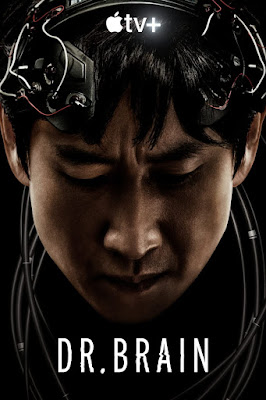
Kim Jee-woon’s Dr. Brain, on Apple TV+

Brain scientists are often a little socially awkward, at least in movies and TV, but Dr. Koh Se-won takes the brain biscuit. He can literally get inside peoples’ heads, but it is almost impossible for him to open up to anyone, not even his wife and son. However, when they are taken from him prematurely, he just so happens to have technology to help him get answers, from other people’s memories. Of course, as with any great innovation, his revolutionary process comes with unforeseen side effects and complications in Kim Jee-woon’s six-episode Dr. Brain, adapted from Hong Jac-ga’s web-comic, which is now streaming on Apple TV+.

The exact circumstances are not spelled out, but Koh was born with a different brain structure that contributed to his intellectual brilliance, but also put him somewhere on the spectrum. Despite his impassive emotional reserve, he marries Jae-yi and they have a son, Do-yoon, who is very much like his father. Unfortunately, Do-yoon was killed in a freak accident, from which Jae-yi never recovered—except maybe he didn’t. Suddenly, Dr. Koh has reason to wonder.

Using his handing-dandy brain-synching apparatus, Koh is able to transfer memories from recently dead brains into his own. It is a process he is still refining. It turns out he also inadvertently synchs many of their skills and instincts. However, the process is dangerously erratic when attempted with a living brain. Instead of true memories, Dr. Koh is flooded with images from their subconscious. Regardless, each time he synchs, his brain absorbs another huge download. If it were not for his atypical brain structure, he probably could not handle it.

Dr. Brain
follows in the tradition of psyche-plumbing thrillers like Spellbound, Battle of Memories, and Dreamscape, where the subconscious is an equally important setting for the drama to play out as the offices and homes of its primary characters. It definitely plays to the strength of genre auteur Kim (Age of Shadows and I Saw the Devil), who brings a bit of a horror sensibility to first installment (a la Flatliners), before setting into psychological-thriller bag for the following five episodes. There are some devilishly inventive developments, including a brain-synch with a cat. Yet, Kim always keeps the conspiracy-driven tension and suspense cranked up high.

Lee Sun-kyun (the “have” father in
Parasite) does the nearly impossible. He scrupulously maintains Koh’s emotional frozen nature, while making us care about his plight. Lee also believably portrays the changes that come over the scientist as he continues to transfer other people’s memories and feelings into his brain-basket. It is a real challenge, but he totally pulls it off.

Yet, the fan favorite of
Dr. Brain is sure to be Park Hee-soon, who is wonderfully sly and grizzled as private investigator Lee Kang-mu. He and Koh come to collaborate together in an inventive way that would be spoilery to reveal. Regardless, whenever he comes on-screen, everything kicks up several notches. Seo Ji-hye does not get much backstory or character development as the cop investigating the bodies that start to pile up, but she is appealingly no-nonsense and quite credible in her action scenes.

Wednesday, September 28, 2016

Submitted by Korea: The Age of Shadows

It was something like a Korean Operation Anthropoid. In 1923, the demoralized resistance pulled off a spectacular bombing of Japanese police headquarters. It turns out, it was an inside job. Hwang Ok, a Korean officer on the despised Japanese constabulary turned yet again. Frankly, even his thinly fictionalized analog is precisely sure where his loyalties lay in Kim Jee-woon’s The Age of Shadows (trailer here), Korea’s official foreign language Oscar submission, which is now playing in New York.

As a Korean on the Japanese force, it is Lee Jung-chool’s job to be a rat. His former friend, the high-ranking resistance agent Kim Jan-ok makes that explicitly clear when he opts for death rather than capture. The incident so rattles Lee, it leaves him receptive to the overtures of Kim Woo-jin, a rising star in the Righteous Brotherhood—or so Kim thinks.

Despite having Hashimoto, a ruthless counter-insurgency copper, constantly looking over his shoulder, Lee manages to play both sides and keep his options open throughout the first two acts. However, the longer he goes without busting his new pal Kim Woo-jin, the closer he comes to switching sides, like Captain Renault in Casablanca. This becomes uncomfortably clear to Lee when all parties end up on a Hitchcockian train bound from Shanghai to Seoul, with a huge shipment of explosives stashed in the cargo car.

Although Age does not exhibit the exquisite lunacy of I Saw the Devil or The Good, the Bad, the Weird, Kim Jee-woon still clearly delights in tweaking and amping up the conventions of the historical espionage thriller. His convoluted plot makes a John le Carré novel look simplistic and he certainly hasn’t gotten shy about staging a shootout. It is not quite the all-out action Nirvana of Choi Dong-hoon’s Assassination, but it still delivers plenty of bang for your buck. The titular echoes of Jean-Pierre Melville’s Army of Shadows are probably not accidental either. There are so many double and triple crosses, Lee essentially loses track of whose side he is on.

Korean superstar Song Kang-ho (looking pretty trim) is terrific as the conflicted Lee. He really humanizes the dilemma between pragmatic but dishonorable survival and the patriotic idealism that would most likely get him martyred. Gong Yoo (recognizable from the monster hit Train to Busan) also gives flesh-and-blood dimension to the earnest Kim Woo-jin. Han Ji-min further boosts the glamour and the tragedy as Yun Gye-soon, the secretary to charismatic resistance leader Jung Chae-san (Lee Byung-hun in a memorable cameo) and Kim’s secret love interest.


If viewers are okay with the deaths of dozens of characters we come to know and root for, then Age of Shadows is tons of fun. Most likely it will be way too much fun for that stick-in-the-mud Oscar, but there is no reason we can’t enjoy it. Enthusiastically recommended for fans of period action and espionage films, The Age of Shadows is now playing in New York, at the AMC Empire.

Sunday, July 07, 2013

NYAFFF ’13: One Perfect Day (short)

Let’s review.  If the characters are on a blind date, it’s a rom-com, but if they are internet dating, it’s a horror movie.  Yes, Korean horror master Kim Jee-woon indeed crosses over to the sunnier side of the street (let’s hope temporarily) with his pleasant short film One Perfect Day (trailer here), which screens today as part of the mighty 2013 New York Asian Film Festival.

Woon-chul badly wants to meet Ms. Right, so he gamely accepts a series of blind dates.  Unfortunately, that is really not a good forum for him.  Nonetheless, he makes a spectacularly counterproductive effort with Yoo-jin.  She is clearly not a good fit for him, but he drags her into a large municipal park (in heels), hoping to win her over through a game of rock-paper-scissors.  It might seem like a dubious choice, but he has his reasons.  However, she still is not the one.  That might be Eun-hee, who appears when and where Woon-chul least expects to find her.

Commissioned by a Korean sporting goods firm to celebrate their fortieth anniversary, OPD is light years removed from Kim’s brilliantly disturbing I Saw the Devil and his underperforming Hollywood debut, The Last Stand (here’s a marketing tip: putting Johnny Knoxville in a hat with ear flaps on your one-sheet will not necessarily guarantee box office gold).  OPD has its charms though, especially when Korean superstar Park Shin-hye lights up the third act.  Still, Yoon Kye-sang’s Woon-chul is so manically keen, it is hard to blame Yoo-jin for wanting the heck out of there.  In fact, viewers might find themselves rooting for Park Soo-jin and her perfect WTF expressions.  Nonetheless, Kim brings it all together with a payoff that implies much, but is quite satisfying.

To serve its promotional function, OPD is findable on the internet, but cinematographer Kim Woo-hyung’s rich use of light and color should look fantastic on a big screen and Kim Jee-woon is definitely a big picture director.  In any event, it is an entertaining short film, making it a nice bonus for Korean rom-com fans when it screens with the feature How to Use Guys with Secret Tips tonight (7/7) and Thursday (7/11) at the Walter Reade Theater, as part of this year’s NYAFF.

Tuesday, October 16, 2012

HIFF ’12: Doomsday Book


The Singularity has become a frequent theme of science fiction novels in recent years, but it has not factored into many films or television shows.  Finally, a bold Korean end of the world anthology feature tackles the Singularity, from a wholly original angle.  There will also be Mad Cow infected zombies and a giant interstellar billiard ball on a collision course with Earth in Yim Pil-sung & Kim Jee-woon’s Doomsday Book (trailer here), which screens during the 2012 Hawaii International Film Festival.

Yim’s lead-off Brave New World is a zombie flick Oprah could get behind.  Military research scientist Yoon Seok-woo finally meets an attractive woman who seems interested in him.  Unfortunately, she indulges his taste for barbeque.  He should have humored her vegan inclinations.  Yoon will be among the first turned into violent, vomiting zombies by widespread contaminated beef.

Frankly, Brave largely plays like an epidemic movie, such as Park Jung-woo’s recent Deranged, except with liberal helpings of gross-out humor.  It hardly blazes any genre trails, but Koh Joon-hee’s sensitive work somewhat humanizes the bedlam as Yoon’s potential love interest.

Kim’s middle story, Heavenly Creature, is something else entirely.  In-myung, a robot owned by a Buddhist monastery, has reportedly attained not just consciousness, but also enlightenment.  A technician has been summoned in hopes that he can tell whether RU-4 unit (a nod to Čapek’s R.U.R., perhaps?) is actually the Buddha.  This request confuses him to the point of peevishness.  Yet, he is still reluctant to immediately implement the UR Company’s harsh protocols regarding newly sentient robots.

Gorgeously shot by cinematographer Kim Yi-yong, Heavenly is an unusually thoughtful genre outing that quietly packs a powerful punch.  While dealing with some heady subject matter, including the meaning of life and the Singularity, he also coaxes some deeply affecting performances from his cast, particularly from the Kim Gyu-ri as the Bodhisattva Hye-joo, who desperately tries to save the enlightened robot.  This is truly an award caliber film.

The concluding Happy Birthday fits somewhere between the prior two films in terms of intelligence and quality, which makes a certain amount of intuitive sense, considering it was co-directed by Yim and Kim.  A giant eight-ball is hurtling towards Earth and young Park Min-seo might have inadvertently summoned it, but only her goofy uncle takes her seriously.

Unlike the first two constituent short films, Birthday really delivers on its doomsday promise, rendered with some reasonably presentable sci-fi special effects.  Yet, it is also strangely upbeat, positively portraying the resiliency of the family unit, albeit a rather eccentric one in the case of the Parks.  It also savagely skewers the Korean media’s talking heads.  Led by the impressive young Jin Ji-hee, Birthday’s small ensemble nicely darts back and forth between comedy to drama, without skipping a beat.

Ranging in quality from okay to outstanding to quite good, the films constituting Doomsday Book probably average out to very-good-plus.  Regardless of the pseudo-math, Kim’s Heavenly Creature is so strong, it single-handedly earns the film a very high recommendation.  Fit for SF geeks and the philosophically inclined, Doomsday Book screens tomorrow (10/17) and this Sunday (10/21) as part of the 2012 HIFF.  The centerpiece selection of this year’s NYAFF, it should have plenty of action ahead of it on the festival circuit.

Thursday, March 03, 2011

Kim Jee-woon’s I Saw the Devil

According to the old adage, “it takes a thief to catch a thief.” A grieving Korean secret service agent applies a similar principle to his own quest for justice. Since his quarry is a serial killer, you can expect some serious bloodletting. Straddling the K-horror and thriller genres in the tradition of Silence of the Lambs, Kim Jee-woon’s I Saw the Devil (trailer here) will not be for the faint of heart when it opens in New York this Friday.

Soo-hyun was the last person to talk to his fiancée Ju-yeon before she was abducted by Kyung-chul, a merciless sexual predator. Profoundly guilt-ridden, Soo-hyun uses his connections, including Ju-yeon’s retired police chief father, to identify the leading suspects. They are all guilty of something, but at least those not involved in her murder are dispatched relatively quickly. Kyung-chul is a different story.

Soo-hyun understands merely killing his prey will not suffice. An elder statesman of sorts amongst sex fiends, Kyung-chul has to experience suffering like Ju-yeon did, if the rogue agent is to be satisfied. Thus begins a brutal game of catch-and-release. However, Kyung-chul’s cunning animal intelligence cannot be underestimated, as each successive round raises the stakes and endangers new innocents. As for Soo-hyun’s soul, it is probably well beyond redemption.

When the final credits roll, Devil will leave most viewers in a state of shock. Though there are scenes of genuinely disturbing graphic violence, this is not torture porn—not even close. In fact, it is more closely akin to Greek tragedy. Indeed, it is the emotional torment rather than physical violence that truly defines the film.

If not exactly subtle in his approach, Kim keeps the intensity amped up to nearly exhausting levels. Tightly executed every step of the way, he has crafted a relentlessly effective cat-and-mouse thriller. Granted, this is the cinematic equivalent bloody red meat, but on that level it works frighteningly well.

Though not as flamboyant as a Hannibal Lector, Choi Min-sik conveys an absolute horror show of twisted malevolence beneath his banal façade. Likewise, Korean superstar Lee Byung-hun projects a visceral sense of pain and rage. Watching them face-off is unforgettable cinema. Although she appears tragically briefly, Oh San-ha is also quite devastating as the ill-fated Ju-yeon.

Viewers who have any reservations whatsoever about Devil should steer well clear. It is a film that will stay with audiences, whether they want it to or not. Light years darker than Kim’s whiz-bang period shoot-em up The Good, the Bad, the Weird, it delivers a different batch of genre goods. For those who understand what they are getting into, Devil is a powerful film, just like a shot to the gut. Recommended with the preceding caveats, it opens this Friday (3/4) in New York at the IFC Center.

Tuesday, April 20, 2010

The Wild East: The Good, the Bad, the Weird

It is the land of wide open spaces, where men live and die by the gun. Welcome to Manchuria—the wild East. By the 1930’s, the Japanese occupation of Korea was well into its fourth decade. With limited opportunities in their homeland, three Korean expatriates seek fortune and glory (particularly the former) in Kim Jee-woon’s genre defying adventure extravaganza, The Good, The Bad, The Weird, an official selection of the 2008 Cannes Film Festival, which opens this Friday in New York.

Fittingly, GBW starts with a double cross. A wealthy Korean collaborator has sold a treasure map to the Japanese. Being greedy and deceitful, he hires the notorious outlaw Chang-yi to steal it back. Unfortunately, Tae-goo, a rival bandit who personifies the adage “it is better to be lucky than good,” robs the train before Chang-yi can. As his gang arrives late on the scene, bounty hunter Do-won also appears. Though he has a name, he is definitely a gunslinger in the nameless Eastwood tradition. The ensuing three-way crossfire sets the tempo for the bigger-than-life action sequences to follow, borrowing as much from Raiders of the Lost Ark as from The Good, the Bad, and the Ugly.

While GBW might inspire comparison to Takashi Miike’s Eastern spaghetti western mash-up, Sukiyaki Western Django, Kim’s take boasts at least twice the inspired lunacy with a fraction of the on-screen cruelty. Still, do not misunderstand. Life is already cheap in Manchuria as the film opens, and Chang-yi is about to hold a fire sale.

GBW
would be a great starter film for action fans looking to expand their horizons into Asian cinema. With plenty of backstabbing and guns blazing, it careens along at a breakneck pace. Yet, many of the action scenes are remarkably well staged, nearly epic in scope. Indeed, the sight of Tae-go weaving in and out of Japanese artillery fire on his motorcycle while chased by two opposing gangs on horseback is definitely big, adrenaline-charged filmmaking that puts to shame many of Hollywood’s recent tent-poles.