Monsters are like bad movies. Nobody intentionally sets out to make either one, but they happen anyway. In
this case, Vicaria’s intentions are good. She wants to resurrect her older
brother Chris, who was killed far too young. Of course, playing God always
turns out to be an act of dangerous hubris in films, as is indeed the case in
Bomani J. Story’s The Angry Black Girl and Her Monster, which opens
today in theaters.
According
to Vicaria, she isn’t just trying to bring Chris back to life. Her true
spiration is to cure death. If she could cure taxes too, that would be great. Obviously,
she is aware of Mary Shelly’s Frankenstein, because she labeled her lab journal
“The Modern Prometheus.” Story also has seen a few Frankenstein films in his
time, judging from the crackling electricity that powers her experiments and a pivotal
line of third act dialogue that transparently echoes Bride of Frankenstein.
Heck, maybe Vicaria’s surname is even Frankenstein. It is coyly never revealed,
but we know it is unusual and sounds “German.”
Like
every Frankenstein Monster, the re-animated Chris turns out to be far more
violent and far less rational than Vicaria hoped. At least he has plenty of
potential victims in their economically depressed neighborhood. There are the
cops everybody hates and Kango’s drug gang, who prey on their human frailties.
Sadly, Vicaria’s father has been one of their regular customers, since her
mother was killed by a stray bullet.
In
terms of style and tone, Angry is somewhat akin Michael O’Shea’s The Transfiguration. Without question, Story emphasizes the socio-economic
circumstances of the characters, but it is not as didactic as you might fear.
True, Vicaria’s best friend Aisha is all-in for woke Columbus rants, but they
sound as counter-productive as Vicaria’s experiments turn out to be.
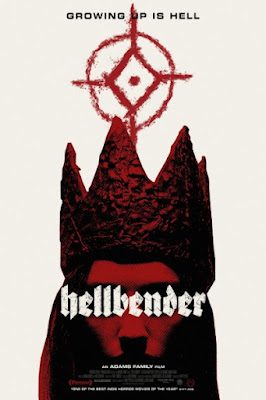
This film is a lot like Terms of Endearment, The Joy Luck Club, and Mermaids,
except the mother and daughter are witches. Technically, the mother uses the
term “Hellbenders,” because it is heavier and more loaded with symbolic meaning,
to better suit their dangerous powers. In any case, if you think witches, you
get the general idea when the daughter, Izzy, learns their true nature in the
Adams Filmmaking Family (mother Toby Poser, father John Adams, and daughter
Zelda Adams)’s Hellbender, which premieres this Thursday on Shudder.
The
mother has always homeschooled Izzy in their remote mountain cabin, claiming
she has a rare autoimmune disease. She also carefully maintains a vegan diet
that looks truly inedible (pinecones and whatnot). If anyone strays too close
to their property, she makes them disappear, literally. However, when Izzy
accidentally stumbles across some kids her age, their teen ways start triggering
her powers.
It
is impressive to see the Adamses release another ultra-DIY horror film,
following the success of the super-cool The Deeper You Dig. While Hellbender
takes a deep dive into folk horror, it is not quite as exhilaratingly original
as their debut. There are some very creepy sequences in Hellbender and
they shrewdly embrace the nostalgia of their lo-fi old school effects, but the
story feels much more familiar. Also, the mother-daughter performances as a
hardcore rock duo somewhat break up the film’s flow—and let’s face it, free
jazz would have been much scarier.
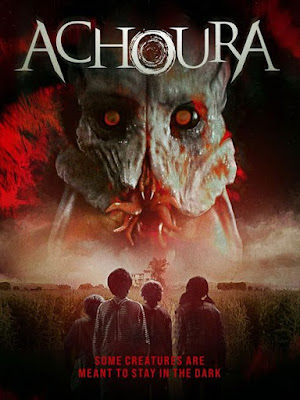
It is hard to enjoy “La Nuit des Enfants,” Morocco’s annual children’s night
festival, when you are a child bride married to a creepy sixty-year-old. The
injustice of Bashira’s situation leaves her particularly vulnerable to a demon
named Bougatate. Her flashback starts the story, but she certainly won’t be its
last victim in Telal Selhami’s Achoura, which releases Tuesday on DVD
and VOD.
Achoura
has
been likened to a Moroccan IT, but for a while, the multiple early
flashbacks make it difficult to understand why. Years after Bashira’s fateful “Children’s
Night,” a group of four friends barely survive an encounter with it, but frankly,
Ali’s brother Samir draws a rather unfortunate fate.
That
was twenty years ago. Despite a pledge to never forget what happened, Ali and his
wife Nadia have largely repressed the incident. However, their estranged friend
Stephane still recollects it vividly, as we can see from his morbid paintings
and performance art. However, they must start remembering when Bougatate is
inadvertently unleashed.
Yes,
the kids who barely survived the monster must reunite to defeat it. Despite
structural similarities to King’s novel (and a lot of tall grass), Achoura is
stylishly creepy. Selhami has a great eye for visuals and the folkloric
elements add further layers of archetypal resonance. However, it really takes about
half-hour for him to finally establish how the first six or seven scenes relate
to each other.
In 2021, Germany perversely specialized in inflicting misery on Europe. Much
to the free world’s chagrin, they forced through Nord Stream 2, Russia’s energy
extorting pipeline, for purely mercenary reasons. There is also a rather
sinister German Christmas relic that brings fear and woe to those who receive
it. The obvious religious significance of Advent is completely ignored in this
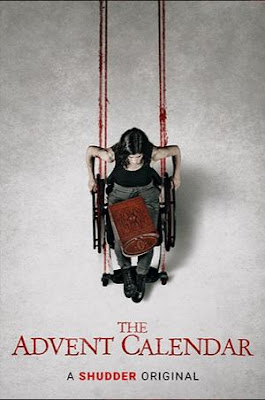
Belgian film. Instead, December 24th is just a fateful day to count
down towards. For Eva, a wheelchair-bound former dancer, each successive day
requires more sacrifices in screenwriter-director Patrick Ridremont’s The
Advent Calendar, which premieres this Thursday on Shudder.
Only
Eva’s hot mess pal Sophie remembered her birthday. To celebrate, she swiped her
a hand-crafted wooden Advent calendar from a holiday market in Munich. Fortunately,
she can also translate the instructions, which are surprisingly stern, even if
they are in German. Each door contains a candy, but if you eat one, you must
eat them all. Also, no skipping ahead. The device is safeguarded against that,
until the stroke of midnight releases the next door.
When
Eva chomps down on the favorite candy of her Alzheimer’s-afflicted father, he
is suddenly calling her on the disconnected land-line. Subsequently, some of
the folks that do her wrong find themselves in a mess of trouble. Eva herself
also starts losing time and coming-to in alarming positions. Yet, the calendar
holds out the promise that she may yet walk again.
Ridremont
takes the traditional careful-what-you-wish-for Twilight Zone-ish
premise and adds a whole lot of Final Destination-style carnage. In
this case, there is definitely a supernatural entity connected to the calendar,
but frankly Ridremont shows way too much of it. Also, Ridremont plays it
somewhat fast-and-loose with the Calendar’s rules. Yet, those same rules still
supply a huge “hidden in plain sight” twist that definitely surprises.
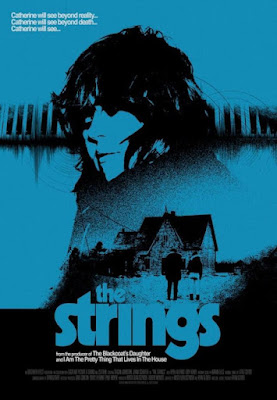
Catherine's moody ambient-techno music is the stuff teen girls listen to during
suicide attempts. It doesn’t have the warming passion of soul or gospel and it
lacks jazz’s improvisational spark to rouse you from your rut. However, it has
an anesthetizing effect that works well for “elevated” horror. The musician wanted
to get away from distractions, but she maybe isolates herself a little too much
in Ryan Glover’s The Strings, which premieres today on Shudder.
Catherine
just broke up with her band, which had been a successful relationship, and with
her boyfriend, which was not. She drove from Toronto out to her late aunt’s
remote Prince Edward Island cottage to write her debut solo EP, but her mind
isn’t in the game. She had agreed to a photo shoot at a notorious farmhouse to
humor Grace, a local photographer, whom she feels a budding attraction to.
However, when she returns to the cottage, she notices weird shadows in the
pictures—and the audience sees a malevolent shape lurking in the margins of the
frame. Sometimes she thinks she sees it too.
When
she does see it, you would think she would be more freaked out by it.
Regardless, it takes about half-an-hour for anything really happens. We’re all
in favor of “sophisticated” horror, but it still needs to consistently supply
tension and suspense. There are some eerily effective sequences in this film,
especially when Glover plays games with our perspective. Yet, there are also long,
slow sequences of Catherine staring into the void. Plus, it all really should build
to a bigger, more terrifying crescendo.
As
part of Catherine’s search for inspiration, she has been exploring physics, particularly
String Theory. That may or may not provide a partial explanation for what it
going on, but at least it accounts for the title. In some ways, The Strings shares
aesthetic and thematic kinships with Sean Hogan’s We Always Find Ourselves at the Sea, but the latter is better served by the concentration that comes
with the short film format.
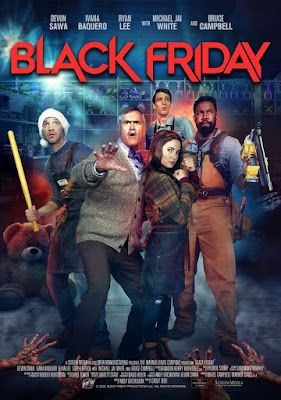
A lot of people who once thought they loved Kevin Smith’s Clerks have
long since forgotten how much it sucks to work retail. Here’s a film to remind
everyone. On this fateful night, the employees of I Love Toys are not just
working for a big box retailer. They are working on the most intense shopping
day of the year. To make matters worse, some sort of zombie outbreak starts
infecting the bargain-hunting shoppers in Casey Tebo’s Black Friday, which
releases tomorrow in VOD.
Everyone
is super-happy to be working on Black Friday, especially Ken, the single dad,
who had to skip Thanksgiving dinner with his young daughters. Chris, the
twentysomething living at home, isn’t missing out on any nice family time, but
he still hates being there. People are queueing up outside like metaphorical zombies,
as they all soon will be in fact. The first to turn will be a rather
foul-tempered granny, but soon they are all snarling and biting.
So,
there is no real plan, but the general objectives are to stay alive and get out
of the building. Sure, we have seen this kind of thing before, but Black
Friday has two genre favorites, Michael Jai White and Bruce Campbell to
elevate everything. Frankly, White is by far the most entertaining thing about
the movie, combining his action cred with some terrific deadpan delivery for
Archie, the store maintenance guy. Of course, Campbell still chews the scenery
like a pro as Jonathan, the slimy store manager.
Devon
Sawa gets way more laughs than you would expect as the Ken, the aging bro. He also
has some sharply written give-and-take with Ivana Baquero as Marnie, his pseudo-work-GF.
Ryan Lee is a bit too shticky and a tad too shrieky as Chris, the sad sack. However,
Stephen Peck creates a character worthy of vintage Seinfeld as Brian,
the store suck-up.
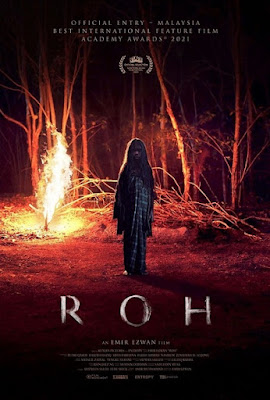
The recent boom of horror films from Southeast Asia makes sense, since
countries like Malaysia and Indonesia have Islamic, Shamanistic, and Animist
supernatural folkloric traditions to mine. It also helps when the local
governments ease up on censoring genre films. You could certainly say Malaysia
did so in this case, when they submitted an eerie tale of black magic for
consideration as a potential best international feature at last year’s Oscars. It
wasn’t nominated but it was still a moment for Malaysian horror. Screenwriter-director
Emir Ezwan’s ROH (a.k.a. Soul) also happens to be genuinely
scary, so it makes perfect Halloween viewing when it releases Friday on VOD.
For
some undisclosed reason, Mak moved with her young son Angah and daughter Along way
into the heart of the forest, a formidable distance from the nearest village.
The children eagerly await their absent father, but it is clear Mak never
expects to see him again. Everyone has a regular regime of chores just to get
by, but their routine is interrupted when a strange little girl follows the
children home.
Initially,
they assume she wandered away from the village, but her sinister behavior
suggests a more infernal nature. Just when they think her evil has passed, a
ruthless old hunter comes looking for her. Caught between a metaphorical rock
and a hard place, Mak’s family experiences curses and supernatural illness.
Perhaps providentially, an itinerant medicine woman offers advice, but she
vibes viewers the wrong way.
ROH
has
some of the gore Malaysian horror films are known for, but it is also darkly brooding
and suggestive. Ezwan masterfully creates an atmosphere of dread and
pestilence. It really is not accurate to describe the film as slow or
deliberately paced. Viewers are not sitting around waiting for things to
happen. Rather, we’re holding our breath and hoping things don’t happen.
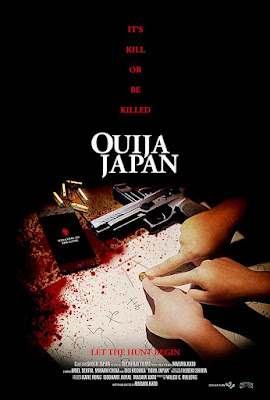
They have something like Ouija boards in Japan too, but traditionally they
invoke trickster animal spirits, sort of like Coyote in the American Southwest.
It is still a bad idea to mess around with one, especially if you have offended
the local fox spirit. Somehow, a group of women on retreat manage to do exactly
that in Masaya Kato’s Ouija Japan, which releases today on BluRay.
Karen
Fujimoto is the expat wife of a Japanese businessman, who has trouble fitting
in with the neighborhood women. Akiyo Yoshihara, her “queen bee” boss at the
community center is always on her case, which sets the tone for the rest of the
women on staff. Her only friend is the caustic Satsuki Murakami, who works from
home (pre-pandemic) and is openly contemptuous of the other cliquey gossips. Much
to Fujimoto’s relief, Murakami also agrees to attend the center’s retreat, even
though it is hard to imagine her singing kumbaya or trusting anyone to catch
her if she falls backward. Fortunately, it turns out they will have activities
she is much better suited for.
Bizarrely,
Yoshihara uses a coin from the local shrine’s collection box for her game of
Kokkuri-san (or Ouija). This angers the already ticked off kitsune, who
magically installs a killer app on their phones that plunges them into a Battle
Royale-style game of kill or be killed. Like Highlander, there can
be only one at the end and if the deaths to not come with sufficient frequency,
the Fox Spirit will select someone at random. Inevitably, Fujimoto and Murakami
team up to take on the other alliances, even though they will eventually have
to turn on each other, if they survive that long.
Honestly,
Ouija Japan is the weirdest conglomeration of genre elements that really
don’t belong together, obviously including Ouija movies, Battle Royale, and cell-phone horror from the likes of Countdown. It
manages to cram them into a relatively economical 78-minutes, so at least that’s
something. This is definitely a cheap looking film with badly dubbed English
dialogue that often sounds like it was delivered phonetically. Yet, its
grunginess almost becomes a source of charm.
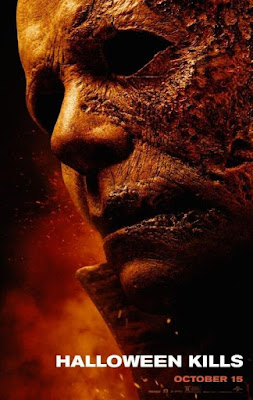
This is truly a Michael Myers film for the Biden years. The chaos we watched
unfold in the Kabul airport and the anarchy we try to ignore every day at the
border has come to Haddonfield. It is Halloween, 2018. Myers has survived
Laurie Strode’s death trap and is killing people with impunity. Sheriff Barker
is powerless to stop him and incapable of restoring law and order as the town
slips into panic and paranoid violence. Only those who previously survived
Myers’ prior attacks can hope to stop him now in David Gordon Green’s
Blumhouse-produced Halloween Kills, which opens Friday in theaters
nationwide.
The
action picks up immediately where Halloween 2018 left off. Strode is on
her way to the hospital, believing she finally put an end to Myers once and for
all. Unfortunately, at this time, he is actually hacking his way through the
firemen that were dispatched to the blaze consuming Strode compound.
This
being Halloween, a group of survivors from the original 1978 horror night have congregated
to commemorate those who died and toast those who saved them, including Tommy
Doyle and Lindsey Wallace, the kids Strode was babysitting, now all grown-up.
When word reaches them of Myers’ fresh killing spree, they decide to find him
and kill themselves. Obviously, it is easier said than done, but Doyle turns
out to be a good recruiter for vigilante patrols. Of course, Strode is convinced
he is coming for her, but her granddaughter isn’t so sure.
In
some ways, Halloween 2018 would have made a really satisfying conclusion
to the franchise, having retconned the other inferior sequels and reboots into
the stuff of fake news and urban legend. However, it probably was unrealistic
to think it would be so easy to kill off a bogeyman like Myers. Unfortunately, Halloween
Kills is conspicuously a middle film that obviously sets up the
already-announced third movie in the sequel trilogy, so there is not a heck a
lot of closure when the credits roll.
On
the other hand, Kill continues to echo the 1978 film in ways that deepen
the tragic resonance of the Michael Myers mythos. The return of his survivors is
more than just fan service (but it is that too, especially Kyle Richards reprising
her old role as Lindsey and Charles Cyphers making his first film appearance
since 2007 as Sheriff Leigh Brackett, now a security guard at the hospital—and they
are both quite good). Rather, their reappearance personifies the degree to which
the community remains traumatized by Myers’s crimes, even forty years later.
Jamie
Lee Curtis and Will Patton are both dependable as ever playing Strode and
Officer Hawkins, but since both are largely sidelined from the film due to
serious injuries suffered they in the previous film, a good deal of the load
falls on Anthony Michael Hall, who is really terrific as Doyle. It is a gritty
tormented performance that gives the film depth and a real edge.
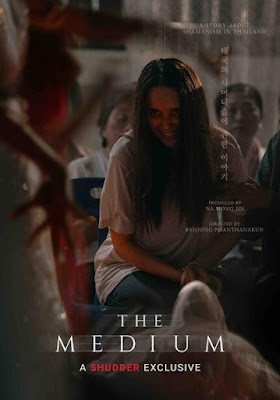
Shamanism in Southeast Asia represents a general fusion of early animist beliefs
with Buddhist stylistic trappings. There are ample examples of similarly
coopted pagan traditions here in the Western Hemisphere—and we have duly mined
them for horror movie inspiration too. Regardless, if you think have a case of
possession in Thailand, you are much more likely to consult a shaman rather than
a priest (especially in the era of Benedict). Nim is such a shaman, but the
supernatural incident she investigates hits much too close to home in Banjong Pisanthanakun’s
The Medium (produced and co-written by Korean genre auteur Na Hong-jin),
which premieres tomorrow on Shudder.
Some
possessions are benign, like the local goddess Ba Yan, who made Nim the village
shaman when she entered her body. Originally, she chose Nim’s sister Noi, as
the next in line for the matrilinear succession, but the younger sibling fought
her selection and converted to Christianity. After months of struggle, Ba Yan
eventually settled on Nim instead. When a mysterious ailment befalls Noi’s
daughter Mink, the family automatically assumes it is Ba Yan once again
attempting to possess a successor. However, as the symptoms become increasingly
severe and disturbing, Nim concludes a more sinister force has latched onto her
niece, mostly likely related to some of the old skeletons rattling around their
family closet.
Technically,
The Medium qualifies as found footage, because we see everything unfold
through the cameras of a film crew shooting a documentary on Nim. However, it
really feels like a doc rather than a quickie Blair Witch knock-off.
Wisely, Pisanthanakun takes his time, fully and respectfully establishing the
characters, isolated setting, and shamanistic beliefs. The first fifteen
minutes really do not horror business per se, but from there on, he slowly builds
the tension drop by agonizing drip, until it finally explodes into utter
bedlam.
This
would indeed make a suitable companion film to Ha’s The Wailing.
(Honestly, if Hwang Jung-min’s swaggering character from that film had suddenly
appeared, we would have completely flipped out.) Ultimately, the gory chaos of
the third act works against The Medium, but Pisanthanakun’s prior
mastery of mood and foreboding still quite distinguishes it.
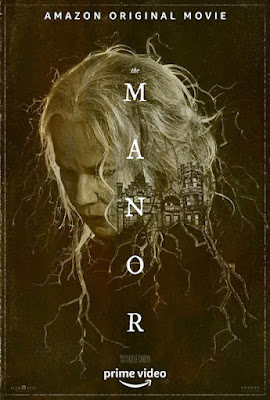
Judith Albright is checking into an assisted living facility housed in a
converted mansion. The architecture is early American gothic and the staff has
a specialization in gaslighting. The question is to what end? Albright must
figure out their game before it is too late in screenwriter-director Axelle
Carolyn’s The Manor, one of the Welcome to the Blumhouse features
premiering today on Prime Video.
As
a former dancer, Albright was always physically healthy and even after a mild
stroke, she is still of sound mind. However, she believes she should have a
little help just in case, so she voluntarily moves into what looks like a nice
facility. Unfortunately, the staff turns out to be a bit more controlling than
she expected, especially about things like cell phones and the front door code.
Her ailing roommate is also petrified with the anticipation that she could die
very soon. It turns out her fears are well grounded.
Soon,
Albright starts to believe she cold be next. She has vivid nightmares of a
demonic figure and the staff appears to be playing mind-games with her. Yet,
their diagnosis of schizophrenic Alzheimer’s protects them from all her
accusations. Only her beloved Josh will half-listen to her, but even he is fast
losing faith.
Throughout
The Manor Carolyn skillfully uses the indignities that come with aging
to intensify the suspense. We can clearly see they’re out to get her, but it is
equally obvious nobody will believe it, due to society’s condescending
assumptions. In some ways, The Manor could be considered a Get Out for
oldsters, but it is actually a much more effective film.
Barbara
Hershey is terrific as Albright. So many of us always associate her with her
classic 1980s and 1990s roles (as in Hannah and Her Sisters, Tune in
Tomorrow, and The Entity), so it is pretty mind-blowing seeing her
in a septuagenarian role (which could also be called acting her age), but she does
so with great humor and vitality. She also brings a distinctive doesn’t-suffer-fools-gladly
attitude that well serves the character, while compounding the precariousness
of her situation.
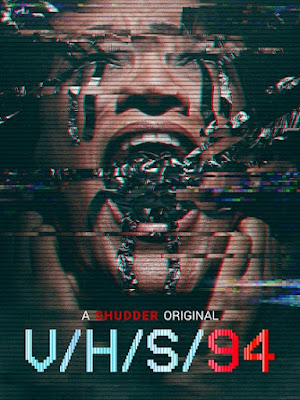
Never take collectors lightly, because they know how to get what they want.
That is especially true of old school VHS collectors. Indeed, the framing
device truly puts the “cult” in cult film fanatics when the V/H/S franchise
returns with V/H/S/94, which premieres today on Shudder.
In
Jennifer Reeder’s wrap-arounds, “Holy Hell,” a SWAT team thinks they are
executing a search warrant on a drug den, but the industrial warehouse actually
houses what appears to be the video-head equivalent of the Heaven’s Gate cult.
There are lots of dead bodies seated in front of video monitors, where naturally,
we will watch the constituent stories unfold.
Chloe
Okuno’s “Storm Drain” consists of the footage shot by Holly Marciano, a local
Ohio TV reporter, and her cameraman, when they ventured down into the titular
sewer in search of a weird rat creature. It is pretty straightforward, but
nicely executed and it ends on an amusing kicker. Also, Anna Hopkins probably
delivers the film’s most memorable performance as the shallow, soon-to-be
freaked out Marciano.
Arguably,
Simon Barrett’s “The Empty Wake” is the most effective and economical installment,
in which, per a grieving family’s odd request, a mortuary worker must record an
overnight wake, even though nobody comes to mourn—almost no one. It really is
creepy, because it is so grounded in the lonely, late-night setting.
If
you have the opportunity to see V/H/S/94 on a big-screen with audience, “The
Subject” (directed by Timo Tjahjanto, one half of the Mo Brothers), might turn
out to be the highlight instead, because it is so deliriously gory and unhinged.
In this case an Indonesian SWAT (this is not a great film to elite squad cop
in) raid a mad scientist’s lair in search of a kidnapped woman. What they find
is a bit disturbing. Tjahjanto does his thing, but it plays better in a group. On
your own, you might notice the thinness of the story, but the over-the-top
splatter effects do their best to compensate.
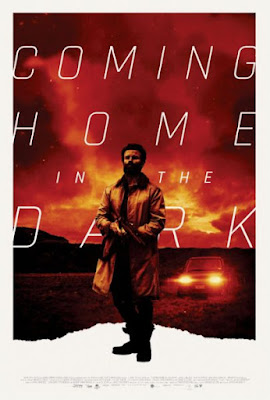
It is the land where they shot The Lord of the Rings, but this
ultra-violent NZ film will make you think twice about visiting as a tourist. “Hoagie”
Hoaganraad thought he would take his family on a nice driving tour, but instead
he finds himself in a grim abduction drama that agonizingly unfolds during
James Ashcroft’s Coming Home in the Dark, which opens today in New York.
Alan’s
step-kids can tell from a distance the two ominous drifters will be trouble,
but the talkative Mandrake and Tubs, his socially-stunted companion, are even
worse than they can imagine. They do not merely rob the family, they start
inflicting real, lasting pain. “Hoagie” tries to be cooperative, but it soon
becomes clear they are not to be reasoned with. Thus begins a desperate struggle
to survive.
However,
the psychopaths are especially motivated, because they seem to recognize Hoaganraad—and
they carry a grudge against him, for some mysterious sin from the past. Even
though only about nine years separate the actors portraying Hoaganraad and
Mandrake, it looks more like a gap of fifteen or twenty, so we can easily guess
their grudge. Instead of shocking, it is all quite predictable and frankly rather
boring. That also means the audience is essentially left with only his wife
Jill to root for and identify with.
The
relentlessly depressing violence Ashcroft and co-screenwriter Eli Kent
constantly serve up will remind horror fans of the grisly Australian grindhouse
film, Killing Ground, but at least Coming Home also incorporates
some effective cat-and-mouse business for Hoaganraad and Mandrake. Nevertheless,
the film is still much more focused on shock than suspense.
Combining a knock-off Necronomicon-style book of evil with carny
folk always means trouble. In this film, some of the nicest people happen to be
part of a cannibal tribe. Sorry, that should have been “alternative cuisine connoisseurs.”
(The on-set sensitivity coach wasn’t particularly diligent on this Brazilian
horror movie.) Regardless, an ancient band of demonic zombies starts feeling their
farofa in Rodrigo Aragão’s The Cemetery of Lost Souls, which screens (online)
during the 2021 Inffinito Brazilian Film Festival.
It
all starts during the early era of Portuguese colonialism, when a priest succumbs
to the temptations offered by an infernal book of demonology, adopting the name
of the infamous sorcerer Cipriano as his own. During a freak storm, he uses his
powers to save a small platoon of conquistadors from certain death, at the mere
cost of their souls. They wreak havoc on the indigenous tribes in a weirdly
Transylvanian-looking district of Brazil, until a freak series of events binds
them to the anachronistic Dracula’s castle.
For
years, Jorge, a shy modern-day carnival laborer has seen in his dreams Ayra, an
indigenous woman held in thrall by Cipriano. One fateful day, the carnival
pitches their tent outside the imposing castle. Of course, Cirpriano and his
horde are still lurking inside and they intend to feast on Jorge’s company.
Cemetery
throws
all kinds of horror elements into the blender, but there is clearly a heavy Evil
Dead influence. The modest budget is equally evident. For instance, the
castle practically looks like it was painted on a bed sheet. However, Aragão is
not afraid to go way over-the-top gory, mostly to gleefully comedic effect.
Little Leah's home life is so awful, the arrival of a ghost almost brings some
relief—almost, but not really. Nobody in her family listens to her, so she will
be on her own when she makes a ghostly “friend” in Ruth Platt’s Martyr’s
Lane, which premieres Thursday on Shudder.
Leah’s
father, a parish vicar (his vicarage incorporates the titular sight of a
historic massacre), is a reasonably conscientious father, but he is rarely
present and available. Unfortunately, her mother is so neurotic, some days she simply
cannot function properly. Her older sister Bex bullies her relentlessly, or at least
that is how Leah sees it. She could use a friend, so she is receptive when an angelic-looking
girl mysteriously knocks on her window. The unnamed girl even has a pair of
costume wings.
However,
their nocturnal play-dates soon take a sinister turn. Leah desperately hopes to
find her mother’s treasured memento that she accidentally lost. Yet, every time
the weird little girl gives her a clue through a game of two-truths-and-a-lie,
it sends Leah off on a fruitless wild goose chase.
Based
on Martyr’s Lane and her previous horror film, it is clear Ruth Platt has
a knack for absolutely raking her characters over the coals. The Lesson was
much more violent, often viciously so, but in that case, it was teenagers
getting brutalized. Frankly, it is a lot easier to take teens enduring violence,
because they kind of have it coming, than watching little Leah enduring all
kinds of abuse and terror. As a result, Martyr’s Lane can be
uncomfortable to watch.
A man from the city finds himself stranded in a quaint village, where they
kill him in a ritual sacrifice. There, that’s folk horror for you. Nature can
also be a nasty, vicious beast in such films. Stone circles and pagan cults are
celebrated in Kier-La Janisse’s Woodlands Dark and Days Bewitched, a
three and a half horror documentary survey of folk horror, which screens as an
on-demand selection of the 2021 Fantasia International Film Festival.
Janisse
starts with the folk horror fans know and love best, the so-called unholy
trinity of Michael Reeves’ Witchfinder General, Piers Haggard’s The
Blood on Satan’s Claw, and Robin Hardy’s The Wicker Man (mercifully,
the Nic Cage remake is scrupulously ignored). The film then flashes back to the
sub-genre’s literary roots in stories like Grant Harrow’s Pallinghurst
Barrow and the ghost stories of M.R. James.
It
turns out the BBC was a fount of classic folk horror in the 1970’s. The James
adaptations of the A Ghost Story for Christmas franchise are still well
regarded and the creepy kids drama The Children of the Stone maintains a
nostalgic cult following. The second half of Janisse’s exhaustive study loses
some of its focus and energy, but there is still some interesting coverage of
international folk horror. It is particularly nice to see Mattie Do and clips
of her film Dearest Sister.
Unfortunately,
a good deal of the critical commentary is predictable and repetitive. Honestly,
if you took a shot for every time some uses a form of the word “colonialism,”
you would be lucky to wind up in the hospital rather than the morgue. The same
is true for the word “patriarchy,” so clearly Janisse did not cast a very wide
net for diverse viewpoints. Frankly, Woodlands is a good example of how
the insular world of hipster film criticism is starting to sound like a
brainwashed pagan cult.
Remember when your gruff driver’s ed. teacher told you to “drive defensively?” That
was good advice. Dutch father Hans does not follow it, even though he has his whole
family in the car. As a result, he inspires homicidal road rage from a serial
killer in Lodewijk Crijns’ Tailgate, which releases theatrically and
digitally tomorrow.
Hans
is pretty frazzled by his nagging wife Diana and bratty young daughters Milou
and Robine. He is also less than thrilled to be going to lunch with his scoldy
mother and his mildly dementia-suffering father. Hans is spoiling or a fight,
so when “Ed the Exterminator” takes exception to his tailgating at a rest stop,
the frazzled father refuses to apologize or back down.
Unbeknownst
to Hans, Ed is experienced at running people off the road and he is fully loaded
with pesticide that is toxic to humans. The psychopath isn’t squeamish when it
comes to menacing the kids along with the adults, but he rather annoyingly
persists in lecturing them on their poor parenting (which admittedly seems to
be somewhat valid), in between his acts of violence.
The
prospect of watching an innocent family getting terrorized is not so
appetizing, so Crijns tries to balance the heat with acid by making Hans
abrasively obnoxious. Unfortunately, that just makes the film thoroughly
unpleasant, in nearly every way.
Arguably,
Jeroen Spitzenberger is quite effective as Hans, because he makes viewers want
to kill him too. The same is true to a lesser degree for Anniek Pheifer as
Diana. You would think the serial killer stalking them would stop the
dysfunctional couple from bickering for ten seconds, but apparently not. On the
other hand, Willem de Wolf is credibly hulking, but problematically nondescript
as the killer.
When you think about it, the premise of Home Alone—an elementary
school aged kid cheerfully fighting off home invaders—should have been pretty
traumatic. This film is a lot more emotionally realistic. The bad guys are part
of a pedophile-abduction ring rather than mere burglars, but at least the two
captives can rely on each other throughout David Charbonier & Justin Powell’s
The Boy Behind the Door, which premieres this Thursday on Shudder.
Both
Kevin and Bobby were snatched out of the park, but the former was the primary
intended victim. The latter is just left in the trunk to suffocate, but
instead, he fights his way out. However, when Bobby hears his friend’s
terrified screams for help, he knows he cannot leave the boy behind. Sneaking
into the isolated house, he discovers Kevin is chained to the wall behind a
locked door. The cat-and-mouse game that ensues is viscerally intense, due to
the disturbingly young age of the boys, but their resourcefulness is admirable.
Young
protags in claustrophobic jeopardy are definitely a thing for Charbonier &
Powell, the filmmaking tandem, whose Djinn released earlier in the year.
There are obvious similarities, but Behind is far more disturbing due to
its thematic content. In this case, the utter conviction and total credibility
of Lonnie Chavis and Ezra Dewey (who also starred in Djinn) keep viewers
hooked on pins and needles. Like Djinn (but maybe even more so here),
the filmmakers and their youthful cast really force the audience to care.
During this film, the suspense really kills.
The
boys’ ultimate antagonist is also extraordinarily creepy, but it would be a bit
spoilerish to call out the thesp by name. Let’s just say this is a deeply chilling
predator. Charbonier & Powell have a sinister talent for maintaining tension
and suspense, while turning the limitations of their confined sets into
positives. It is almost too much at times, but it is all highly effective.
Aicha Kandisha is like a Moroccan Bloody Mary, but ironically, she has a more
feminist attitude. She is invoked in a similar Candyman style, but she
only kills men. The trouble is, she never stops with just one. That rather
alarms the teenaged girl who summons the North African spirit to punish her
violent ex in screenwriters-directors Alexandre Bustillo & Julien Maury’s Kandisha,
which premieres tomorrow on Shudder.
Amelie’s
Parisian Banlieu community was already pretty grim and they were constantly
making it more blighted with their tagging. Their favorite canvas is a
condemned housing project, where they uncover Aicha Kandisha’s name on one of
the graffiti and asbestos crusted walls. Morjana, the daughter of Moroccan
immigrants, explains the legend of Kandisha, a vengeful spirit, who in life seduced
and murdered Portuguese invaders. In death, she returns to wreak vengeance on
behalf of those who raise her, but she also kills five more men within the
summoner’s circle.
Kandisha
has
some familiar Bloody Mary/Candyman elements, but what really distinguishes it
is the way it incorporates of North African Islamic myth and folklore (Dachra
had a similar flavor, but it runs deeper here, even with the French
setting). At one point, the film reminds us the pentangle was derived from the Sign
of Solomon, which holds equal significance in Muslim, Judeo-Christian, and esoteric
traditions. Kandisha also has some of the best exorcism sequences of the
last two or three years of demonic horror films.
On
the other hand, the three primary teen protags are not developed much better
than the typical low-budget horror movie stock figures. Frankly, the three
young thesps are not particularly memorable. On the other hand, the way
Bustillo & Maury present the young women’s relationships is rather smart
and acutely believable. Most of the time, they really don’t seem to like each
other at all, but they keep killing time together, out of boredom and habit.
In North Africa, they take witchcraft seriously—like Salem serious. That is
how Tunisia’s (believed to be) first horror movie halfway credibly carries the Amityville-style
“based on a true story” tag line. Aspiring journalism grad students like
Jassmine are more interested in the Jasmine Revolution, but true to
journalistic group think, their reports are so similar, their crusty old French
prof has banned it as a topic for their final project. Instead, Jassmine and
her two bickering colleagues venture into a remote country hamlet hoping to
find an original true crime story in Abdelhamid Bouchnak’s Dachra, which
opens tomorrow in physical and virtual theaters.
Jassmine
is probably more talented than her obnoxious cameraman Bilel and sound guy Walid,
but she works with them anyway. She should be listening more to Bechir, the
devout grandfather who raised her. He is concerned she still has nightmares of a
malevolent “Woman in Black,” but of course, she just blows off his concerns.
Instead, she agrees with their half-baked plan to score an interview with a suspected
witch who has been secretly committed to an insane asylum.
The
interview is rather awkward, but it leads them to a strange tucked-away village
(or Dachra) where strange things seem to be afoot. The women are suspiciously
quiet, but the talkative Saber is maybe a little welcoming. Whatever is going
on, it just might involve Jassmine personally.
Dachra
incorporates
plenty of established genre tropes, including elements of supernatural, cult,
and folk horror. The good news is it teases us with the (dubious) promise of found
footage too, but instead it presents itself as a professional film. Bouchnak’s
cafeteria-style approach actually works pretty well. The backdrop of widespread
superstition and traditional Islam gives the film a sense of absolute
conviction, like Catholic possession films in the tradition of The Exorcist.
Witchcraft is utterly real in Dachra and it is profoundly dangerous.