Showing posts with label Witch films. Show all posts

Thursday, June 25, 2026

Forbidden Fruits, on Shudder

Are these mallrats a cult or a coven? Which would be worse? Or is there really a difference? And  where do they still have malls? Apparently, Texas. Maybe that’s why everyone is moving there. Regardless, locals would be safer ordering from Amazon in Meredith Alloway’s Forbidden Fruits, which premieres tomorrow on Shudder.

Apple and her two co-workers are the Mean Girls of the mall, which rather tracks considering scenes from
Mean Girls were also shot at the real-life Sherway Gardens mall (in Toronto, not Texas). She jealously guards their place at the top of the hierarchy, but she allows Pumpkin to make the unprecedented social climb from pretzel store to their “Free Eden” boutique. Evidently, her name is just sufficiently fruit-like to qualify.

Awkwardly, Cherry resents Pumpkin joining the Free Eden sales staff, because it jeopardizes her status as Apple’s favorite. Fig is more down-to-earth than the infantilized Cherry. She even has a healthy relationship with her secret boyfriend. However, all three store clerks share a dark secret regarding Pickle, Pumpkin’s predecessor, who roams the mall in a mentally agitated state. Supposedly, one of Apple’s spells accidentally backfired on Pickle, but Pumpkin suspects it was more intentional. In fact, Pumpkin has further suspicions regarding Apple and her coven. That is why she started working in the mall in the first place.

Like Aleshea Harris’s
Is God Is, Forbidden Fruits started life as a stage drama, Lily Houghton’s awkwardly titled Of the Woman Came the Beginning of Sin and Through Her We All Die, but Alloway and the playwright pumped up the genre elements when adapting it for the screen. Most of the film has a weird “what am I watching vibe,” but that makes it memorable, in a good way. It is not exactly horror, at least not really, but there is certainly a macabre undertone and eventually a good deal of blood.

Arguably, it is a rather incisive satire of Wiccan New Age feminist ideology, in which the rhetoric of self-empowerment becomes a spell to smite thine enemies. Whether intentional or not, Apple’s contempt for traditional family and general bourgeoisie striving soon reveals its horrifying true face.

Monday, January 19, 2026

Mother of Flies, on Shudder

Mickey considers Solvieg a healer. The locals call her a witch. This is not a case of potato-potahto. Viewers can tell from some of the flashbacks that the locals are probably more right than wrong. Either way, Mickey entrusts herself to the strange woman’s care in the latest film from the Adams Filmmaking Family (John Adams, Zelda Adams, and Toby Poser), Mother of Flies, which premieres this Friday on Shudder.

Sadly, Mickey’s cancer has returned while she was away at college—aggressively. Exhausted with conventional treatments, she has convinced her father Jake to accompany her while she visits Solveig. Of course, Jake is suspicious, but Micky assures him Solveig is not trying to swindle her. She didn’t even advertise or pitch her services in a commercial sense. According to Mickey, Solveig came to her in a dream.

Jake is still skeptical, as well he should be. He doesn’t take to Solveig’s vegetarian cooking, while some of the “healer’s” “treatments” look quite distressing. Yet, Mickey believes Solveig’s weird occult remedies must be working. Awkwardly, the college student starts to resent her father’s doubts, arguing they undermine the faith Solveig’s treatment requires.

The Adamses have confirmed
Mother of Flies was inspired by their own family history of cancer survival, but most viewers could guess as much just from watching. Every frame rings with uncomfortable authenticity, while a good deal of dialogue sounds adapted from memory. It is definitely one of the most emotionally sophisticated horror films of the year. To some extent, the serious, very mortal issues of mortality overshadow the supernatural horror that should drive the film. However, Solveig is always massively creepy.

Saturday, February 24, 2024

Witchcraft, on Eurochannel

The kind of antisemitic “blood libel” slander you can currently find on tiktok and social media comes straight out of the 13th Century, so why should we be surprised by modern day accusations of witchcraft? Such rumors dogged Hanna’s missing-and-presumed-dead mother when she lived in this rustic community in northern Germany, so they predictably fall on her too when she returns for a hot, uncomfortable summer in Esther Bialas’s Witchcraft (a.k.a. Hanna’s Homecoming), which premieres tomorrow on Eurochannel.

Hanna’s dad has a serious case of denial. He seems to think nothing will happen if Hanna keeps her head down, spending all her time working for the family’s farm and butcher shop. Yet, even the family employees start bullying her as soon as she arrives, especially the brutish Gunnar. It only gets worse when several of her tormentors (or their pets) experience painful misadventures. She only makes one friend, the mysterious Eva, who is also an outsider visiting family. However, she exerts a questionable influence over Hanna.

If you cannot figure out Eva’s deal after five minutes, you probably have not seen very many genre movies. Nevertheless, Bialas does a decent job maintaining the is-it-supernatural-or-is-it-Scooby-Doo-villainy ambiguity. She creates a creepy atmosphere, especially through the use of the
Blair Witch-y sigils that adorn the forest and out-buildings. Nevertheless, there is a simplicity to Lena Krumkamp’s screenplay that betrays Witchcraft’s made-for-German-TV origins.

Monday, October 24, 2022

The Murder Podcast: Horror-Comedy with Ramen

Chad Thadwick and his best stoner pal Eddie make the amateur podcaster-sleuths of Only Murders in the Building look like Sherlock Holmes, Nero Wolfe, and Miss Marple. The lads are a bit dim-witted, even when they haven’t been hitting the bong. Nevertheless, their ill-conceived attempt at true crime podcasting uncovers a sinister supernatural entity in director-screenwriter William Bagley’s The Murder Podcast, which releases Wednesday on VOD.

Thadwick’s current podcast, “Ramen Reviews with Chad Thadwick” is attracting about as many listeners as you would expect. (Keep in mind, his ramen is strictly the cheap store-bought kind, not fine dining ramen.) After his impatient brother-in-law raises his rent, Thadwick convinces his sidekick Eddie to switch formats to criminal investigation. Conveniently, his quiet suburban town just had its first suspicious death in years. Officer Stachburn assures the media the victim’s head simply popped off accidentally, as the result of a freak fall, but even an idiot like Thadwick can tell that’s bogus.

Viewers know from the prologue, the first victim brought the spirit of an angry witch home with him, after he stumbled across her grave during a hike. The moron took the coin off her tombstone, which had sealed her inside the tomb. Naturally, she starts bumping off victims, as that coin passes from hand to hand.

You can often see how hard Bagley is trying to entertain horror fans throughout
Podcast. As a result, many of the bits feel rather forced. However, some of the gags manage to connect, especially when ramen suddenly becomes relevant to the narrative again, thanks to its high sodium content. On the other hand, the lore surrounding the witch is better developed than the usual bogeymen of most horror-comedies. Weirdly, some of the “straight” material helps retain viewers, like the revelation Thadwick’s disgraced conspiracy-mongering father tried to expose the witch during her last killing spree, at the cost of his credibility.

Wednesday, July 13, 2022

She Will: A New Witch Film Executive-Produced by Dario Argento

Recovering actress Veronica Ghent just wants to be alone, like Garbo. Instead, she has to talk to fellow guests at her secluded retreat about local witch lore, as if she were part of the cast of Lux Æterna, or even one of Dario Argento’s “Three Mothers” films. (The latter would be aptly fitting, since the Italian auteur is on-board as an executive producer.) There is definitely something about place and its sinister history that exerts power over the present in Charlotte Colbert’s feature directorial debut, She Will, which opens Friday in New York.

The frosty Ghent will be a difficult assignment for her nurse, Desi Hatoum, but viewers will soon understand why she is so bitter. Having just endured a double mastectomy, the former sex symbol learned her former director-lover, Eric Hathbourne is making a sequel to their greatest hit, without her. His career seems to be cruising along just fine, even though it is an open secret he had an inappropriate relationship with the underaged Ghent back then.

She wants to block out all news of Hathbourne and the rural artists’ retreat is just the place to do it. It was built on the outskirts of a forest where women were burned during the Scottish witch-hunting era. Of course, it also happens to be smack dab in the middle of a cellular dead zone. Not surprisingly, Ghent can’t stand the artsy types, but she is strangely “receptive” to the environment.

She Will
is a dynamite debut that is not well-served buy reductive labels like “#metoo horror,” or whatever. It is enormously stylish and heavily atmospheric, but also ambiguous with respects to its supernatural goings-on, in the right kind of way. As Ghent, Alice Krige truly becomes a grand dame of horror, in the tradition of Joan Bennett in Dark Shadows and the original Suspiria or Tilda Swinton in the remake. She is regal and also quite something to deal with.

Tuesday, May 03, 2022

Noe’s Lux Æterna

Benjamin Christensen's Häxan is probably the first horror documentary. Its images are so eerie, it has been excerpted and edited into dozens of subsequent films. (Being in the public domain also makes it attractive.) Once again, it sets the mood for a film about witches, but the lunacy that follows the opening snippets is all Gaspar Noe. First, they talk, then they go crazy in Noe’s Lux Æterna, which opens Friday at the Metrograph.

Throughout the film, Noe uses a split-screen, very much like the so-called “Duo-Vision” of Richard L. Bare’s notorious
Wicked, Wicked. Of course, Noe’s film is also all very meta, with the cast playing loosely fictionalized (and improvised) versions of themselves. It opens with director Beatrice [Dalle] talking to her star, Charlotte [Gainsbourg], while the rest of the crew prepare (haphazardly and chaotically) for a big stake-burning scene.

Clearly, Beatrice and Charlotte respect each other, because of their common experiences in the industry. However, the crusty old cinematographer and sleazy producers are openly contemptuous of the inexperienced director (most of whose work has been in front of the camera). It all comes to a head when the shoot nose-dives into Hell, but when that happens on a Noe production, it is simply called a Tuesday.

The film opens with an epileptic strobe warning, with good reason. It is short, but strange—and relentlessly flashing.
Lux Æterna is not even an hour long, but it would be hard to watch much more without your eyeballs exploding. A lot of the split-screen use is just as gimmicky as Bare’s 1973 cult favorite, but the visual explosion of the climax is vintage Noe.

Arguably, this is very much a horror film—a pretty shocking one in fact. It just really takes its time on the build-up. After all, there is a long tradition of artsier horror films, gravitating towards witches and witchcraft, including the Visconti/Pasolini/De Sica anthology
The Witches and good old Häxan. Like many of those films, there is also a pronounced feminist angle here, particularly when it comes to the film production process. Ironically, Noe might up indicting himself, in retrospect—given what he puts his cast through.

Monday, February 21, 2022

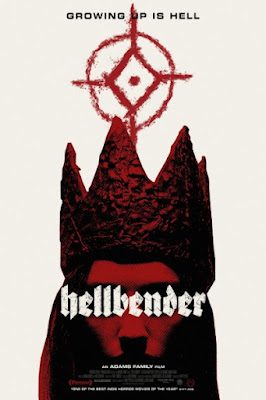
Hellbender, on Shudder

This film is a lot like Terms of Endearment, The Joy Luck Club, and Mermaids, except the mother and daughter are witches. Technically, the mother uses the term “Hellbenders,” because it is heavier and more loaded with symbolic meaning, to better suit their dangerous powers. In any case, if you think witches, you get the general idea when the daughter, Izzy, learns their true nature in the Adams Filmmaking Family (mother Toby Poser, father John Adams, and daughter Zelda Adams)’s Hellbender, which premieres this Thursday on Shudder.

The mother has always homeschooled Izzy in their remote mountain cabin, claiming she has a rare autoimmune disease. She also carefully maintains a vegan diet that looks truly inedible (pinecones and whatnot). If anyone strays too close to their property, she makes them disappear, literally. However, when Izzy accidentally stumbles across some kids her age, their teen ways start triggering her powers.

It is impressive to see the Adamses release another ultra-DIY horror film, following the success of the super-cool
The Deeper You Dig. While Hellbender takes a deep dive into folk horror, it is not quite as exhilaratingly original as their debut. There are some very creepy sequences in Hellbender and they shrewdly embrace the nostalgia of their lo-fi old school effects, but the story feels much more familiar. Also, the mother-daughter performances as a hardcore rock duo somewhat break up the film’s flow—and let’s face it, free jazz would have been much scarier.

Wednesday, May 13, 2020

Diablo Rojo PTY: Panama’s 1st Horror Movie


There is extensive Panamanian folklore regarding evil witches, or Bruja, but most of these characters we are about to meet would rather not hear about that right now. That is because they are running for their lives from a coven with supernatural powers. They have a vehicle, one of Panama’s few surviving festively decorated “Diablo Rojo” buses, but they lack fuel and a reliable sense of direction in Sol Moreno & J. Oskura Najera’s Diablo Rojo PTY, Panama’s first horror movie, which releases tomorrow on Amazon.

The witches are out to get Miguel Moreno, but he has no idea why. It starts with a drunken hook-up that takes a macabre turn, spooking the bus driver badly. Much to the confusion of his assistant, he floors the bus, refusing to heed the cops chasing behind him. Despite what seems like a few minutes on the road, Moreno and the patrolmen pursuing him find themselves miles away from the capitol, outside the country village Moreno grew up in.

They temporarily find refuge with the parish priest, who remembers Moreno and might have an idea about the bad karma catching up with him. Unfortunately, the destructive senior officer sabotages their sanctuary, forcing everyone back on the road.

Okay, DR PTY is not exactly up there with The Exorcist, but its unruly energy and gleeful gore are infectiously entertaining. It is a shame this film will not have more opportunities for first-run midnight screenings, because this film is probably best experienced with a theater full of whooping and hollering horror fans.

Regardless, you can’t keep a knuckleheaded underdog down. We can still appreciate the generously splattering practical effects and the half-serious attempt to draw from Panamanian folk culture and pop culture. As a bonus, the depiction of Padre Andres is mostly sympathetic. Granted, he thinks most of the sanctuary-seekers are idiots, but they mostly are.

Tuesday, August 06, 2019

The Night Sitter: Old School Horror Comedy


Starting in the 1980s, most horror movies have been set in suburbia (or remote summer camps). That is because if you want to scare people, you have to go where they live. This is not Amber’s neighborhood, but she inadvertently put herself in the profoundly wrong place at the wrong time, when she accepted a baby-sitting gig for larcenous reasons. Much to her own surprise, she will do her best to protect her young charge in Abiel Bruhn & John Rocco’s The Night Sitter, which releases today on VOD.

Ted Hooper is a wealthy collector of occult relics, so you know he has more money than sense. Amber and her accomplices are sure they can plunder plenty from his spacious suburban home, while he is on his date. Heck, they are not even dead set on opening the conspicuously locked trophy room. On the other hand, Ronnie, the obnoxious son of Hooper’s girlfriend (also sleeping over) is curious enough for the entire group. Things will get tough for Ronnie, but it will actually be Hooper’s sensitive son Kevin who gets the fateful papercut on the pages of an infernal book of witches.

The situation soon gets downright Suspirious when the witches known as “The Three Mothers” start terrorizing the occupants of the Hooper house. Amber’s cronies are not much help, but at least Vincent, the Jack Black-like dude living across the street, has some insight into weird supernatural mumbo jumbo. Frankly, they are all pretty easy pickings for the witches, except for the resourceful Amber. Having bonded with Kevin before all the toil and trouble broke out, Amber scrambles to defend him from the literal forces of darkness.

For fans of vintage horror movies, Night Sitter is nostalgic in all the right ways. It mostly keeps its tongue planted in its cheek, but it still serves up plenty of mayhem and a fair amount of gore. Amber would not be out of place in the Scream franchise, but the rest of the characters would be more compatible with Dan O’Bannon’s classic Return of the Living Dead, which is quite august company, among horror comedies.

Elyse Dufour is terrific as Amber, making her the snarkiest, most confident potential final girl in recent memory. She also develops some nice on-screen chemistry with both Jack Champion and Ben Barlow, as Kevin and Vincent, respectively. However, Jermaine Rivers and Amber Neukum steal scene after scene as Rod, Amber’s horndog accomplice and Lindsey, his ditzy, soon-to-be-possessed girlfriend.

Bruhn & Rocco certainly do not reinvent the wheel, but they keep things zippy. Sitter is not as funny as Better Watch Out, an obvious comparison film, but its horror elements are arguably scarier. Regardless, it is all quite a bit of fun. Recommended for old school horror fans, The Night Sitter is now available on VOD platforms.

Friday, February 22, 2019

The Changeover

Laura Chant is a “sensitive.” That sort of means she has the “Shine.” It also means she could possibly transition into a full-fledged witch, but there is no guarantee the process will be safely completed, just like there is no guarantee obnoxious teenagers can successfully evolve into mature adults. Chant has very personal and pressing motivation for fulfilling her witchly promise, which raises the stakes considerably in Stuart McKenzie & Miranda Harcourt’s The Changeover, opening today in Brooklyn.

From time to time, Chant gets premonitions, but her over-worked, working-class mum does not want to hear about that. Instead, she just wants Chant to shut-up and take care of her little brother, Jacko. You could say she has not done so well on that score, but it is hard to be prepared for the danger represented by Carmody Braque. He happens to be a larva, a supernatural parasite that sucks the life-force out of their victims. Tragically, Braque managed to sink his hooks into Jacko, after he tricked the lad into “letting him in.”

Channt is definitely out of her depth, but she finds an ally in her brooding classmate, Sorenson Carlisle, a witch (not a warlock), from a long line of witches. His mother and grandmother could have some helpful advice for Chant, whereas her mother just nags and nags.

Based on New Zealand YA author Margaret Mahy’s 1984 Carnegie Medal-winner of the same name, The Changeover is one of the better films based on YA novels, but admittedly, its only competition is the greatly underappreciated Before I Fall. It is not saying much to argue it is much better than I Still See You, November Criminals, and Fallen, which it most definitely is. A lion’s share of the credit is due to Timothy Spall, who is jolly fun to watch chewing the scenery as Braque.

Th crafty Spall is indeed fun to watch, but Erana Janes is quite compelling as Laura Chant. Nicolas Galitzine is rather dull as Carlisle, brooding teen witch, while Lucy Lawless is frustratingly underemployed as his mother, Miryam. Still, the ensemble definitely exceeds the low expectations viewers might have for another YA movie adaptation. In this case, Changeover’s deep roots, stretching all the way back to ’84 arguably suggest this story has some staying power. In fact, there are some rather intriguing elements to Chant’s psychological and paranormal battle with Braque. Frankly, it probably deserves better than its excuse-me-once-a-day run at the Kent Theater in Brooklyn, but that’s what it has. Recommended for fans of supernatural teen fiction, Th Changeover is now playing in select cities.

Saturday, November 04, 2017

Cinepocalypse 2017: Hagazussa—A Heathen’s Curse

Alas, poor Albrun is the original lonely goatherd. You would think superstitious villagers would try not to antagonize a suspected witch. However, this is the 15th Century Austrian Alps, so in addition to their paranoia, they also have a slightly volky intolerant thing going on. They will harass and ostracize Albrun and her mother, but matters will end badly for everyone in Lukas Feigelfeld’s Hagazussa: A Heathen’s Curse (trailer here), which screens tonight as part of Cinepocalypse 2017 in Chicago.

If Albrun’s mother really had evil powers, presumably she wouldn’t let the villagers get away with their loutish behavior. Instead of casting spells, she seems to suffer from them. Unfortunately, she will soon be leaving Albrun behind in the cold hard world. Ten or so years later, Albrun is similarly raising an infant daughter on her own. We could assume it is the product of an assault, but Hagazussa is not a talky film, making backstory difficult to glean.

Albrun’s life briefly brightens when one of the village women appears to befriend her, but her motives are actually quite sinister. That makes Albrun angry and quite possibly tears the last fibers holding her sanity in place. This is the sort of film that garners a lot of attention for its technical artistry, but Aleksandra Cwen is quite remarkable as grown Albrun. Watching her psyche splinter into pieces is a ferocious viewing experience.

Shot in arresting Gustave Doré-like black-and-white by cinematographer Mariel Baqueiro, Hagazussa is a hushed spectacle of mud, rain, and rotting carcasses. You can practically smell the decay and corruption wafting off the screen. However, Feigelfeld’s pacing is slow even by the standards of slow-burners. Narrative is a low priority for this film. It is more about immersing viewers in this world of dread. Towards that end, the eerie sound work of foley artist Peter Roigk and the almost subliminal score of Greek chamber trio Mohammad really get under viewers’ skin, possibly unnerving us more than the macabre imagery.


Everyone and their black goats are comparing Hagazussa to Robert Eggers’ The Witch, for obvious reasons, but it also arguably shares a kinship with Haneke’s The White Ribbon. Feigelfeld is not merely inviting the audience to witness a case of isolated madness. He is giving us a peak into Teutonic original sin. This is a demanding film that really ought to go further over the top during the climax, but you have to give credit to Feigelfeld for realizing such a singular vision. Recommended for fully fortified fans of avant-garde horror in the Häxan tradition, Hagazussa: A Heathen’s Curse screens tonight (11/4), as part of this year’s Cinepocalypse.

Monday, July 17, 2017

Czech That Film ‘17: The Noonday Witch

This is no ordinary hag. The supernatural predator immortalized in Czech nursery rhyme and Dvorak’s symphonic suite always strikes at high noon. She may or may not be stalking the daughter of a recently bereaved widow or possibly her guilt has metastasized into something toxic in Jiri Sadek’s The Noonday Witch (trailer here), which screens during this year’s Czech That Film in Chicago.

Eliska has just moved back to her husband provincial hometown with her daughter Anetka, but without her husband. That is because he is buried there. Evidently, he died in a misadventure that was most likely suicide, but she has yet to tell Anetka. Unfortunately, given the nature of his demise, she stands to receive no insurance benefits. This puts Eliska under tremendous stress that compounds whenever Anetka asks about her absent father. To make matters worse, the region is suffering from a historic draught. The last time water tables were this dry, bad things happened.

It seems they happened to Mayor Mraz’s desiccated-looking wife. Eventually, Eliska learns Madame Mrazova was committed for killing her son. Psychologically, she is unable to bear the guilt, so she now blames the Noonday Witch—or so the Mayor assumes. Ms. Mrazova has been agitated lately, because she senses the witch now has her eyes on Anetka. At first, Eliska does not want to hear her crazy talk, but she eventually sees alarming signs she might be right—or perhaps the single mother is creating them herself, acting out of guilt, stress, and the power of suggestion.

Noonday will inevitably be compared to the over-hyped Babadook, but it is the superior film by a good measure. Sadek and cinematographer Alexander Surkala give the film a distinctive look that is both sun-drenched and eerie. The film has a folkloric vibe, yet it still feels contemporary. Most critically, Sadek handles the evil entity, such as it might be, with dexterous subtlety.

As Eliska, Anna Geislerova mentally cracks up quite spectacularly. Whether there is anything uncanny or not afoot, her nervous breakdown is totally convincing. Veteran Czech thesp Daniela Kolarova is even creepier as Mrazova, while Zdenek Mucha grounds the film as the decent, remorseful Mayor Mraz.

The sun has never been scarier than it is in Noonday, because it dispels the shadows we might hide in. Arguably, it is ambiguous to a fault, but there is no denying the claustrophobic tension Sadek builds. Highly recommended, The Noonday Witch screens this Friday (7/21) and the following Wednesday (7/26) in Chicago, at the Siskel Film Center, as part of the 2017 edition of Czech That Film.

Friday, November 18, 2016

The Love Witch: Getting Her Wicca Groove Back

Although it directly pays homage to cult movie favorites of the 1960s and 1970s, the roots of this satire go back to satirical 1940s war-of-the-sexes novels like Fritz Leiber’s Conjure Wife and Thorne Smith’s The Passionate Witch. According to their eerily believable premise, many if not all women secretly practice witchcraft, while just about every man is, not so secretly, an idiot. Fleeing the scandal of a conveniently dead husband, Wicca-practicing Elaine wants to start fresh in a Northern California town, but she is not about to change her spell-casting, man-consuming ways in Anna Biller’s The Love Witch (trailer here), which opens today in Brooklyn.

This Marin County-esque community should be perfect for Elaine. They generally tolerate the local coven of witches and the strip club serves a major communal gathering spot. She will not even have to redecorate her new apartment. It is already appointed in Early American Naugahyde, with Tarot Card motifs.

Elaine just wants to be loved and she is willing to give everything of herself in return. However, she will not solely rely on her conspicuous sex appeal alone. She will also resort to the overwhelming force of a love potion. Perversely, this often reduces viral men to simpering children, who must be gotten rid of, for everyone’s sake.

If feminist cinema were always this hot and naughty, you would find a lot more Ms. Magazine readers in frat houses. There is enough eroticism in Love Witch to keep Jean Rollin distracted. However, the real indulgence for genre fans is Biller’s lovingly lush recreations of the look and trappings of the groovy Serial-era. Channeling Douglas Sirk and John Stahl (Leave Her to Heaven) as well as Hitchcock, Polanski, and late career Russ Meyer, cinematographer M. David Mullen gives the film a strikingly vibrant, candy-colored look appropriate to the swinging milieu. Those rear-screen projections and soft-focuses are just spot-on bonuses.

Arguably, Biller could have used some collaborative help in the editing bay, because the two-hour running time is really pushing it. Someone with a little emotional distance should be able to tighten up the third act with no ill effects. However, even when the narrative hits a slow patch, it is easy to just imbibe the nostalgia as you wait for it to pick up again.

Biller further burnishes her reputation for richly detailed period art and design work, but the real discovery in Love Witch is Samantha Robinson, who smolders up the screen as Elaine. Simultaneously sinister and vulnerably needy, it is a wonderfully ambiguous and surprising performance. Laura Waddel counter-balances her nicely as the sympathetic but tragically conventional Trish (a pseudo-rival for Elaine, who simply isn’t in her same league).


There are macabre bits and pieces to be found regularly throughout Love Witch, but it is not really a horror movie per se. Nevertheless, there are enough naked black masses to prevent hardcore fans from getting antsy. It is just loaded with killer attitude and style to die for. Enthusiastically recommended for fans of spell-casting witch movies, The Love Witch opens today (11/18) at the brand spanking new Brooklyn Drafthouse.

Friday, October 30, 2015

Scary Movies 9: Cherry Tree

There is only one thing trees are good for in horror movies: producing paper. Much like the “Hanging Tree” in Hollow, these titular fruit bearing limbs are decidedly bad news. Unfortunately, people still cling to the Luddite notion deforestation is a bad thing. Otherwise, they might clear out the not-so mythical satanic vegetation of David Keating’s Cherry Tree (trailer here), which screens as part of the Film Society of Lincoln Center’s Scary Movies 9.

According to legend, the notorious cherry tree was the focal point of a powerful coven of witches’ dark rituals. Of course, the legend is more or less true, as teenaged Faith (at least she’s not named Chastity) is about to find out. Sissy Young, her new, conspicuously evil field hockey coach tells her so, straight out. Faith can save her Leukemia-stricken single father Sean, if she agrees to get pregnant on the coven’s behalf. They have a ritual to perform that requires a very special sacrifice.

Faith accepts out of desperation, but is quickly troubled by the supernatural circumstances of her lightning fast pregnancy. She is also concerned about the disappearance of Brian, the nice chap at school, whom she chose to hold up her end of the bargain with. She is also unnerved to find Young seducing her newly cured father and generally hanging around, acting creepy. As she figures out the full implications of her deal with Young, she comes to understand what makes Faustian bargains so dashed Faustian.

There is definitely a Rosemary’s Baby vibe to Cherry Tree. Keating and screenwriter Brendan McCarthy steadily crank up the paranoia, as Faith discovers how many respected townspeople are in on the occult conspiracy. Yet, they give it a distinctively Pagan flavor all its own. Young’s centipede familiars are also all kinds of creepy, in a slithery, cinematic kind of way.

Arguably, the character of Faith is problematically passive and Naomi Battrick’s portrayal is a bit bland. However, Anna Walton exhibits massive horror movie chops as the slinky, sinister Young. She chews the scenery like an old school Hammer pro and exudes an air of sexual menace. She definitely embraces the Pagan spirit of it all. Although more reserved, Sam Hazeldine is similarly terrific anchoring the film as Faith’s ailing father.

Thanks to the moody cinematography of Eleanor Bowman and some suitably creepy set design, Cherry Tree follows nicely in the tradition of lushly crafted Anglo-Irish supernatural horror films. The final parting shot is a bit of a groaner, but for the most part, it is tight, tense, and evocative of ancient evils that feel disconcertingly real. Highly recommended for horror fans, Cherry Tree screens this coming Wednesday (11/4) at the Walter Reade, as part of Scary Movies 9.

Tuesday, October 13, 2015

The Inhabitants: Nobody Checks Out of this Bed & Breakfast

You have to assume any New England building dating back to the Seventeenth Century must have been involved in witchcraft in some way. The historic Noyes-Parris House, former home of Rev. Samuel Parris of Salem Witch Trial infamy, is a good example. Fittingly, the early Colonial house serves as the central location of brothers Michael & Shawn Rasmussen’s old school The Inhabitant (trailer here), which releases today on iTunes.

Despite the freakiness of Rose Stanton, the somewhat age-addled retiring proprietor, a married couple is delighted to buy the March Carriage bed & breakfast—and for such a reasonable price. Dan and Jessica Coffey believe it is an investment in their future, but they really did not poke around enough. If they had, they might have noticed the weird witchcraft paraphernalia in the cellar and the video surveillance monitors still functioning in the attic. They also might have been curious to learn Lydia March, a midwife accused of witchcraft, met her grisly end while living there.

The first few days are filled with rustic charm, but when Dan is suddenly called away on business, he returns to find a radically different vibe. If only their dog Wiley could talk. Instead, he will have to look for answers in the surveillance tapes and the local witchcraft museum.

There is no question the Noyes-Parris/March Carriage is an absolutely terrific location for a horror film. The Rasmussen Brothers fully exploit it, taking viewers into all sorts of dark rooms and passageways. The Inhabitants bears obvious comparison to Ti West’s The Innkeepers (some of his fans were down on it, but we were bullish on it here), with good reason. Both films seem to absorb and project the eerie energy of their backdrops, creating claustrophobic terror. However, The Inhabitants also brings to mind films like Ted Geoghegan’s We Are Still Here and, believe it or not, the first V/H/S film (they both make grainy video tape pretty damn blood-chilling).

Of course, you can also see stylistic hat-tips to the ambitious low budget horror films of the late 1970s and early 1980s. Everything feels real and hand-crafted. Presumably, any computer generated effects were used sparingly. Fortunately, the Brothers Rasmussen intuitively understand what we do not see is always scarier than what we clearly can (especially if it is cheesy looking). They also created an intriguingly eerie backstory that rings true to local lore. While we’re at it, let’s give Wiley (a.k.a. Bailey) some credit. He’s very well trained and rather expressive for a canine performer.

The humans are not bad either, particularly Michael Reed as Coffey, the out his depth everyman. He seems reasonably proactive and intuitive for a horror movie husband, while Judith Chaffee is suitably unsettling as Stanton. Elise Couture-Stone holds up her end well enough, but Jessica Coffey is just the sort of role that demands disciplined consistency rather than method emoting.

Perhaps most impressively, the Brothers Rasmussen demonstrate a really strong eye for visual composition. You can tell throughout The Inhabitants that they have carefully determined who and what should be in the foreground and background of each shot. It is a surprisingly well-crafted and satisfying ultra-indie film that deserves a wide genre audience. Highly recommended for horror fans, The Inhabitants is now available on most major VOD platforms.

Thursday, January 29, 2015

Sundance ’15: The Witch

If you want to psychoanalyze a culture, look at the horror movies it produces, because that will show you what really scares them. Consider this the exception that proves the rule. In writer-director Robert Eggers’ period chiller, early 1600s Puritan New Englanders feared the Devil could have designs on their souls. Worse still, they might be tempted to deal it away. These are not baseless anxieties in Eggers’ The Witch, which screens during the 2015 Sundance Film Festival.

Thanks to their father’s zealous pride, Thomasin’s family has been expelled from their Puritan community to an isolated hardscrabble farm, where they must fend for themselves entirely. It has not been going well. Their crop failure is bad news in strictly economic and sustenance terms, but it is even more ominous as a sign or portent. Poor teenage Thomasin becomes the family scapegoat after her infant brother uncannily vanishes while she is minding him. Her father is relatively forgiving, but her mother is witheringly judgmental.

Of course, the grieving parents are understandably disturbed, since they believe their unbaptized baby is now surely damned. Unfortunately, Thomasin’s bratty young sister and (now) youngest brother mischievously or perhaps maliciously seem to do everything possible to cast supernatural suspicion on Thomasin, yet they seem to be the ones who are inexplicably drawn to the family goat, Black Phillip.

Who would have thought a moody, suggestive period horror film would be the hot ticket at Sundance, but it clearly pays to have a p&i screening on the first full day of the festival. Regardless, it is an unusually effective and historically accurate film. Those are wooden trunnels holding the farmhouse together, not nails. Throughout the film, you can feel a palpable sense of physical and spiritual isolation that malevolent powers may or may not be exploiting. There is indeed a fair degree of ambiguity in The Witch, but it is still safe to say evil is afoot.

The cast also looks and sounds perfectly in keeping with the times. There is no hamming it up or hinting at contemporary ironies. As Thomasin, Anya Taylor-Joy comes across as a genuinely tormented soul, while Ralph Ineson and his rich, commanding voice seem to carry the historical weight of Puritanism and all its collected hypocrisies. These are haunted people in more ways than one.

In the movies, good things rarely happen in the deep, dark woods. The Witch is no exception. It is a visually arresting film, sensitively lensed by Jarin Blaschke with a suitably Puritanical, washed-out color palette, but in a way that pulls viewers into the world and intensifies the mounting dread. Enthusiastically recommended for fans of high end genre films, The Witch screens again today (1/29) and Saturday (1/31) in Park City and tomorrow (1/30) in Salt Lake, as a U.S. Dramatic Competition title at this year’s Sundance Film Festival.