Wednesday, January 31, 2007

Elegy of the Uprooting

Elegy of the Uprooting
By Eleni Karaindrou
ECM New Series 1952/53


110 musicians were assembled for the Eleni Karaindrou concert documented on the double CD Elegy for the Uprooting, including a concert orchestra, choir, an ensemble of traditional Greek instruments, celebrated Greek vocalist Maria Farantouri, and the composer herself on piano. Remarkably, despite the presence of so many, the results are striking for their effective simplicity.

For the Elegy concert, Karaindrou integrated themes she had composed for ten films and two stage dramas, all of which had thematic commonalities. As the title suggests, displacement and mourning figure prominently the works Karaindrou scored, so they coalesce together fluidly.

Karaindrou is best known for collaborating with the filmmaker Theo Angelopoulos, with eight of his films represented in Elegy. His latest film The Weeping Meadow (2004) and an adaptation of Euripides’ Trojan Women are the touchstones, to which she returns throughout the program.

Meadow is a refuge story twice-over. A young Greek girl fleeing 1919 Russia finds shelter with a Greek family. Despite her attraction to the son, bearing him twins, she is forced to flee the unwelcome marriage proposition of the father. “The Weeping Meadow” theme, heard several times orchestrated for French horn, accordion, and strings, is an elegant melody, appropriate to the elegiac concept. The first version (disk 1, track 3) is a dramatic string feature, while the final (disk 2, track 19) is more dirge-like.

The other cornerstone of Elegy is Trojan Women. Karaindrou’s themes and Farantouri’s voice interpret lyrics adapted by K.X. Myris, capturing the sorrow of the imprisoned women of Troy. Selections like “The City That Gave Birth to You” have a more exotic sound, as they incorporate traditional Greek instruments. Hearing them layered under the choir, one can easily envision a Greek chorus standing against a wind-swept vista.

There are many delicate moments in Elegy, like the solo piano performance of “Refugee’s Theme” from Angelopoulos’ The Suspended Step of the Stork, a film about a border town consisting entirely of stateless people. “Dance” is also a haunting theme carried by oboe, from another Angelopoulos film Ulysses Gaze which starred Harvey Keitel as a prodigal filmmaker adrift in the war-torn Balkans.

Karaindrou is a powerful classical composer, though she has been influenced by traditional Greek music, as well as jazz, particularly label-mate Jan Garbarek (although those influences are not pronounced on Elegy). Clearly Karaindrou is inspired by the themes of her film and theater collaborators, having experienced exile from Greece during the 1970’s. Again, what is most impressive is her use of a large assembly of musicians to pare the music down to its essence, achieving emotional and expressive clarity. It is arresting music that rewards repeated listening.

Tuesday, January 30, 2007

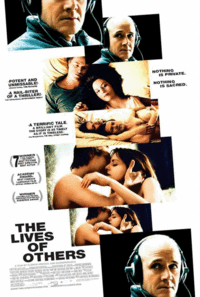
Coming Attraction (and Oscar Nominee): The Lives of Others

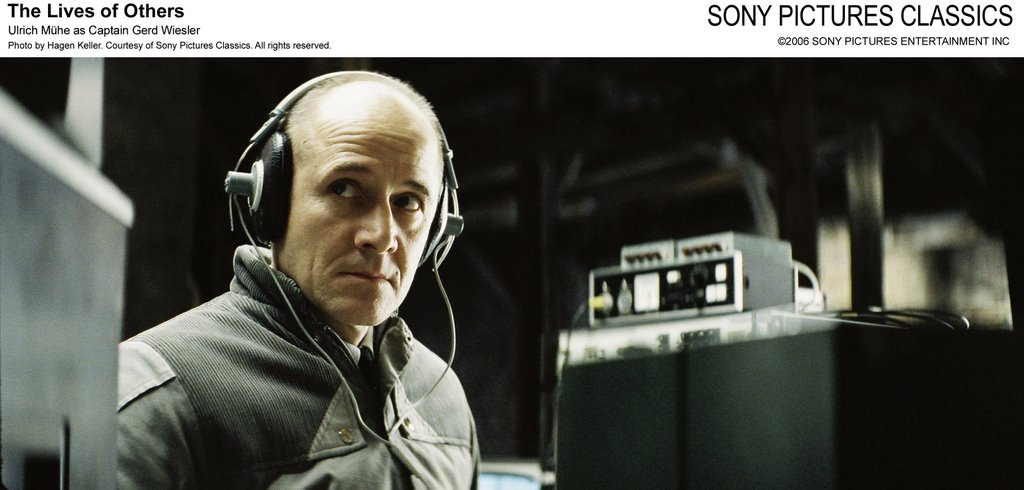
This year’s crop of Oscar contenders has been an underwhelming lot, but there is a bright spot. One of the nominees for best foreign language film, The Lives of Others (Das Leben der Anderen), offers profound insight into the nature of totalitarian systems and the human desire for freedom—and it actually comes from Germany.

It is 1984 in East Berlin. The Communist Party rules through fear, using the Stasi, the State Security force, as their instrument of terror. Those of an artistic bent are most likely to be targets of Stasi surveillance, which usually leads to interrogation and internment in the feared Normannenstrasse headquarters. Ulrich Mühe plays Capt. Gerd Wiesler, a faceless Stasi functionary, who excels at his duties. However, during a routine assignment watching writer Georg Dreyman and his actress girlfriend Christa-Maria Sieland, played by Sebastian Koch and Martina Gedeck respectively, Wiesler experiences a gradual awakening of his conscience. As Dreyman, a former darling of the Cultural Ministry, conspires to write an expose for the western press, Wiesler takes tentative steps to protect his would be quarry.

Much has been said about Hannah Arendt’s concept of the banality of evil. Lives essentially portrays the converse: a cog in the wheel of an evil system, who comes to the realization that he can no longer actively participate in the Stasi’s crimes.

Writer-director Florian Henckel von Donnersmarck visited the GDR on several occasions as a child, and clearly the experiences had a lasting impression. His story is also well informed by the samizdat literary tradition. No aspect of Socialist (and it is explicitly identified as such) rule is romanticized—the atmosphere of fear is unrelenting. He truly captures oppressive environment of East Berlin, from the washed out colors to the Brutalist architecture, fitting for a brutal system.

On one level, Lives is quite effective as a kind of spy thriller, creating quite a bit of suspense. It is also a story of tragedy compounded, in which suicide is an important theme. Yet FHVD’s moving script concludes on an elegant note. The acting is first rate, particularly Mühe and Koch. Gabriel Yared’s score, including the crucial “Sonata for a Good Man,” perfectly fits the on-screen action. Appropriately, it was recorded by the Prague Symphony Orchestra.

This is an exceptional film, and clearly the class of the Oscar field. Whether the Academy concurs is another matter, but this is a film that deserves a campaign on its behalf. Released by Sony Pictures Classics, it opens in New York (at the Angelika) and in Los Angeles on February 9, unrolling around the country later. Viewers who seek it out will be well rewarded for their efforts.

(Welcome Gateway Pundit readers, you won't be dissapointed when Lives rolls out nationally.)

Monday, January 29, 2007

Anat Fort in Concert

When Anat Fort’s new CD A Long Story releases on March 6 you can expect it to be reviewed widely because there is a good story behind it. Fort, with the help of some mutual associates, was able to convince drummer Paul Motian to play on the CD. Motian was so pleased with the results, he recommended it to ECM’s Manfred Eicher, and suddenly Fort found herself on the roster of one of the premiere jazz labels in the world.

As good as the story might be the music is what matters in the long run. Last night in St. Peter’s, Fort and her quartet played their final American concert before setting off on a European tour (where the CD is already available). Hearing them is convincing—her music definitely backs up the story. With Perry Robinson on clarinet, Ed Schuller on bass, and Roland Schneider on drums, Fort played a set of striking originals.

She varied the program nicely with quartet, trio, duo, and solo performances, mostly, but not entirely, drawn from the forthcoming Long Story. Fort’s original “Just Now” was heard in two very different versions, as a solo variation and as a vehicle for the entire quartet. “Morning: Good” is a particularly beautiful composition, and could well be the favored radio track of Long Story.

There was a high degree of musical empathy evident amongst the quartet. Replacing Motian is a daunting task, but Schneider’s percussion gave a rich texture to the proceedings. Schuller contributed some high caliber pizzicato solos and supported Fort admirably. Hearing a distinctive musician like Robinson is always a cool thing. Well before Don Byron and Chris Speed, he was one of the few artists bringing the clarinet into more adventurous contexts. He was also heard on ocarina for one particularly effective performance.

Fort has sparkling touch on the keys and a strong compositional sense. She identifies Bill Evans and Keith Jarrett as influences, and that comes through in her playing. In addition to that introspectiveness, there is also sometimes a playful slightly off-kilter quality, most pronounced last night in the trio performances.

It’s great to hear about a musician having success after years of paying dues, and it was rewarding to hear original music from Fort’s quartet.

Sunday, January 28, 2007

Dying Crapshooter’s Blues

The Dying Crapshooter’s Blues
By David Fulmer
Harcourt, Inc.

0-15-101175-3

Jazz has had several of its own sleuths, notably Bill Moody’s Evan Horne and David Fulmer’s own Valentin St. Cyr series. Now Fulmer gives the blues its due in the mystery genre with The Dying Crapshooter’s Blues.

Set in Atlanta during the 1920’s, Crapshooter tells the story of the shooting and drawn out death of Little Jesse Williams, a smalltime gambler, pimp, and general “rounder.” As Williams’ friends pay their respects on his deathbed, two receive special requests. Blind Willie McTell, the legendary bluesman, is charged with immortalizing Williams in a song to be sung over his grave, to be entitled: “The Dying Crapshooter’s Blues,” which can be found on many McTell compilations, including Atlanta Twelve-String. Joe Rose, a more successful thief and gambler of uncertain ethnicity, gets the unenviable task of investigating the soon-to-be murder.

As in any good blues song, there is a woman involved. Her name is Pearl Spencer, an old acquaintance of Rose’s, who drags him into the investigation of a high society burglary, which draws all the attention of the corrupt Atlanta P.D., (as opposed to the shooting of the African-American rounder). Indeed, as Rose starts asking questions about each crime, he starts to suspect they may both relate to corruption within the police force.

Fulmer shows a deep appreciation of the period and seamlessly weaves the real-life figure of McTell throughout the story. He shows his blues record collector sympathies in a side-plot involving Columbia Records field recorders. The real blues sensibility comes out in the gothic death-watch that dominates the story and McTell’s blues that commemorates the death of Little Jesse. Fulmer vividly describes McTell writing his celebrated lyrics in claustrophobic conditions as his friend slips away:

“The blind man sang the first lines.

Little Jesse was a gambler, night and day
Well, he used crooked cards and dice

A sinful guy, good-hearted, but had no soul
Heart was hard and cold like ice

Jesse was a wild reckless gambler, he won a gang of change
Many gambler’s heart he let in pain

When he began to spend and lose his money,
he began to be blue and all alone
But boys, his heart had even turned to stone

Willie hesitated, then spoke the rest of it.

What broke Jesse’s heart, why he was blue and all alone
Sweet Lorena packed up and gone . . .

At that, Jesse opened his eyes again and smiled, his face softening with a sweet sadness. ‘You gonna make me famous, Willie?’” (p. 97)


That’s what the blues are all about.

Crapshooter is more period crime story than mystery. Fulmer tips his hand revealing most of the villains fairly early, but he makes low-life 1920’s Atlanta a compelling backdrop to the story. Fulmer also uses the historic realities of segregated Atlanta to heighten the tension. Indeed, investigating the Williams shooting is a very dangerous pursuit for Rose, especially when it leads back to crooked cops. Fulmer has a good ear for dialogue and for music, which enriches the story. It is a well-paced read that blues aficionados and period mystery readers should both appreciate.

Friday, January 26, 2007

NOLA Charters and Choice

Arguably the most significant challenge facing New Orleans is the task of rebuilding the city’s educational system, and some profound proposals for reform are being discussed. IAJE’s Jazz Education Journal assessed the situation in Antonio J. García’s “Jazz Education in New Orleans, Post-Katrina.” It was discussed in a post here, but some of numbers and implications of the piece begged further inquiry.

García wrote:

“Of the 57 schools slated to open in Louisiana’s State Recovery School District this fall, only five are traditional public schools overseen by an accountable and elected school board. The other 53 are charter schools, which receive both federal and state dollars but operate with more autonomy.” [Again, I assume that’s a typo in the math.]

and:

“The Catholic [school] administrative system was better suited to meet the challenge of the displaced students, as the pre-Katrina needs of Baton Rouge and New Orleans had already resided under one roof. And the Catholic music programs had often been better funded than their secular counterparts.”

According to García and an Urban Institute policy paper he cites, forty percent of New Orleans student population attended Catholic parochial schools before Katrina. Of those students, 79% have returned to class in a Catholic school-if not New Orleans, then Baton Rouge or whatever city they found refuge in.

Most residents of New Orleans were far from affluent, so the fact that 40% of parents opted to send their children to Catholic school is highly telling. The Urban Institute paper, written by Paul Hill and Jane Hannaway, explains in large measure why they would make this choice:

“In the 2004-2005 school year, only 44 percent of fourth graders proved proficient in reading and only 26 percent in math. Eight graders performed even worse. Twenty-six percent were proficient in reading and 15 percent in math.”

For the coming school year, the overwhelming majority of operational schools in New Orleans will be charter schools (53 vs. 4). The state of Louisiana and the Urban Institute (hardly a right-wing hotbed) authors advocate expanding charters schools as a way of rebuilding the educational system in a way that serves students and maintains flexibility for an uncertain future. Hill and Hannaway go further including this potentially controversial proposal:

A Scholarship plan under which all New Orleans students, no matter where each went to school previously, can take a set amount of money to any local school. This amount (including funds for facilities rental) could come from a combination of state and federal aid. Far more than a voucher plan, the idea is to prompt the private sector to open more schools and thus promote school quality.”

It seems the only reason not to call this a voucher plan is the political baggage attached to the V-word, but the logic is inescapable. Clearly, the educational bureaucracy has proved itself incapable of dealing with the dire effects of Katrina, while Catholic and Charter schools have stepped up to the plate. The potential implications of what is brewing in New Orleans are enormous, but have gone largely unnoticed. We might well see in New Orleans a robust charter school environment and a viable voucher system that includes parochial schools, reforms taken not as a principled economic policy, but as a Hail Mary attempt to rescue the city’s schools and by extension, its future.

Thursday, January 25, 2007

Epic Performance

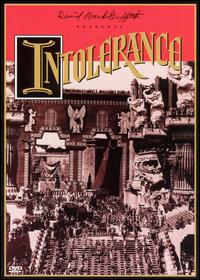
For some reason silent films just do not translate well for modern audiences, and not for their black and white photography. There just seems to be a fundamental sound barrier that keeps contemporary audiences at a distance. However, Wycliffe Gordon’s original score for D.W. Griffith’s Intolerance (1916), performed live last night to accompany a screening of the film as part of the Jazz Museum in Harlem’s "Harlem in the Himalayas" series at the Rubin Museum, demonstrated how music can break that barrier.

Intolerance is an epic film of four thematically related stories from different periods of history (Babylon, 15th Century France, the Holy Land, and then contemporary California), running over three hours in length. Indeed Gordon and his ensemble played for nearly four hours straight, with only a twenty minute intermission. It was an epic performance, in which Gordon played throughout on trombone, trumpet, tuba, and didgeridoo, laying out for only the briefest passages.

Intolerance was Griffiths’ make-up movie for the racist Birth of a Nation. It was intended as a plea for peace and tolerance, although there is only one non-white face to be seen from an extra during a street scene. Many of the characters were heroic or villainous archetypes, with names like “Mountain Girl” and “Brown Eyes.” It proves the effectiveness of music to pull viewers into a challenging film, keeping their attention despite a slow start, ultimately hooking them in. As each disparate storyline reaches their simultaneous climax, Gordon’s music creates legitimate suspense.

A jazz soundtrack might sound counter-intuitive for stories of antiquity, but Gordon fits his music to Griffiths’ images remarkably well, like the stark blues accompanying the prison scenes, or the swinging groove for the Babylonian bacchanals. In addition to interesting film-scoring, it was great jazz, which deserves to be released on CD (although that would probably require at least three disks).

This is Gordon’s second score for silent film, following his commission for Oscar Micheaux’s Body and Soul. It is an impressive work as composition, and even more impressive as a display of musical endurance by Gordon and his ensemble. There is talk of a DVD release for Body and Soul with Gordon’s soundtrack. It would be great to see that come to pass, and for Intolerance as well. Modern soundtrack music, in this case jazz, may prove to be the best method to keep these films accessible, and not unseen and forgotten.

Wednesday, January 24, 2007

The Black Dahlia

The Black Dahlia
Directed by Brian De Palma
Score by Mark Isham
Universal Home Entertainment


Jazz has had a hard time finding its way into film soundtracks, but film noir has sometimes opened the door a crack. Brian De Palma’s adaptation of James Ellroy’s novel, The Black Dahlia, effectively employs a jazz-influenced score composed by Mark Isham in a film that embraces the film noir tradition.

Isham himself has recorded jazz sessions as a leader, and co-led excellent sessions with Art Lande for ECM. He is probably in more demand for his film work in a diversity of styles, including legitimate jazz soundtracks for The Cooler and Afterburn. While not explicitly a jazz score, Isham’s Dahlia soundtrack, featuring his muted trumpet, is clearly jazz influenced and inspired.

Isham’s music, combined with De Palma’s direction and the Oscar nominated cinematography of Vilmos Zsigmond, Dahlia lovingly recreates the look and feel of film noir. The dark tones heard over De Palma’s long tracking shot, which begins with the discovery of the Black Dahlia’s body, establish the mood of foreboding menace. Scoring scenes between Josh Harnett and Scarlett Johansson, Isham’s music conveys mournfulness and longing. For femme fatale Hilary Swank’s come hither scenes, Isham’s trumpet themes express romance and danger in equal measure.

It is as film noir that Dahlia succeeds as an entertaining picture, portraying a shadowy, smoke-filled world of police corruption and Hollywood depravity. Sometimes the plot does not make perfect sense, but there is long tradition of frankly incoherent storylines in the genre, extending back to classics like The Big Sleep. The weak link is Harnett, who just does not have the on-screen presence to carry off the role of Detective Bucky Bleichert, coming across more wooden than earnest. Aaron Echhart however turns in a great performance as Bleichert’s partner, the mercurial Detective Lee Blanchard, a flamboyant and nuanced character, who is corrupt but not completely unsympathetic.

The Black Dahlia looks and sounds great. It might not be the best of the genre, but a lot of the elements are brought together nicely.

Tuesday, January 23, 2007

The Changing Face of Prague

BC, our man in Prague, sends this story about Prague 6’s plans to erect a Ronald Reagan memorial at a yet to be determined site. Prague 6’s Mayor Tomas Chalupa told the Prague Post:

“Reagan was ‘the most important personality that enabled the fall of communism” and is thus a key figure in Czech history.”

Prague is divided into administrative districts, somewhat like boroughs in the City, which are totally confusing to visitors. Prague 6 happens to border Letna Park the historic site of two notorious monuments. The Czechoslovakian Communists finished a gigantic statue of Stalin in 1955, two years after the dictator’s death. Following Khrushchev’s de-Stalinization campaign, the monument became an embarrassment to the local party, and was ultimately destroyed in 1962, leaving chunks of statue strewn throughout the park for years to come.

Years later, a vanity statue of Michael Jackson was erected on the same pedestal, alongside the giant metronome installed in 1991. The ironic monument was part of the successful efforts to lure Jackson and his ego to kick-off the 1996 HIStory tour in Prague.

Prague is a beautiful city filled with impressive monuments, but its Twentieth Century statuary was a mixed bag. The Stalin monument was conceived to curry favor with a tyrant. The Jackson statue came during the ironic go-go years of the “Wild East.” A Reagan memorial comes after adequate time for reflection, and would age much more gracefully than its predecessors in Letna Park.

Monday, January 22, 2007

Weill

Weill
By Anne Kerry Ford
Illyria Records CD003


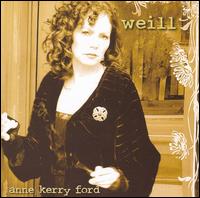
Kurt Weill’s reputation is intertwined with that of his early collaborator Bertolt Brecht, but while Brecht was politicizing his lyrics, Weill was more interested in the art of his melodies. Anne Kerry Ford’s new set of Kurt Weill songs, simply titled Weill, provides a fresh look at the composer, including examples of his collaborations with a variety of different lyricists, including Ira Gershwin, Maxwell Anderson, and Langston Hughes.

Ford is a vocalist more in the cabaret tradition, also known for an acting career on the soap opera Days of Our Lives and in the films Clean and Sober and Fearless. For many of the songs here, particularly those with Brecht lyrics, like the demanding "Pirate Jenny," her theatrical training is helpful in interpreting dramatic and sometimes thorny lyrics.

Ford clearly takes inspiration performing in Weill’s native Germany backed up by the German WDR Big Band, one of the best bands in Europe. The great jazz pianist Roger Kellaway wrote most of the arrangements, giving a jazz feel to some of the tunes. This is particularly strong on “One Life to Lead” with lyrics by Gershwin, which even features some scattish vocalizing over William Artope’s trumpet.

“My Ship,” also from Lady in the Dark, Weill’s Broadway collaboration with Gershwin and Moss Hart, is a beautiful ballad feature for Ford with simple but elegant piano accompaniment from John Boswell. It is also interesting to hear Ford singing the alienation and blues of Hughes’ “Lonely House” and effectively rising to the concluding emotional crescendo.

Indeed, Ford has a strong voice that is never overwhelmed by the orchestra on tunes like the opener “I’m a Stranger Here Myself.” Ford handles the lowdown brass voicings of Kellaway’s arrangement, as well as Odgen Nash’s suggestive lyrics quite well on another standout tune that would be of strong interest to jazz listeners.

Evidently, Kurt Weill is set for another Broadway revival. LoveMusik a musical directed by Harold Prince, dramatizing Weill’s relationship with Lotte Lenya and featuring his songs, is scheduled to debut soon. Those Broadway patrons would certainly also enjoy Ford’s Weill. It is clearly an independently conceived self-contained project, which straddles cabaret and big band vocals in a way that could appeal to a wide theater-going audience. The result is a well-selected set of Weill songs (no “Mack the Knife”—too obvious) that showcases Ford’s voice and gives a deeper appreciation for the breadth of Weill’s compositions for musical theater.

Saturday, January 20, 2007

Tommy Dorsey


Tommy Dorsey: Livin’ in a Great Big Way
By Peter Levinson
Da Capo Press tradepaper
0-306-81502-8


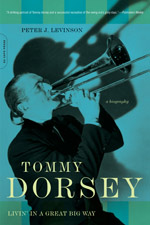
At the height of his success, Tommy Dorsey acknowledged two bands superior to his: the first was Jimmy Lunceford, and later Count Basie. However, Dorsey’s influence on American popular music is enormous, as Peter Levinson chronicles in his biography, Tommy Dorsey: Livin’ in a Great Big Way.

Tommy Dorsey’s story is of course intertwined with that of his alto playing brother, Jimmy Dorsey. Levinson describes an often strained relationship between the band-leading brothers, in which: “Almost from the beginning, the two brothers referred to each other as ‘The Brother’ or ‘Brother.’” (p. 6) In his assessment of the Dorseys, Levinson suggests Jimmy was the superior musician, but Tommy Dorsey was the one with the leadership ability.

Dorsey employed some of the best musicians of the 1930’s and 1940’s including: Buddy Morrow, Ziggy Elman, Charlie Shavers, Louis Bellson, Buddy Rich, Dick Haymes, and a young Frank Sinatra. His eye for talent also extended to the business side of the industry. Rejected by the military for health reasons, Charlie Wick became a part of the Dorsey organization as an arranger and manager of Dorsey’s ballroom. It would be the start of an interesting career for Wick, as Levinson details:

“Wick later made a successful transition into other areas, which included making the publishing deal for Winston Churchill’s epic series History of the English-Speaking Peoples and advising Ronald Reagan in his gubernatorial bid in California. Later, he served in the Reagan administration for two terms as director of the U.S. Information Agency (USIA).” (p. 169)

Dorsey’s outfit consistently ranked at the top of each big band category, but events of the 1940’s would have a tremendous impact on the band business. The American Federation of Musicians’ luddite recording strike, designed to combat the growing influence of radio and juke boxes had a disastrous effect on swing musicians. As Levinson writes:

“The ill-conceived recording ban was finally lifted in November 1944. It was finally obvious to [union boss] James C. Petrillo that the ban on recordings using musicians didn’t result in more work for them in other areas. On the contrary, it provided less employment.” (p. 185)

Ironically, Dorsey would have a hand in driving the final nail into the coffin of the swing era. Stage Show, the variety television show hosted by the Dorsey Brothers in the 1950’s is remembered for two things. Reports that Charlie Parker was watching it the night he died provide one claim to trivia immortality. Stage Show was also the venue for Elvis Presley’s television debut, well before his celebrated performance on Ed Sullivan. According to Levinson, many in the band did not see the Presley appeal, but Dorsey’s eye for talent was as sharp as ever:

“[Band member] John Frosk added, ‘We didn’t like him because he looked dirty, and he needed a haircut. We thought he never bathed.’ But at the end of the rehearsal, Louis Bellson recalled, Tommy said, “You see that guy Elvis Presley—he’s going to be one of the biggest names in show business in a short time.’” (p. 288)

His appearances of Stage Show clearly led to bigger things for Presley. One can argue for a place in rock & roll history for Tommy Dorsey simply for helping make Presley a star. Considering the number of instruments the Dorsey Brothers destroyed in their sibling fights, one might claim they were forerunners of The Who as well.

There many revealing anecdotes collected in Livin,’ and Levinson is not shy about covering the more scandalous events of Dorsey’s life. Levinson seems to have mixed feelings about Tommy Dorsey, the man, but is a staunch defender of Dorsey’s music. The resulting biography is fast reading and totally entertaining, regardless of how one feels about the man or his music.

Friday, January 19, 2007

Hearing Humanity in Music (or not)

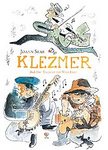
Many jazz artists, like John Zorn and Don Byron, have experimented with Klezmer music, so Joann Sfar’s graphic novel, Klezmer, could be of interest to the jazz community. It won’t be discussed it in much detail, because, disclosure, it is published by a corporate cousin of my publishing house (its sales have no impact on my compensation).

It does bring to mind radical left-wing Gilad Atzmon’s supposedly satirical Artie Fishel band, whose website features this comedic gem:

“Klezmer: Gypsy music played badly to a degree of genuine art form. Artie expertise.”

He kids, because he doesn’t love. It seems he willfully misses the art and humanity of the music that has crossed genre boundaries. Sfar’s afterward offers some interesting thoughts:

“I think about Shostakovich, who for years carried around in his suitcase his Opus 79, “On Jewish Folk Poetry.” And each time Stalin or the others would forbid him to present it. I think about Isaac Babel, whose short stories on Odessa were scattered, banned, lost. I love that mad project they had, of getting people to like the Jews.

“I think human populations need friendship. When men sense that they are not liked, they invent the blues or Gypsy music or klezmer.” (p. XXII)

Most jazz artists get the affinity between klezmer, jazz, and blues. Evidently, Atzmon does not. Again, it shows the dangers of politicizing art, as opposed to creating art that might be political. Duke Ellington always said there are only two kinds of music: good and bad. That’s a more rewarding perspective, than insisting on evaluating art through a narrow ideological perspective.

As Sfar suggests, jazz, blues, klezmer, and Gypsy music share a similarity in that they are all music of the underdog. That is probably an unattractive aspect to political artists like Atzmon, who court power through their activism and extremist associates.

Thursday, January 18, 2007

Stamp of Approval

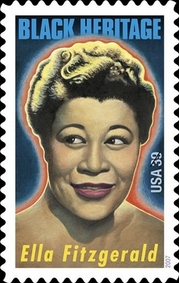
Quick IAJE flashback: during the opening night concerts, a representative of the U.S. Postal Service took the stage to reprise a ceremony held earlier that day at Jazz @ Lincoln Center: the unveiling of a commemorative stamp honoring Ella Fitzgerald. For a nation supposedly lax in honoring its original artists, jazz and blues musicians are remarkably well represented on stamps (see list below).

It takes about three years for a proposed stamp to come to fruition. The public is welcome to make suggestions, which are evaluated by a non-partisan selection commission. One of the main criteria is that subjects must be deceased. Obviously, a President Ford stamp can now be expected. It’s worth considering making a nomination. Jazz fans should try to keep the jazz stamp collection growing. Mainstream conservatives should bear in mind the left has been much more successful in honoring their heroes, than have we, the President Reagan and Ayn Rand stamps being notable exceptions.

Here’s a consensus candidate: Lionel Hampton, a perennial J.B. Spins favorite. I profiled Hampton at Tech Central Station here, but here is the pitch in a nutshell:

Hampton broke down color barriers, performing in Benny Goodman’s Quartet, the first racially integrated musical combo to publicly perform as such.

He was the pioneering jazz vibraphonist, considered by many to have recorded the first improvised jazz solo.

He recorded extensively and led one of the more successful and longest lived big bands.

He was a humanitarian, funding public housing projects in Harlem and was an outspoken supporter of the State of Israel, and contributed the proceeds from his Israeli tours to the Israelis.

And of course, he was an active Republican, who campaigned on behalf of his friends, Presidents Nixon and George H. W. Bush.

There are other worthy candidates for postal immortalization. Obvious irony aside, Milton Friedman would be a brilliant choice for recognition by the Federal postal bureaucracy. Other good choices would be: Dizzy Gillespie, Art Tatum, Illinois Jacquet, Sarah Vaughan, Woody Herman, Bix Biederbecke, Whittaker Chambers, Friedrich Hayek, and Russell Kirk. Nominating info here.


Jazz and blues artist stamps with year issued:

Louis Armstrong ‘95
Mildred Bailey ‘94
Count Basie ‘96
Eubie Blake ‘95
Hoagy Carmichael ‘96
John Coltrane ‘95
Tommy & Jimmy Dorsey ‘96
Duke Ellington ‘86
Errol Garner ‘95
Benny Goodman ‘96
Ferde Grofe ’97 (included for his work with Paul Whiteman)
W.C. Handy ‘69
Coleman Hawkins ‘95
Billie Holiday ‘94
James P. Johnson ‘95
Robert Johnson ‘94
Scott Joplin ’83 (ragtime, close enough for government work)
Glenn Miller ‘96
Charles Mingus ‘95
Thelonious Monk ‘95
Jelly Roll Morton ‘95
Charlie Parker ‘95
Ma Rainey ‘94
Jimmy Rushing ‘94
Bessie Smith ‘94
Sonny Terry ‘98
Rosetta Tharpe ‘98
Dinah Washington ‘93
Ethel Waters ‘94
Muddy Waters ‘94

Wednesday, January 17, 2007

Out Chorus from Doc Jazz

The Doc Jazz in this instance is not the independent jazz label, but the moniker of Tariq Shadid, a Dutch-Palestinian “songwriter” and polemicist, whose greatest internet exposure seems to be from a rather heavy-handed diatribe regarding the proximity of the Israeli Holocaust memorial Yad Vashem to Deir Yassin, the site where 248 Palestinians were killed during the hostilities of 1948. Shadid uses a crude sort of grim arithmetic of aggrievement, equating the death of 248 Palestinians with the extermination of six million Jews.

Shadid announced on his Musical Intifadah site, that as of February of this year, no more updates would be going up there (not linking, but you can find it at docjazz dot com). He’ll be concentrating his efforts on his upcoming CD. Good luck with that. Don’t expect much jazz from the cat with the Doc Jazz handle. The songs on his site identified as Jazz Fusion or Acid Jazz, like “Smile” and “Castles in the Sky” are at best warmed over R&B or milktoast funk. If there a clave beat in the so-called Latin Jazz number “Eres Mi Vida—Ya Hayati,” it escaped my listening. Even those labeled smooth jazz wouldn’t pass muster on CD101.1 (NY’s notorious smooth jazz station). You won’t hear any jazz Musical Intifadah, but you can find some virulent, hateful lyrics like:

“Do you remember all the faces of the innocent Iraqis
And innocent Afghanis killed with your rockets?
Did you ever hear about being an honourable soldier
If its possible at all well then ur definitely not that soldier”

The music assembled by Doc Jazz is propaganda, not art. Like propaganda, it demonizes its enemies, repeating lies, such as those about American soldiers committing atrocities. In this case, Shadid’s songs are not even honest about the genre they represent. Happy trails Doc . . . and stay out of trouble.

Tuesday, January 16, 2007

IAJE: Jazz, Politics and the American Identity

On Thur. at IAJE, Jazziz sponsored a panel entitled Jazz, Politics and the American Identity. I went so you wouldn’t have to, so here is the report promised in the Day 2 post. It was largely what you would expect. The diversity of opinion expressed ranged from: “the Iraq War is Bad” to “Bush is Evil.” Larry Blumenfeld was a particularly talky and opinionated “moderator.” He opened with the joke that panelists would be collaborating on the composition “Prelude to a Troop Surge” to set the tone.

Panelists included musicians Dave Douglas, Craig Harris, Charlie Haden of the Liberation Music Orchestra whose compositions include “Chairman Mao” and “Song for Che,” and Loren Schoenberg musician and curator of the Jazz Museum of Harlem.

To start, Blumenfeld asked Haden to recount his 1971 arrest in Portugal, a familiar story to those who regularly suffer through Democracy Now. Afterward, Douglas cautioned us: “that could happen here to any of us.” Obviously, Douglas has never walked by Union Square, or he would have seen the extent to which protest is catered to in this country.

Schoenberg was the voice of reason, largely keeping his remarks nonpartisan. He essentially challenged panel attendees, if they were unhappy, don’t just moan and gripe at a jazz conference. Get involved locally. That’s my paraphrase. He was a little more diplomatic. Interestingly, he also gave credit to the Nixon Administration for expanding the NEA and NEH.

Harris was clearly on the left side of the spectrum, but did seem connected to reality. At one point he produced murmurs of disbelief when he said: “I’m sure a lot of people at this conference voted for George Bush . . . maybe not in this room, but at this conference.” Surely that was true if you included the small businessmen and military band members setting up their booths in the exhibit hall.

In addition to making off-hand jabs at the President, Douglas argued there is some nefarious attempt to rewrite history, musically to exclude the avant-garde, and politically to portray the 1960’s as a period of dangerous excess. As far as the 1960’s are concerned, Douglas seems to be the revisionist, trying to wish away the dangerous excesses of the Weathermen Underground and the Black Panthers, among others.

On the music front, I shared his disappoint in Ken Burns’ handling of the avant-garde, for instance, but as a filmmaker Burns is entitled to his own editorial choices. The Schoenberg principle seems to apply here. NEA Jazz Masters are nominated by the public and then voted on by a panel of experts. I would suggest Douglas and his followers nominate worthy artists like Andrew Hill, Sam Rivers, and Pharoah Sanders.

New Orleans did come up. Predictably it was used as a handy tool to bash the Bush administration. Douglas at least made a welcome pitch for the Jazz Foundation, and in the midst of his “moderating” Blumenfeld actually made a legitimate point when he took Pelosi to task for not including NOLA in her much hyped 100 days agenda.

It would be interesting to know if any effort was made to invite more right-leaning panelists. I don’t mean cranky bloggers either. Cuban defectors Paquito D’Rivera and Arturo Sandoval would have brought a much different perspective with regards to foreign policy. I have no idea where they stand on the capitol gains tax, but they are staunch critics of the Castro regime, unlike Haden and Harris. (It is entirely possible they were invited, but as busy musicians, were unable to attend.)

Oddly, the panel was not as bad as I expected. However, it would have benefited enormously if it had presented a legitimate cross-section of opinion with a moderator content to moderate.

Monday, January 15, 2007

IAJE Day 4

Again, we’re starting this one at 11:00, with Western Michigan U’s Jazz Octet. This was the best student band I heard at the conference. All eight showed a tremendous level of musicianship and most had contributed interesting arrangements to the band’s book. No sheet music on the bandstand for them either. The guest musicians included Stefon Harris who burned on one of WMU’s originals “Narnian Nights,” coming back for more several times. Fred Hersch and Billy Hart, who have both worked with WMU, also sat in for an impressive finale.

The only paper I heard delivered was Mark Baszak’s Jazz and Hip Hop: a New Brand of the New Jazz. Delivering papers is a tough assignment. Baszak did well enough, and his overview of jazz and hip hop interaction was authoritative. Once again, there were no Q’s in the Q&A, just statements looking for an Amen. In the future, IAJE needs to put any hip hop related program in a larger room, because people were sitting on top of each other—to hear a paper.

Gary Thomas & Exile Gate’s sounded good, but they were so over-amplified I had to leave. Downbeat’s live blindfold session featured Ron Carter—look for it in the May issue. It doesn’t seem fair to reveal spoilers here, but Carter came with candor, so they should have plenty of good copy to work with.

There was a good turnout for the screening of Joe Williams: a Portrait in Song. IAJE should screen more rare films that are not currently available on DVD. Portrait is a nice film, capturing the grace of Williams. In discussing his many Tonight Show appearances, it also illuminated the service Carson did by keeping artists like Williams and Buddy Rich in the public eye, even if they were not ratings generating flavor-of-the-month pop stars.

Pekka Pylkkänen’s Tube Factory was the best French group I heard there. Their group interplay was impressive, and they showed a comfort level at a variety of tempos and intensity levels. This was followed by a sax clinic put on by Swiss alto player George Robert (Row-Bear) and Phil Woods, with unannounced guest Bob Mintzer on tenor. Robert played with Woods’ European big band, and they clearly know how to spur each other on.

OK, let’s get to the evening concert, which featured French all-star groups and well known leftist Charlie Haden’s Liberation Music Orchestra—perhaps a fitting combination. Before introducing the French ensembles, IAJE president Chuck Owen uttered the unfortunate remark of the evening when he thanked the French Ambassador Jean-David Levitte for the “high degree of French collaboration” in the conference.

Michel Legrand, looking dapper in white scarf, played one of his tunes with a French student band. It was nice, and just seeing Legrand is an event in itself. Didier Lochwood and Richard Galliano fronted French all-star ensembles, including Stephane Huchard on drums, playing in a much more traditional context than on his French Blue Note albums.

Word had reached most conference participants around 7:00 that Michael Brecker and Alice Coltrane had both passed away. Haden had worked with both and was clearly in mourning. He dedicated the set to Brecker, Coltrane, Dewey Redman (whose memorial he had played at Sun. night) and to world peace. Aside from that last general dedication and simply identifying song titles, Haden would make nothing even resembling a political statement during the set.

I have taken issue with Haden’s politics in the past, so feel free to take that into account. This really is an excellent band. On tunes like “Going Home” and the bluesy, gospel-feeling “Amazing Grace” they really delivered the goods. The tunes in-between however, sounded ponderous at times. Instead of saying something heavy, they tell you they are saying something heavy. One nice exception was “Not in Our Name,” which sounded quite a bit like Gerry Mulligan’s theme for the movie Luv when I heard it. (Mulligan actually never recorded it apart from what was heard in the film itself, but Buddy Rich covered it on The New One.) The loss of Brecker, Coltrane, and Redman is deeply saddening to the entire jazz community. One hopes their family and friends, including Mr. Haden, find solace in their time of mourning.

Despite ending with some unfortunate news—a circumstance beyond IAJE’s control—it was a strong conference, with many top-flight performances. Technically, IAJE ended Sat. night, but Sun. seemed like an unofficial Day 5 at St. Peter’s. Jazz Vespers was packed to hear vocalist Janet Planet lead a group that included Gene Bertoncini on guitar. This was followed by a memorial to Walter Booker, the great bassist who played with Cannonball Adderley, Sonny Rollins, the JFK Quintet, and scores of others. Those paying tribute included surprise guests T.S. Monk and Roy Hargrove, in addition to Charles Davis, Onaje Allan Gumbs, Jimmy Cobb, and of course Bertha Hope. Those who stayed the extra day to pay their respects were rewarded with some beautiful music.

IAJE Day 3

At this year’s IAJE, anything scheduled before 11:00 AM may as well have been in Toronto (scene of next year’s conference), as far as I was concerned, so Fri. started with the panel discussion featuring the 2007 NEA Jazz Masters. A.B. Spellman was a game host, eliciting some great memories from the honored guests. Chairman Gioia smoothly interrupted at one point to present Jimmy Scott with a special commemorative edition of the remarks his Congressional Rep. was entering into the Congressional Record. As usual, the questions from the audience were not questions, but statements in search of validation. When you have Phil Woods available, why not ask him about Charlie Parker? Curtis Fuller holds the distinction of being the only person to record with Bud Powell, John Coltrane, and Jimmy Smith. Maybe people would want to ask him about those experiences? No, people would prefer to gripe about the cost of jazz clubs (which I contend are a bargain compared to say the cost of seeing a Broadway show or the Rolling Stones in concert). While the program listed the panel at two hours, Spellman informed the crowd it was actually only scheduled for 75 minutes. If he called an audible to cut discussion off on his own, I applaud the call.

The representing military big band this year was the United States Air Force Academy Band Falconaires. They performed some spirited originals like “Mark’s Time” composed specifically for the band by Sammy Nestico and “Hey, That’s My Bike,” contributed by Metalwood’s Brad Turner. I mentioned to one of the members of the several exhibiting military bands that I thought America got a bad wrap for not supporting the music, because every branch of service has at least one top flight swing band. He certainly agreed: like yeah—you’re starting to catch on.

The BMI/NY Jazz Orchestra performed some interesting compositions, with the best probably being Asuka Kakitani’s “Dance I.” This group includes Deanna Witkowski on piano, who reports her concert of Marylou Williams’ liturgical music later that same night at St. Peter’s still drew a nice crowd despite the competition from IAJE. There is hope she will be able to present it in other venues, which would be great.

On Thur., photographer David Redfern received the Milt Hinton Award for jazz photography at the opening general session, which hardly anyone goes to. He presented some of his work Fri afternoon, including his iconic photo of Bill Evans at Ronnie Scott’s. Redfern expressed his concerns about the greatly restricted access photographers now face at live events, as well as the impact of digital photography on historical archives.

The most disappointing performance came from the Orchestre National de Jazz (ONJ)’s program “Close to Heaven Tribute to Led Zeppelin.” The arrangements seem to fall in the predictable trap of playing real loud, then real soft, then loud again. To be fair, their cover of The Rain Song on the French government sponsored sampler French Quarter, did not display such tendencies, and worker better as a result. Still, they never really exploited the subversive possibilities in covering songs like “Black Dog” and “Dazed and Confused,” the way The Bad Plus does when they turn inside out tunes like “Teen Spirit” and the “Theme from Chariots of Fire.”

Fred Hess and his band, including the vastly underappreciated Ron Miles on cornet represented Denver well. Evidently, they do a regular spoken word with musical accompaniment Jean Shepherd-style bit featuring the Clef family, complete with visual aid. However, instead of trying for whimsy and pathos, they go absolute absurdity, aided by the enthusiasm of the only non-Coloradan Matt Wilson. The complete absurdity of it actually won the audience over as it went on.

IAJE has to start putting Dave Liebman into the Metropolitan or Grand Ballrooms. Every time he has played the conference, it has been packed to the rafters. It was another great show, with a particularly effective arrangement and performance of “On Green Dolphin Street.”

The presentation of the NEA Jazz Masters dominated the evening concert. In between award presentations, the Clayton Brothers Quintet and the Dizzy Gillespie alumni band played some swinging sets. The most moving speech came from Curtis Fuller, who credited a nun from his orphanage for starting his musical career. Phil Woods provided the funniest, and Ramsey Lewis the longest—or maybe it just seemed that way being the last of the night.

Friday, January 12, 2007

IAJE Day 2

Panels started for real on Thur. One interesting assembly discussed jazz on television. Somehow they did have enough material for an hour panel. Don Braden discussed the challenges of scoring Cosby, the most recent show from the Cos. The original conception was for something Monk-like, but the network wanted a more upbeat theme. At least it gave work to musicians like Braden, Arturo O’Farrill, and Dave Valentin. There was a representative from Legends of Jazz with Ramsey Lewis. Evidently, it has received decent ratings for PBS, around .3 (point three). The real challenge it faces continues to be timeslot—no help there from WNET 13 here in New York. There was also a panel on Jazz and Politics, which I’ll have to pull out of the deck and address separately once I’ve reviewed my notes. It was about what you suspect it was, though.

There was a strong musical lineup through the day, including Ed Neumeister’s NeuHat Ensemble, a big band augmented with string ensemble that had a distinctive sound. Taylor Eigsti’s young quartet did well for themselves, distinguishing themselves on “Love for Sale” and doing the nearly impossible by making Bjork’s “I’ve Seen it All” actually sound interesting.

One of the best shows was Jerry Dodgion’s Joy of Sax with Frank Wess. The kicked off with “Quill” a tribute to Gene Quill composed and arranged for the group by Phil Woods. The tune and the performance, Woods' first live hearing of their rendition, were sparkling. Then Wess came out for the first of several deserved standing ovations. He can still bring it, whether chewing up the choruses on flute for a slow blues, or bringing down the house on tenor for “Cotton Tail.”

Dave Samuels and David Friesen as Double Image, were more cerebral, but the vibe and marimba duo’s freely improvised set provided some memorable moments too. Ingrid Jensen performed a set of originals in her warm Woody Shaw inspired style, to a packed house, showing she deserved the upgrade in space from her last IAJE appearance.

As was the case Wed. night, the highlight of the Grand Ballroom shows, featured Mario Rivera, this time playing with Conrad Herwig and Brian Lynch’s Latin Side of Miles Davis group. His baritone really gave heavy authority to the proceedings.

Again, the 11:00 Trianon concert was the place to be. JoAnne Brackeen’s quartet played some amazing music, including Afro-Cuban and Spanish derived songs. Brackeen also played a beautiful solo take of “Lush Life.” Overall, despite the long set changes in the Grand Ballroom, the vibe has been good so far.

(again, forgive typos and the like. I'll make correction and flesh some things out after the show.)

IAJE Day 1

This year’s IAJE should be very well blogged. When I posted quickly Wed. afternoon, two people had already signed onto Blogger from that terminal in the conference's internet café area. As mentioned Wed. on the fly, IAJE started well, with Bobby Watson and the La Guardia High School Jazz Sextet. The Monk Institute supports several high school jazz programs, bringing in big name artists like Watson for month long teaching gigs. The results sound impressive. Watson also noted approvingly that the Monk Institute does not allow their ensembles to play with sheet music on the bandstand. You have to respect the old school approach, there.

The evening’s concerts established a nice vibe. One for All played a nice set of their upbeat hardbop. The Grand Ballroom show in the Hilton featured a nice mix. Doc Severinsen was scheduled to guest with the Music School’s Crescent Super Band, but was forced to cancel—no announcement why. Ernie Watts stepped in as a last minute replacement (no disrespect, but I was more interested to hear him than Severinsen) and performed a couple tunes with the Crescent band, including a driving performance of “East Coast Envy.” Joey DeFrancesco played a swinging set with Ron Blake, but the vocal number did not have nearly the same energy. Musicians this year seem much less reticient about plugging CDs, which is fine. After assuming in jest everyone had already bought his last CD, DeFrancesco joked that if anyone doesn’t, surely they can have someone burn it for them. That’s the state of the business, I suppose. The best act of the Grand Ballroom lineup was the Latin Giants of Jazz, consisting largely of Tito Puente’s former band, including the great Mario Rivera, performing the music of Puente, Machito, and Tito Rodriguez. A few people were even dancing, and nobody dances anymore. In between musical acts, there was also an appropriate presentation to Wendy and some of the Jazz Foundation’s financial angels, St. Agnes Varis of AgVar Chmicals and longtime Foundation supporters e-trade, for there support of NOLA musicians.

The real revelation came during one of the late night concerts. Norwegian trumpeter Mathias Eick had been awarded the IJFO International Jazz Award for New Talent during the Ballroom show, and he got his set in the Trianon room for a show featuring his regular working trio. Eick will be recording for ECM and he should fit in nicely there. He still has his own conception, running a gamut of moods, from a heavy keyboard distorted e.s.t. vibe, to a lighter, freer ECM-ish sound, and finishing with a mellow swing. So far, Eick is the discovery of the show.

Wednesday, January 10, 2007

IAJE--Live Report 1/10 1:45

Currently blowing off breakout sessions for quick post (forgive typos). Things started off right with Bobby Watson playing with the LaGuardia High of Music & Art Jazz Sextet. This is really what IAJE does best, showcasing veteran performers with the next generation of jazz. The speeches following were a mixed bag. At one point there was an analogy about global warming which recommended Gore's film. I'd rather jazz be compared to something of which there is consensus for it's actually existence, but so be it. The music was great and that's the heart of what IAJE is all about.

Tuesday, January 09, 2007

Can’t We All Get Along in Alphabet City

(Reader’s note: not much, if anything, will be going up here during IAJE (1/10-1/13). Look for reports shortly thereafter. If not attending IAJE, check out Deanna’s concert Fri. night at St. Peter’s.)

Yesterday, I received an e-mail press release about a jazz family feud going on in Alphabet City. Evidently, 5C Café on Avenue C is struggling to continue as a performance venue because of a motion filed by Jemeel Moondoc, an avant-garde jazz saxophonist living on the fifth floor of their building. Under a court order live performances are only allowed until 7:00 PM weeknights and 9:00 PM Fri. and Sat. nights. According to the PR, also posted on 5C’s website:

“Moondoc, president of the CO-OP that houses 5C Café, called the police while Roy Campbell, Susie Ibarra and Reuben Radding were performing on Saturday afternoon October 7, 1995 claiming the music disturbed the residents. Two weeks later he asked a Supreme Court judge to slap a sound injunction on 5C that permitted only string instruments. Finally in 2004, a higher court overturned the string instruments only part of the injunction as unconstitutional but left the hours in place.”

5C is putting on a PR push, asking for public support at court hearing scheduled this Fri. They are also turning up the heat, taking aim at Moondoc’s livelihood, urging: “Musicians can support the cause by NOT hiring and NOT performing with him. Booking agents can support the cause by not hiring him.”

I’m sympathetic to businesses unfairly targeted by zoning regulations—particularly those that provide services I enjoy, like jazz performances. One should reasonably expect a certain amount of noise when living in Alphabet City in the first place. Still, we should reserve complete judgment until Moondoc has a chance to make his case. One certainty is that he needs to enlist some PR help fast. I suspect this is the kind of “odd but true” story about infighting Downtown hipsters which could get picked up beyond New York. I’ll refrain from making snarky comments about the obvious ironies aside from saying this is pretty far a field from the Alphabet City of Rent.