Showing posts with label Alain Delon. Show all posts

Sunday, February 20, 2022

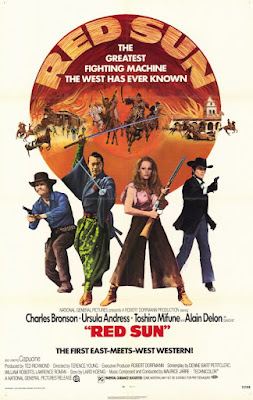
Toshiro Mifune at Film Forum: Red Sun

It is often referred to as a Spaghetti western, but since it was filmed in Spain by a British director, there must be some Manchego and Stilton in that pasta. Ramen too, thanks to Toshiro Mifune. He inadvertently helped establish spaghetti westerns, since he starred in Yojimbo, which was remade as A Fistful of Dollars (and sort of Django). Therefore, it was only fair that Mifune got to star in one. It is okay as western go, but the cast is stacked with legends. Mifune will have his vengeance while preserving his honor in Terence Young’s Red Sun, which screens Wednesday as part of Film Forum’s Mifune retrospective.

Link Stuart thought he was robbing an army payroll train with his shifty partner Gauche, but the former Frenchie gambler from New Orleans intends to keep the loot all for himself. Unwisely, he does not verify Stuart is completely 100% dead. On the other hand, he totally kills one of the samurai escorting the new Japanese ambassador to Washington on the train and steals the ceremonial sword meant as a gift for the president.

Honor demands his fellow samurai, Kuroda must recover the sword and return it to the ambassador in seven days. Kuroda also wants Gauche to taste his steel, for the sake of his late friend. Inconveniently, he will need the help of the uncooperative Stuart to track Gauche’s gang, but the samurai is persuasive.

Frankly, there is way too much bickering between Kuroda and Stuart during the first two acts. Just team up together already and get on with it. Nevertheless, Mifune and Charles Bronson (who co-starred in
The Magnificent Seven, adapted from The Seven Samurai, starring Mifune) are perfect as the two East-West vengeance seekers. Bronson is an anti-hero with the emphasis on anti. In contrast, Kuroda is a model of rectitude, but Mifune molds him into a figure of tragic nobility. He really is the only one we root for.

Alain Delon is smooth and slimy as the villainous Gauche, while Ursula Andress actually brings a bit of fieriness to Cristina, the femme fatale prostitute. However, Capucine might even be more seductive as her madam Pepita, who is also Stuart’s sometime squeeze. Plus, Tetsu Nakamura brings dignity as well as his super-employable English fluency to the film as the ambassador. So yes, that is a heck of a cast.

Thursday, June 24, 2021

Melville’s Le Cercle Rouge

The opening quotation is fake, but the soundtrack is totally legit. You might have thought the late 1950s and the early 1960s were the peak of swinging crime jazz and it probably was in Hollywood, but Eric Demarsan really uncorked a classic for Jean-Pierre Melville’s 1970 penultimate film. Georges Arvanitas on piano, Guy Pedersen on bass, Daniel Humair on drums, and the groovy vibes of Bernard Lubat set the noir mood and sound terrific together. Oh, and the film is really good too. Uncut (as it always should have been) and freshly restored in pristine 4K, Melville’s Le Cercle Rouge opens tomorrow at Film Forum, exclusively brick-and-mortar-style.

We know Corey is hardboiled, because he is played by Alain Delon. Ironically, he is about to be paroled early for good behavior. However, one of the crooked prison guards tries to recruit him for jewel heist up in Paris. So much for rehabilitation. Meanwhile, Vogel escapes from the straight-arrow Inspector Mattei, who was extraditing him from Marseilles to Paris. When the two crooks cross paths, Corey helps Vogel elude the dragnet and recruits him for his big heist caper.

They will need another accomplice with sharpshooting skills. Vogel knows just the man: Jansen, a severely alcoholic ex-cop. Of course, Mattei is still on their trail and feeling the heat from the cynical chief of police. There is also the business of finding a fence who can handle that kind of heat.

Cercle Rouge
is classic Melville, starting with the unmistakable presence of Alain Delon (who became an international icon in Melville’s Le Samorai). It is slower, more deliberately paced, and longer (140 minutes) than typical caper movies, but Delon makes it work. Fortunately, we have the Demarsan soundtrack to have something to listen to when the cast quietly broods (which is often).

Sunday, September 01, 2013

Frank Riva: Alain Delon vs. the French Connection

He is a narc of Dickensian dimensions.  After undercover detective Frank Riva dealt a staggering blow to the French Connection, he had to permanently disappear.  Dead to the world, he retired to his own island paradise.  However, he is recalled back into service to investigate a case that hits very close to home in the French television series Frank Riva, now available in a complete DVD collection from MHz Networks.

Riva was his mother’s maiden name.  The not-so ex-copper adopted it while infiltrating the Loggia mafia clan and kept it during his exile.  He was always very close to two fellow officers: Marc-Antoine Rezzoni and Xavier Unger.  The latter is now the Chief Commissioner of Police, whereas the former has just been shot, probably fatally, while leading an off-the-books operation.  Intimately aware of Rezzoni’s backstory, Riva will take over his squad to investigate the shooting.  It will get complicated quickly.

Many of Riva’s former underworld associates are quite surprised to see him.  So is his ex, Catherine Sinclair.  She also has one for him—he’s a father.  Not with her, but with one of Loggia family’s professional women, whom Riva became involved with as part of his cover.  Essentially growing up an orphan, Nina Rizzi only had Sinclair looking out for her, as a way to feel closer to her vanished father.  Unfortunately, the young woman still got mixed up with Maxime Loggia, the possessive nephew and presumptive heir of the recently deceased Loggia godfather.  As one might expect, the succession within the rebounding Loggia clan turns out to be a trickier matter that will have repercussions throughout the series—as will the circumstances surrounding Sofia Rizzi’s murder.

Series writer-creator Philippe Setbon sensitively conveys a sense of lives interrupted and time lost, which differentiates Frank Riva from the field of other gangbuster shows.  While this occasionally leads to the odd melodramatic excess (largely in during the second season), Setbon and series director Patrick Jamain balance the micro and macro stories relatively well.  Riva is a compelling noir-ish character, precisely because he always seems to have one foot out the door.

Indeed, this is a perfect TV gig for associate producer, Alain Delon.  The contrast between the older, weathered Delon and pictures of his 1960’s dashing self (circa Joy House and Le Samurai) add further poignancy.  While certainly still distinguished looking, his Clint Eastwood-like power to attract much younger women seems somewhat dubious.  Evidently, it is good to be the star and producer.

Regardless, Delon is appropriately steely in the lead.  Riva is also notable for re-teaming him with Mireille Darc (co-star of Godard’s Le Weekend) with whom he had formerly been personally and professionally associated.  After a rather overwrought introduction, her Sinclair eventually evolves in mature and convincing ways. 

Boasting quite a cinematic cast, regular Costa-Gavras collaborator Jacques Perrin goes toe-to-toe with Delon, painfully expressing many of the series’ themes of regret and the corrupting power the past.  Frankly, the series actually picks up some of its best supporting characters as it goes along, including Jimmy Esperanza, a Colombian cop assigned to Riva’s unit, played with hardboiled understatement by Eric Defosse.  Géraldine Danon also lends the proceedings a striking corporate femme fatale presence as Swiss mob lawyer, Alberta Olivieri.

Setbon’s compulsive need to romantically match-up Riva’s subordinates stretches credulity, but one can understand the impulse.  Whether or not it is wholly believable, Frank Riva ends with a sense of family and shared experience.  Although it is a French series, it has a pronounced Italian flavor (for obvious reasons) that should widen its appeal.  Regardless, it is just great to see Delon doing his thing.  Yet the music might be nearly as cool.  Largely consisting of variations on Julien Chirol and Pierre-Luc Jamain’s title trumpet theme composed, it has a funky but lyrical sound that could have been inspired by “Time After Time” era Miles.

Tightly focused, there are no one-off cases in Riva.  Setbon usually has at least one big revelation for each episode that often drops just before the credits roll.  It pulls viewers in quickly and builds steadily, making it a good candidate for holiday weekend binge viewing.  Recommended for fans of Delon and double-crossing police dramas, Frank Riva is now available on DVD from MHz Networks.

Friday, August 15, 2008

Joy House: Noir and Swinging

Joy House (Les Felins)
Directed by René Clément
Koch Lorber


René Clément’s career had its ups-and-downs, but his collaborations with Alain Delon were high points. Their first, Purple Noon, established Delon as an international star. The second, Joy House (original trailer here), is a sophisticated film noir that ought to have been included in either the MoMA’s Jazz Score series or the Film Forum’s French Crime Wave retrospective. Happily though, it is now available on DVD.

Delon plays Marc, an amoral gigolo, which is a promising start to any film. Dumb enough to romance the wife of an American mobster, he quickly finds he is not safe, even on the Riviera. Needing a hiding place, he takes work as the chauffeur of Barbara Hill, a reclusive American widow living alone with her niece Melinda, or so they tell Marc. He quickly suspects there is another player somehow involved in the Hill household—someone who probably played a role in Barbara’s bereavement. After all, it is impossible for Marc to believe the beautiful widow, played by Lola Albright, is not enjoying the attentions of a man. He would certainly volunteer for the position, but it is the niece (a pre-Barbarella sex-kittenish Jane Fonda) who repeatedly throws herself at him, leading to something more complicated than a love triangle (a rhombus maybe).

Delon’s adventurer might not be particularly likeable, but he is not an idiot, immediately recognizing all is not right with his employers. Lola Albright, of Peter Gunn fame, brings a surprising vulnerability to her black widow role. As Melinda, Fonda is reasonably credible, conveying the danger lurking beneath her coy surface. What really makes the film enjoyable though, is some of the hardboiled dialogue. At one point the European contact for the American gangsters tells them he is Corsican. “Well, that’s not your fault,” one replies.

Titled Les Felins in the French version, there is a pronounced feline theme, with the women literally showing claws at times. Clément creates a sense of desire turning claustrophobic, heightened by Jean André’s production design, which really makes Barabara’s castle-like villa another character in the drama.

Adding a sultry flavor is Lalo Schifrin’s groovy little crime jazz score. Recorded with members of the Paris Opera Orchestra as well as trumpeter Roger Guérin, who also played on Martial Solal’s soundtrack for Breathless, and bassist Pierre Michelot, who played on Miles Davis’s Elevator to the Scaffold soundtrack and was a member of the house band seen in Bertrand Tavernier’s Round Midnight, Schifrin’s soundtrack was only just issued in full four years ago. However, his main theme, “The Cat” took on a life of its own, with Jimmy Smith, Claude Nougaro, Peggy Lee, and Schifrin himself recording cover versions of it at the time.

The new DVD version includes both the English and French language versions, and they are not precisely the same, with the French being a bit longer, giving a bit more context, as when Marc and Barbara spar during their initial interview. In either version, House is a clever crime story with a cool swinging sixties vibe. Having taught it in a jazz and film class as an example of Schifrin’s film work, I am happy to see it readily available again.