Showing posts with label Christian Schwochow. Show all posts

Friday, December 31, 2021

Schwochow’s Munich: The Edge of War

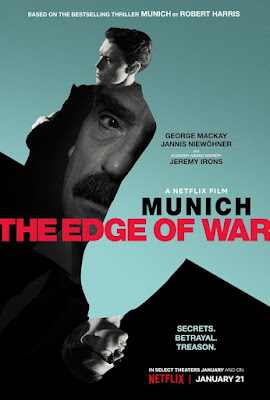
If we let the CCP blatantly violate the Sino-British Joint Declaration, openly turn Hong Kong into a police state, and engage in hostile militarism throughout the South China Sea, maybe they will be satisfied and start acting nice. After all, appeasement was a smashing success when Hitler was given the Sudetenland, right? Actually, it was Neville Chamberlain’s agreement that gave appeasement the bad name it deserves. Young British foreign office bureaucrat Hugh Legat sees that infamous history unfold as an aide to Chamberlain in Christian Schwochow’s Munich: The Edge of War, based on Robert Harris’s novel, which opens today in New York, in advance of its January 21st premiere on Netflix.

Initially, Legat is more concerned with helping Chamberlain prevent a European war than resolving the Cold War brewing between him and his wife. It is really bad timing when he is attached to the Prime Minister’s Munich delegation and also quite a surprise. It turns out Paul von Hartman, a German government interpreter, pulled some strings with his military contacts to request Legat’s presence. They were friends at Oxford, but had a falling out over Hitler. At the time, von Hartman was an enthusiastic supporter, but now that he knows the Fuhrer’s true intentions, he is profoundly alarmed.

Von Hartman believes elements in the military will turn against Hitler Valkyrie-style if the British hold firm on their commitments to Czechoslovakia. He also has a damning document that spells out Hitler’s expansionist military plans in detail. He needs Legat to help him convince Chamberlain, but even if his old friend agrees to help, it is highly questionable whether the war-averse PM will listen.

Ben Powers’ adaptation of Harris is a really smart thriller of espionage, politics, and bureaucratic in-fighting. However, some of its implications are highly debatable.
Mild Spoiler: Edge ultimately presents an extremely revisionist defense of Chamberlain, arguing he bought time with his non-agreement for England to rebuild its military. Yet, on the other hand, it also posits a potential resistance to Hitler that was undercut by Chamberlain’s appeasement and obliquely implies Hitler’s also needed time to steel the resolve of the German people.

In any event, Schwochow (who has previously helmed sensitive historical dramas, like
The German Lesson, West, and The Tower) mines a good deal of suspense from the brainy material and maintains even more tension regarding the fates of Legat and von Hartman. George Mackay and Jannis Niewohner nicely humanize the cerebral main characters and portray their complicated friendship with surprising poignancy down the stretch.

Friday, November 06, 2020

Schwochow’s The German Lesson

The National Socialists were harsh art critics, whose tastes were highly suspect. Now it is a badge of honor, but the artists whose work they dubbed “Degenerate” faced professional hardship and even personal peril. Max Ludwig Nansen is one such artist. He has been officially prohibited from painting and his old friend Jens Ole Jepsen willingly enforces the edict. The resulting resentment, tragedy, and bad karma will envelop everyone close to them, especially Jepsen’s son Siggi, in Christian Schwochow’s English language adaptation of Siegfried Lenz’s classic post-war novel, The German Lesson, which releases digitally today.

The war is over and twenty-something Siggi is undergoing some strict rehabilitation. As part of the program, he must write an essay on the joys of duty, with respects to German citizenship (hence the title). The disgraced Siggi embraces the task, with excessive and obsessive zeal. Most of the film flashbacks to the war years, to explain how he reached this point.

As a child, he considered Nansen, the gifted but suspiciously bohemian artist more of a father-figure than his own martinet father, a true-believing local National Socialist official. Nansen was once close friends with his father. The artist even saved the latter’s life years ago. However, the elder Jepsen almost fetishizes authoritarian conceptions of duty and loyalty, so he consequently turned against his friend. Yet, in their small northern coastal town, it is hard to avoid each other, especially when the rest of Jepsen’s family maintains bonds of friendship with Nansen and his ailing wife. Of course, bitterness builds in all quarters when the elder Jepsen suspects the Nansens of harboring his oldest son, an army deserter.

At various junctures, young Siggi’s naivete and carelessness make matters worse for Nansen. Yet, he retains a love of art (especially the modern variety) instilled in him during their painting lessons. He is not his father’s son, so to speak, but his dysfunctional formative years take a toll. Frankly, he could probably use some kind of rehab.

Lenz’s source novel enjoys a lofty reputation in Germany, but it is not so well-known here in America, giving us a fresher slate to judge Schwochnow’s adaptation, written by his screenwriter mother, Heide. In terms of theme and subject matter,
German Lesson sounds comparable to Never Look Away, with a Max Beckmann-figure (at least in terms of  style) replacing the Gerhard Richter-Sigmar Polke composite, but Donnersmarck’s film was grander and far more emotionally resonant.

In contrast,
German Lesson is a darker, murkier exploration of the German national character, during its worst historical moments, like The Reader, but with a better developed moral-ethical sensibility. There is never any sympathy expressed for the abusive elder Jepsen. Indeed, the film’s depiction of censorship and the confiscation of art produces visceral outrage.

Tuesday, November 04, 2014

The Tower: a Family and a Regime Come Undone

By the 1980s, most East Germans realized if they hadn’t finished building socialism by now, they never would. Dr. Richard Hoffmann sort of got the picture, but there were blind spots in his understanding. For instance, he does not recognize the pleasant—dare we say bourgeoisie—nature of his Dresden “Tower” neighborhood necessarily makes him somewhat suspect. Unfortunately, his son will become intimately acquainted with the GDR’s hypocrisy and vindictiveness in Christian Schwochow’s The Tower, which opens this Friday in New York.

Based on Uwe Tellkamp’s prize-winning novel, The Tower was original produced as a three hour German television mini-series that Music Box Films will release on VOD, along with the two hour (on the dot) American theatrical version. We have only seen the latter, but there are no gaping holes apparent, suggesting they used a scalpel worthy of Dr. Hoffmann at the peak of his powers rather than Harvey Weinstein’s meat cleaver.

Dr. Hoffmann is indeed rather pleased with his situation in 1982. He will be the recipient of a prestigious medical award and is widely seen as the likely successor to the clinic’s fuddy-duddy director. Somehow, he is successfully juggling his career, a family life with his wife Anne and his underachieving son Christian, while secretly keeping house with his mistress Josta Fischer and their illegitimate daughter. However, publically reprimanding an incompetent doctor with close ties to the central committee is not a smart strategy for promotion. In fact, it is the beginning of the end.

Shortly thereafter, Dr. Hoffmann is visited by the Stasi. Out of youthful ideological zeal, he agreed to be an informer during his student days, but tried to forget the old arrangement as he became disillusioned by reality. They now expect him to renew his snitching duties. Of course, the Stasi knows all about his secret life. They also have a damning report he submitted on his best friend and longtime professional colleague. Dr. Hoffmann tries to stall and prevaricate, but his position becomes increasingly sticky when Christian runs into the sort of ideological trouble at school that could permanently ruin his future.

There is something fundamentally appealing about a film that starts with Hoffmann and his cronies stealing Christmas trees literally tagged for privileged Party apparatchiks. While Schwochow largely skips over familiar issues of shortages and privations because of the characters’ relatively well-to-do standing, he vividly portrays the everyday duality of GDR life. Whenever the Hoffmanns need to have a serious discussion, they invite each other for a walk. When they do speak, ostensibly neutral code-words are peppered throughout their discourse.

As the Job-like Dr. Hoffmann undone by a ruthless state and his own moral failings, Dresden-born Jan Josef Liefers is riveting like car crash. It is a thoroughly grounded performance, but it takes on classically tragic dimensions. Yet, it is Claudia Michelsen who really anchors the film with her quiet authority. Frankly, there is not a lot of room for Streep-ish histrionics in The Tower, because that was an indulgence East Berliners could not afford.

Schwochow actually has two films opening this weekend in New York. West more fully explores the challenges of immigration frequently alluded to in Tower, but the Hoffman family saga has considerably more heft and bite. Both are recommended, but if time only allows for one, it should be The Tower (of course, the fuller VOD cut is probably even better). It takes a hard, honest look at what statism does to people, while pulling audiences into a sweeping Cold War drama. Highly recommended, the theatrical version of The Tower opens this Friday (11/7) in New York at the Cinema Village, whereas West opens at Anthology Film Archives.