Many
other jazz vocalists had stronger voices and better technique, but it is Billie
Holiday we love best. It is complicated—you just have to hear it in her
music. Grammy and Tony Award winner Dee Dee
Bridgewater helps illuminate that Holiday mystique in the musical character
study Lady Day (promo here), now running at
the Little Shubert.
If
you do not already know the basics of Billie Holiday’s life then go hang your
head in shame. Like many jazz artists of
her era, she had addiction issues, plus her own peculiar talent for getting
involved with the wrong men. Despite her
headliner status, Holiday’s legal problems caused her cabaret card to be
revoked, preventing her from working in New York nightclubs. Robert, her
pseudo-manager and indomitable champion, hopes a high profile London concert will
lead to an American comeback. Although
she fully recognizes the importance of the gig, Holiday is still running maddeningly
late for the afternoon rehearsal.
When
Holiday finally arrives, she is carrying the full weight of her accumulated
insecurities. However, when she gets
down to business with her band, the old magic is clearly there: “A Foggy Day,” “Miss
Brown to You,” “All of Me,” and “Strange Fruit”—all great. Unfortunately, the audience can see the
demons inside her growing restive.
Even
with all the fantastic music, many patrons just will not get Lady Day, precisely because it
understands Holiday so well. Granted,
some of the first act flashback-reveries are a little awkward. Nevertheless, playwright-director Stephen
Stahl makes the difficult but ultimately correct choice opening the second act
with a gin-fortified Holiday sabotaging the very concert the first act had been
building up towards. It is not an easy
task for a consummate artist like Bridgewater, but she stays true to character,
performing some appropriately ragged renditions of Holiday standards. Yet, when we see her slowly center herself
and gut out the rest of the disastrous show, we understand why we love Billie
Holiday. It is exactly because of those acutely
compelling pyrrhic victories.
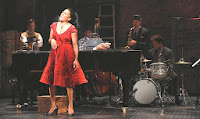
Bridgewater
has recorded Holiday tributes before and her affinity for the Lady shines
through in every song and sequence. She
goes beyond merely matching Holiday’s exquisitely vulnerable cadences, exposing
her haunted soul. Obviously, she is the
front-and-center star, but the quartet nicely backs her up, both musically and
dramatically. Led by pianist Bill Jolly,
they swing the standards vigorously and sensitively, as the circumstances require,
while also convincingly portraying all the subtle backstage (or in some cases,
on-stage) frustrations of gigging with Holiday.
As thankless as the role of Robert looks on paper, David Ayers also invests
him with a surprisingly degree of empathy and presence.
There
is talk of moving Lady Day to
Broadway, which would be great in many ways, but this show is best seen in as
intimate an environment as possible. At times, the audience genuinely feels
like it is watching a rehearsal in a nearly empty concert hall. Unlike some previous Swing Era inspired book
musicals, Stahl’s production really shows a keen understanding of how to
present jazz on stage. Highly
recommended for fans of Holiday and Bridgewater (admittedly two sets that
probably have significant crossover), Lady
Day runs until March 16th at the Little Shubert Theater.
(Photo: Carol Rosegg)


