Showing posts with label Keira Knightley. Show all posts

Thursday, December 02, 2021

Silent Night: Last Christmas, Ever

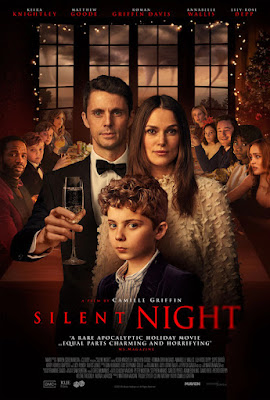
It is sort of like The Big Chill, but the suicide[s] haven’t happened yet. Unfortunately, the world is ending, so a group of old college friends decided to spend their last Christmas together before the inevitable. The government says we’re doomed, so it must be true, right? One of the kids is not so sure and he is willing to risk it in director-screenwriter Camille Griffin’s Silent Night, which releases in theaters and streams on AMC+ tomorrow.

Frankly, even if you had decades of holidays ahead of you, it is hard to imagine wanting to spend even one with some of these obnoxious people. The worst are Sandra, who clearly thinks she is Kim Cattrall’s
Sex and the City character, her dopey husband Tony, and their massively spoiled daughter Kitty. The caustic Bella and her passive girlfriend Alex are not much fun either. Frankly, James and Sophie are far and away the most likable, but everyone is against her, because the younger woman is not part of their clique. Ordinarily, Nell and Simon are probably decent enough, in a British upper-crust kind of way, but they are on edge and trying way too hard. Their disgustingly precocious and sensitive son Art is not making things any easier.

For some strange reason Art is not ready to just give up and die. As in many end-of-the-world movies,
Silent Night is cagey about the exact “science” of the apocalypse. Apparently, it involves a green cloud sweeping the planet. Regardless, it is surely our fault somehow. Fortunately, the British government has supplied all legal residents with a handy no-more-mornings-after pill. Yet, Sophie is reluctant to take it, because she is pregnant.

There is something in
Silent Night to rub everyone the wrong way. Not bothered by the vacuous characters or a gratuitous swipe at the UK Conservatives? Well, maybe you will be put off by its invitation to doubt the pronouncements of governments and so-called “science” authorities (like, I don’t know, Fauci maybe?). As a result, you really have to respect Griffin for staking out some a-plague-on-both-your-houses territory. However, the people are still horrifyingly cringy.

Monday, November 12, 2012

Keira Knightley as Anna Karenina


Anna Karenina won the game of Russian birth roulette.  Born into privilege, she initially enjoyed all the benefits of her well structured life, but lost everything due to a reckless love affair.  Such was the price of offending Russian society at a time when it was trying to act French.  Notions of  social role-playing have now inspired the hyper-stylization of Joe Wright’s take on Tolstoy’s classic Anna Karenina (trailer here), which opens this Friday in New York.

Everyone is playing their socially expected role you see, so why not set Anna Karenina in a creaky old theater?  From time to time, Wright will break away from the stagey confines, particularly when checking in on Levin, the rustic landowner and long suffering friend of Karenina’s ne’er do well brother.  Of course, there are also trains, like the one taking the title character to Moscow, where she hopes to provide emergency marriage counseling for said brother and his justly aggrieved wife Dolly.  It is sort of pleasant trip spent in the company of the Countess Vronsky, whose cavalry officer son meets her at the station.

The mutual attraction between Karenina and Vronsky are immediately evident, only intensifying at an eventful Moscow society ball.  Having thrown over the plodding Levin in hopes of landing Vronsky, Dolly’s younger sister Kitty is deeply hurt when the officer ignores her in favor of the married Karenina.  Spooked by the prospect of scandal, she hastens back to St. Petersburg and her husband Karenin, a progressive but culturally traditional government official.  As everyone should know, Vronsky follows her—and so does scandal.

There have been enough movie and television treatments to support a lengthy compare and contrast session.  In many ways, Tom Stoppard’s adaptation is quite distinctive, establishing a strong contrast between country simplicity and urban hypocrisy, while finally giving Levin his due.  However, Wright’s stylistic conceit is far too distracting, taking viewers out of the story time and time again.  The theatrical device is not even particularly original, having been used to greater effect in Manoel de Oliveira’s Satin Slipper, Louis Malle's Vanya on 42nd Street, and several Shakespearean films.  Frankly, it is a rather baffling aesthetic choice, considering the whole appeal of a novel like Anna Karenina is the big messy sweeping grandeur of it all.

Nonetheless, there are several outstanding performances in Wright’s film, especially from his lead, Keira Knightley.  It is hard to think of anyone else with the same brittle beauty and aristocratic bearing, who can convey burning self-destructive passion and guilt-ridden anguish with comparable power.  Yet, the real surprise of Wright’s Karenina is Jude Law’s performance as Karenin, the wronged husband.  Even though he looks considerably younger than the Karenin described in the source novel (about twenty years older than his wife), Law creates a deeply sympathetic portrait of a fundamentally decent man, trying to act accordingly, despite the painful embarrassment of the circumstances.

In contrast, the casting of Aaron Taylor-Johnson as Vronsky is a head-scratcher.  In truth, Wright lets his Vronsky off rather easily.  In previous versions, Vronsky is something of a shallow cad, but here he is more or less a dumb kid who fell in love too young, but that creates a host of dramatic problems.  Essentially, Anna Karenina is supposed to fall for Vronsky, because he is manlier than her husband, not vice versa.  What she sees in this Vronsky is hard to fathom.  I got stuff in the fridge that looks older than Taylor-Johnson and I’m not ready to throw it out yet.

Granted, Wright’s visual approach lends itself to some dramatic transition shots, but it never lets the film settle in and put down roots.  Watching it makes one wonder what the director had in mind.  Perversely, it is like Wright elicited award caliber performances from Knightley and Law, but then deliberately undermined them the postmodern theatricality and a maddening case of miscasting.  There is room for some experimentation when tackling Tolstoy, but it should serve the interests of the picture.  For instance, Sergei Solovyev’s relatively recent Russian production of Anna Karenina was considerably more expressionistic than traditional costume dramas, while staying true to the novel’s tone and story. 

It is a shame Wright had to be so showy, because there is quite a bit of good stuff in Stoppard’s screenplay and the mostly impressive work from the accomplished ensemble cast.  Recommended mostly for Knightley and Law’s diehard fans, Wright’s frustrating Anna Karenina opens this Friday (11/16) in New York at the AMC Loews Lincoln Square.

Monday, September 24, 2012

Stars in Shorts: Branagh, Firth, Knightley, and Company


Following his epic adaptation of Henry V, Sir Kenneth Branagh’s third Academy Award nomination came for a short film—a treatment of Chekhov’s Swan Song.  Although he has now reinvented himself as a tent-pole director, with the new Jack Ryan thriller on the way, Branagh periodically returns to shorter forms of filmmaking.  That is indeed Branagh appearing as the villain in Benjamin Grayson’s Prodigal, which screens as part of Shorts International’s Stars in Shorts program (trailer here), opening this Friday at the IFC Center.

While Branagh is a delight as Mark Snow, the head of a shadowy research group (and namesake of the X-Files composer), Prodigal (trailer here) largely recycles a number of the themes and motifs familiar from Chris Carter’s television series.  David O’Neill regrets entrusting Samantha, his young daughter with powerful telekinetic abilities, to the Prodigal institution.  He enlists the help of a secretive branch of the federal government, but in retrospect, this is probably a further mistake.  Aside from Branagh, the cast is a bit colorless, but Prodigal certainly looks like a polished production.  Fans of Winter Ave Zoli (from Sons of Anarchy) will be also interested to see her as David’s wife Angela.

Probably the funniest short of the block is Robert Festinger’s The Procession, starring Lily Tomlin and the sort of starrish Jesse Tyler Ferguson as the shallowest, most self-centered mother-and-son tandem you would never want to be trapped in a car with during a funeral procession.  It basically plays like an unproduced episode of Seinfeld or Curb Your Enthusiasm, but it works.

One of the standouts of the program, Rupert Friend’s Steve also starts out in a somewhat comedic vibe, but takes a decidedly dark turn.  A couple’s bickering is interrupted by a neighbor’s seemingly reasonable inquiry about a leak.  However, the title character will be back, with weirder complaints.  He will also expect tea.  Colin Firth is memorably off as Steve, while the glammed down Keira Knightley is convincingly harried as his reluctant host.  It is a nice short acting showcase, fittingly helmed by Friend, recognizable as the protag-journalist in Renny Harlin’s 5 Days of War, among other big screen roles.

Film and sound editor Jay Kamen’s Not Your Time is pretty amusing as well.  Featuring Jason Alexander as Sid Rosenthal, an editor who always wanted to helm a Busby Berkley musical, it mines Player style laughs by featuring a cast of Hollywood insiders as themselves.  Music students will also appreciate Kamen’s send-up of atonal avant-garde classical composition.  While the humor is distinctly dark, Alexander’s shticky persona best fits brief running times, like NYT’s twenty five minutes.

Neil LaBute continues to seek redemption for his The Wicker Man remake with two characteristically cutting contributions.  Jacob Chase’s After School Special, written by LaBute, is an ironic twist kind of short, with its name “star,” Wes Bentley, not really factoring in the business end of the film.  Nonetheless, the closing scene definitely stings.  Sexting, both penned and helmed by the playwright, builds to a more obvious punchline, but Julia Stiles is deliciously catty as the other woman, burying herself in a mountain of LaButian dialogue.  It is smart gig for Stiles, who was terrif in Shakespeare in the Park’s Twelfth Night years ago, but seems to get the dumbest parts offered to her.

Perhaps the slightest constituent film is also the one with the greatest built in audience anticipation.  In Chris Foggin’s Friend Request Pending Dame Judi Dench and her crony engage in a bit of social networking and cyber flirtation, presumably before they nip off to India’s greener retirement pastures.  One of the floating heads on the program poster, Tim Hiddleston also eventually appears in a jokey cameo during Pending’s closing seconds.  A harmless reunion of My Week With Marilyn assistant director Foggin and co-stars Dench and Penny Ryder, it will probably endear itself to the Marigold Hotel set.

Though shorts programs are often inconsistent by their aggregated nature, there is no out and out clunker in StarsSteve might be the high point, but it notably represents a good way to see Branagh, Stiles, and LaBute doing their thing.  Recommended for fans of short films and LaBute, Stars in Shorts opens this Friday (9/28) in New York at the IFC Center.

Monday, November 21, 2011

Jung vs. Freud: A Dangerous Method

Jungians consider Freud to be unnaturally sex-obsessed. Conversely, Freudians argue Jung debased the science with his superstitious mumbo-jumbo. Probably they are both more right than wrong. The birth of this great and enduring rivalry is dramatized in David Cronenberg’s A Dangerous Method (trailer here), which opens this Wednesday in New York.

Carl Jung married well and lives an upright life. A leading practitioner in a controversial new field of study, he is eager to apply the methods of psychoanalysis advocated by Sigmund Freud. Sabina Spielrein represents the perfect opportunity. Though possessing a rather sharp intellect, she is so profoundly disturbed she cannot function in society. Yet, when Jung gets her talking, the roots of her mental torment become clear. While the word “cured” might be too strong a term, she is able study medicine, with the intent of becoming of psychiatrist herself. Everything might have ended happily at this point, were it not for the libido’s self-destructive drive.

After giving into temptation once or a couple dozen times, the guilt wracked Jung breaks things off with his sort-of former patient rather precipitously. This drives the newly agitated Spielrein to seek the treatment of Jung’s new mentor, Dr. Sigmund Freud. As a result, Freud becomes somewhat disappointed in his younger colleague, while Spielrein increasingly aligns herself with the Freudian in her academic writings. Not surprisingly, these developments exacerbate the philosophical division between Freud and Jung.

Though clearly not nearly as renowned as her male colleagues, Spielrein arguably led the more cinematic life. A Russian Jew who tragically returned to her homeland during the early Soviet era (where much of her family perished during Stalin’s reign of terror), Spielrein was eventually killed by the National Socialists during WWII. Not just a beautiful woman, her scholarship is thought to have possibly influenced both Jung and Freud. (Jung also spanks her quite a bit in Method, if that happens to be your thing.)

Kiera Knightley really goes for broke as Spielrein, laying on the accent a tad thick, but bringing a remarkable physicality to the role. She makes neurotic twitchiness rather hot, even worthy of Oscar consideration. Despite having the screen time of a supporting player instead of a lead, Viggo Mortensen is convincingly smart and compulsively watchable as Freud, avoiding all the shticky goatee-stroking clichés associated with the iconic figure. Whereas the always tightly-wound Michael Fassbender is appropriately intense depicting Jung’s deeply rooted tension-and-release behavioral patterns.

Adapted by Christopher Hampton from his stage play, which in turn was adapted from John Kerr’s book, Method’s greatest problem is its flattening narrative arc. Had it followed Spielrein through her demise in WWII it would have ended on a more significant, if tragic note. As it stands though, the film just sort of runs out of story.

Throughout Method, Cronenberg adroitly handles both the rigorous intellectual debates and the provocative sexuality, largely rendering the latter with wise restraint. Probably more highbrow than old school Cronenberg fans might expect, he and Hampton clearly seem to want to present this critical period in the development of psychological study for its own sake rather than as a vehicle for lurid melodrama. It just lacks that epiphany moment. Frequently fascinating nonetheless, the overall quite engaging Method is definitely recommended when it opens this Wednesday (11/23) in New York at the Lincoln Plaza and Landmark Sunshine cinemas.

Monday, November 07, 2011

Brit Noir: London Boulevard

It is no longer the sixties, but London still swings. Yet, one recently released ex-con has no interest in the party scene. Resolved never to return to prison and weary of his sister’s Lindsay Lohan lifestyle, the taciturn Mitchel seeks to live a quiet life. Unfortunately, he is inundated with all the wrong sort of job offers in William Monahan’s London Boulevard (trailer here), which opens this Friday in New York.

Mitchel is determined not to fall into his old ways, particularly not with his unreliable old running mate, Billy. Of course, that is exactly what is expected of him. Gant, the ragingly psychotic mob boss even wants to groom Mitchel for a leadership role. The ex-con finds unlikely refuge in the only straight job open to him. A veritable prisoner in her own home to the stalkerazzi outside, beautiful actress-model Charlotte needs handyman who can be handy with intruders. Mitchel’s criminal record in no way disqualifies him for the job.

Boulevard is billed as a modern riff on Sunset Boulevard, but the parallels are rather superficial. With her face on every magazine cover, Charlotte is more of a Greta Garbo than a Norma Desmond. Mitchel is also much more proactive than ill-fated Joe Gillis, eventually falling hard for the mysteriously morose Charlotte.

For some reason, there has been considerable negative “buzz” for Boulevard, but it is completely unjustified. It hums along nicely, self-consciously emulating the vibe of Get Carter and similarly stylish Brit noirs. Colin Farrell is in his element here, quite compelling as the hard-nosed anti-hero. Keira Knightley is appropriately alluring and vulnerable as the isolated Charlotte, as well.

However, for a film like this the supporting cast is almost more important than leads and Boulevard’s is terrific. Ray Winstone emphatically doubles down on his tough guy persona, savoring Gant’s villainous instability. Appearing as a corrupt cop, Eddie Marsan adds further genre color and credibility. Yet, David Thewlis really takes the honors as Jordan, Charlotte’s live-in manager and enabler, Boulevard’s Erich von Stroheim, if you will. We expect a heavy jealousy trip from him, but the gonzo agoraphobic turns out to be far more interesting than that. Regrettably though, the photogenic Ophelia Lovibond’s character Penny is abruptly dropped as soon as she introduces the leads, despite some nice chemistry with Farrell’s Mitchel in early scenes. Those are the dues.

Boulevard is a dark and tragic film, but it is also loads of fun. Noir fans will understand that paradox. A sleek morality play featuring a top-shelf ensemble, Boulevard is highly recommended when it opens this Friday (11/11) in New York at the IFC Center.

Wednesday, October 05, 2011

NYFF ’11: A Dangerous Method

Jungians consider Freud to be unnaturally sex-obsessed. Conversely, Freudians argue Jung debased the science with his superstitious mumbo-jumbo. Probably they are both more right than wrong. The birth of this great and enduring rivalry is dramatized in David Cronenberg’s A Dangerous Method (trailer here), which screens tonight as a gala selection of the 49th New York Film Festival.

Carl Jung married well and lives an upright life. A leading practitioner in a controversial new field of study, he is eager to apply the methods of psychoanalysis advocated by Sigmund Freud. Sabina Spielrein represents the perfect opportunity. Though possessing a rather sharp intellect, she is so profoundly disturbed she cannot function in society. Yet, when Jung gets her talking, the roots of her mental torment become clear. While the word “cured” might be too strong a term, she is able study medicine, with the intent of becoming of psychiatrist herself. Everything might have ended happily at this point, were it not for the libido’s self-destructive drive.

After giving into temptation once or a couple dozen times, the guilt wracked Jung breaks things off with his sort-of former patient rather precipitously. This drives the newly agitated Spielrein to seek the treatment of Jung’s new mentor, Dr. Sigmund Freud. As a result, Freud becomes somewhat disappointed in his younger colleague, while Spielrein increasingly aligns herself with the Freudian in her academic writings. Not surprisingly, this exacerbates the philosophical division between Freud and Jung.

Though clearly not nearly as renowned as her male colleagues, Spielrein arguably led the more cinematic life. A Russian Jew who tragically returned to her Soviet era homeland, much of Spielrein’s family perished during Stalin’s reign of terror, while she was eventually killed by the National Socialists. Not just a beautiful woman, her scholarship is thought to have possibly influenced both Jung and Freud. (Jung also spanks her quite a bit in Method, if that happens to be your thing.)

Kiera Knightley really goes for broke as Spielrein, laying on the accent a tad thick, but bringing a remarkable physicality to the role. She makes neurotic twitchiness rather hot, essentially usurping the film. Still, despite having the screen time of a supporting player instead of a lead, Viggo Mortensen is convincingly smart and compulsively watchable as Freud, avoiding all the shticky goatee-stroking clichés associated with the iconic figure, whereas the always forceful Michael Fassbender is appropriately tightly wound depicting Jung’s deeply rooted tension-and-release behavioral patterns.

Adapted by Christopher Hampton from his stage play, which in turn was adapted from John Kerr’s book, Method’s greatest problem is its flattening narrative arc. Had it followed Spielrein through her demise in WWII it would have ended on a more significant, if tragic note. As it stands though, Method just appears to run out of story.

Throughout Method, Cronenberg adroitly handles both the rigorous intellectual debates and the provocative sexuality, largely rendering the latter with wise restraint. Probably more highbrow than old school Cronenberg fans might expect, he and Hampton clearly seem to want to present this critical period in the development of psychological study for its own sake rather than as a vehicle for lurid melodrama. It just lacks that epiphany moment. Frequently fascinating nonetheless, the overall engaging Method screens twice tonight (10/5) at Alice Tully Hall as part of the 2011 New York Film Festival.

Monday, May 02, 2011

Infidelity in Tribeca: Last Night

Most married couples argue about three things. Joanna and Michael are financially well off and childless. That only leaves one other point of contention, but it is a big one. Indeed, jealousy and betrayal may or may not scuttle the Reed’s wedded bliss in Iranian-born, Orange County-raised writer-director Massy Tadjedin’s Last Night (trailer here), which opens this Friday in New York following its high-profile screenings at the recently wrapped 2011 Tribeca Film Festival.

Joanna Reed is in a period of self-doubt. She cranks out vapid free-lance pieces for fashion magazines, rather than tackling her second book. In contrast, Michael Reed is a picture of confidence, assuredly moving from deal to deal at his real estate development firm. Still, everything appears perfectly fine between them, until they attend his boss’s soiree. When Ms. Reed gets a load of Sam’s new colleague, Laura, whom he evidently works quite closely with but has never mentioned, she immediately suspects something.

Playing innocent and blaming her generous portions of wine, Mr. Reed re-establishes peace before leaving on business trip that will indeed include the sultry Laura. With impeccable timing, Alex Mann, Ms. Reed’s old French flame, turns up the next morning, hoping to reconnect and possibly rekindle their romance. Over the course of the evening, both Reeds will flirt with temptation and wrestle with guilt.

Smartly scripted by Tadjedin, Night is not simply about whether each spouse will betray the other, but just what exactly constitutes betrayal. Rather than tying it all up in a neat little package, Tadjedin maintains a sense of ambiguity that makes the film far more intriguing than a simple morality play (or cinematic polemic against marriage).

Tadjedin’s intimate approach gives Night a very European air, further heightened by Peter Deming’s rich, cool cinematography (perfectly befitting the Reeds’ smart set) and editor Susan E. Morse’s vaguely Nouvelle Vague cuts. It looks and feels like a film for adults, which it is, though little is shown on-screen that would have to be cut for commercial broadcast.

While she is outwardly cool and reserved, Keira Knightley suggests a host of inner turmoil as Joanna. In perhaps Night’s most subtle and intriguing performance, Guillaume Canet projects equal intelligence and greater emotional nuance as Mann. Eva Mendes also shows surprising dimensions as Laura, the potential other woman, yet the irony of her back-story remains largely unexplored. As one might expect, Sam “3D” Worthington (from Avatar and Clash of the Titans) is the weak link of the quartet, but he is not as terrible as one might expect. Ironically, his stolid presence works rather well in the “honey, what’s wrong?” scenes.

Night was an especially appropriate selection for the Tribeca Film Festival, featuring many scenes shot on the streets of the neighborhood or at other recognizable lower Manhattan locations, like SoHo House. The legit New York ambiance certainly does not hurt. Ultimately ambivalent on the efficacy of marriage (especially in regards to the Reeds), Night is a smartly rendered relationship study (that surely could not currently be produced or released in Tadjedin’s native Iran, more’s the pity). One of the better English language narrative features at Tribeca this year, Night opens conventionally this Friday (5/6) in New York at the Angelika Film Center.
Thursday, March 19, 2009

Dylan Thomas: The Edge of Love

New York is the proud home of the White Horse Tavern, world famous as the site of Dylan Thomas’s last round of cheer. While the Welsh poet had quite the reputation for imbibing spirits, alcoholism is the least of his flaws in a new bio-picture. Opening tomorrow in New York, John Maybury’s Edge of Love (trailer here) is a highly unflattering portrait of a hopelessly self-absorbed individual, who also happened to be a great poet.

As Edge opens, World War II is raging, but not for Thomas. Sharman MacDonald’s screenplay clearly implies he is shirking his duty through a dubious medical deferment. He is also a neglectful father, unfaithful husband, and a selfish, petty man. From this starting point, he only becomes less sympathetic as the film progresses.

A chance encounter with his childhood sweetheart rekindles Thomas’s affections for the beautiful Vera Philips, played by Keira Knightley. Unfortunately, he is already married to Caitlin (portrayed by Sienna Miller), who provides their child some measure of parental supervision, when not pursuing her own affairs. The Thomases invite Philips into their lives, with both harboring some sort of attraction to her. However, it is Captain William Killick who wins her reluctant heart, only to leave shortly after their wedding for a Hellish tour of duty behind enemy lines in Greece.

Married just long enough to get pregnant, Philips (now Killick) moves back to Wales, living next door to the Thomases, supporting their wastrel lifestyle with Killick’s money, while mostly deflecting their advances—though the distributor would surely like to point out that Knightley and Miller have a scene bathing together. When the shell-shocked Captain comes home, his condition is aggravated by the vicious village gossip, which eventually pushes him past his breaking point.

As Killock, Cillian Murphy is quite nuanced, preventing the Captain from coming across as a stereotypical crazed veteran. Frankly, when he finally snaps, the audience is ready to see the egotistically Thomas and his snobbish radio colleagues get the beat-down they deserve. They sneer at concepts like patriotism and service from the relative safety of the countryside, while Killick witnessed the horrors of war first hand. It is when Edge dramatizes such differences of values that it is at its sharpest.

The ethereal Knightley also has some fine moments, particularly early in the film, revealing a hitherto unknown singing talent. Her performances of sweetly sentimental big band vocals are surprisingly enjoyable and the somewhat jazz-influenced soundtrack by Angelo Badalamenti (best known for his work on Twin Peaks) is often appealingly breezy. Unfortunately, Matthew Rhys is rather flat and charmless as the difficult Thomas, which leads to considerable credibility problems for the film.

Co-produced by BBC Films, Edge is sort of a cross between Masterpiece Theater and an HBO original drama, but it is probably too racy for PBS, while not showing enough skin for premium cable. Despite a problematic lead performance, Edge has some diverting moments, certainly including Knightley’s musical numbers. It opens tomorrow in New York at the Angelika.