Showing posts with label Maigret. Show all posts

Wednesday, March 11, 2026

Rendez-Vous ’26: Maigret and the Dead Lover

This year marks the ninety-fifth birthday of Georges Simenon’s famous French sleuth, Inspector Jules Maigret, who was born middle-aged and nursed on beer and apple brandy. PBS’s new, younger Maigret was pretty good, but he wasn’t really Maigret. This is the Maigret you know and probably love. Mrs. Maigret definitely loves him too, so he really doesn’t give a toss about anyone else. However, he is a professional, so he diligently works to solve his latest case, just like always, in Pascal Bonitzer’s Maigret and the Dead Lover, adapted from Simenon’s less diplomatic-sounding Maigret and the Old People, which screens again during the 2026 Rendez-Vous with French Cinema.

Even though Maigret drinks like a fish, he has a reputation for discretion, so he is assigned the potentially politically sensitive case of retired ambassador mysteriously shot multiple times by an unknown person or persons. Despite his calm, workmanlike investigative approach, Maigret’s patience will be sorely tested by his sole witness, Jacqueline “Jacotte” Larrieu, who is stone-deaf without her hearing aids. She also seems to think it is her duty to the foreign ministry to be as unforthcoming as possible.

Regardless, Maigret soon discovers the ambassador and the Princess Isi de Vuynes openly carried romantic torches for each other, despite her marriage of duty to another blue blood. Both families knew of their true love, but the not quite lovers always accepted their duties and their fate. Hence, they waited to reunite until her aristocratic husband might die, which ever so coincidentally happened a week prior.

Maigret is a tricky role to cast, because he is the polar opposite of flashy. What distinguishes the Inspector is his world-weary fatalism and his understated mordant wit. Frankly, Charles Laughton was probably too flamboyant in
The Man of the Eiffel Tower, even though he was jolly entertaining to watch. Jean Gabin, Harry Baur, and Rupert Davies were all much closer to Simenon’s Maigret.

Denis Podalydes truly makes a pitch perfect Maigret, gliding through the film with a general spirit of disappointment, but never surprise. He also shares some charming chemistry with the great Irene Jacob. We instantly get all their intimate years spent together and all the bottles of wine they polished off in each other’s company.

Saturday, October 04, 2025

Maigret, on PBS

A quick afternoon drink can still help fight crime. However, smoking a pipe is now frowned upon, but Chief Inspector Jules Maigret still carries his late father’s unlit pipe, as something to fiddle with to help him think. Georges Simenon’s famous slath is still an unusually cerebral copper, but this time around, he is younger and dramatically less jowly. Benjamin Wainwright joins the fraternity of Charles Laughton, Jean Gabin, Rupert Davies, and Gerard Depardieu (whose 2022 Maigret movie suddenly became far less commercial, thanks to his bro-mance with Putin), conspicuously standing out from fellow Maigrets. Regardless, the titular police inspector remains as incisive and intuitive as ever in creator-lead writer Patrick Harbinson’s six-episode Maigret, which premieres tomorrow on PBS.

As season one opens, Maigret has only just been promoted to Chief Inspector of “Le Crim” (a.k.a. the “Criminal Brigade,” much like the Major Case Squad in
Law & Order: Criminal Intent), but he is already under tremendous pressure from Prosecutor Mathilde Kernavel to catch a gang of sophisticated armed robbers. Yet, much to her frustration, he is more interested in investigating the untimely death of Honore Cuendet, a refined cat burglar, whose philosophy of stealing, combining elements of elitism and egalitarianism, always amused Maigret.

Unfortunately, his seemingly questionable priorities offer an opportunity for Inspector Cavre, the rival Maigret was promoted over, to undermine his authority with the prosecutor. The rest of the Squad is solidly Team Maigret, particularly Sgt. Lucas (who is now a woman). “The Lazy Burglar” establishes Harbinson’s template, combining a classic, titular Simenon novel, with a second original, more contemporary mystery. He still spruces up the classic case, turning Maigret’s prime murder suspect into grotesquely wealthy Syrian wheeler-dealer, closely connected to the current regime.

The initial two-parter also introduces us to Madame Louise Maigret, the Chief Inspector’s beloved wife, who is also quite a bit younger than usual, but their close partnership represents the most important consistency with the previous Maigret productions fans know and love. In fact, this might be the most heartfelt, touching marriage currently depicted on television.

Maigret and Kernavel are initially on the same page at the start of “Maigret’s Failure,” investigating the disappearance of a popular influencer. Unfortunately, the Ministry insists Maigret take time out to protect Fumal, a widely despised, but powerful captain of industry. Ironically, Fumal personally requested Maigret, his old childhood nemesis, whom he now hoped to have as his new bodyguard. Instead, Maigret deduces Fumal fabricated the threats, so he cancels the protection detail. Super awkwardly, Fumal is murdered shortly after.

Although Harbinson takes a lot of liberties with Simenon’s stories, episodes three and four are good exampless of how he captures a good deal of the darkness Maigret often confronts in the novels. “Failure” also nicely leads into the next two-fer mystery, “Maigret Comes Home,” by establishing Maigret’s thorny relationship with the Countess de Saint-Fiacre, his father’s former employer. Unfortunately, the Countess becomes the victim in the two-part conclusion. Sadly, Maigret couldn’t return in time to save her, but he stays long enough crack the case, even though he is supposed to be in Paris tracking down a random psych killer.

Tuesday, December 20, 2022

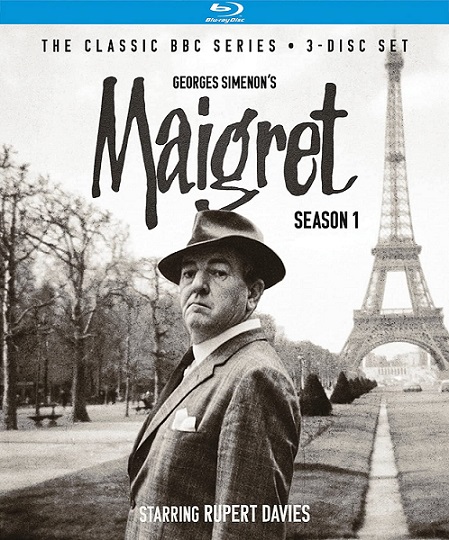
Maigret, Season One (BBC 1960)

Inspector Jules Maigret was a rumpled, middle-aged detective and the unswervingly faithful husband of Madame Maigret, but don’t compare him to Columbo. He might be unassuming, but any dumb crook can tell the Inspector is nobody’s fool. British actor Rupert Davies made that vividly clear with his portrayal of Georges Simenon’s perennially popular detective in the early 1960s BBC series. It was a hit at the time, but many episodes have been virtually unseen since their original broadcast, due to the poor quality of the tapes. Happily, the series has been restored to viewable condition (not perfect, but never headache-inducing), with the first season releasing today on BluRay.

The pipe-chomping Maigret is known for his compassion towards victims and criminals alike. He understands only too well how human weaknesses and frailties can lead to crime, even murder. However, he never plays it fast-and-loose with the law, but he is happy to grant frequent breaks for a quick nip at the nearest bar. That is why Sgt. Lucas is so loyal to his “patron” (or boss)—and why Lapointe, the newest rookie in his department quickly shares his devotion.

Poor Lapointe will be the focus of the first episode, “Murder in Montmartre,” when a stripper he had carried a torch for turns up murdered. It is rather a conventional procedural story, but the exterior location shots document the Paris of the early 1960s that [probably] largely no longer exists.

The second installment, “Unscheduled Departure,” based on the novel
Maigret Has Scruples, represents the sort of psychological gamesmanship, especially that within families and marriages, that really distinguishes the series’ best episodes. In this case, a man visits Maigret claiming his wife is trying to kill, based on highly dubious and circumstantial evidence. Maigret is next visited by the man’s wife, who claims he is going mad. With each subsequent visit, the stakes and potential for murder rises, but technically, no crime exists for Maigret to investigate.

“The Old Lady,” “Liberty Bar,” “A Man of Quality,” and “The Mistake,” are all highlights for similar reasons. They are not necessarily baffling mysteries to solve, but rather it is Maigret’s ability to perceive, empathize, and back-of-the-envelop-psychoanalyze that so compellingly drives the stories. Each episode is based on a Simenon novel, so Giles Cooper and a battery of other screenwriters always stay rather faithful to the source material.

“The Burglar’s Wife” and “The Cactus” are also particularly amusing for the way Davies embraces Maigret’s Maigret-isms. This is a surprisingly boozy show. It is also very noir, especially compared to other British series of the era. Stylistically, it bears some comparison to the iconic
Peter Gunn. There is no real jazz in in the 1960 series, but Ron Grainer’s melancholy French café-style theme is distinctively catchy, almost becoming an ear-worm.

It is a shame it took so long to clean up the tapes, because if this
Maigret had been available to PBS stations in the 1970s and 1980s, Davies’ Maigret would have been as familiar to viewers as Leo McKern’s Rumpole or Roy Marsden’s Adam Dalgliesh. Dozens of actors have taken their turn playing Maigret, but Davies’ take really inspires confidence. He is less flamboyant than Charles Laughton in The Man on the Eiffel Tower (seriously, who wouldn’t be?) and less hardnosed Jean Gabin in Maigret Sets a Trap, but “fatherlier” and somewhat more “lubricated.”

Tuesday, October 17, 2017

Maigret Sets a Trap: Jean Gabin is Jules Maigret

He is often called “Inspector,” but Jules Maigret was in fact the Commissioner of the Paris Major Crimes Division. He is a sleuth, but also a bureaucrat. Some of the least dashing actors in history have played Maigret. In 1958, Jean Gabin still exuded plenty of screen presence, but it had a jaded world-weary edge that still suited Georges Simenon’s famous detective. When a serial killer starts goading him, the Commissioner goads him right back in Jean Delannoy’s nifty film noir, Maigret Sets a Trap (trailer here), which opens this Friday in New York.

A ripper-style killer stalking full-figured brunettes has half the Parisian force on the streets, but when they still do not reach his latest body quickly enough, he leaves a message for “Monsieur” Maigret via a police call box. That “Mr.” business really sticks in the Commissioner’s craw. Recognizing his quarry’s arrogance, Maigret recruits a small-time informer to play it up big when he is arrested for the killer’s murders. He then floods the Fourth Arrondissement with decoys drawn from the police clerical pool to draw out the real killer under the watchful eyes of their back-up units.

It very nearly works, but the killer manages to slip away. Yet, the circumstances of his escape may yet give him away. However, their biggest break comes through chance. Ordered to follow anyone suspicious watching Maigret’s media circus, Det. Lagrume tails a very out-of-place and well-to-do housewife to an assignation with a gigolo that she seems weirdly disinterested in. It is not much to go on, but when Maigret pays a visit to Madame Yvonne Maurin and her squirrely husband Jean, Marcel, he immediately starts giving the couple the Columbo treatment.

During the course of Maigret, viewers learn all about the 1950s network of police call boxes in Paris and get a tutoring in criminal psychology and the dangers of over-indulgent parenting. Like many great film noirs, it has a real vintage modern feel, as well as a bountiful helping of nocturnal Parisian ambiance. In fact, Maigret would pair up nicely with other classic French noirs, even including the granddaddy of them all, Rififi.

Gabin is a terrific Maigret pitching his flinty interpretation of the Commissioner somewhere between the larger-than-life Charles Laughton in The Man on the Eiffel Tower and the down-trodden Harry Baur in A Man’s Neck. For extra-added steeliness, Lino Ventura appears in the relatively minor role as Inspector Torrence, one of Maigret’s “Faithful Four.” Again, like the best noir crime dramas, Maigret is fully stocked with colorful supporting performances, including Olivier Hussenot as the nebbish Lagrume and Gérard Séty as the sleazy ladies’ man, Jojo Vacher.

Arguably, Delannoy’s adapted screenplay, co-written with Rodolphe-Maurice Arlaud and Michel Audiard, pushed the thematic envelope of its day with some surprisingly frank discussions of sexual hang-ups and psychological emasculation. Regardless, Maigret is a great deal of fun, but it really should be considered a procedural rather than a mystery, because we can tell the Commissioner is on the right track halfway through the second act. Very highly recommended, Maigret Sets a Trap opens this Friday (10/20) in New York, at the Metrograph.

Thursday, August 08, 2013

Cine-Simenon: A Man’s Neck

Georges Simenon led a colorful life.  There might have been a few women and some fast living.  After the war, he also faced allegations of collaboration, but his defenders always maintained he was too self-absorbed for such matters.  Harry Baur was one of a multitude of actors to play Simenon’s signature detective, whose wartime experience is tragically above suspicion.  Imprisoned and roughly interrogated after ill-advisedly appearing in an early 1940’s German film, Baur either succumbed to injuries sustained or was helped along the way shortly after his release. His biographic details add further tragic context to Julien Duvivier’s A Man’s Neck, which screens during the Anthology Film Archives’ Cine-Simenon retrospective.

Willy Ferrière has a rich aunt, who refuses to die, but a mystery pen-pal offers to help the old dear along for 100,000 francs.  The freelance killer also has a scapegoat lined up to take the fall: the clueless Joseph Heurtin.  Yes, this is the Maigret case Burgess Meredith later adapted as The Man on the Eiffel Tower, but it is simultaneously similar and different in intriguing ways.

As it happens, both films also serve as time capsules of Paris, pre- and post-war.  Not surprisingly though, the earlier French film is darker and somewhat franker than the RKO production.  The stories run along parallel lines, but diverge on key points, such as the complicity of Ferrière’s mistress in Duvivier’s film.  Indeed, there is little innocence per se in this distinctly dark crime drama.

Both Baur and Laughton look like world weary civil servants, but the latter could not help playing the part with panache.  He was Charles Laughton, after all.  In contrast, Baur’s Maigret is a down-trodden bureaucrat often at risk of fading into the background, until roused to outrage by the psychotic Radek.  It is a close call, but in a head-to-head match, Laughton probably takes it by a jowl.

Likewise, Meredith’s Heurtin is a truly unique portrait of a man made vulnerable by his acutely anti-social nature.  Alexandre Rignault’s Heurtin also quite effective, but we have seen such simple-minded hulks before and since.  However, Valéry Inkijinoff’s frenzied and lusty Radek is something else entirely. Franchot Tone exceeds expectations in Eiffel Tower, but the Russian Inkijinoff is truly creepy.

In fact, both are very good films.  Duvivier shows an eye for procedural detail, giving viewers an unromanticized look inside the Paris gendarmerie. While more naturalistic and generally jaundiced in his portrayal of human nature, Duvivier also shoehorns in small, elegantly telling moments, as when Maigret and Radek take time out from their verbal sparring to listen to his Chanson-singing neighbor.

Neck is a lean, mean film noir that packs surprising punch. It is a deeply flawed world, but not one in which moral judgments are impossible.  Recommended by itself or in conjunction with Meredith’s Eiffel Tower (showing separately), A Man’s Neck screens this Saturday (8/10) and next Wednesday (8/14) as part of Cine-Simenon, now underway at Anthology Film Archives.

Wednesday, August 07, 2013

Cine-Simenon: The Man on the Eiffel Tower

Georges Simenon remains one of the best known Belgian writers, but his signature detective, French Police Commissaire Jules Maigret has been played by French, British, Dutch, Italian, Armenian, Czech, Russian, and Japanese actors.  British born Hollywood legend Charles Laughton also picked up Maigret’s trademark pipe for a memorable one-off, The Man on the Eiffel Tower, directed by the Burgess Meredith, which screens as part of Anthology Film Archives new retrospective, Cine-Simenon.

It is post-war Paris, where expat Bill Kirby has a wife, a mistress, a rich but prickly old aunt, and an aversion to work.  After he complains about the old dear’s longevity in a crowded café, a mystery man slips him a note.  His problem can be solved for 100,000 Francs.  He need only mail her key to an anonymous postal drop—and so he does.

For Maigret, the most suspicious aspect of the crime scene is how thoroughly it implicates the Joseph Heurtin. The bespectacled knife-grinder simply does not strike Maigret as a killer.  Playing a hunch, the Inspector allows Heurtin to escape, hoping he will lead the police to the master criminal pulling his strings.  Maigret soon concludes the real murderer is the Czech Johann Radek, a dissolute former medical student.  However, proving it will be a trickier matter.  Thus commences a game of cat and mouse that will indeed take both men to the famous Parisian landmark.

All AFA screenings will be in 35mm, which is good to know, since there are some pretty scruffy prints of Eiffel in circulation.  Evidently, it was one of the few films shot on a certain brand of color stock that has not aged gracefully.  Nonetheless, it is jolly good little suspenser, as well as an evocative time-capsule of post-war Paris.

Frankly, it is a shame Charles Laughton went one-and-done as Maigret, because he fits the part like a comfortably rumpled suit.  It would make a good double feature with his classic performance as the not-quite-as-crafty-as-he-thinks-he-is Sir Wilfrid in Billy Wilder’s Witness for the Prosecution.  In addition to helming with economy and style (reportedly with the occasional assist from his two big name co-stars), Burgess Meredith is effectively squirrely as Heurtin, even foreshadowing hints of Henry Bemis in the classic Twilight Zone episode Time Enough at Last.  Yet, perhaps the greatest revelation is Franchot Tone’s diabolically manic Radek.

Indeed, Laughton’s shrewd persona, Simenon’s clever plotting, and the still impressively dizzying climax promised by the title are hard combination to beat.  An all-around entertaining classic, Eiffel does right by the source novel, which was also the basis for an earlier French adaptation duly included in Cine-Simenon as well.  Highly recommended regardless of the condition of its surviving prints, The Man on the Eiffel Tower screens this Friday (8/9) and Sunday the 18th at the Anthology Film Archives.