Showing posts with label Mattie Do. Show all posts

Saturday, October 25, 2025

Brooklyn Horror ’25: Tales from the Woods


These fairy tales often leave the “happily” out of “every after,” but if you read the original Brothers Grimm and Charles Perrault, they often did so too. Not surprisingly, the genre filmmakers participating in this series of fairy tale-based short films had no trouble relating to their chosen stories, even though they often took extensive liberties. Nevertheless, the results still vary amongst the three short films in the Tales from the Woods series that screened at this year’s Brooklyn Horror Film Festival.

By far, the most successful is Mattie Do’s
Sleeping Beauty, which turns Princess Aurora into a Fisher King curse. The Laotian filmmaker (The Long Walk, Dearest Sister) transfers the French folk tale to colonial Vietnam, where the governor’s biracial son Philippe falls under the spell of the sleeping beauty and brings her home to meet his parents.

Unfortunately, no amount of kissing will wake her up, but that doesn’t bother Philippe. His mother Dao recognizes the source of his bewitchment from folk legends, but she is too timid to act accordingly, even if it brings ruin to her family and the surrounding community. Obviously, Do incorporates some rather provocative taboo themes, but they deliver a subversive twist to the familiar fairy tale. Sonadala Sihavong is also terrific, in a crushingly human way, as Dao.

Surprisingly, the weakest constituent short film comes from the usually mind-bending filmmaker-tandem of Justin Benson & Aaron Moorhead (
Spring, The Endless, Synchronic, Something in the Dirt). Jacques the Giant Slayer opens with an intriguing late 19th Century expedition vibe, but the creature encounter underwhelms.

Tuesday, March 01, 2022

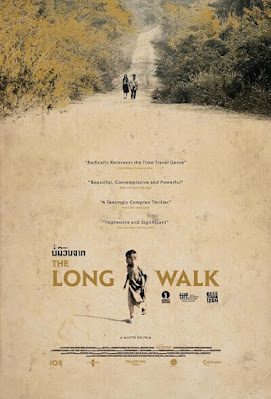
Mattie Do’s The Long Walk

There are some genre elements that don’t often get smashed together, especially not in Laos. For instance, there are sort of dystopian cyberpunk elements—sort of. Yet, the Laotian village setting looks frozen in time. There are a lot of strange things that unfold, but you should probably let them surprise you as they come up in Mattie Do’s The Long Walk, which releases today on VOD.

An old man (with a William Gibson-like implant in his arm) constantly walks the lonely stretch of road from his ramshackle farm house to the nearest provincial town. His only companion is a young woman, who never speaks. That’s because she is a ghost—but what about the young boy she introduces him to (silently, of course)?

It turns out the old man has a rather ominous reputation for either being a ghost talker, or someone who makes ghosts. That is why when a local woman goes missing, the cops come to his dilapidated home, to either accuse him or murder or enlist his aid divining the body. They are obviously not sure which.

Eventually, Do springs elements form films like
Looper on the unsuspecting audience, but her approach is almost too quiet and deliberate for its own good. The film runs nearly two hours, which is probably half an hour too long. Nevertheless, this is a very unusual and often unsettling story. Frankly, Long Walk is even more original than her previous film, Dearest Sister, but the execution isn’t quite as tight.

Regardless, Yannawoutthi Chanthalungsy is totally riveting as the grizzled old man. You can see from one look how much guilt and baggage he carries—and indeed it turns out he is haunted in every sense. Even though she almost never speaks, Noutnapha Soydara gives an acutely sensitive performance as the young woman. Yet, somewhat surprisingly, most of the emotional heavy-lifting falls to Por Silatsa, who shows tremendous range as the boy.

Saturday, January 14, 2017

Dearest Sister: Ghosts and Class Distinctions in Laos

Whether or not Voltaire really wrote “lotteries are a tax on stupidity,” he would probably enjoy having the sentiment attributed to him. Nok is the exception. When she plays, she wins every time, because she has inside information from beyond. However, it is unclear if those winning numbers were really meant for her in Mattie Do’s Dearest Sister (trailer here), which now streams exclusively on Shudder.

Nok has come to Vientiane to serve as an all-purpose care-giver for her distant cousin, Ana. Immediately, she understands she is stuck in a precarious position. She is not family enough to be considered equals with Ana and her Estonian expat husband Jakob, yet she is not to lower herself by consorting with their resentful maid and her husband, the surly gardener. Ana is slowly losing her vision and she often sees recently departed ghosts with what sight remains. She is also prone to psychic seizures, during which she repeats winning lottery numbers passed along to her by the spirits. When she comes to Ana never remembers anything she might have said, but Nok will.

Despite keeping the source of her windfalls secret, Nok starts to bond with Ana through her natural peasant’s affinity for the supernatural. Unfortunately, when Nok gets a taste for big city high-living, it will quickly lead to her disgrace. Of course, no matter how bad things look for her, they can always be fixed with a new set of numbers.

As the first Laotian woman to helm a feature film, the American born Do is absolutely a trailblazer. Happily, she has massive filmmaking talent to go along with her notoriety. Even though Shudder acquired Dearest, it is definitely a slow burner rather than a fright fest. Yet, it never, ever drags. Do is clearly an actor’s director, eliciting some subtle but intense performances from her ensemble, but she also controls the mood and atmosphere like an old master.

Amphaiphun Phommapunya totally burns up the screens as the quietly covetous Nok. Yet, Vilouna Phetmany might even outshine her as the entitled but increasingly terrified Ana. She also has a believably rocky rapport with Estonian Tambet Tuisk, who defies all stereotypes and expectations by giving such human dimensions to the ethically-challenged expat.

Frankly, Laos could use more filmmakers of either sex and more freedom of expression in general. It is a one-party Marxist state, albeit one apparently plagued by tremendous class inequities. Regardless, Dearest is the sort of moody and sophisticated supernatural drama that is always welcomed by genre fans around the world. Very highly recommended, Dearest Sister is now streaming on Shudder.