Showing posts with label Preservation Hall. Show all posts

Thursday, May 05, 2022

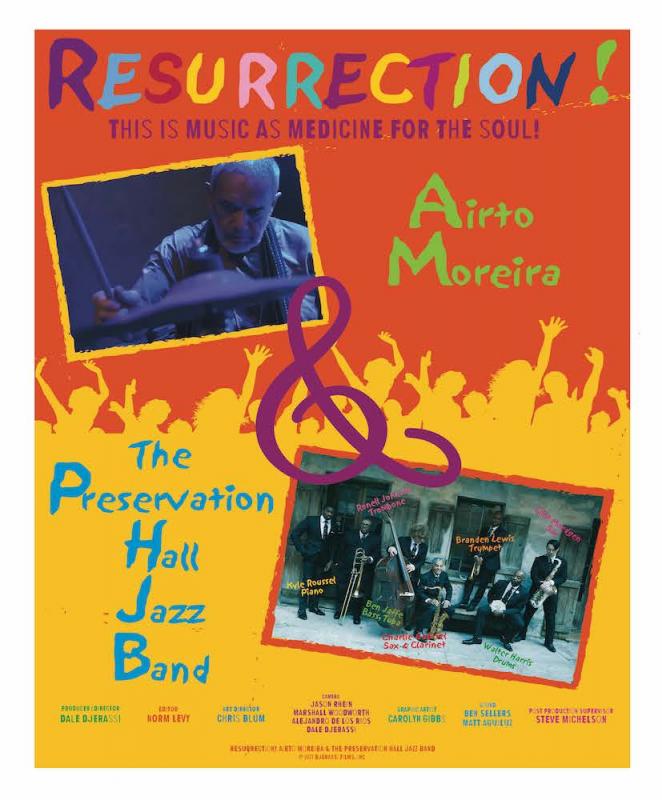
HIFF '22: Resurrection! Airto Moreira & The Preservation Hall Jazz Band

Brazilian percussionist Airto Moreira came to America for love, following his wife, Flora Purim, but he stayed for the music. Anyone whoever collected CTI Records in the 1970s inevitably bought many Moreira played on, perhaps including the sessions he led for Creed Taylor’s label. He was also a one-time member of Weather Report and Return to Forever. Those are some heavy fusion credits, but Moreira leaped at the chance to play with the band arguably most-steeped in jazz tradition, the Preservation Hall Jazz Band. Their meeting is documented in producer-director Dale Djerassi’s twenty-one-minute short film, Resurrection! Airto Moreira & The Preservation Hall Jazz Band, now screening at film festivals.

Djerassi gives viewers a brief thumbnail sketch of Moreira’s life and career, incorporating some colorful graphics (including an eye, an ear, and a toe, serving as a pictographic pronunciation guide for “Airto”). Moreira himself refers to the stormy drama that complicated his marriage during the 1970s, but he never talks specifically about Purim’s incarceration on a cocaine charge. This is a happy film, so do not expect anyone to dive too deeply into old pains.

Although Purim never appears in
Resurrection, the short documentary is still a family affair. His daughter, vocalist Diana Moreira also performed with him at Preservation Hall and his son-in-law Krishna Booker, the son of Moreira’s old musical comrade Walter Booker, also adds some additional percussion. The Moreiras only had about an hour of rehearsal with the Preservation Hall Jazz Band, some of which Djerassi filmed, but the percussionist was clearly comfortable being amongst family and the New Orleans musicians.

In fact, one of the most interesting aspects of
Resurrection is the parallel Moreira draws between the influence Brazilian Carnival exerted on his musical life and New Orleans jazz musicians’ formative experiences with Mardi Gras and second-lining. It turns out Djerassi’s short documentary nicely compliments Jason Berry’s film, City of a Million Dreams, an exploration of the New Orleans jazz funeral tradition, which is also currently playing on the film festival circuit.

Of course, the best part of
Resurrection is hearing the Moreira play with the real deal NOLA jazz musicians. Frankly, when the Moreiras jam with Charlie Gabriel on Ary Barroso’s “Aquarela do Brasil,” fittingly in Congo Square, a lot of viewers will wish Djerassi had included the entire tune.

Tuesday, April 19, 2022

Take Me to the River New Orleans

Even without jazz, New Orleans would be one of most important musical cities. That might be a heavy statement, but it is backed up by the likes of the Neville Brothers, The Meters, Dumpstaphunk, Fats Domino, Allen Toussaint, and Dr. John. When you add jazz back in, forget about it. Martin Shore doesn’t forget about NOLA’s jazz roots, but he definitely emphasizes the funk and R&B when he takes his documentary franchise to our favorite city in Take Me to the River New Orleans, which opens this Friday in the Crescent City, itself.

Shore visits studios all over New Orleans, where he pairs up legendary musicians, with up-and-coming local artists. It is an approach we’ve seen many times before. Frankly, a lot of fans would rather just see Irma Thomas (on her own), who kicks off the film with Ledisi, performing her classic “Wish Someone Would Care.” We do not mean to insult Ledisi, but this kind of Tony Bennett
Duets project is getting to be a cliché.

It is way more interesting to hear a diverse group of New Orleans drummers: Shannon Powell, Herlin Riley, Alvin Ford Jr., Terence Higgins, and Stanton Moore, kvetch and jam on “Li’l Liza Jane,” because it is a real dialogue. Donald Harrison, Jr. represents the jazz tradition and helps explain the significance of the Mardi Gras Indians. He also jams hard on the “Saints” with his nephew Christian Scott and the Tipitina’s Interns. You can’t get much more New Orleans than that.

Shore visits Preservation Hall, but we do not really hear much from the current bands there. However, a number of brass bands perform and discuss the current funkier scene, including the New Breed, Rebirth, and the grandaddies of them all, the Dirty Dozen Brass Band (who back Aaron Neville on a rousing “Stompin’ Ground”).

It is totally cool to see Walter “Wolfman” Washington included, jamming with Ani DiFranco on a real deal Cajun tune. The sessions involving rappers are a mixed bag, with the most successful being the Soul Rebels jamming with the late 5
th Ward Weebie on “504/Enjoy Yourself.” The tribute to Toussaint is a bit gimmicky, but somehow Snoop Dog and G-Eazy almost sound like they belong on “Yes We Can,” with the Meters, William Bell, and Big Sam Williams doing all the hard work of keeping things funky.

Wednesday, February 13, 2019

A Tuba to Cuba: On the Road with the Preservation Hall Jazz Band


Don’t expect to hear “When the Saints Come Marching In.” Hip jazz fans know requests of that “good old good one” will set you back a whopping twenty bucks in Preservation Hall. Honestly, it is probably worth it, but the band will really stretch themselves in new directions during this goodwill tour. Forget the politics and get ready to get down during T.G. Herrington & Danny Clinch’s A Tuba to Cuba (trailer here), which opens this Friday in New York.

There are not a lot of seats in Preservation Hall and it is not well-air-conditioned, but they still pack in the standing-room-only crowds for every performance. The Hall was founded by the late, beloved Alan Jaffe, whose son Ben succeeded him both as the Band’s tuba player and the artistic director of the Hall. Having grown up in the middle of New Orleans jazz, Jaffe is particularly aware of its Latin influences—what Jelly Roll Morton called “The Spanish Tinge.”

It turns out the NOLA-Cuba axis was a two-way street, as demonstrated by a sizable expat population that migrated to Santiago de Cuba, due to dissatisfaction with the Louisiana Purchase. Yet, that free-flow of culture and people was shut off when Cuba became a closed Communist police state.

There is some terrific music in Tuba to Cuba that more than compensates for the problematic way the film ignores the merciless human rights abuses that still continue unchecked under the Royal Castro family regime. There is no mention of the violent thuggery directed at the Ladies in White or the jailing of dissidents, like Dr. Oscar Elías Biscet. However, there is plenty of music and it sounds terrific.

As you would expect, the Preservation Hall band-members and the local musicians (whether they specialize in jazz or rumba) mesh together seamlessly. In fact, they immediately recognize a kinship between the second-line and rumba traditions. They also feel a deep rhythmic connection that runs through Congo Square back to Africa.

Hopefully, Tuba to Cuba will also lead to more recognition for the world class musicians of Preservation Hall. Arguably, Mark Braud is younger than modernist snobs would expect, but he has masterful chops worthy of the city’s great trumpet tradition. On the other hand, the sunnily charismatic Charlie Gabriel is everything you could ever hope for from a New Orleans jazz statesman.

The music will recharge your batteries and the human connections forged during the film are genuine, so you might as well overlook the ugly truth, including widespread censorship and street violence employed as a tool of state intimidation, which Herrington and Clinch clearly did their best to conceal—but let’s not make a habit of it. Recommended for fans of New Orleans-style jazz, A Tuba to Cuba opens this Friday (2/15) in New York, at the Village East.

Monday, March 19, 2012

All In: the Poker Doc

It is thought that the city of New Orleans introduced the game of poker to America, just like jazz, another enduring staple of Americana often associated with vice. Fittingly, the Preservation Hall Jazz Band provides the soundtrack for All In (trailer here), Douglas Tirola’s brisk and informative poker documentary, which opens this Friday in New York.

For poker players, April 15th is a date of infamy, even beyond its tax implications. It was on that date last year that the government indicted three of the largest online-poker sites, effectively ceasing their operations (funny, this Justice Department was supposedly not in the business of enforcing morality). The ripple effect was tremendous, leading to the cancelation of the poker television shows that fueled the game’s spike in mainstream popularity.

If the so-called “Black Friday” is All In’s key date than Chris Moneymaker is its touchstone figure. Often perilously broke due to a bad sports book habit, the average looking accountant reached the World Series of Poker through an internet tournament. When he was randomly assigned to the televised table, his underdog performance made him a star.

Black Friday was so significant to this subculture or industry (call it what you will), it sent Tirola and his team scrambling to re-cut and update what had been a much more upbeat All In. Ironically, some of his interview subjects, including big name players like Chris Ferguson and Howard Lederer (son of linguist Richard), have been implicated in the more serious charges surrounding Full Tilt Poker. To his credit, Tirola acknowledges the fact forthrightly.

The net effect leaves All In hanging in a rather interesting but precarious position. It still gives a pretty good nutshell overview of poker’s history and cultural significance, but assumes an actual explanation of the game would be unnecessary. Hey, the best way to learn the game is just by sitting down at the table, right? Indeed, some of the most amusing sequences involve professional players’ reactions to John Dahl’s entertaining Rounders, which they thank for bringing millions of sucker dollars into the game.

It is great to hear the Preservation Hall Band throughout All In. Indeed, their swinging sounds are even more important now, preserving the jauntiness appropriate to a film celebrating the country’s rakish gambling tradition. (They do not play “The Saints” though, presumably because that costs extra.) All told, All In is a pretty fascinating look at game that was riding high mere hours ago but will always appeal to players looking to bluff their way ahead. Though seemingly tailored-made for a high profile cable broadcast, it is still recommended for the curious when it opens this Friday (3/23) in New York at the Cinema Village.

Friday, December 26, 2008

Christmas in New Orleans: St. Louis Cathedral & Preservation Hall

They love their Christmas music in New Orleans. During the season, you can hear it at some the Crescent City’s most hallowed spaces, including St. Louis Cathedral and the slightly less imposing Preservation Hall.

Originally completed in 1727 and rebuilt in 1794, the Cathedral-Basilica of St. Louis, King of France might be the most recognizable building in New Orleans, rising over Jackson Square on the banks of the Mississippi. It is also where hip New Orleanians go for Christmas concerts based on Monday night’s turn out for the diverse trio of Theresa Andersson, John Fohl, and David Doucet. Originally hailing from Sweden, Andersson fell in with the city’s legendary R&B scene, while maintaining a rootsy acoustic sound on the fiddle. Fohl is a regular member of one of New Orleans top local organ trios, as well as a sideman in Dr. John’s band. Doucet is a respected standard bearer of the Cajun musical tradition. Together their Christmas concerts at the Cathedral have become something of a tradition for them, even resulting in a CD of their Christmas music.

Andersson has a lovely voice, nicely featured on “Hark the Herald,” but their finest number may have been their instrumental version of “Little Drummer Boy,” displaying their dazzling technique, but not at the expense of feeling. Fitting New Orleans’ history as a port city melting pot, it was a trilingual night, with Andersson performing the German and English lyrics to “Silent Night” and Doucet performing the French carol “Il Est Ne, Le Divin Enfant,” which he learned from the nuns in Catholic school.

Though the décor is meaner, Preservation Hall is certainly sacred ground for those who love traditional New Orleans hot jazz and Dixieland. While the Hall is all about tradition, their Creole Christmas Eve shows are a relatively recent institution, only in their third year. This year, they featured the St. Peter Street Allstars under the direction of Lars Edegran, also a Swedish transplant. Edegran has been leading groups at the Hall for years, usually on piano, but he is also an accomplished banjo and guitar player. With the raspy blues shouter Big Al Carson on vocals and a top notch group of New Orleans style jazz musicians, notably including Freddie Lonzo on trombone and Shannon Powell on drums, they ragged up favorite yuletide carols with old school flair.

Up-tempo pieces like “Rudolph the Red-Nosed Reindeer” were particularly amenable to their hot style of interpretation, but Carson’s finest vocal may have come on their beautiful rendition of “It Came Upon a Midnight Clear.” Edegran and company also mixed in a couple of tunes from their usual repertoire. In fact, it must have been Christmas, because they concluded the first set with “The Saints,” which ordinarily will set you back a ten-spot if you want to hear it at Preservation Hall.

Music is a way of life in New Orleans, so it naturally figures prominently in their Christmas celebrations. St. Louis holds their special Christmas concerts throughout the month of December, featuring important local artists like Ellis Marsalis and Irvin Mayfield in addition to Anderson, Fohl, and Doucet’s annual concert. Preservation Hall is open year round, but Christmas Eve is the day to hear carols there. Of course, it is not impossible to hear Christmas music there on other days, but it might cost some change. Remember, traditional requests are two dollars, other requests are five, and “The Saints” will set you back a full ten.