Showing posts with label Robert Mugge. Show all posts

Tuesday, October 12, 2021

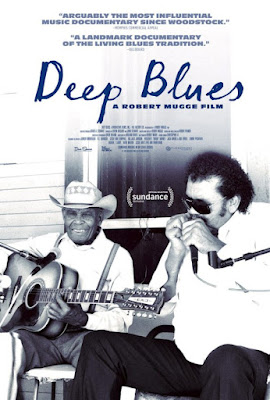
Robert Mugge’s Deep Blues

In 1990, you could walk right into Wade Walton’s Big Six Barber Shop in Clarksdale and get a shave, a haircut, maybe even a song from the Blues and civil rights icon, just like Sonny Boy Williamson and Howlin’ Wolf once had, back in their day. As a local activist, Walton’s shop had once been bombed during the 1960s, but he had been largely overlooked by the music industry since cutting a few records in the 1960s. He was exactly the sort of real-deal Blues artists music journalist Robert Palmer and Eurythmics guitarist Dave Stewart set out to document in Robert Mugge’s freshly 4K-restored Deep Blues, which opens virtually tomorrow.

If you scratch a rock guitarist with chops, you will probably find Delta Blues in his blood. Stewart is no different from Keith Richards in that respect, so he seems to get along famously with Palmer (who wrote extensively about both Block and rock). They started their Blues tour in North Mississippi, which has its own harder-edged Blues sound, working their way down to the delta.

Their first encounter was with Booker T. Laury, a Blues and Boogie-Woogie pianist, who was a contemporary of Memphis Slim and Sunnyland Slim. He was still attacking the keys with explosive energy, making his rendition of “Memphis Blues” a fitting way to kick-off the film. Their next stop is with R.L. Burnside, whose plaintive vocals and rhythmic guitar sounds on “Jumper on the Line” were about as North Mississippi as you could ever hope to find. When you see his neighbors gather round his porch to listen to him play, you have to wonder if they understood how much European Blues fans would have paid to hear Burnside in such an intimate venue.

Palmer definitely kept it real, capturing Jessie Mae Hemphill performing both with her fife-and-drum band and her juke-joint Blues combo. Sadly, it is clear many Blues artists could not quit their day jobs, because Big Jack Johnson, a.k.a. “The Oilman” still held the day job that inspired his nickname, while Walton was still cutting hair in his barber shop. Weirdly, Walton is the only musician whose performance, an appealingly easy-going take of “Rock Me Baby” is not presented in its entirety. However, Big Jack Johnson’s “Daddy When is Mama Comin’ Home” is definitely one of the film’s highlights.

It is also cool when Mugge and Palmer literally take viewers into the jukes and soak up the ambiance while Junior Kimborough and Roosevelt “Booba” Barnes tear up multiple numbers. Barnes also happened to own the club where he played, on Greenville’s notorious Nelson Street. At the time, Barnes’ Playboy Club was part of the mayor’s campaign to revitalize the historic Blues district into a musical destination, much like Beale Street today. Sadly, that has yet to happen.

Friday, December 11, 2015

Sun Ra: a Joyful Noise

He hailed from Saturn and he came to stretch the music, while still swinging it. Don’t even talk about Herman Blount from Birmingham, because we do not want to hear it. Sun Ra will always be jazz’s preeminent space traveler, occupying a truly unique place in music history. Sun Ra left the planet in 1993, but he could come back at any time. In the meanwhile, it is nice to have Robert Mugge’s classic performance documentary Sun Ra: a Joyful Noise (trailer here) available on DVD again, as part of MVD’s Mugge reissue program.

Sun Ra was not just about the future. He also looked back to the past, often incorporating ancient Egyptian symbolism in his costumes and stage settings. It is therefore fitting that Mugge interviewed Sun Ra in the Egyptian wing of the Museum of the University of Pennsylvania. In Joyful Noise, Mugge follows a game plan very similar to that of Gil Scott-Heron: Black Wax, breaking up the live on-stage performances with what could be considered spoken word interludes or even performance art based on public persona. Of course, Scott-Heron’s highly dated political rants can hardly hold a candle to tripped-out cosmic philosophizing and linguistic word play of Sun Ra.

One of the coolest things about Joyful Noise, besides Sun Ra himself, is the way Mugge captures the breadth and versatility of his music. Under Sun Ra’s direction, the Arkestra could play the sort of blistering free jazz that would inspire cats like Sonic Youth’s Thurston Moore or throw everyone a change-up, launching into a totally swinging, in-the-pocket set, in the Ellington tradition. However, as an early adopter of electric keyboards, Sun Ra always gave his stylistic multitudes a funky edge. Happily, you can hear it over and over again in Joyful Noise.

In his way, Sun Ra was just as political as Scott-Heron. Check out his Blaxploitation science fiction cult classic Space is the Place if you doubt it. Yet, one can confidently argue Sun Ra was far more influential. It is hard to imagine the development of afrofuturism without him. He also hired and retained some incredible musicians, including Marshall Allen (featured taking an incendiary alto solo), John Gilmore (who eloquently explains why he settled in for such a long stint with the Arkestra just as he was making a hardbop name for himself), and the incomparable vocalist June Tyson (watch her during their rooftop performance and just try to compare her to anyone else).

Mugge also ends the film perfectly, capturing the infectious energy of the Arkestra’s intergalactic second-lining that closed their gig for the Baltimore Left Bank Jazz Society. We will never have enough Sun Ra, but A Joyful Noise is an especially accessible introduction to the man and his music. Very highly recommended, Sun Ra: a Joyful Noise is now available on DVD and BluRay, from MVD.

Friday, November 13, 2015

Black Wax: Mugge Documents Scott-Heron

It is profoundly sad watching Gil Scott-Heron in his prime, knowing how terribly he would struggle with drugs in his later years. Of course, the gifted artist who sabotaged a potentially long and fruitful career through substance abuse is one of the oldest stories in jazz. However, Scott-Heron was supposed to be the heir to Oscar Brown, Jr., shining a light on the nation’s urban pathologies with his socially conscious lyrics. Instead, he was largely undone by the very dangers and malaise he decried. Happily, it is the forceful Scott-Heron music documentarian Robert Mugge captured in performance at a DC club and pontificating on the streets of the capitol in Gil Scott-Heron: Black Wax (trailer here), which releases today on DVD as part of MVD’s Mugge reissue program.

Many consider Scott-Heron the forefather of rap, but his concert at the Black Wax club is very much in a jazz bag, albeit a decidedly funky one, thanks to the bluesy guitar work of Ed Brady and a swinging horn line featuring Ron Holloway. Even though Scott-Heron has plenty to say, he and his band definitely keep everyone’s toes tapping. If only all protest songs were as groovy as “Johannesburg.”

You can better see why Scott-Heron is considered an apostolic link to rap and hip hop in the monologues and poetry he recites during various DC location shoots. Again, the talent is clear to see. Frankly, Scott-Heron could have easily pursued a stand-up comedy career, in the Richard Pryor-George Carlin tradition. Unfortunately, his political commentary is so dated, it is truly painful. Seriously, he offers up chestnuts like Ronald “Ray-Gun,” the actor playing the role of president. From a post-Cold War, Twenty-First Century vantage point, even William Jennings Bryan’s Cross of Gold speech holds up better.

Fortunately, the music still grooves. Despite his crossover jazz-soul-funk status, Scott-Hero could really swing a band. He also had a sly delivery that suited his hipster-prophet persona quite well. Clearly, the Black Wax concert is the main attraction, but Mugge has a keen eye for ironic backdrops. The wax museum sequences are particularly surreal, in a playful sort of way.


It is a shame Scott-Heron’s demons did not allow him to fully capitalize on his stature as a crossover jazz great in the 1990s and 2000s. Such opportunities might have challenged some of his hard left preconceptions, but they also would have helped spread awareness of his music. Instead, Scott-Heron will largely be remembered as he is seen in Mugge’s film, which makes it a rather important snapshot. A must-see for fans and a good time for anyone with ears for jazz-funk (even with the polemical interruptions), Gil Scott-Heron is now available again from MVD on DVD and BluRay.