Showing posts with label Roberto Rossellini. Show all posts

Sunday, May 31, 2026

Open Roads ’26: Roberto Rossellini Living Without a Script

Most people know Roberto Rossellini from his classic Italian Neo-Realist films and his scandalous love affairs. This documentary is about neither. Okay, maybe there is a little of the latter. Nevertheless, he had already severed his relationship with Anna Magnani and Ingrid Bergman has one foot out the door when directors Ilaria de Laurentiis, Rafaele Brunetti, and Andrea Paolo Massara pick-up the story of his life in the documentary Roberto Rossellini: Living Without a Script, which screens tomorrow as part of Open Roads: New Italian Cinema 2026.

Throughout the film, Rossellini sounds much like Miles Davis, repeatedly telling admirers that of they like his 1950s Neo-Realist classics, they should just re-watch those old films—but they no longer interested him. Instead, he developed a fascination with India, which he hoped to document in a non-fiction film. The filmmakers and commentators clearly imply Bergman dismissed such ambitions as a pipe dream (especially given their increasingly dire financial straits), until Nehru greased the wheels for the production of what became
India: Matri Bhumi.

It was a slow production, because Rossellini spent so much time wooing his future wife Sonali Senroy DasGupta, his ostensive co-screenwriter. Yes, he was still technically married at the time they met, but to be fair, so was DasGupta. See, there’s still plenty of good stuff left to cover in
Living Without a Script. In fact, it almost functions as a sequel to Francesco Patierno’s The War of the Volcanoes, which reveled in the gossip surrounding the start of his relationship with Bergman.

Yet, despite the considerable time devoted to Rossellini’s romance with DasGupta, the discussion of the filmmaker’s nonfiction television output will be new to a lot of viewers. Most of it remains hard to find outside Italy, perhaps with good reason, because a good deal of what we see in
Living Without a Script looks rather dated.

Tuesday, November 16, 2021

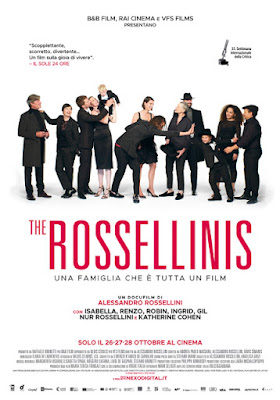
DOC NYC ’21: The Rossellinis

The Rossellinis are like the Kennedys of European art cinema and fashion. They all inherit high expectations and a legacy of scandal. For Alessandro, the bi-racial son of Renzo and grandson of the illustrious Roberto, the pressure drove him to drugs and general neurosis. However, he more or less came to terms with his famous family by helming his first film, the documentary The Rossellinis, which screens as part of the 2021 DOC NYC.

About the first fifteen minutes or so is devoted to explaining how everyone is related to each other—and viewers will appreciate the crib notes. As every true cineaste knows, the romance between Ingrid Bergman and Roberto Rossellini scandalized Hollywood. However, Rossellini basically did it all over again in India, when he married screenwriter Sonali Das Gupta. Alessandro’s father was supposed to be the family’s next great filmmaker, but he was never allowed to escape his father’s shadow. The only film Renzo helmed in his own right has rarely been screened, but that is how he met Alessandro’s mother, a dancer from America.

Clearly, Alessandro Rossellini always felt insecure because he lacked the supermodel looks of his aunt Isabella and his uncle Robin (who was once romantically linked to women like Princess Caroline of Monaco, but now lives in isolation on his mother’s Swedish island summer home). In fact, his relationship with his celebrated actress-model aunt is rather strained, for many reasons, several of which are really his own fault. Indeed, his sit-down sequences with her are excruciatingly uncomfortable.

Thursday, September 27, 2012

NYFF ’12: The War of the Volcanoes


Before Pitt, Jolie, and Aniston dragged their relationships through the tabloids, Ingrid Bergman, Roberto Rossellini, and Anna Magnani thoroughly outraged the filmmaking world.  However, they did it with exponentially more talent.  Francesco Patierno documents their headline-making scandal and the competing film sets on which it played out in The War of the Volcanoes (trailer here), a selection of the Cinema Reflected sidebar at the 50th New York Film Festival.

Rome, Open City was an international triumph for both Magnani and her director, Rossellini.  They quickly became close collaborators and lovers, despite their differences in temperament.  Magnani was the passionate, ever faithful diva.  Rossellini was the charmed smooth talker.  It probably would not have lasted, even without Rossellini’s mutual admiration for the unhappily married Ingrid Bergman.

Looking for a break from the Hollywood system, Rossellini’s Stromboli appeared to be the perfect project.  A morality play set against the exotic backdrop of the volcanic Aeolian Islands, Stromboli was largely lifted from a proposal developed by Rossellini’s cousins—or at least that is how they saw it.  Slightly put out by the appropriation, the budding filmmakers produced their film anyway, with Hollywood director William Dieterle at the helm and none other than the spurned Magnani herself as the star.  Guess which director brought their film in on-time and within budget.

As production began on the isolated Stromboli Island, thanks to Howard Hughes, the relationship between Rossellini and Bergman intensified.  With rumors swirling and pictures of PDA’s splashed across the newspapers, she became radioactive for her former Hollywood colleagues, leading to no end of stress for the Swedish movie star.  The narrative elements of both competing films, featuring disgraced women shunned by narrow-minded islanders, did not exactly help either, but it certainly represents fertile soil for film critics and historians to analyze.

Most movie fans will know the broad strokes of this infamous story, but the details are fascinating.  Patierno completely eschews talking heads, telling the tale through anonymous voiceover narration, archival publicity footage, and shrewdly selected clips from the principles’ films that thematically fit the events under discussion (like for instance, Hitchcock’s Notorious).  Almost entirely black-and-white as a result, Volcanoes captures a vivid sense of the era’s sophistication.

While rather a shorty at fifty-two minutes (preceded by a ten minute short following the eternal Manoel de Oliveira during the filming of The Strange Case of Angelica), War of the Volcanoes is nonetheless quite informative and entertaining, like a gossip show for upscale cineastes.  Recommended for fans of Italian cinema and Hollywood’s golden age, War of the Volcanoes screens this Saturday (9/29) and the following Wednesday (10/3) as part of the 2012 NYFF.