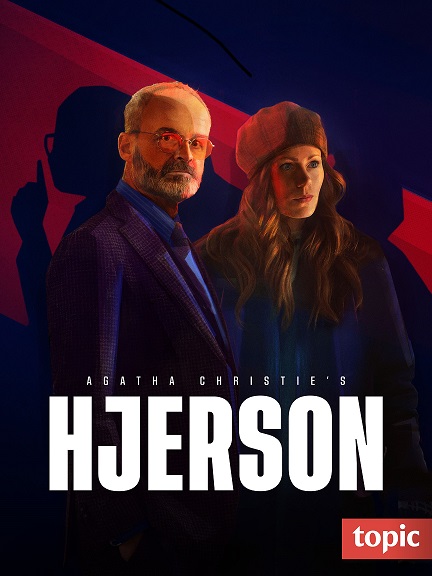
Sven Hjerson is to Agatha Christie’s novels what Beebo is to DC Comics. He is
a fictional character within a fictional world. Several of Dame Agatha’s stories
featured Ariadne Oliver, a mystery writer not completely unlike herself, whose
fictional detective was the fastidious Hjerson, who is not radically different
from Hercule Poirot. Rather shrewdly, Swedish television capitalizes on the
sleuth’s local potential in the eight-episode Agatha Christie’s Hjerson,
which premieres Thursday on Topic.
Technically,
the series should probably be called Agatha Christie’s Ariadne Oliver’s
Hjerson, since it all presumably unfolds in the pages of her novels, but
creator Patrik Gyllstrom (perhaps wisely) ignores the meta implications. It
turns out Hjerson is actually Finnish, from the Swedish-speaking autonomous archipelago
of Åland, but his professional career was spent solving crimes for the Swedish
police, until his spectacular fall from grace.
However,
his notoriety and brilliance are assets to freelance TV producer Klara
Sandberg, who wants to escape her MILF Hotel program, with a
crime-solving show, starring Hjerson. Contacting the misanthropic recluse is
tricky by design, but she knows she can corner him on an over-night ferry to Åland.
There also happens to be a muck-raking journalist on-board, who meets an
untimely death. Obviously, that will be their first case [sort of] together.
Each
case lasts two episodes and they vary in degree of mysteriousness. The shipbound
opener is about as twisty as a 1970s Quinn Martin two-parter. Fortunately, the
subsequent mystery in Åland is considerably more involving. It starts with the strange
disappearance of a man in chicken suit and features Bjorn Andresen (who played
the teen Dirk Bogarde obsesses over in Death in Venice) as Hjerson’s old
crony Oscar (seeing the grey, wrinkly Andresen now should totally freak out anyone
who saw Visconti’s film in theaters).
About
the time Hjerson finally agrees to Sandberg’s proposal, at least in very
general terms, they are approached by Ronda Svensson (a mystery novelist in the
world created by mystery novelist Ariadne Oliver, who was created by mystery
novelist Agatha Christie) to investigate a murder that was committed in a
manner precisely like one in her unpublished manuscript. Thematically, it is
sort of like “Captive Audience,” the James Mason episode of The Alfred
Hitchcock Hour, but Gyllstrom and co-screenwriter Bjorn Paqualin take it in
an interesting direction.
Impressively,
Gyllstrom isn’t afraid to riff on Alec Baldwin’s negligent shooting incident
(and make reference to it) in the concluding mystery-arc. However, in this instance,
it is the jerky arrogant actor who gets shot. Obviously, this is a good case
for the gossip-obsessed Hjerson, even though playing it coy with Sandberg. Again,
this mystery isn’t bad, considering Gyllstrom has to wrap it up in ninety
minutes, give or take.
This five-part series is based on a real-life Swedish true crime book, but it
could be any number of cases, since family members are always the first
suspects when someone is murdered. It sure looks like Sanna Ljungqvist killed
her strict father, Bengt, with her boyfriend Marcus Tingstrom, the thuggish poppa
of her child, but volunteer missing persons-searcher Tanja Thorell is the only
one investigating the case in director-co-creator Gustav Moller’s The Dark
Heart, which premieres today on Topic.
Ljungqvist
is fresh out of school with a forest-management degree, but Bengt
condescendingly dismisses all her new ideas for their forestry business.
Ironically, that pushes her into the arms of brooding Tingstrom, whose father
has long-feuded with Bengt, as their fathers did before them.
It
sure seems like something bad happened to old Bengt, because he has been
missing for over a year in the later time-line. Ljungqvist’s older sister
Emelie, who hasn’t lived on the family tree farm in years, contacted Thorell’s
missing persons group. Basically, she administers a Facebook page and a list of
a few dozen volunteers, but she mobilizes them all to search the woods around
the Ljungqvist farm. However, Ljungqvist and Thorell will not grant them
permission to search their property, thereby raising Thorell’s suspicions—quite
rightly so.
Dark
Heart was
probably conceived as a thriller that explored the troubling emotional terrain of
family dysfunction, like Blood and Broadchurch, but it leans much
more towards angst than suspense. Although the initial split narrative is a
little confusing, viewers will pretty much know what happened and are where it
is headed, right from the start.
Ironically, nobody mentions String Theory in this series, even though it follows a
group of scientists studying the origins of the universe, who become obsessed
with a mysterious length of cord. Somehow, it just appeared, but it appears to stretch
unendingly through the forest surrounding their research institute in
co-creators Dominique Rocher (director of The Night Eats the World)
& Eric Forestier’s three-part French series The Rope, which
premieres Thursday on Topic.
Bernhardt
Mueller is the director of a remote astronomical observatory. Its equipment is
old, but still powerful and the sudden vogue of theories he and his wife Agnes
hypothesized are poised to give the institute a new lease on life. Weirdly, a
week before their critical “data harvesting” Serge Morel, the facility manager
literally stumbles across a length of rope in the forest. Ulrik, Agnes Mueller’s
colleague and secret lover, manages to bang up his leg trying to follow it, so
he will not be available the next morning for Bernard’s rope-following hike. He
will be the lucky one.
Days
later, Mueller’s party remains unaccounted for. Of course, he and Morel managed
to recruit the most angsty group possible, including terminally ill research
director Sophie Rauk, Leila, an anxiety-ridden data scientist and her
increasingly frustrated husband Joseph, and visiting scholar Dani Johannes,
whose work explores the relationship between science and her lost religious
faith. Out of all of them, Morel is the only you would want to be lost in the
wild with. Yet, the rope seems to exert an obsessive hold over some of them,
driving them forward, despite the risks and the dead bodies they start to
encounter.
The
premise of The Rope is a bit like other suddenly-in-Hell-or-Purgatory
films, like the endless stairs in Black Ops, but it also shows the
perspective of those not stuck in the fantastical Sisyphean situation. In fact,
it is even more compelling watching Agnes and Ulrik trying to fathom the depths
of the universe than Morel’s crew compulsively following the rope. Still, the
contrast between the mysteries of science and the mysteries of the cosmically
inexplicable distinctively bifurcates and dramatically distinguishes The
Rope from its predecessors.
Kholat Syakhi literally translates to “Dead Mountain,” so it sounds like a
super fun location for a winter hike. Nine Russian hikers died on the slope of
the Ural Mountain in 1959, but the bizarre circumstances surrounding their
deaths and the subsequent secrecy of the Soviet authorities gave rise to a host
of conspiracies theories among suspicious Russians. Purportedly based on the
declassified files of the latest, new-and-improved investigation of the
so-called Dyatlov Pass Incident, showrunner-directors Vaeriy Fedorovich and
Evgeny Nikishov address a good deal of the lore surrounding the tragedy, but
they never really supply satisfying answers in the eight-episode dramatic
mini-series Dead Mountain, which premieres today on Topic.
The
hiking party has long been missing when fictional KGB Major Oleg Kostin is
summoned from Moscow to investigate, but officially he is not really there. Why
would a high-ranking KGB official be assigned to the presumed disappearance of
eight provincial students and their thirtysomething guide? Dead Mountain never
really explains that fundamental plot point, but it eventually reveals Sasha Zolotaryov,
the older man, was in fact a colleague of sorts. (Liam Le Guillou’s documentary
Unknown Compelling Force also points out that several of the eight Ural
Polytechnic Institute students were studying nuclear power, possibly making them
of greater interest to state security.)
The
series starts with Kostin’s dogged investigation, filmed in washed-out Soviet
color, but frequently flashes back to the chaotic final days of the Dyatlov
expedition, rendered in a black-and-white that often evokes the style and vibe
of vintage Soviet cinema. Kostin is aided by Ekaterina Shumanova, the medical
examiner, who maybe not-so-coincidentally happens to be the widow of Kostin’s
old Red Army buddy. In fact, the guilt he carries from the great war might have
a direct bearing on his investigation.
As
they tease out the truth, we watch the Dyatlov Party encounter angry bears, the
hostile indigenous Mansi people, terrible weather, mysterious lights in the
sky, and a fugitive from the nearby labor camp. They are also distracted by
love triangles and revelations Zolotaryov might not entirely be what he presents
himself to be. Some of the Dyatlov mythology will be half-explained away, but a
dark supernatural mysticism hangs over the entire incident.
Admittedly,
the gulag’s fugitive-hunting KGB squad are nasty pieces of work, but the series
itself largely presents the official story uncritically, sort of like if Oliver
Stone’s JFK had endorsed the Warren Commission Report. In terms of
drama, the long, drawn-out demise of the Dyatlov Party reaches the point of
being downright punishing. You have to start face-palming each time one of the
students is talked about of turning back. Seriously, you’re hiking on Dead
Mountain, it’s snowing, and there are armed goons from the gulag running around
the slope. What could go wrong?