Showing posts with label Werner Herzog. Show all posts

Sunday, December 03, 2023

Werner Herzog: Radical Dreamer

For younger generations, Werner Herzog has become their Peter Lorre. They might not know his bold early films like Fitzcarraldo, but they love his accent, enjoy seeing him play the villain in the Mandalorian and Jack Reacher franchises, and dig seeing him play himself on The Simpsons. Just wait till they hear about how he ate his shoe. For a fuller picture, Thomas von Steinaecker takes stock of Herzog’s entire career in the documentary profile, Werner Herzog: Radical Dreamer, which releases Tuesday on VOD.

Radical Dreamer
starts with Herzog’s difficult wartime childhood in Germany and proceeds in An orderly manner to his current unlikely celebrity salad days in America. He generally just follows Herzog as he retraces the major events of his life, waiting for the filmmaker to say something eccentric. Fortunately, he frequently obliges. Herzog was too young to have understood WWII at the time, but he was part of the post-War generation that helped decide what German culture would look like in the 1960s.

Even today,
Aguirre: The Wrath of God and Fitzcarraldo are probably the films that define Herzog as a narrative filmmaker. They were extreme in just about every way. The production experiences were partly like performance art and partly like the Labors of Hercules. It is amazing they were complete without (greater) tragedy. Fitzcarraldo became especially celebrated/notorious thanks to Les Blank’s “making of” documentary, The Burden of Dreams.

Radical Dreamer
reminds viewers of what life was like for cineastes before VCRS, when fans used to line-up around the block for screenings of Aguirre or Fitzcarraldo, because they did not know when they would ever get another chance to see them. A lot has changed since then. Those same fans would probably be shocked by the notion of Carl Weathers appearing in a documentary about Herzog, but here he is, discussing his Mandalorian co-star.

Tuesday, March 08, 2022

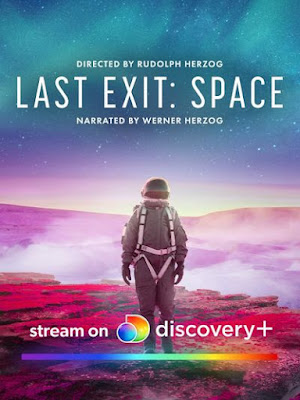
Last Exit: Space, on Discovery+

It was not as bad as the legendary Soviet sleep deprivation experiment, but the infamous Russian 1999-2000 isolation test should have become an international scandal when a Canadian crewmember faced harassment from her fellow test-subject. Naturally, the Russians blamed her. She finally breaks her silence to help explain the extreme challenges of interplanetary travel and prospective space colonization in Rudolph Herzog’s Last Exit: Space, narrated by his father, Werner, which premieres this Thursday on Discovery+.

Herzog’s approach is not surprisingly similar to that of his father (who is also on-board as an executive producer), especially in a doc like
Lo and Behold. Essentially, the Herzogs explore the obstacles to space colonization and the potential scientific methods for overcoming them, like antimatter drives and suspended animation. However, in every instance, science has a long way to go to facilitate our prospective interplanetary expansion.

Not so ironically, the social challenges might be the hardest to overcome. The unfortunate French-Canadian representative of the Canadian Space Agency speaks at length about her experiences in the Russian simulation. Perhaps the best line in the film goes to the sociologist, who likens potential Mars colonies to Amazon fulfillment warehouses (sounds like fun, right?).

However, the lack of participation of the new space-faring titans, especially Elon Musk is a glaring oversight. Instead, we just get speculation of intergalactic class-based exploitation, posited like a leftwing version of the revolution in Heinlein’s
The Moon is a Harsh Mistress.

Regardless, Rudolph Herzog keeps things rather snappy, interviewing either the very smart (such as astronaut Mike Foale) or the very eccentric, like the Brazilian UFO cult, who are quickly eliminated as a possible resource for deep space travel.

Friday, April 07, 2017

Herzog’s Salt and Fire

Werner Herzog is a modern-day adventurer who travels to the remote corners of the globe to make eccentric films and documentaries on-location. However, he perhaps spent too much time in the sun without his pith helmet while shooting amid Bolivia’s Salar de Uyuni salt flats. Perhaps the film he brought back makes sense to him, but everyone else will be completely baffled by Salt and Fire (trailer here), which opens today in Los Angeles.

Laura Somerfeld and her two busybody UN ecologist colleagues have been kidnapped by masked gunmen, but before we get much further, let’s flashback to see if they had a pleasant flight to the unnamed country bearing a strong resemblance to Bolivia. They have come to collect data on the disastrous El Diablo Blanco (that means “White Devil”) salt lake. Before they can even start, they are kidnapped by Matt Riley, the CEO of the energy consortium cleverly known as “The Consortium” (which sounds only slightly less sinister than the “Cabal”), who were responsible for the disaster. Does he want to stop them from filing their paperwork? No, apparently, he just wants to recite dramatic monologues for Somerfeld.

As they work their way through Ecclesiastics quotations and renaissance art analysis, a strange Stockholm Syndrome-esque attraction grows between Somerfeld and Riley, until he up-and-strands her in the middle of White Devil Lake with two weeks-worth of supplies and two young legally blind indigenous brothers to care for.

If you think S&F sounds ludicrous, wait till you get a load of the outrageously stilted dialogue. Think of it as a film that combines the worst eccentricities of Eugène Green and … well, Werner Herzog. In terms of credible motivation, this film is an absolute train wreck—so much so, cult movie fans will be rubbernecking at its weird procession of non-sequiturs in slack-jawed bemusement for years to come. Herzog unsubtly goes for broke trying to invest the film with Biblical significance. Truly, in the Land of Salt, the nearly blind are just as confused as the rest of us.

One thing is for certain—you can’t fault Michael Shannon for a lack of trying. He struts about wearing his leather jacket in the desert and inveighing to the high heavens like a prophet in the wilderness. Veronica Ferres looks a little freaked out as Somerfeld, which in all likelihood she was. However, Gael García Bernal and Volker Michalowski are just cringe-inducingly embarrassing as the ineffectual Doctors Cavani and Meier, whom Riley deviously sidelines with nasty bouts of Montezuma’s revenge.

Just when you think the film can’t possibly run any further off the rails, it ends with a series of goofy sight gags. In filmmaking, there is the easy way, the hard way, and the utterly ridiculous way. Here, Herzog opts for the third way, all the way and then some. Presumably, there is an environmental message in there somewhere, but it will be hard to take it seriously, if you can find it. Frankly, all that salt cries out for a gigantic margarita glass, so cheers everybody. Indeed, the Salt and Fire can only be enhanced by potent potables when it opens tonight (4/7) in LA, at the Arena CineLounge.

Monday, August 15, 2016

Lo and Behold: Herzog Surfs the Net

The internet profoundly influenced daily life even more than we realize. Frankly, it is hard to remember how we engaged in piracy, anonymous slander, and bullying before it existed. Yet, we could lose all these advances in one Carrington Event. Werner Herzog takes stock of our digital condition in Lo and Behold: Reveries of the Connected World (trailer here), which opens this Friday in New York.

You need not explain the perils of the internet to Hillary Clinton. Nobody is more secretive when it comes to hiding email archives, yet the personal data of her donors has still been splashed all over cyberspace. That is not exactly what Dr. Leonard Kleinrock had in mind when he collaborated on the internet’s creation. Like all good things, the internet does not lack competing creation stories, but a strong case can be make for the team of scientists assembled in UCLA’s Boelter Hall, feverishly working to send a digital message up the road to Stanford. That is where Herzog begins his ten-part meditation, finding Kleinrock to be figure of appropriately Herzogian enthusiasm.

The connected world also used to be a small world. One early pioneer still has the slim volume of all the collected email addresses of the entire connected world (sorted twice). In fact, early protocols were intended for that sort of tight little community and lagged behind the exponential growth that began in the mid-1990s. As a result, it is not long before Herzog stares into the abyss of the internet’s dark side.

Nobody better understands the anonymous malice the internet unleashes than Catsouras family. When their teen daughter Nikki was tragically killed in a car wreck, scores of trolls bombarded them with a gory leaked photo of the accident scene, along with their callous commentary. (Frankly, since Catsouras was driving a sports car, this could also be considered as part of the ugly Occupy Decency-class warfare movement, but Herzog maintains a rigidly narrow focus during this section.)

Ironically, tight focus is generally the one thing this far-ranging kitchen sink survey lacks. Herzog touches on just about everything, including internet security (with the help of in/famous hacker Kevin Mitnick) and our increasing dependency on the net for just about everything. For the record, it is not just preppers who are worried about the implications of future Carrington level solar flares. Herzog talks to scientists who share their concern. He also devotes time to commiserate with those afflicted with extreme electromagnetic sensitivity, who have found a refuge in the cell tower free zone surrounding the radio telescope in Green Bank, WV (which is named for lifetime pork barrel champion Robert C. Byrd, like everything else in West Virginia).

Basically, Herzog hopscotches through the landscape of the connected world, eliciting plenty of genuinely provocative insights, but never fully working through any of the issues addressed. Evidently, Herzog and commissioning executive producer Jim McNiel have hours of solid supplemental footage that may very well be re-purposed into different media forms, including perhaps the miniseries Lo and Behold really should have been. Still, it would be interesting to listen to Herzog discussing the history of lint traps, so given its heady topics, Lo and Behold should be a no-brainer for his fans. Recommended for what it is—an unresolved and perhaps unfinished work of technological-sociological history from a major documentarian-auteur, Lo and Behold opens this Friday (8/19) in New York, at the IFC Center.

Wednesday, November 09, 2011

Herzog’s Into the Abyss

It might technically be impossible to tell if someone is guilty just by looking at them, but death row inmate Michael Perry certainly gives the appearance of a sociopath. However, the late Perry turns out be the least compelling figure in his own case. Werner Herzog doggedly probes the raw emotions surrounding the death penalty, talking at length with the families of Perry’s victims, his accomplice, and those charged with carrying out the ultimate sentence in Into the Abyss: A Tale of Death, a Tale of Life (trailer here), which opens this Friday in New York at the IFC Center.

Of course, Perry proclaims his innocence in his final interview, but Herzog, an avowed opponent of capital punishment, never bites. After all, Perry initially confessed to the crime and the evidence (both physical and circumstantial) backed him up. It was indeed Perry who committed the murders and only Perry, according to his now remorseful criminal collaborator, Jason Burkett, currently serving a life sentence for his own role in the murders.

To his credit, Herzog lays open the premeditated brutality of the three killings they were convicted of, in cold unsettling detail. Coveting the cars owned by Sandra Stotler, the mother of a mutual friend, Perry ambushed the middle-aged woman in her own home, pumping two rounds from a 12-gauge shotgun into her. When her son Adam arrived home with another friend, Jeremy Richardson, the killers intercepted them, luring them both into the forest on a pretext, where they were executed. This narrative is never challenged in Abyss.

Herzog does not merely take the innocence defense off the table. He gives victim’s family members time to fully express their grief and pain. The fact that Jeremy Richardson’s brother Charles looks like a redneck who could have walked out of a more idiosyncratic Herzog doc makes his unvarnished testimony vividly real and forceful. Yet, nothing compares to the heartache of Lisa Stotler Balloun, the grown daughter and sister of Sandra and Adam Stotler.

Ironically, Herzog’s most persuasive case against the death penalty comes not from those directly involved with the Stotler murders, but from the professional staff charged with implementing capital sentences. For the prison chaplain and former corrections officer Herzog interviews, it is clear the weight of the executions they have witnessed heavily burdens their souls. In a sense, this becomes analogous to a second-hand smoke argument against the death penalty.

There are some viscerally powerful scenes in Abyss, but Herzog’s concerted efforts to elicit sympathy for Burkett become somewhat obvious and heavy-handed. Excessive time is also devoted to the woman Burkett married, who rather unconvincingly insists she is not a prison groupie. Still, he wisely limits his own on-screen presence, maintaining an appropriately somber and respectful tone throughout the film.

Herzog readily admits his goal is to spur people to reexamine their assumptions about capital punishment. Yet, those who enter the film agreeing with Herzog might just leave with the sinking feeling justice was done in this case, in nearly every respect. That is good filmmaking, if flawed propagandizing. The former is more valuable. Surprisingly nuanced and balanced, Abyss is considerably better than one might expect. One of the best true crime documentaries of the year (far superior to Incendiary, for instance), Abyss opens this Friday (11/11) in New York at the IFC Center.

Tuesday, April 26, 2011

Herzog’s Cave of Forgotten Dreams

Werner Herzog offered to make his latest and perhaps most ambitious film for the princely sum of one Euro, before taxes. Granted, he probably had additional compensation arranged, but he really just wanted to get on the set. To gain access to the over 30,000 year-old Chauvet Cave, the unclassifiable auteur offered to become an essentially unpaid employee of the French Cultural Ministry, which controls access to the ancient site. Succeeding where scores of filmmakers previously failed, Herzog brings the arguably most exclusive place on Earth to any and all film patrons with genuine lifelike 3-D in Cave of Forgotten Dreams (trailer here), which opens this Friday in New York.

Given the delicacy of the millennia old cave paintings and the stunning geological features, access to Chauvet is tightly regulated. Among other concerns, the simple accumulation of CO2 exhaled through normal breathing could cause significant damage. Strict limits were placed on the size of Herzog’s crew and the amount of time they could spend inside. To accommodate the confined spaces, they even redesigned the 3-D cameras to be smaller and more agile. Yet, even with these constraints, Herzog conveys a vivid sense of what it is like to step foot within the primordial cavern.

Both in terms of form and function, Forgotten is arguably the greatest use of 3-D technology seen in commercial (broadly defined) theaters. Although it has come a long way in the age of Avatar, 3-D has always been more impressive conveying depth than pointy things jutting out of the screen. Obviously, Chauvet has awe-inspiring depth. There are also legitimate educational and aesthetic reasons for rendering Chauvet in 3-D, considering the average person stands about zero chance of ever visiting there in the flesh.

Of course, Forgotten is not filmed entirely within the Chauvet Cave. In scenes that hardly require 3-D photography, Herzog interviews many of scientists involved in the site for geological and anthropological context. In the tradition of 1950’s Hondo, in which arrows were periodically shot towards the camera to prove it was all still 3-D, we even have a scene of one scientist demonstrating the Paleolithic Chauvet peoples’ harpoon-like weapon.  Aside from that little bit of silliness, Forgotten is a classy package, featuring Herzog’s singularly distinctive narration and an elegant classical chamber-chorale music soundtrack composed by cellist Ernst Reijseger, which is arresting in its own right.

If Herzog lays on the metaphysical ruminations a bit thick in the denouement, it is what we come to expect from. In any event, it all looks quite striking through cinematographer Peter Zeitlinger’s (3-D) lens. Some fans might be a bit disappointed we do not get to watch Herzog eat another shoe in 3-D. However, Forgotten is still an informative and artfully crafted film. Perhaps the best application of 3-D technology seen outside museum I-maxes, Forgotten opens this Friday (4/29) in New York at the IFC Center.

Wednesday, November 12, 2008

Les Blank: Blues and Cajun Music

Blues, roots music, garlic, and eccentric German directors are the stuff of inspiration for documentarian Les Blank. Probably best known for his documentaries featuring Werner Herzog, Blank’s second film was in fact a Dizzy Gillespie short. A wide cross-section of his filmography screens at the Film Forum for a week-long retrospective, starting this Friday.

Blank’s initial breakthrough documentary was The Blues Accordin’ to Lightnin’ Hopkins, but he will probably always be remembered for his Werner Herzog films. The twenty-minute short Werner Herzog Eats His Shoe is pretty much what it sounds like—basically Fear Factor for the art-house set. As bizarre motivation, the established Herzog bet Errol Morris he would eat his shoe if the aspiring filmmaker ever finished his first film. Obviously it worked, and Blank was there when Herzog lived up to his part of the bargain. (If you’re wondering, he cooked it first, with garlic.) Soon thereafter, Blank would document the turbulent making of Herzog’s Fitzcarraldo, in Burden of Dreams (trailer here). It was a process often described as well above and far beyond the chaos of Apocalypse Now.

However, some of the coolest films in the series relate to various forms of American folk music. Blank returned to the blues in 1971 for A Well Spent Life, a profile of Texas country bluesman Mance Lipscomb. Unlike the rest of his blues revival colleagues, Lipscomb was “discovered” in the 1960’s, not “rediscovered.” He made his recording debut on Arhoolie, the blues enthusiast label in 1960. Oddly enough, he would also cut an album for Sinatra’s Reprise label, which not surprisingly, quickly went out of print.

Well Spent rather starkly captures the life of a sharecropper who just happened to be a world renowned blues artist. Recent revisionist blues scholarship argues many blues collectors have idolized individuals who really did not consider themselves musicians. Playing the blues for their own enjoyment or an extra dollar here and there, they happened to be captured on songhunters’ field recordings and from there, legends ballooned. In a way, Well Spent lends some credence to those arguments. Clearly, Lipscomb spent far more time eking out a hardscrabble existence as a sharecropper than singing the blues. However, there is an undeniable, almost archetypal appeal to Lipscomb’s blues. Often seen performing backlit by sunsets, Well Spent also features some of Blank’s most attractive photography.

While his Lipscomb film is a mid-sized forty-four minutes, Blank also made some relatively brief blues films, like the five minute Cigarette Blues. Starring Sonny Rhodes, also from Texas but based in the Bay Area, Cigarette is an unusual “PSA” produced by the Dallas Museum of Art. Featuring Rhodes’ smoking (if you will) slide guitar and a cigarette-butt sculpture created by an artist recently deceased from lung cancer, it is one of the hipper anti-smoking film.

Blank did his undergraduate work at Tulane, so his affection for Cajun and Creole culture should come as no surprise. The full length documentary J'ai Été Au Bal gives an affectionate history of Cajun music. While Zydeco artists like Clifton Chenier (also the subject of Blank’s earlier film Hot Pepper) are discussed, in this film Blank keeps his focus on the Arcadians. However, he argues the two musical forms are closely related. Both use the same ingredients derived from French, African, and blues music sources, differing only in their proportions.

Au Bal gives a brisk history of Cajun music’s milestones, including the first Cajun record cut by Joe and Cléoma Falcon, the husband and wife accordionist and guitarist. Blank profiles many Cajun musicians, including fiddler Dennis McGee, considered the apostolic link between the original Cajun musicians and succeeding generations. Arguably forward thinking in his time, in 1929 McGee cut six sides with Creole accordionist Amédé Ardoin, at a time when racially integrated sessions were far from the norm. We also hear from many more contemporary performers, like Dewey Balfa, who is credited with launching a Cajun music revival with a well publicized set at the Newport Folk Festival. Altogether it gives viewers a comprehensive taste of Cajun music.

Blank has a true eye and ear for the music of Americana. His Film Forum retrospective starts Friday, screening twenty-six films in seven days. A Well Spent Life screens Saturday the 15th with Blank’s Herzog films. J'ai Été Au Bal screens Sunday with Hot Pepper. Cigarette Blues screens next Thursday with Blank’s polka film In Heaven There Is No Beer?, one of the many interesting combinations of the series.