Tuesday, December 11, 2012

Kill ‘Em All: Playing Survivor in Bangkok


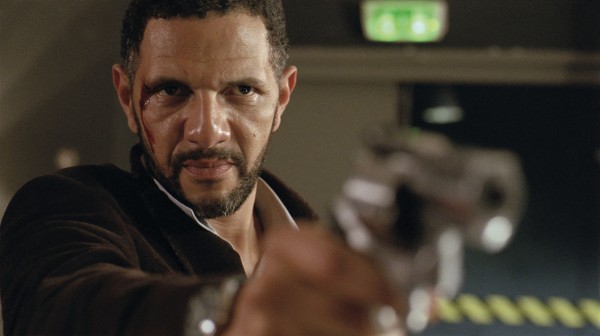
Hired killers are not inclined to make alliances.  Nonetheless, to survive the “Killing Chamber,” eight captured assassins will have to work together.  Needless to say, not all of them are going to make it in Raimund Huber’s Kill ’Em All (trailer here), which releases today on DVD and BluRay from Well Go USA, just in time for Christmas.

The premise is elegantly straight forward.  A shadowy criminal mastermind has abducted the top freelancers working in Bangkok, forcing them to face off in death matches, until there is only one.  Defiance of his instructions will lead to another dose of gas flooding the chamber.  On the other hand, each victor earns a trip to the weapons room.  Basically, it is a martial arts Survivor with décor left over from the Saw franchise.  Frankly, it is strange nobody made this film sooner, but here it is now.

Let us have no illusions.  This is an old school exploitation movie, through and through.  What it might lack in subtlety, it makes up for with in-your-face violence, choreographed with authority by fight director Tim Man.  Those nostalgic for Enter the Dragon rip-offs like Kill and Kill Again will get plenty of red meat here.  The dialogue can be rather clunky though, but that’s okay, the delivery often is as well.  Yet, despite ‘Em All’s profound B-movieness, the characters are better delineated than one might expect.

Gabriel is an explosives expert who wants everyone to join hands and work together to survive.  He is also suicidal, so this might be his lucky day, regardless.  Som is a Black Widow type assassin, who stuns opponents with her fearsome midriff of death.  She also seems to know more about their predicament than she lets on.  Carpenter is the crusty old Gary Buseyesque American expat of the hitman world, who hasn’t survived this long for no reason.  “The Kid” is the quiet, wiry type, but you do not want to face him in a death match.  Throw in a sadistic man child and a German anarchist and you have yourself a colorful crew.

No, this is not Crouching Tiger, Hidden Dragon‘Em All was obviously shot on a shoestring, but Huber still recruited a cast that will interest genre fans.  None other than Shaw Brothers veteran Gordon Liu appears as their evil tormentor, “Snakehead.”  Perhaps even more significant to martial arts connoisseurs will be the final film appearance of Joe Lewis, the international kickboxing champion and one time student of Bruce Lee, as Carpenter.  Ammara Siripong (co-star of the Thai martial arts film Chocolate) is also an impressive screen presence as Som.  Arguably, she has the best fight sequence, involving the lethal use of bricks (once again, ‘Em All is more about brute force than finesse).

You should know by now if Kill ‘Em All is your idea of a guilty pleasure.  For action fanatics, it has some cool moments, especially those featuring the undeniably attractive Siripong and the late great Lewis.  You could say it’s a bit grungy and unsophisticated, but Kill ‘Em All is still the perfect film to put on after a big family Christmas dinner.  Recommended accordingly, it is now available for home viewing from Well Go USA.

Monday, December 10, 2012

Anime Gets Medieval: Berserk the Golden Age Arc I—The Egg of the King


They were not called dark ages for nothing.  Battlefield carnage and an inflexible class system are the realities of the day.  Yet, the charismatic leader of a band of mercenaries has unthinkably lofty aspirations in Toshiyuki Kubooka’s Berserk the Golden Age Arc I: The Egg of the King (trailer here), the feature anime adaptation of Kentara Miura’s popular manga series, recently released on DVD and Blu-ray by Viz Media.

The relatively young looking Guts is a ferocious sword-for-hire if paid well enough, but he is not a joiner.  Nonetheless, the mysterious Griffith is determined to recruit him for his “Band of the Hawk” mercenary troupe.  While Guts easily overpowers Griffith’s best warriors, including the fiercely loyal Casca, he is no match for their angelically effeminate leader.  Bested in a fair fight, Guts swears fealty to Griffith, quickly becoming his favorite.

Thanks to Guts’ reckless courage, the Band of the Hawk earns the gratitude of the Midland Kingdom.  Much to the shock and disdain of the nobility, Griffith is rewarded with a title.  However, he has even further ambitions, including catchy the eye of the Princess.  It will probably end badly if you believe the prophecy of Nosferatu Zodd, but you can’t always accept the word of giant demonic mercenaries.

While the Berserk series was produced in Japan (with the original Japanese soundtrack available as a DVD option for purists), it was clearly shaped by the Medieval Europe that served as the foundation of Tolkien’s Middle Earth and most subsequent epic fantasy series.  Yet, the anti-heroism of Egg is rather distinctive.  Indeed, the opening battle sequences are unusually stylishly by anime standards, yet surprisingly brutal.

Intended for mature audiences, Egg should be considered anime for Game of Thrones fans.  Blood will definitely run.  There is even some brief fan service provided by Casca.  While most of the target audience is probably already familiar with the franchise characters, new arrivals pretty much have to roll with the punches.  We can glean there were some difficult childhoods in the past, forging everyone into lethal warriors.  Of course, how much characterization do you need in the middle of a full scale siege?

As dark and moody as Egg gets, it never lets the angst interfere with the action.  As a result, the awkwardly titled Berserk the Golden Age Arc I: the Egg of the King delivers all kinds of hack-and-slash, making it a fitting stocking stuffer for a reasonably “grown-up” fantasy fanatic awaiting the new season of Thrones and the final Wheel of Time novel.  Recommended pretty enthusiastically for genre and anime fans that prefer blood and guts over magical devices, Berserk … King is now available for home viewing from Viz.

Get Back on the Bus: The Magical Mystery Tour Returns


It was a film produced in psychedelic color that debuted on BBC1 at a time when most British televisions were black and white.  It was programmed for Boxing Day, a traditional evening of family television viewing, guaranteeing those least inclined to appreciate a spot of hippy goofiness were most likely to see it.  Due to its disastrous reception, many Beatles fans only know The Magical Mystery Tour as the bestselling album.  After years of obscurity, the film has been re-released for public consumption, even returning to broadcast television with a special presentation this Friday on PBS’s Great Performances (promo here) to be followed by the premiere of Francis Hanly’s behind-the-scenes documentary Magical Mystery Tour Revisited.

The plot, such as it is, will hardly matter to diehard Beatles fans.  The real attraction is the music, including the band’s only video performance of “I Am the Walrus,” done in precisely the style one might expect.  The audience follows the day-glo tour bus as it makes a series of surprise stops throughout the English countryside.  Ringo Starr plays Richard Starkey who takes his recently bereaved Aunt Jessie on the tour, bickering like cats and dogs every step of the way.  The other three lads are also on the tour, essentially playing unnamed versions of themselves, as well as a pack of trickster wizards.  Stops will include a visit to an army recruiting station, a chaotic marathon, a brief swing through a London strip club, with a number of wacky dream interludes in between.

Seen with contemporary eyes, MMT, directed by the Fab Four with the assistance of former Hitchcock collaborator Bernard Knowles, looks exactly like the trippy jokiness we would expect from the post-Pepper Beatles.  Sort of like a series of Python sketches stitched together, but not nearly as consistently funny, it makes perfect sense to find Terry Gilliam singing its praises in Revisited.  Still, the film itself very definitely feels like a giddy time-capsule from a more innocent age when Postmodernism was little more than glint in the eye of the French intelligentsia.

At just under an hour’s running time, MMT offers viewers the title song, “Fool on the Hill,” “Your Mother Should Know,” and the Bonzo Dog Doo-Dah Band performing “Death Cab for Cutie” amidst its improvised tomfoolery.  Frankly, the latter number might be the most memorable, since it accompanies a PBS-safe striptease.  Ironically, the making-of-program clocks in at almost exactly the same length.  We hear from both surviving Beatles as well as Martin Scorsese, who evidently saw every movie ever made when he was a teenager and influenced by everyone of them.  Hanly also incorporates some archival footage of John Lennon and George Harrison.  Everyone seems to credit or blame Paul McCartney with the original concept for MMT, but that hardly makes any sense, since “Revolution #9” played backwards clearly implies he died before 1967.

MMT is neither the affront to good taste many argued at the time, nor the lost masterpiece most fans will be hoping for.  It is the product of its time, well in keeping with the playful personas carefully crafted by the Beatles.  An amusing but minor film, it is certainly worth fans’ time for the music and to satisfy their curiosity when it airs on free TV this Friday (12/14), along with Hanly’s companion film, as part of the current season of Great Performances.

Sunday, December 09, 2012

Spanish Cinema Now ’12: The Dream and the Silence


Oriol is an architect, but he is terrible at rebuilding broken things, like his family.  At least he is carrying on just fine.  Not only has he forgotten the accident that killed his youngest daughter, he has blotted out all memory of little Celia.  It might sound like the set-up for a psychological drama, but traditional narrative form is not something Jaime Rosales gets hung up on with his pseudo-experimental The Dream and the Silence (trailer here), which screens during the Film Society of Lincoln Center’s 2012 Spanish Cinema Now.

Oriol and Yolanda are two very unexceptional parents with two perfectly presentable daughters, Alba and Celia.  That all changes on the fateful day Oriol drives Celia back from her grandparents’ home.  The architect’s mental block might help him deal with the situation, but it makes matters far worse for Yolanda, who as a result feels added pressure to keep Celia’s memory alive.  As her emotions fray, Oriol becomes more distant and disengaged in family life.  From time to time, the audience witnesses extreme situations that could have been the stuff of genre cinema, but are presented by Rosales in a diffuse, roundabout manner instead.

Take a deep breath before walking into Dream, because it is described by the sympathetic as “demanding.”  Like high-end mumblecore, Rosales employs a highly improvisational approach with mostly nonprofessional cast.  While it sometimes takes a while to tease out what is going on in a given situation, viewers will get a keen sense of the personalities that make up this family.  Jaume Terradas is especially powerful as the grandfather who was one of the last people to see Celia alive.  When bickering with his wife and later mourning a grandchild, his weathered face commands the screen.

At times though, Rosales appears to be fighting his actors with his stylistic excesses. Granted, he frames some striking tableaux, but they lose some of their potency when held too long.  As for the Godardian jump-cuts, they are an unnecessary distraction.  Still, Óscar Durán’s black-and-white cinematography is unusually powerful, better described as stark rather than beautiful.  For added intellectual heft, the film is bookended by scenes of work by Miguel Barcelo (seen in The Double Steps) taking shape on his canvas.

Without question, Dream is a festival film that is unlikely to see any regular theatrical bookings in America, except perhaps in the ever daring Anthology Film Archives, God bless them.  There is a there there, but there is also plenty of meandering slack.  Visually distinctive but indulgently elliptical, Dream and Silence is only for cineastes that privilege image over narrative.  It screens this coming Thursday (12/13) at the Walter Reade Theater as part of this year’s Spanish Cinema Now.

Saturday, December 08, 2012

Spanish Cinema Now ‘12: The Sleeping Voice


They might be atheists, but they certainly have their passion plays.  A Communist martyr will meet her fate as her sister vainly struggles to save her in Benito Zambrano’s The Sleeping Voice (trailer here), which screens tomorrow as part of the Film Society of Lincoln Center’s 2012 Spanish Cinema Now, their longest running annual film series.

As Voice opens, twelve prisoners are executed by a firing squad as the women inmates of Madrid’s Ventas jail break into “The Internationale.”  Yes indeed, why ease into things, when you can break out the bloody shirt right off the bat.  The best Spanish films on the Spanish Civil War explore the irony and moral ambiguity of the bloody conflict.  This is not one of those films.

It is 1940 and General Francisco Franco is very much alive.  He is quite well in fact, having just consolidated power.  With the support of the church, he has rounded up all the leftwing troublemakers, including Pepita’s beloved sister Hortensia.  Although she and her husband are active in the Communist guerilla forces, we are assured she is innocent of everything.  Arriving in the big city to support her very pregnant sister during the sham trial, Pepita finds work as a maid for the well to do Don Fernando.  While he is sympathetic to her situation, she is not to mention jails or Loyalist family members around his wife, a committed Nationalist whose brother was killed by the Communists.  Of course, being completely guileless, she does so anyway.

Despite her determination to stay out of politics, Pepita finds herself embroiled in a plot to help Hortensia’s husband escape to France.  That is how she meets the dashing “Black Jacket.”  Against her better judgment, she starts to fall for the wanted fugitive.  While she navigates the shadowy world of Franco’s Spain, the clock ticks down to her sister’s presumed death sentence.

Voice has an unmistakable point of view, which is perfectly fine.  However, the large ensemble of women inmates is largely a collection of interchangeable martyrs.  You would think the Nationalists would have scooped up one or two less than noble prisoners, by sheer virtue of their volume.

Still, there are some interesting figures sprinkled in here and there, particularly Don Fernando, a Loyalist sympathizer, whose past activism cost him his medical practice.  Only his high ranking military officer father prevents him from sharing Hortensia’s fate.  Pepita is also an intriguing character (rather fortunately so, since she is the lead), often appearing mired in childlike state of arrested development, yet knuckling down in times of crisis.

There is something deeply arresting about María León’s performance.  Her Pepita is the absolute picture of naiveté, yet she develops some pleasing chemistry with Marc Clotet’s Black Jacket.  Jesús Noguero also adds a realistically human dimension to the proceedings as Don Fernando, even though he is banished from the third act.  Conversely, the undeniably lovely Inma Cuesta is stuck playing a symbol rather than a character as secularly angelic Hortensia.

Cinematographer Alex Catalán’s work is attractive to look at, but Zambrano’s hand is simply too heavy.  We just so get it after a while.  Frankly, Voice’s sequences outside the prison, in which poor Pepita learns something of life, consistently work better than the scenes of predictable sisterly solidarity behind the walls.  Achingly earnest but fairly grueling over the long haul, The Sleeping Voice is mostly for diehard Spanish cinema fans and any surviving veterans of the Abraham Lincoln Brigades.  It screens tomorrow (12/9) and this coming Thursday (12/13) at the Walter Reade Theater during this year’s Spanish Cinema Now.

Friday, December 07, 2012

Goddess: Center Stage


She was one the biggest stars of her generation but the press was out to get her.  Eerily, Ruan Lingyu’s short life paralleled the trajectories of her most tragic roles.  Her career was marked by scandal, making her story a natural for big screen adaptation.  Mixing narrative with documentary snippets, Stanley Kwan She was one the biggest stars of her generation but the press was out to get her.  Eerily, Ruan Lingyu’s short life paralleled the trajectories of her most tragic roles.  Her career was marked by scandal, making her story a natural for big screen adaptation.  Mixing narrative with documentary snippets, Stanley Kwan sympathetically profiles Ruan in Center Stage (trailer here), which fittingly concludes the Asia Society’s Goddess film series tomorrow.

There are two divas in Stage, Ruan and Lily Li, played by two divas of a later generation: Maggie Cheung and Carina Lau, respectively.  A gifted actress, Ruan is often called the Greta Garbo of Republican China.  She gained fame as a romantic heroine, but is now best remembered for her more politically charged films.  Unfortunately, she fell for the wrong man at an early age.  Arguably, it was a mistake Ruan significantly repeated once, perhaps twice.  Ultimately, her ne’er do well ex would serve as the media’s willing tool.

Stage can be quite maddening, because it recreates scenes from many of Ruan’s films that are now considered lost.  Many of them look like they were really darn good, but we can only hope they eventually turn up in a mysterious film vault someplace.  Naturally, Kwan also gives the audience a behind-the-scenes look at the surviving classics, Goddess and New Women, which kicked off the Asia Society’s retrospective last month.

Cheung is not a bad likeness for Ruan, perfectly expressing her brittle vulnerability.  Her Ruan struggles to maintain a placid façade, but she obviously feels the sleights of others on a very deep level.  Indeed, screenwriter Peggy Chiao clearly ascribes a great deal of her success as an actress to her remarkable empathy.  It is a star turn from Cheung, justly awarded best actress at the 42nd Berlinale.

Kwan’s talking head segments, both archival and original black-and-white interviews with cast and crew, give the film a stop-and-start rhythm that can be distracting.  Still, much of this commentary is rather interesting stuff, including the final sit-down granted by Li Lily, Ruan’s friend and fellow diva (represented in the Goddess series with Daybreak).  Cheung’s sympathetic take on Ruan adds an intriguing meta-dimension to the film.  Her candid segments also serve as a reminder how striking she is, considering how pale and drawn she often looks when appearing in character as Ruan.

At well over two and a half hours, Stage truly brims with ambition.  Sort of the HK equivalent of Jessica Lange’s Frances Farmer bio-pic, it is a finely crafted period production that should satisfy Ruan’s fans with its earnest ardor for their star.  Viewers will come to feel like they understand the exquisitely morose idol, yet suspect there is something about her that will always remain unknowable.  Anchored by a great lead performance, Center Stage is highly recommended for fans of Ruan, Cheung, and Hong Kong cinema in general when it screens tomorrow (12/8), wrapping up the Goddess film series at the Asia Society.

Off White Lies: Hezbollah Bombs, Israeli Hospitality


The second war in Lebanon is raging.  As Hezbollah rains down bombs on northern Israel, everyday Israelis respond by pulling together, offering refuge to evacuees.  Shaul is not from the north, but he is in need of shelter, especially now that his underwhelmed daughter has been bundled off to live with him.  He might be problematic, but it is hard to judge the irresponsible “inventor” too harshly in Maya Kenig’s Off White Lies (trailer here), which opens today in New York.

Fresh off the plane from America, Libby is pretty appalled by the sight of her slovenly father, Shaul.  She is also confused why he does not take her straight to his home.  Of course, he does not have one.  He was hoping to stay with a buddy up north, but the bombardments scuttled those plans.  A news report gives Shaul a bright idea: accept the hospitality of a family hosting displaced northerners.  This will be Libby’s first time pulling a fast one, but the girl has to learn sometime.

Shaul and Libby land in the well to do home of senior military officer Gidi and his wife Helit.  Unfortunately, both are naturally suspicious.  While the father and daughter’s frequently evolving story ought to offer plenty of red flags, the host family sort of falls for Shaul’s goofy charm.  Nonetheless, exposure always lurks just around the corner.

Obviously, the extraordinary circumstances help the father and daughter repair their relationship.  Kenig and co-writer Dana Dimant clearly are not allergic to a little sentiment, but at least they are not compelled to tie everything together into a pretty bow.  Although Lies hits a lot of quirky notes, it is still interesting to see Israeli life during wartime from the perspective of an indie dramedy.

Gur Bentwich’s goonish likability really is Kenig’s ace in the hole.  Never too manic or shticky, he is just eccentric enough to be real.  Elya Inbar has some nice getting-reacquainted scenes with him, even though Libby’s petulance gets a little wearisome over time.  However, Tzahi Grad gets the lion’s share of the laughs as the gruff but surprisingly pragmatic Gidi.

Featuring several well drawn characters and a comparative sense of restraint, Kenig’s film is a pleasant enough excursion into family dysfunction.  Considerably better than The Fitzgerald Family Christmas (for instance), Off White Lies is recommended for fans of Israeli cinema. It opens today (12/7) in New York at the Lincoln Plaza Cinemas.

Thursday, December 06, 2012

Fitzgerald Family Christmas: Long Island Cheer


Where are the Griswolds when you need them?  It is the season for sentimentality and Edward Burns intends to indulge.  He returns to Long Island for a big Irish family get together in The Fitzgerald Family Christmas (trailer here), which opens tomorrow in New York.

Their mother’s birthday is two days before Christmas, but aside from Gerry, her favorite, none of the grown Fitzgerald children want to come home to celebrate.  Grown might be too strong a word.  Let’s say they are over twenty-one.  Gerry is the professional martyr who still lives at home.  He has four sisters whose names are impossible to keep straight.  It is easier to just number them in accordance with how annoying they are, number four being the most insufferable.  He also has two brothers, one of whom would have been forgotten were it not for a handy set of press notes.

There is still a Fitzgerald father out there, but he is dead to Rosie Fitzgerald after he walked out on her when the brood was still quite young.  Unfortunately, Jim Fitzgerald will be dead to everyone soon.  His final wish is to spend his last Christmas with the family.  Gerry tries pleading his case, but his mother and assorted siblings remain steadfastly opposed. 

Various other family dramas crop up, including Sister #1’s pregnancy with her abusive husband.  Brother Quinn and Sister #4 are pursuing significantly younger and older romantic partners, respectively, while Sister #3 sent her husband packing in favor of their landscaper.  Sister #2 actually has a presentable husband and young baby, but she is still absolutely miserable to be around.  Meanwhile, completely forgettable Brother Cyril just got out of rehab.  Right, good luck with that.

Christmas with the Fitzgeralds will make viewers convert to Buddhism.  The only appealing scenes involve Brother Gerry’s awkward courtship of Nora Daugherty, the nurse of a longtime family friend.  It is nice to see realistically flawed, everyday looking (slightly worn even) people develop a down-to-earth relationship.  Reuniting from The Brothers McMullen, Burns and Connie Britton display real romantic chemistry together.  He helms these sequences with a sensitive touch the rest of the middling family chaos lacks.

Granted, it should also be noted Ed Lauter might just give a career performance as the remorseful absentee father.  In fact, there are several very nice supporting turns peppered throughout this overstuffed holiday feast of subplots, each of which is neatly resolved, lest they spoil the turkey.  While not an outright affront to cinema, The Fitzgerald Family Christmas is unlikely to become anyone’s holiday tradition.  More liable to test viewers’ patience, it opens tomorrow (12/7) in New York at the Village East.

Wednesday, December 05, 2012

Wagner & Me: Stephen Fry Geeks Out


Can you separate an artist’s work from their offensive ideology?  Hollywood asks Middle America to do exactly that nearly every weekend.  Granted, the case of Richard Wagner is of a much higher magnitude.  After all, we know whose favorite composer he was.  Stephen Fry is also an ardent admirer, who tries to reconcile his beloved music with the man’s problematic legacy in Patrick McGrady’s Wagner & Me (trailer here), which opens this Friday in New York.

Fry is clearly a civilized man of the arts, who actually lost family members in the Holocaust.  He also loves Wagner’s music.  Love might be an understatement.  Touring the celebrated Bayreuth concert hall built to the composer’s specifications as it prepares for its annual Wagner festival, Fry is absolutely giddy.  All his sophistication deserts him.  It is a total fanboy geek out.

Frankly, Fry might cringe at some of this footage in years to come, but on the other hand, cynicism is overrated.  Fry conveys his passion for the music and God bless him for it.  To his credit though, he does not ignore the dark side of Wagner.  While he does not delve too deeply into the composer’s documented anti-Semitic sentiments, he fully explores the way Hitler and the National Socialists used the long deceased Wagner to legitimize their reign of insanity.  W&M is particularly eye-opening when addressing the support Wagner’s heirs lent to Hitler at a very early stage in his career.  Fry also visits a violinist who survived the concentration camps to get her considered judgment on Wagner, which is indeed quite reasonable and reflective.

Wagner will always be a tricky figure to come to terms with.  On a basic level, an artist like Wagner or a veteran of film and television like Fry cannot help it if some unsavory characters become fans of their work.  Yet, many will fairly argue there were chauvinistically nationalistic themes in Wagner’s operas that were all too compatible with National Socialism.  Fry somewhat tries to rehabilitate his idol (while wisely refraining from the “he was a big fan of Mendelssohn and some of his best friends were Jewish” defense the Wagner establishment has floated), but he never closes the deal.

In fact, viewers might walk away from W&M more critical of Wagner the man than when they walked in.  That is a testament to Fry’s honesty if not necessarily his persuasiveness.  Interesting but not essential, Wagner & Me opens this Friday (12/7) in New York at the Quad Cinema.

Goddess: Ashes of Time Redux


Ouyang Feng is an agent for freelance swordsmen looking for some dirty work.  You could call him a cutthroat’s cutthroat.  Likewise, when it comes to love, he is a cynic’s cynic.  If you suppose a woman was the cause of his hardened heart, you would be correct.  It is a logical guess, considering Wong Kar Wai’s Ashes of Time Redux (trailer here) screens this Friday as part of the Asia Society’s film series Goddess: Chinese Women on Screen.

Instead of adapting Louis Cha’s epic novel The Eagle-Shooting Heroes, Wong conceived of an original pseudo-prequel that can be fully appreciated without prior familiarity with its inspiration.  Every year, the swashbuckler Huang Yaoshi pays a visit to his friend Ouyang’s desert home.  Both are men with complicated pasts.  For his latest visit, Huang brings a bottle of supposedly enchanted wine that is said to induce forgetfulness.  Huang imbibes.  Ouyang does not.

After Huang disappears, apparently under the effects of the potent drink, Ouyang carries on with business.  However, his next clients are somehow involved with his soul-sick friend.  Clan leader Murong Yang recruits Ouyang to murder Huang in retribution for spurning his sister, Murong Yin.  Soon thereafter, the sister tries to hire Ouyang to murder her compulsively controlling brother.  In a hallucinatory evening (which is par for the course in Ashes), Ouyang realizes Yin and Yang are the same divided person.

The seasons pass, but it is hard judge time in the desert.  Ouyang recruits a wandering swordsman to defend the village from a band of outlaws.  His skills are formidable, but he is rapidly losing his sight.  The man’s one desire is to see his native land once again before going completely blind.  Eventually, Ouyang also yearns for home, where the woman he once loved lives as his brother’s wife.

Redux is the restored and reworked de facto director’s cut of Ashes Wong oversaw when he realized how many dubious copies of the film were in circulation.  Featuring fight choreography by Sammo Hung, it is quite stylistically daring by martial art film standards, bordering on the outright experimental.  There is indeed a fair amount of combat, but the action is rendered impressionistically blurred, almost like a series of freeze frames.

As promised, there are also several divas, including Brigitte Lin in sort of a dual role as the Murongs.  Although she is always recognizable, Lin brings a conviction to both personas that keeps the audience off-balance.  Yet, it is Maggie Cheung who really lowers the diva boom as the woman from Ouyang’s past.  Emotionally devastating but never indulgent or showy, it might represent the best second for second cameo ever.  As a bonus, Charlie Young is a genuinely haunting presence as the peasant girl out to avenge her brother.

While the film’s color palette reportedly varies depending on its various editions, any retrospective of cinematographer Christopher Doyle’s work ought to start or finish with Ashes.  The golds and burnt-umbers of Redux are absolutely striking.  Frankly, Ashes Redux is a daring classic of the genre that might be new to a lot of people who might think they have seen it already (like a wuxia Bladerunner).  Highly recommended, Ashes of Time Redux screens this Friday (12/7) at the Asia Society.

Tuesday, December 04, 2012

Restless: The Cold War for American Public Opinion


Who would benefit from keeping America out of the war in Europe?  It is a question that will preoccupy a former British secret agent all her life.  She was supposed to be set-up in a manner that would badly discredit the British intelligence community with the American public.  She was also supposed to be dead.  However, the Russian exile has more lives than a cat in the Sundance Channel’s two part mini-series adaption of William Boyd’s Restless (promo here), which kicks off this Friday night.

When professional Cambridge student Ruth Gilmartin pays a visit to her mother’s country home, she finds the woman in the throes of paranoia, or so she presumes.  Sally Gilmartin claims there are people watching the house from the surrounding tree-line.  It all has something to do with her service as a spy during WWII.  At the time, she went by her real name, Eva Delectorskya.  Initially, this is all too much for Gilmartin to accept, but the site of a shadowy figure in the woods gives her pause.  Reading her mother’s file, she gets the gist of the story viewers see in periodic flashbacks.

A former Russian aristocrat, Delectorskya is recruited by British intelligence in France after her brother is murdered by Fascist thugs.  Lucas Romer will be her handler.  Although he is not inclined towards any sort of emotional involvement, sparks will eventually fly between them.  Delectorskya turns out to be a natural agent, but her missions are often rather dodgy.  Yet, somehow disaster always turns into success, at least within the agency bureaucracy.

Transferring to New York, they both assume roles at a dubious wire service that specializes in releasing disinformation to mislead the Germans.  From time to time, a little field work is required to plant an especially sensitive story.  Delectorskya assumed that was all she was doing when she accepts her fateful assignment to Albuquerque.  Unfortunately, she soon discovers someone at the agency sold her out.  The consequences of that ill-fated mission will linger for decades.

What more can you ask of a miniseries that gives you Charlotte Rampling buying a shotgun?  She plays Delectorskya/Gilmartin like the strong, intelligent woman she would have to be.  Downton Abbey’s Michelle Dockery also looks the part of her daughter, but her shocked incredulity goes on far too long.  In fact, the first installment does not lack for exposition, but the second part pays off with interest.

When the elements are all in place, Restless becomes quite a rich feast of skullduggery, helmed with a fair degree of style by Edward Hall.  As young and old Romer respectively, Rufus Sewell and Michael Gambon might not exactly be the spitting image of each other, but they are definitely at home with the murky intrigue.  A strong ensemble from top to bottom, character actor Adrian Scarborough makes a particularly strong impression as Delectorskya’s ally, Morris Devereux.  However, as the resilient young Delectorskya, Hayley Atwell is a bit pedestrian, lacking the Mata Hari allure one would expect from her.  Still, she becomes Charlotte Rampling, which is something.

While Boyd’s screen adaptation of his own novel is smart and tense down the stretch, his nondescript title never seems particular apt, but no matter.   Restless is a quality period production long on atmosphere that should satisfy for regular viewers of Masterpiece Mystery and BBC America’s mystery-thrillers. Recommended for fans of British television and espionage junkies, Restless begins this Friday (12/7) on the Sundance Channel and concludes one week later (12/14).

Sahkanaga: Puppy Love and Rotting Bodies


Life as an undertaker’s son was probably not easy for a Georgia teenager, even before the crematory scandal.  Based on the notorious case of over three hundred supposedly cremated bodies discovered dumped in the Blue Hills, John Henry Summerour’s adds a slightly macabre spin on the tried and true coming of age tale in Sahkanaga (trailer here), which opens this Friday in Brooklyn and Atlanta.

Sheriff Kershaw dies a bad death.  A popular public figure, the entire town mourns his passing.  Of course, the anti-social Paul is hardly grief-stricken.  Frankly, he is quite okay with the Sheriff’s untimely demise, since it was the catalyst bringing his granddaughter Lyla to their sleepy town.  She makes quite the impression on the awkward teen when as he assists his father with the funeral.  Much to his surprise, Paul finds the Sheriff’s body sprawled out in the woods shortly thereafter.

Paul’s father subcontracts cremations to the amiable Chris.  Yes, his one man operation is the most affordable on offer, but he always seems reliable.  Unfortunately, Chris clearly has issues Summerour only hints at.  However, he also might be able to incriminate Paul for a stupid kid mistake he now sorely regrets.  Naturally, the truth will eventually come out, forcing Paul’s family to face the community’s understandable anger.

The summer infatuation story is rather standard stuff, but at least co-leads Trevor Neuhoff and Kristin Rievley look like real life kids.  Surprisingly though (particularly for a film screening in Dumbo, Brooklyn), Sahkanaga treats themes of faith seriously and fairly.  The Walker County citizenry are church goers, but that does not make them closet hypocrites.  It turns out the Sheriff was, but that subplot is merciful left to wither on the vine.  In contrast, rather than a venal predator, the town’s television prayer line host is a sympathetically dotty elderly lady.  Viewers rather feel for her when she is pulled into the grisly tale.

The fact that the troubled Chris is African American is neither belabored nor ignored.  Likewise, the responses to his crimes run the gamut of social enlightenment.  This is not a film out to score cheap shots against the Deep South.  As a result, Sahkanaga feels grounded in reality without getting preachy or burying its head in the sand.  Richly nuanced, Charles Patterson’s performance as the cremator is low key, but quite powerful.  It really helps make the film.

Summerour’s pay-off is subtle, but it stays with you.  Ultimately, Sahkanaga suggests faith might indeed help people face adversity.  Despite the somewhat weak presence of its protagonist, it is a distinctive film, capturing a vivid sense of place. A mature, forgiving work, Sahkanaga is worth seeing, if playing somewhere relatively convenient.  Recommended for patrons of the indie film scene and Southern audiences, Sahkanaga opens this Friday (12/7) at the ReRun Gastropub in Brooklyn and Plaza Theatre in Atlanta.

Wu Dang: The Martial Arts Treasure Hunt is On


Every five hundred years or so, a prestigious martial arts tournament is held at the Taoist monastery on Wu Dang Mountain.  It might sound like the perfect set up for a kung fu movie, but it is really just a pretext to allow its sponsor to hunt for seven mystical treasures hidden throughout the exotic environs.  Call it distraction by Kumite.  Prof. Tang Yunlong might be an adventurer, but he has a pressing need for the mythic treasures in former John Woo protégé Patrick Leung’s Wu Dang (trailer here), which Well Go USA releases today on DVD, Blu-ray, and various digital platform.

A western dressing, modern man, Prof. Tang could be considered Republican China’s Indiana Jones, except for his daughter Tang Ning, whom he has schooled in the martial arts.  He does not need the treasures for financial reasons.  Instead, he hopes their storied power can cure the rare genetic disease his daughter inherited from her late mother.

Tian Xin is also after the treasures, or at least one of them.  An Excalibur-like sword forged from a meteorite once belonged to her father and she is honor-bound to reclaim it.  Prof. Tang will not need it for long, so he is happy to make a deal with her (especially since she is played by Mi Yang).  Unfortunately, there are others after the treasures, whose motives are far less noble.

Action choreographer Corey Yuen (director of the original Transporter) really ups the ante with some spectacular fight scenes.  There are some nifty matches staged for the tournament’s ring, picturesquely perched precariously on the edge the mountaintop.  Yet, when Prof. Tang and Tian Xin start fighting together, in a scorching sort of martial arts tango, Wu Dang really puts films like Mr. & Mrs. Smith to shame.  These are sequences genre fans will immediately re-watch and enjoy just as much a second and third time around.

Stepping out for the first time as the co-lead of a martial arts film, Yang is a fantastic as Tian Xin.  Deceptively flirty and all kinds of lethal, she puts her stamp on the action heroine role.  In the rare event a Hollywood actress takes on such a part, it is hyped to the heavens as something extraordinary, but every HK and Mainland star of note eventually gets an opportunity to flex their kung fu chops.  That’s one of the reasons we like these movies.

Likewise, as Tang Ning, Jiao (Josie) Hu kicks butt pretty darn well too, at the youthful age of thirteen.  So endearing in Tom Shu-yu Lin’s Starry Starry Night, she is definitely a movie star of the future.  While she looks somewhat older than her limited years, the admittedly chaste pseudo-romantic relationship between her and Louis Fan’s doofus novice still seems a bit inappropriate.  However, the father-daughter rapport between her and Wenzhuo (Vincent) Zhao’s Prof. Tang is surprisingly touching.  A veteran of the Once Upon a Time in China franchise, Zhao knows how to conduct himself in a fight scene and also develops real chemistry with effervescent Yang.

Granted, Wu Dang ends in a smorgasbord of New Agey sentimentality, but that happens sometimes.  Yuen’s fight choreography and the two appealing central relationships more than compensate.  A kung fu film more or less suitable for family viewing, Wu Dang will still thoroughly satisfy genre connoisseurs.  Recommended with surprising affection, it is now available in home viewing formats from Well Go USA.

Monday, December 03, 2012

The Sheik and I: Feel the Arts Festival Love


This is a film the Sheik of Sharjah does not want you to see.  In the Emirate of Sharjah, he has the first and final say on everything.  A self-styled scholar, he has published tracts like The Myth of Arab Piracy in the Gulf.  If ever there was someone in need of a thorough mocking, it would probably be him, but don’t tell that to the Sharjah Art Foundation.  Why yes, the Sheik happens to be their primary patron.  However, the issues Iranian-American filmmaker Caveh Zahedi encountered while filming a commission for the Sharjah Biennial cut deeper than the merely economic.  He documented his outrageous yet chilling misadventures in The Sheik and I (trailer here), which opens this Friday in Brooklyn.

Frankly, the Sharjah Biennial was asking for it.  They recruited Zahedi, told him what great fans they were of his appropriately titled I Am a Sex Addict, proclaimed the theme of the Biennial was “art as a subversive act” or some such artspeak, and assured him nothing was off limits, except the Sheik.  Talk about planting a seed.  Granted, they also said no frontal nudity and no mocking the prophet, constraints Zahedi thought he could easily abide by.  The Sheik just got in his head.

With his wife and young son in tow, Zahedi quixotically sets off on a Roger and Me quest to get the Sheik to play himself in his Biennial film.  He intends to blend documentary and fictional narrative in a way that will mock American stereotypes about the Middle East.  However, he cannot ignore the way his requests freak out everyone around him.  They might say art is a subversive act, but nobody seems to mean it.  To his credit, Zahedi never ignores this hypocrisy or the harsh facts of everyday life for migrant workers in the UAE.

Does Zahedi conduct himself rather recklessly at times?  Probably.  However, charges that he endangered people’s lives might be technically true but completely unfair.  To be invited to make a film in a closed, repressive society is a rare opportunity.  To make a puff piece would completely squander that prospect and betray any notions of artistic or journalistic integrity one might hold.  Zahedi duly holds up a mirror to the UAE society.  It is not his fault if what he sees is dirty, dangerous, and decidedly undemocratic.

Nonetheless, the important thing to keep in mind about Sheik and I is that it is a really funny movie.  The sarcastic yet weirdly guileless Zahedi serves as the perfect everyman-commentator on the bizarre deceit and denial going on around him.  He also stands his ground quite admirably down the stretch, especially when the dreaded b-word comes out: “blasphemy.”  Indeed, it is rather telling when a playful dance involving Indian street children and Islamic prayers becomes the stuff of a potential fatwa (no joke).  Had he staged a similar number incorporating Catholic rituals, the Pope probably would have found it cute.

Truly packed with revealing scenes, Zahedi clearly captured more than anyone realized at the time and what he did not record, he recreates with some South Park-ish animated sequences.  Diehard doc watchers will also enjoy the brief but amusing appearances by Zahedi friend and advisor Alan Berliner.  With a third act explosion of irony, The Sheik and I absolutely must be seen to be believed.  Worthy of being screened with Mads Brügger’s The Ambassador, Zahedi’s docu-provocation is very highly recommended when it opens this Friday (12/7) at Videology in Brooklyn.

IFWES ’12: The Lookout


One of the hazards of a career in crime is the proximity to criminals.  Initially, the sniper-mastermind of a small gang of bank robbers is only concerned with keeping the cops at bay.  However, he soon must contend with a shadowy figure outside the law in Michele Placido’s The Lookout (trailer here), which screened last night as the closing selection of the 2012 In French with English Subtitles Film Festival in New York.

Parisian police Captain Mattei thinks he has the drop on Vincent Kaminski’s gang, but it is the sniper-lookout who has the drop on the cops.  Kaminski does his job, but it is not a clean getaway.  The married Nico has been badly wounded.  Their only option is the disgraced suburban Dr. Feelgood, who periodically supplies morphine to gang’s secret addict, Éric.  Keep your eye on him.

Given the hail of bullets Kaminski rained down on Mattei’s men, the armed robber could not be hotter.  Nico and his brother try to lay low and recuperate.  However, Kaminski is pinched due to a suspicious anonymous tip.  Of course, no prison will hold the marksmen, especially when he feels slightly betrayed.

Placido certainly is not afraid of generating a body count in The Lookout.  The first act shoot-out is just a massive spectacle of flying ammunition.  Yet, sensitive viewers should be warned, the film takes a dark detour into rather shocking territory, much to the surprise of both cops and robbers.  It is not for the delicate, but The Lookout has some real jolts in store.  Indeed, Placido pivots into left field relatively agilely, pulling viewers along with his ultra-slick Michael Mann style.

As Kaminski, Mathieu Kassovitz broods like a monster and comes across convincingly hardnosed, in a wiry kind of way.  Daniel Auteuil certainly knows how to play a civil servant under pressure, also acquitting himself rather well for a middle-aged guy in the believably staged action scenes.  Olivier Gourmet is simply chilling as the underground sawbones, in ways that would be spoilery to explain.  In fact, the large ensemble cast of dozens all look pretty credible as either cops or robbers.

The Lookout is exactly the sort of French film that exports well, with a story that could easily be transferred to an American city like New York without jeopardizing its dramatic integrity.  Gritty in tone but super cool visually (thanks to cinematographer Arnaldo Catinari), The Lookout delivers for fans of Mann’s Heat and Affleck’s The Town.  It ought to have a plenty of action on the festival circuit, driven by its star power.  A strong closer, it capped three days of entertaining French Cinema programmed by the In French with English Subtitles Film Festival, who donated all their proceeds to the Metro New York Make-a-Wish Foundation, Entraide Française, and Hurricane Sandy relief efforts.

Sunday, December 02, 2012

IFWES ’12: Armed Hands


There is not a lot of love lost between NATO and some Serbians.  An elite Marseilles police captain understands this only too well.  A group of Serbian gangsters has hijacked a shipment of the military organization’s arms, leading to a wave of violent hold-ups.  As it turns out, the Serb network also smuggles drugs, forcing the captain to make an uneasy alliance with the Parisian vice cop daughter he never took the time to know.  It is a dangerous game for all involved in Pierre Jolivet’s Armed Hands (trailer here), which screened as part of the 2012 In French with English Subtitles Film Festival, now underway in New York.

Captain Lucas Skali is a perfect fit for festival special guest Roschdy Zem.  Yes, he has played many diverse characters throughout his career, but he truly excels in hardnosed roles, such as those he played in Point Blank, 36th Precinct, Paris By Night, and even Anne Fontaine’s comparatively breezy Girl from Monaco.  Skali is not a superman nor is he always very sympathetic, but he is all business, so do not trifle with him.

Getting wind of the Serbian operation, Skali almost loses an informant when a set-up buy goes down badly.  Oh well, eggs will break when you’re making omelets.  Hot on the trail, they follow the gang to Paris, where his grown daughter Maya Dervin works for the corrupt Julien Bass.  The extent of Bass’s graft is not immediately apparent, but he seems to be at the center of a number of dodgy deals.  In fact, one of the more intriguing aspects of Armed is the way it depicts a sort of twilight economy shared by both the vice cops and the criminals they pursue.  Naturally, Skali and Dervin find themselves working different ends of the same case.  It is a serendipitous situation Skali tries to make the least of.

Without question, Jolivet is more interested in the procedural side of “policiers,” rather than shoot-out spectacles.  Frankly, Armed is somewhat reminiscent of 1970’s films, not in terms of superficial style, but for its jaded, anti-heroic vibe.  While not as chocked full of attitude as Paris by Night, it is decidedly moody all the same.

Again, that plays to Zem’s strengths.  Appropriately world-weary yet ruthless, Zem commands the screen as Skali.  Leïla Bekhti is also quite credible as Dervin, but her character’s inclination towards self-pity often feels a bit off.  Is she her father’s daughter or what?  Still, Marc Lavoine (excellent in Tony Gatlif’s Korkoro) is ambiguously sleazy in a rather effective way as Bass.

Armed is the sort of cerebral, detail-rich crime drama genre fans will relish digging into.  Given the commercial subject matter and Zem’s steadily increasing American art-house stardom, it should be a cinch for extensive festival play.  Recommended for connoisseurs of French cinema and those who appreciate intricate, multi-character procedurals, Armed Hands should have international legs.  It did not disappoint patrons when it screened at this year’s In French with English Subtitles Film Festival, which concludes today (12/2) with another full day of screenings.

Saturday, December 01, 2012

IFWES ’12: Happiness Never Comes Alone


Is an underachieving jazz musician the most promising step-father material?  Probably not—and he is not interested anyway.  Nonetheless, people have a way of coming together in romantic comedies.  Featuring a big name cast and liberal portions of slapstick comedy, James Huth’s Happiness Never Comes Alone (trailer here) was a crowd-pleasing opener for the 2012 In French with English Subtitles Film Festival, now underway in New York.

Sadly, Sophie Marceau could not be in New York last night, but her animated co-star Gad Elmaleh was present for a post-screening Q&A.  The French Ambassador was there too, but Elmaleh was under the impression he left early and mercilessly skewered him accordingly.  Nobody ever said diplomacy was easy.  At least Elmaleh was a hit, on-screen and in-person.

As the ostensibly mismatched Sacha Keller and Charlotte Posche, who are in fact perfect for each other, Elmaleh and Marceau develop some nice chemistry together.  The son of a celebrated classical pianist, Keller definitely has a hedonistic Peter Pan thing going on, until he meets Posche.  She is a mature and sophisticated director of a non-profit arts foundation and the ex-wife of the director of the corporation he composes freelance jingles for.  She also has three kids from her two previous marriages.  That ought to be more than enough to scare off the cradle-robbing Keller, yet he is overwhelmingly attracted to her.

Of course, there are those working to keep the two lovers apart, especially her not ex-enough-husband.  Surprisingly though, her brood warms to the musician.  Still, the course of true love never runs straight, detouring in this case to New York City’s Great White Way.

Both Elmaleh and Marceau take a number of pratfalls in Happiness, which is pretty impressive in the case of the latter, given her glamorous image.  Frankly, her Posche might get hit on the head with a bathroom sink more times than any movie character since the glory days of Laurel & Hardy.  That should also give you a good idea of the film’s tone.  In fact, it is roughly similar to Pascal Chaumeil’s Heartbreaker, but the comedy is broader (leaving less to be lost in translation).  Jazz fans might find the jazz isn’t very jazzlike though.

Regardless of one’s taste for physical humor, it is rather refreshing to see Marceau playing a professional woman who is attractive to be sure, but also someone relatively down-to-earth and no longer an ingénue to life.  Aside from brief references to the Holocaust from Keller’s grandmother, Happiness never addresses any hot button themes, making it a good screening selection for whenever an ambassador might be expected.  However, the In French fest has some gritty looking crime dramas on-deck, starring genuine movie stars like Daniel Auteuil and festival special guest Roschdy Zem. 

Recommended for fans of romantic comedy with a strong physical component, Happiness Never Comes Alone is evidently unlikely to screen in America outside of festival play, due to issues of musical clearance.  Interested viewers should therefore keep their eyes open.  Fans of French cinema in general should also definitely check out this year’s IFWES festival, with screenings throughout Saturday (12/1) and Sunday (12/2) at the French Institute Alliance Française’s Florence Gould Hall.