Showing posts with label Religion in film. Show all posts

Tuesday, August 05, 2025

Shaman: Missionary Horror

According to this film, Christian missionary work is tantamount to a deadly sin. Candice and her family came to Ecuador to provide food, teach English, and share the faith that has provided them inspiration and sustenance. Evidently, this is evil, in a “white savior” kind of way, so they will pay, horrifically, in Antonio Negret’s Shaman, which releases this Friday in theaters and on digital.

Frankly, Candice’s faith is fairly well earned at this point. From her perspective, it was thanks to God’s blessings that her husband Joel overcame his severe drug addiction. Their faith and gratitude led them to their current missionary postings at the foot of the Andes, but their son punky Elliot is less than thrilled with the arrangement. Nevertheless, their faith has been rewarded with yet another baptism as the film opens. Of course, that bores Elliot, so he wanders into a cave, where he awakens the ancient evil spirit, Supay.

After a long search, Candice retrieves the half-catatonic Elliot from the local Shaman’s dugout. His behavior changes drastically during the following days. At first, they suspect the Shaman dosed him with mind-altering substances, but eventually Father Meyer agrees to conduct an unsanctioned exorcism. The priest is a good man, but his faith has wavered, which is less than optimal for demon-dispelling, especially when the old, old-timers keep making ominous statements like: “your God has no power here.”

Honestly, the approach of director Antonio Negret and screenwriter Daniel Negret is so heavy-handed, it might leave fingerprints on your eyeballs. Obviously, they consider missionary outreach an original sin that demands retribution.

It is a shame, because the clash of cultures and beliefs could have provided an intriguing backdrop for a fusion of folk horror and demonic possession horror. (After all, Father Merrin managed to fight demons in Kenya throughout
Dominion: The Prequel to the Exorcist.) In this case the Negrets also give their most compelling character, Father Meyer, decidedly shabby treatment.

Tuesday, July 15, 2025

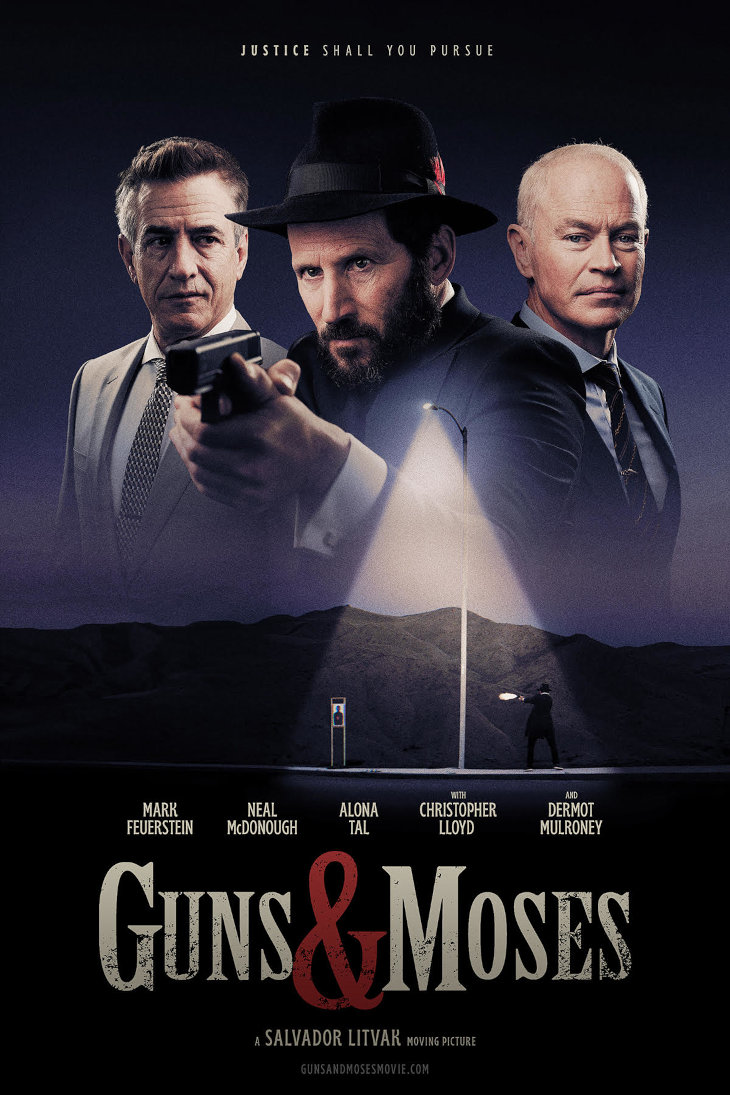
Guns & Moses: A Rabbi Stands Up to Corruption

In Chinatown and The Two Jakes, it is water and oil that fuel corruption. Now, money from green energy greases palms and fills dirty pockets. Except, maybe it isn’t all that green. When a solar energy magnate is assassinated, the cops assume it is an antisemitic hate crime, but his rabbi suspects government land use and energy regulation might be the true motivations for Alan Rosner’s murder in Salvador Litvak’s Guns & Moses, which releases Friday in theaters.

Rabbi Mo Zaltzman lacks a proper Temple, but he has thriving community in the southern California town of High Desert. Rosner pledged to fund a permanent home for the High Desert congregation, but he will be quickly cut down by an assassin’s bullet.

Suspicion quickly and conveniently falls on Clay Gibbons, a young, troubled skinhead, who had menaced the Rabbi’s storefront community center. It all looks pretty done and dusted to the cops but Rabbi Zaltzman really believed he was starting to reach Gibbons, so he starts digging. He finds the deceased was deeply enmeshed in schemes involving environmental impacts statements (both phony and legit), as well as contested scrub land possibly needed by the state’s eternally under-construction light rail.

Rabbi Zaltzman turns out to be a very appealing amateur sleuth and Rosner’s solar-panel farm shines as a cinematic location. However, Litvak and co-screenwriter (and wife) Nina Litvak cannot match the clever plotting of Harry Kemelman’s
Rabbi David Small novels. The character is strongly drawn and relatable, but the mystery/thriller business is about as complex as an episode of a 1970s network TV detective show.

Nevertheless, the Litvaks and company make some serious points that are very much oof our current moment. Indeed,it is quite significant to watch Rabbi Zaltzman reluctantly agree to arm himself. Yet, this is a very real-life experience for many Jewish Americans, especially in light of recent attacks in DC and Boulder. The title is no joke.

In fact, Litvak stages several highly satisfying shootouts. The action is nicely realized, but the cast really lands the film. Mark Feuerstein quite charmingly portrays the Rabbi’s fatherly corniness, as well as his earnest and devout faith. He wears well over the course of the film and maybe even warrants a follow-up. He also develops nice chemistry with Alona Tal, as Hindy Zaltzman.

Friday, August 24, 2018

Andrei Tarkovsky’s Andrei Rublev


In 1960, the Soviet Union launched a campaign lionizing Russian icon painter Andrei Rublev to encourage Russian pride during the post-Stalinist thaw. That narrowly opened the window for a cinematic bio-pic. Andrei Tarkovsky would have been the Party’s absolute last choice to make such a film, but somehow Mosfilm put it into production anyway. They were not happy with the results, demanding cuts and withholding Tarkosky’s epic from domestic distribution. However, the rest of world immediately hailed the film as a masterwork. It is a powerful but demanding film that anyone with a serious interest in cinema as a legit form of art must wrestle with eventually. There is no time like the present, because the digitally restored Andrei Rublev opens today in New York.

Do not expect a conventional biographical treatment. There are no scenes of the precocious Rublev in short pants. We never even see him paint a single bush-stroke. Instead, Tarkovsky and co-screenwriter Andrei Konchalovsky (the great Russian director, who also helmed Tango & Cash) skip over years and even decades, focusing on seven incidents in his life, whose full significance and inter-connectedness will be revealed in the final scenes.

When we first meet Rublev, he is one of a trio of itinerant icon-painting monks. Despite his relative youth, Rublev’s reputation proceeds him, much to the consternation of his Iago-like colleague Kiril. When the master Theophanes the Greek requests Rublev to be his chief assistant and de facto anointed successor, Kiril’s rage prompts him to break with the Orthodox Church. Although fame and accolades are Rublev’s for the taking, he becomes increasingly disillusioned by the corruption of the Church and nobility, as well as the harsh and unjust conditions endured by the peasantry.

Rublev will also be traumatized by acts of barbarism that Tarkovsky stages in graphically violent long takes, on an epic scale worthy of Cecil B. DeMille. Over fifty years later, these sequences still have the power to shock, but it is worth noting a notorious scene in which a cow is set on fire was cut from all but the earliest edits (the cow was fine, by the way).

If you want to get sucked into somebody else’s life and throw your empathetic arms around them, Andrei Rublev will leave you cold like the Siberian tundra. However, the boldness of Tarkovsky’s grotesquely baroque vision is arresting, in an immersive kind of way. Even though they are ostensibly science fiction films, it is not hard to see echoes of Tarkovsky’s Daumier-and-Bruegel-like set pieces in Aleksey German’s Hard to Bea God and Andrzej Zuławski’s On the Silver Globe.

Frankly, it is Tarkovsky’s bold strokes that drive the film rather than his cast’s elocution and emoting. Still, Anatoly Solonitsyn performance as Rublev is genuinely haunting—you could even call it iconic. Yet, it might just be Nikolai Burlyayev’s manic, frantic portrayal of Boriska, a young aspiring bell-caster very likely in over his head that could very well define the film’s sense of hope and desperation.

Andrei Rublev is an unpolitical film, by just about every conceivable criterion, but it is easy to see why the Soviets thought it was bad for Party business. There is no question Tarkovsky and Konchalovsky vividly illustrate the dark side of orthodoxy—with a small “o.” Yet, the Vatican was hip enough to include on their “Great Films” list, compiled to mark the 100th anniversary of cinema (a pretty solid honor roll that includes obvious masterpieces and some genuinely worthy outliers). Frankly, it is the sort of film you are supposed to sink into and get a little lost in, but when it bites back, it clamps down hard. Highly recommended as one of the most important films ever, Andrei Rublev opens today (8/24) in New York, at the Film Society of Lincoln Center.

Saturday, June 02, 2018

Open Roads ’18: Equilibrium


What is the proper role for a priest? Should he fight for justice or maintain the balance of power, like a 1970s State Department bureaucrat, who read too much Bismarck? It seems like a no-brainer in theory, but would you be tempted to opt for stability, if you had to chose in the real world? Don Giuseppe will make his choice and his parishioners will make theirs when he is transferred to his native Campania in Vincenzo Marra’s Equilibrium (trailer here), which screens during Open Roads: New Italian Cinema 2018.

Don Giuseppe has always been actively engaged in the world. He did life-altering missionary work in Africa and he has steadfastly ministered to the illegal aliens congregated at a migrant shelter in Rome. Frankly, he is concerned he could become a little too engaged when a social worker admits her romantic feelings for him. To preserve his calling, Don Giuseppe requests and is granted a transfer to a blighted district just north of Naples.

When the good father first meets Don Antonio, whom he will succeed, the veteran cleric seems to be quite the crusader himself through his campaign against the illegal noxious waste dumping in the hills above town. However, it soon becomes clear this is cheap activism, since nobody claims responsibility for the dumping and everyone generally agrees it is a less than ideal practice. However, when it comes to standing up for the vulnerable in the community, Don Antonio is much more circumspect.

Frankly, Don Antonio has done his best to intimidate the isolated Assunta into accepting her boyfriend’s sexual abuse of her daughter. Unfortunately, she happens to live in the housing project that is the center of the local drug dealers’ transactions. Having the cops pay a visit would be bad for business. For the sake of peace in the valley, Don Antonio is willing to sacrifice Assunta and her daughter—and the cops and dealers are right there with him. However, Don Giuseppe will not play that game.

Equilibrium is a deeply moving film that challenges what faith really means and how it should be manifested in the real world. Marra filmed docu-style, employing many street level long-takes. He recruited many non-professional actors from the region, scoring a double jackpot with Mimmo Borrelli and Roberto del Gaudio, who are both tremendous as Don Giuseppe and Don Antonio, respectively. Borrelli is a quiet marvel, expressing so much questioned faith and Christian love through subtle and restrained looks and gestures. In contrast, del Gaudio is flamboyantly charismatic and chillingly Machiavellian. Astrid Meloni, one of the few professional ringers, adds further layers of compelling human messiness as Veronica, Don Giuseppe’s source of temptation.

It is impossible to watch Equilibrium without hearing echoes of the Catholic Church’s sex abuse scandals. It is easy to damn in retrospect, but the film clearly challenges viewers to ask what they would have done if they were cops, social workers, or lay leaders trying to hold their communities together. Throughout the film, Marra shows in concrete terms why ostensibly responsible people often opt for stability over moral principle, while never endorsing or excusing their expediency. It is a tough, powerful film. Very highly recommended, Equilibrium screens tomorrow (6/3) and Wednesday (6/6) at the Walter Reade as part of this year’s Open Roads.

Friday, April 27, 2018

Tribeca ’18: To Dust


Albert is no Mr. Wizard. He is an embittered community college professor gone to seed, but Shmuel wouldn’t know the difference. For the Hasidic cantor, any participation in scientific inquiry is sinful, but the recent death of his wife leads to a desperate obsession with human decomposition in Shawn Snyder’s Best New Narrative Award winning To Dust, which screens during the 2018 Tribeca Film Festival.

Shmuel takes Orthodox teaching very seriously, particularly the part about “dust to dust.” In fact, he becomes consumed with anxiety, worrying his beloved wife’s soul will be in torment until her body fully returns to the earth. His concern is so troubling, he will even sin himself by seeking answers at a local community college. The initial meeting with Albert goes badly—the cantor keeps calling the professor “doctor” and the professor keeps calling the cantor “rabbi.” Nevertheless, the divorced, pot-smoking instructor tries to give Shmuel some answers using a rather graphic 1960 study of pig decomposition. Imagine his surprise when Shmuel drags him into his own practical experiments, using swine.

To Dust probably sounds like it pushes the line of good taste, given the prominence of dead pigs in the narrative. However, it is refreshingly thoughtful and sensitive it the ways it addresses Orthodox Judaism. Above all else, this is a deeply mournful film that readily forgives its characters’ foibles and excesses. There are indeed some rather grisly images, including the archival footage from 1960 and some morbid nightmare sequences, but they are always counter-balanced by the human element. It could very well appeal to the audience for Avishai’s Sivan’s Tikkun, but it is a dramatically warmer, more grounded, and more humanistic film.

Géza Röhrig (from Son of Saul) is quite remarkable as Shmuel. It is a quiet performance, but his anguish always feels very real and acutely pressing. He develops genuine chemistry with Matthew Broderick’s Albert that is hard to define or describe but is tangibly potent. Even though Broderick is playing another self-loathing man-child, he does his best work in years teasing out humanizing subtleties in the failed academic.

To Dust is an Alfred P. Sloan Foundation-supported film, which speaks volumes about the seriousness of Snyder and co-screenwriter Jason Begue’s science. Viewers could probably even recreate some of the experiments, but we would advise against trying that. Yet, it is the not-quite-buddy relationship that really lies at the core of the film. For extra added novelty, Ron Perlman served as one of the producers, so you’d better take note. Highly recommended, To Dust screens again Saturday night (4/28) and twice on Sunday (4/29), as an award-winner, at this year’s Tribeca Film Festival.

Tuesday, December 26, 2017

On Wings of Eagles: A Chariots of Fire Pseudo-Sequel

Eric Liddell, the Olympic runner who wouldn’t compete on the Sabbath, was born and died in China, so he is still frequently referred to as the first Chinese gold medalist. He was also a devout Christian missionary, so for obvious reasons, it is tricky to fully depict the man of faith amid the current Chinese cultural-ideological climate (or pretty much any other time since the Japanese occupation). Still, Christian Chinese director Stephen Shin Kei-yin and Canadian “co-director” Michael Parker make a good faith effort picking up Liddell’s story after Chariots of Fire left off in On Wings of Eagles (a.k.a. The Last Race, trailer here), which is now available on DVD.

In Hugh Hudson’s classic, Liddell’s scoldy sister Jenny always insisted China was his true destiny and she was right. For years, Liddell preached and taught school there, marrying his wife Florence, with whom he had three daughters. Sadly, Liddell would never meet the youngest, because he was able to send his pregnant wife and family to the safety of Canada before the Japanese reached Xiaozhang village in rural Heibei, where he accepted his final posting.

Of course, everyone respected Liddell, including Xu Niu, a rickshaw driver with vague underworld connections, who became Liddell’s fixer and friend. His narration is particularly cagey when it comes to the lessons Liddell taught him, often sounding more like warmed over humanistic bromides. Yet, we clearly see crucifixes, Christian services, and hear hymns in decidedly dramatic contexts.

All things considered, we have to give Shin and Parker credit for getting in as much Christianity as they did. Unfortunately, the film is greatly disadvantaged by the lack of a stirring Liddell sermon. After all, Chariots has that beautiful “how to run a straight race” homily Ian Charleston’s Liddell delivers in the rain to a group of world-weary stragglers. It was probably just meant to help establish his character, but perfectly crystallizes the film in one scene. Nothing in Wings comes close to that moment.

Inevitably, Wings also echoes the Korean film My Way when the physically depleted Liddell is forced to run two pivotal races against the supposedly sporting camp commandant. However, the second race somewhat departs from the obvious formula, in a way that brings home the tragedies of war. Like many recent Chinese films, Shin, Parker, and co-screenwriters Rubby Xu and Christopher C. Chan wave the bloody shirt over the Japanese occupation, but at least they depict two Japanese soldiers trying to act decently, which you could certainly consider an act of Christian charity.

Joseph Fiennes gives a quietly dignified performance as Liddell, but too often he is drowned out by the other overly busy missionary-prisoners. Among that lot, Richard Sanderson is the clear stand out as Dr. Hubbard Peterson. Canadian raised Chinese star Shawn Dou is a bit stiff at times as Xu Niu, but he has some nice moments with Fiennes and Luo Yongging as his adopted son Xiao Shitou, who is quite an effective young performer, despite his unsubtle heart-string-pulling duties. Dou also deserves credit for taking on a potentially tricky project like this when he already has the terrific environmentally-themed Cultural Revolution drama Wolf Totem on his resume.

Sometimes you have to grade on a curve. Frankly, it is a minor miracle Wings was not completely emasculated. It is clear throughout the film Liddell was a good person, who believed devoutly and put others’ well-being ahead of its own.  The production values are a bit TV-movie-ish, but if a lot of streaming services had commissioned it, they would be carpet bombing Emmy voters with screeners. Worth seeing, especially in light of what it represents, On Wings of Eagles is now available on DVD.

Monday, June 13, 2016

Department Q: A Conspiracy of Faith

Scandinavia is known for its Calvinist piety and sexual permissiveness. It is the former that offends a particularly nasty serial killer. His murders are designed to take faith as well as lives. Carl Mørck lost his faith long ago and he doesn’t have much of a life, so he might be the perfectly flawed cop to stop the cruel predator in Hans Petter Moland’s A Question of Faith (trailer here), which opens as part of the entire Danish crime trilogy this Friday at the IFC Center.

Technically, the discovery of a kidnapping victim’s SOS in a bottle washed up on shore is not a cold case either, but everyone on the force recognizes it requires the sort of obsessive futility only Mørck can deliver. Unfortunately, he is only a shadow of his normally gaunt self. He has yet to bounce back from the tragic events of The Absent One, despite Assad’s best motivational efforts. Nonetheless, the Department Q coppers start following up, discovering the writer of the note is mostly likely a missing boy from a vaguely defined fundamentalist community.

They are ordinarily not inclined to talk to cops—a prejudice that works in favor of the kidnapper-murderer. Yet, through some dogged police work Mørck and Assad soon uncover his pattern. After months of ingratiating himself with the community and family, Johannes kidnaps two siblings, puts the family through the ransom-paying ordeal, only then forcing them to make a Sophie’s Choice. Inevitably, his crimes leave the parents bereft of faith, as well as a child.

When it comes to faith, the atheist Mørck is much closer to Johannes (a self-identifying Satanist) than the Muslim Assad. However, when the Department Q team starts closing in on the killer, Johannes decides to test the faith he mistakenly assumes Mørck holds.

Faith is by far the best of the Department Q trilogy and one of the best of the bumper crop of Scandinavia thrillers, easily surpassing the heavyweight champion Millennium (Girl Who) series. In this case, calling up Moland, who helmed the nifty, twisty In Order of Disappearance, pays considerable dividends. Faith is the tightest and tensest of the trilogy, but also the smartest and most mature. It deals with the issue of faith in the face of tribulations in a respectful manner. Frankly, this is a film the Evangelical community should embrace, because it clearly rejects the nihilism of Johannes.

For genre fans, the Christian-hating Johannes is also the massively evil villain the franchise has been waiting for. Pål Sverre Hagen (Thor Heyerdahl in Kon-Tiki and the archaeologist father in Ragnarok) plays spectacularly against time as the viciously calculating serial killer. He makes the audience pine for Biblical retribution. Nikolaj Lie Kaas and Fares Fares continue to play off each other well, while Johanne Louise Schmidt and Søren Pilmark nicely flesh out the greater police force, as Rose, the Department Q assistant, and their captain, Jacobsen.

Faith pushes Mørck to even lower existential depths, but it pays off viewer investment in both the constituent film and the entire trilogy quite handsomely. For those who must prioritize their time, it should stand alone well enough and definitely represents the series high point. Enthusiastically recommended, Department Q: A Conspiracy of Faith opens this Friday (6/17) in New York, at the IFC Center, along with The Absent One and Keeper of Lost Causes (separate admissions).

Friday, June 10, 2016

Tikkun: The Anti-Inspirational Near-Death Film

Haim-Aaron could be the Orthodox Jewish Dannion Brinkley or Betty Eadie, but notoriety is the last thing he wants. He was not seeking grounds to question his faith either, but it happens just the same in Avishai Sivan’s distorted and disorienting auteurist vision, Tikkun (trailer here), which opens today in New York.

This is not your father’s Yentl. Viewers should be able to quickly figure that out from loving attention Sivan focuses on kosher slaughter practices during the opening sequences. Initially, Haim-Aaron is the devoutly obedient son his father always wanted. He studies at the Yeshiva with a zeal approaching martyrdom. Unfortunately, his most recent bout of fasting leaves him so weak a fall in the shower nearly kills him. In fact, Haim-Aaron is effectively dead for forty minutes. Yet, somehow after the paramedics give up, Haim-Aaron’s father manages to revive his comatose son.

Of course, nothing is the same for Haim-Aaron after his death. He seems like the same submissive wet noodle, but he now has trouble stifling his sexual stirrings. Even though Haim-Aaron cannot conceive of a life outside religion, he simply is unable to maintain his previous level of intense devotion. He even starts falling asleep in class. Soon, his father’s sense that something is amiss is amplified by his visions of a talking alligator slithering out of the toilet to chide him for interfering with God’s will. Yes, seriously. In fact, that doom-saying gator gets enough screen time to be considered a significant supporting player.

Shot in a strikingly chilly black-and-white, Tikkun a harshly intimate examination of cloistered alienation, punctuated by moments of absolute madness. Sivan never engages with genre cinema conventions, but the alligator scenes will still inevitably draw some curious midnight movie patrons. Frankly, Tikkun is so uncompromisingly realized, it is hard to say whether they will be disappointed or dazzled by its severity. However, even those closely familiar with Eraserheads and Audition will be taken aback by the film’s climatic transgressions. It is not just the Hasidic community who are likely to be offended by Sivan’s ultimate destination.

The formerly Hasidic Aharon Traitel (who also helped translate Yiddish texts for Sivan) is uncomfortably believable as the emotionally stunted Haim-Aaron. At times, we can almost see his muscle memories guiding his performance. Yet the real soul-plumbing, knock-you-back-on-your-heels performance comes from Khalifa Natour, as the tormented butcher. Despite his problematic decisions and an extreme faith bordering on insanity, he remains a deeply human and perversely sympathetic figure.

“Tikkun” is one of those conveniently ambiguous words with multiple meanings, including rectification and in some contexts, a form of spiritual reincarnation to right a past wrong or complete some unfinished business. However, Sivan’s Tikkun absolutely, positively should not be considered a Judaic analog to 90 Minutes in Heaven. It is a tough, defiantly bleak portrayal of Orthodox religious life and human nature in general. It is recommended on its considerable technical merit for hardcore cineastes, but general audiences should be strongly cautioned. It opens today (6/10) today in New York, at the IFC Center and the Film Society of Lincoln Center.

Friday, December 25, 2015

Yellow Day: the Good Man and the Woman in Church

In “Yellow Days,” Sinatra sang about “when the sunlight had a special kind of brightness.” This is a different sort of Yellow Day, but it still involves bounteous sunshine and a pair of separated lovers. Lovers might be too strong a word, but the man and the woman in question would make a perfect pair if they could only find each other again in Carl Lauten & G.P. Galle Jr.’s Yellow Day (trailer here), which opens this Christmas Day in select markets.

Half the film takes place in a Catholic Church, yet the balance of Yellow Day feels very much like an Evangelical film. “The Good Man” has come to Camp Grace hoping to find Monica. They had found themselves locked inside St. Joseph’s Chapel, It Happened One Night style. Of course, nothing really happened that night, but a connection was forged. Nevertheless, Monica abruptly disappeared the following morning. Only knowing that she is a regular counselor at Camp Grace’s annual Yellow Day celebration, the Young Good Man has come in search of her.

Unfortunately, Monica is nowhere to be found this Yellow Day. However, the Good Man has faith—and a spirit guide in a little girl who could be the spitting image of Monica at age ten. She knows all about Yellow Day, but she is still susceptible to ominous bouts of dread. When she appears to him, the film usually shifts gears into symbolic animated sequences, drawing heavily on chivalric Christian imagery.

By the standards of Evangelical cinema, Yellow Day is remarkably professional. The co-leads, Drew Seeley and Lindsey Shaw are not just competent, they are winningly charismatic. They develop real (but chaste) chemistry together. Ashley Boettcher is similarly polished and likeable as the mysterious little girl. St. Joseph’s Chapel is also a wonderfully warm and cinematic setting for their faith-based courtship. However, the supposedly expansive Camp Grace looks comparatively small on-screen.

Through the animated segments (passably but unremarkably crafted), producer-screenwriter Galle adds an allegorical level to the film that is admirably ambitious, but it often obscures more than it illuminates. However, the Catholic Galle falls into the same trap that ensnares most Evangelical filmmakers. He just cannot let much time elapse without “a word from our sponsor.” Yes, the film has a tendency to get a tad preachy, especially when on the grounds of Camp Grace. He is entitled to convey his message and it happens to be a rather worthy one, but it would be more effective he slipped it in more subtly and selectively.

Still, compared many overtly Evangelical releases, Yellow Day represents a significant step up in filmmaking game. Perhaps it is well-served by the Catholic-ecumenical background of its creatives. The good will generated by Seeley, Shaw, and Boettcher also goes a long way. Frankly, even for the defiantly cynical and/or agnostic, it is relatively easy to watch—maybe even pleasant. As a point of comparison, most viewers will be receptive to the next film from Galle and his team, whereas nobody in their right mind would want to see another John Martoccia film after soldiering through Death of a Tree. Exceeding expectations with its general sweetness, Yellow Days opens in carefully selected theaters today, such as the Awataukee 24 in Phoenix, with a wider release to follow on January 8th, including the AMC Empire in New York. Merry Christmas.

Sunday, May 10, 2015

Korean Movie Night: Fatal

It is impossible to make broad generalizations about the depiction of Christianity in Korean cinema. Yes, there are the crude stereotypes and kneejerk jibes, but there are also rather nuanced and humanistic portrayals as well. For a recovering sex crime victim, it is a source of comfort and life affirmation. Unfortunately, the consolation of faith will be overwhelmed by the lingering corrosiveness of sin in Lee Don-ku’s Fatal (trailer here), which screens this Wednesday as part of the Asia Society’s free Korean Movie Night series, co-presented by the Korean Cultural Service in New York.

Never very smart or self-assertive, the conflicted Lee Sung-gong meekly stands by while his classmates rape a teen-age girl one-by-one in the adjoining room. When told to take his turn, Lee duly enters. Just what he does or does not do to the drugged woman is never fully revealed. However, his guilt and complicity are firmly established. In fact, the incident will constantly haunt Lee, even though he continues to crave the approval of the sociopathic ringleader Gyu-sang, a decade later.

More out of boredom than spiritual yearning, Lee attends an Evangelical Christian service, but is struck by the church’s welcoming reception of visitors. Joining a young members’ study group, he comes face-to-face with Park Jang-mi, the victim from ten years ago. However, either due to the effects of the date-rape drugs or the suppression of memories, Park does not recognize him. Immediately obsessed with her, Lee stalkerishly follows her, contriving ways to worm into her life. It actually seems to work for a while, but Lee’s repressed emotions will come crashing out during the group’s retreat. Not knowing any other way to “fix” what they have done, the destabilized Lee starts to get Biblical with the unrepentant rapists.

Yes, this is strong stuff, especially given the unvarnished realism of director Lee’s stylistic approach. The one exception is the masterfully intense “confession” sequence during the retreat, in which you can practically see Lee Sung-gong’s psyche shatter on-screen. Fatal is a very unsettling film that never lets its problematic central character off the hook. It has been described as a revenge drama, but it does not fit comfortably into any category. It is just too raw and too intimate.

As Park, Yang Jo-a is a revelation. She sets the screen on fire during the film’s centerpiece scene. Audiences will not be able to breathe, let alone fidget. It is that kind of riveting. Yet, her earnestness and vulnerability throughout the film is also deeply moving. Likewise, Nam Yeon-u quietly but forcefully conveys just how deeply Lee’s guilt has arrested his psychological development. You can see he is just a shell of a person.


The third act mayhem might sound like a commercial concession, but every step feels like it follows according to a grimly fatalistic logic. It is a power film and a sit-up-and-take-notice debut for its director and much of the cast (especially Yang), but it not for the faint of heart or the overly sheltered viewer. Visceral and downright draining, Fatal is recommended for those who appreciate unsweetened black coffee drama, when it screens this Wednesday (5/13) at New York’s Asia Society.

Friday, April 03, 2015

Death of a Tree: Temptation Tidies Up the House

The depth of your religious conviction is a lot like your sex life. If it works for you, that’s swell, but the rest of us really don’t want to hear about it. Bizarrely, both aspects of a converted Catholic widower’s life will be explored in glorious detail in John Martoccia’s Death of a Tree (trailer here), which opens today in New York.

In all fairness, religion is an important part of everyday people’s lives that remains criminally underdeveloped in mainstream commercial filmmaking. Martoccia set out rectify cinema’s religion deficit, from a readily admitted Catholic perspective in Tree and his relatively well received debut Vito Bonafacci. That is a fine mission to take on, but right from the start, it is hard to figure just who Tree’s intended audience might be.

James is a tough talking, tattooed artist, who converted to Catholicism after his wife’s death, with all the zeal the saying implies. You will know his house, because it is the one with the big Virgin Mary statue on the front porch. James is already a mainstay at the local Planned Parenthood protests and serves as an unofficial lay counselor to his fellow parishioners, so he is seriously considering the priesthood as his next logical step. Then he hires Erica to tidy up around the house.

Somehow, they once knew each other from way back when, but that backstory is never clearly explained. In any event, a lot of water has passed under the bridge since then. Erica is a little surprised how devout James is, but she is strangely impressed when he lets her know what a harlot she is for shacking up with her boyfriend. She naturally finds herself attracted to James as a result and thereby sets out to seduce him. Alarmed by his stirrings of passion, James confesses regularly, but he just cannot get her out of his system.

It is hard to say which are more awkward, the melodramatic May-Decemberish relationship or the many scenes of James protesting outside Planned Parenthood. Frankly, it would probably be healthy for the culture if a film seriously depicted the values and commitment of Pro-Life activists. However, part of that portrait should involve their struggles as to how they should best calibrate their message. When James quietly preys while a thug screams and spits in his face, it is a powerful image. Yet, most of the time, the protestors have their volume cranked up to eleven. Even if you are somewhat sympathetic, they look and sound pretty shrill, but somehow that seems to reach hearts and minds in the film.

On the other hand, the central relationship is just problematic through and through. As James and Erica, Ronnie Marmo and Gracie Tyrrell never develop any believable chemistry. By the time matters really get out of hand, viewers will be hoping Erica will pull off her face to reveal a succubus sent to tempt James, but nothing cool like that is going to happen in this film.

Tree probably says everything Martoccia wants it to, but he completely loses sight of how it might be received by third parties, including those who might benefit from the Church’s teachings. That means it doesn’t work, regardless of what his intentions might be. We feel bad saying it, but Death of a Tree cannot be recommended as cinema or an apologia when it opens today (4/3) in New York, at the Quad Cinema.

Wednesday, August 27, 2014

The Calling: Popping Pills and Chasing Serial Killers

It is hard to say which are dumber in this non-mystery: the Christians who willingly sacrifice themselves in rituals that violate nearly every tenet of their faith or the Keystone cops who spend more time chasing their tails than the only suspect we ever see. At least, Detective Hazel Micallef has the excuse of being a pill popping drunk. Nonetheless, she is the only copper smart enough to figure out a serial killer is on the loose in Jason Stone’s logically challenged The Calling (trailer here), opening this Friday in select theaters.

Micallef lives with her mother, drinks too much, and openly carries on with a married man in the small Canadian town of Fort Dundas (perhaps that should be Fort Dunderhead). She is currently the town’s acting police chief by virtue of seniority, but her position is tenuous at best. However, when one of her mother’s church cronies is decapitated, Micallef’s atrophied intuition says it must be the work of a serial killer.

With the help of her long suffering deputy and a green transfer from Toronto, she identifies similar facial manipulations in other bodies just outside her jurisdiction. For some reason, she seeks the counsel of Father Price, who immediately confirms each victim’s mouth has been molded to form part of a long forgotten early Christian sacrificial-reincarnation prayer. Gee, that’s not suspiciously convenient at all.

Of course, about ten seconds later we learn the good Father is indeed well acquainted with the killer. While he is morally conflicted (because Donald Sutherland could not possibly play an out-and-out bad guy in a Susan Sarandon movie), he still acquiesces to the mysterious Simon’s dubious scheme.

The Calling is based on the first of three Micallef mystery novels written by Michael Redhill under the Inger Ash Wolfe pseudonym. However, there is not much mystery in the film and common sense is also scarce as hen’s teeth. On paper, the Micallef character sounds promising, but Sarandon is the wrong person for the role. Instead of embracing her degenerate nature, she plays her like some sort of martyr, trying to be a hard drinking Sister Helen Prejean with a badge.

Evidently, Gil Bellows is the new go-to-guy whenever a casting agent needs a small town deputy, but he provides a much needed sense of stability for the ludicrous plot. As Father Price, Sutherland manages to say some ridiculous lines with a straight face. Sarandon’s fellow Oscar winner Ellen Burstyn must have owed one of the producers a big favor, because she has absolutely nothing interesting to do as Micallef’s mother. Regardless, she appears natural and credible in all her scenes, unlike the awkward looking Topher Grace, sticking out like a sore thumb as the freshly re-assigned Ben Wingate. However, Christopher Heyerdahl brings real presence and a bit of ambiguity as Simon, the symbolically loaded bogeyman.

Ill conceived and executed in a manner that minimizes any potential suspense, The Calling just doesn’t have much going on. Clearly, Scott Abramovitch’s screenplay fancies itself some sort of Bill Maher critique of faith-before-reason Christianity, but its defining characteristic is its blandness. Not recommended, it opens this Friday (8/29) in select cities.

Friday, February 21, 2014

Holy Ghost People: This is not Neil Young’s Sugar Mountain

Shouldn’t all those snakes be on a plane somewhere? Oh, but this is the back hill country, so these serpents have been provided for your worshipping convenience.  There will be a lot of praising the Lord, but not enough passing of the ammo in Mitchell Altieri’s Holy Ghost People (trailer here), which releases today in select theaters and on itunes.

Charlotte, the recovering drug addict cocktail waitress, needs help rescuing her not-so recovering drug addict sister from a messianic cult in the West Virginian backwoods.  After watching Mitchell, the alcoholic Afghanistan veteran get the snot beat out of him in a bar fight, she decides he must be the man for the job. With the help $200 in thoroughly crumpled bills, she convinces him to escort her up Sugar Mountain to the Church of One Accord, where Brother Billy preaches the Gospel for his cult-ish congregation.

Brother Billy looks a little nuts, but he has a way with words. However, he is a model of stability compared to Smiling Bobby, who seems to aspire to be the worst Dick Tracy villain ever. Everything about the place is seriously off, but Charlotte still manages to talk her way into spending the night, ostensibly as prospective new members. However, it pushes Mitchell’s nose out of joint when everyone assumes he is Charlotte’s father. In fact, the tension between the outsiders will grow steadily.

The first ten minutes of HGP has a certain degree of grit and the concluding showdown has its moments. Unfortunately, the bulk of the film consists of vaguely sinister sounding Jesus talk and a fair amount of snake handling. Frankly, it seems a little odd the film is still launching today, considering the tragic and widely reported death of National Geographic’s snake handling Pastor Jamie Coots. After all, whenever there is a spree shooting, every film with firearms is duly postponed until the next year the Rangers win the Stanley Cup.  Of course, there is probably a good chance you did not know a snake handling movie was opening today until you read this review.

Regardless, Emma Greenwell is not bad as the protagonist.  Co-writer Joe Egender has a real flair for fire-and-brimstone and chews the scenery with appropriate relish.  Veteran TV character actor Roger Aaron Brown is also a steadying presence as the not so nutty cult member, Brother Cole. Conversely, as Wayne, True Blood alumnus Brendan McCarthy looks like he was dying for the film to wrap.

Some might see HGP as an attack on Evangelicals, but it is really just a bore. Basically, it is hicksploitation that never gets adequately exploitative. There is some okay atmosphere, but the overall experience is underwhelming. Not recommended, Holy Ghost People opens today (2/21) in select theaters.

Saturday, November 16, 2013

The Fake: Faith and Fraud in Provincial Korea

Pastor Sung is sort of a Korean Elmer Gantry, except he is the closest thing to a good guy in this dark animated examination of human nature.  He had the profound misfortune to become entangled with a ruthless con artist, but the man out to expose them is the worst of the lot in Yeon Sang-ho’s The Fake (trailer here), which just started a week-long Oscar-qualifying run in Los Angeles.

The best part of absentee father Min-chul has been his absence.  Physically and emotionally abusive, his homecoming is far from a happy event for his meek wife and daughter, the long suffering Young-sun.  Plundering Young-sun’s college savings for gambling money, Min-chul inadvertently drives her into the arms of the local faith-healing church—the very sort of outfit he most despises.

Devastated by a prior scandal, the gentle Pastor Sung has fallen for the false promises of “Elder” Choi, a wanted con man.  Through drunken happenstance (and a night in lock-up), Min-chul learns the truth about Choi, but nobody will listen to the obnoxious cretin.  A savage war commences between Min-chul and Choi’s henchmen, while the shadowy crook pressures Pastor Sung to finish fleecing his flock.

Fake is nothing like what you probably expect, beyond its pitch black portrayal of human nature.  Its depiction of blind faith might be unflattering, but nothing is more miserable than the abject lack of a higher meaning in one’s life.  Min-chul is not an anti-hero.  He is a vile brute driven by rage and contempt for his fellow man—and he is unquestionably the face of atheism throughout the film.  In a variation on Chesterton, Min-chul suggests those who believe in nothing, hate everything.

With its acrid irony and complete lack sentimentality, Fake is not likely to be embraced by Christian audiences. Yet, it is a deeply moral film.  It is also unremittingly pessimistic, perhaps setting the world’s record for the most grimly naturalistic animated feature ever.  Frankly, Yeon’s figures are not very expressive, perhaps showing slightly less definition than those in his feature debut, The King of Pigs. However, his characters very definitely have something to say.  Set in a provincial small town scheduled to be demolished for the sake of a massive public works project, the film also has a distinctive, vaguely apocalyptic vibe that is hard to shake.

Parents should note, Fake is completely inappropriate for children.  In addition to its very complex themes, there is considerable violence, harsh language, and all kinds of inhumanity directed at man and beast alike. However, the mature audiences for whom it is intended should find it a visceral, but surprisingly thoughtful film.  Highly recommended for those who appreciate challenging adult animation (and Academy members), The Fake is now showing at the CGV Cinemas in Los Angeles.

Saturday, January 19, 2013

Sundance ’13: This is Martin Bonner


It seems like the only job Martin Bonner can get involves doing the Lord’s work.  He has decidedly mixed feelings about that.  Yet, his own uncertainties make him a more accessible adviser for a remorseful ex-con in Chad Hartigan’s This is Martin Bonner (trailer here), which screens during the 2013 Sundance Film Festival in Park City.

An Australian transplant in Reno, Martin Bonner is starting over.  After a long period of unemployment, he now works for a Christian outreach program for recently released prison inmates.  Technically, he is not Travis Holloway’s mentor, but he makes a tenuous connection when pinch-hitting for his assigned volunteer.  It is not that Holloway does not like the devout Steve Helms.  He is simply more comfortable with Bonner.

Bonner is a film could have gone one way or another.  We quickly learn Bonner was fired from his previous church job because of his divorce.  However, Hartigan never really grinds that axe.  Nor is the Evangelical Helms presented in fanatical terms.  Instead, the film could be called a study of questioned faith in action.  Frankly, it is offers some of the most mature and nuanced discussions of Christianity in everyday practice you are likely to see in any major film festival.

Paul Eenhoorn’s performance as Bonner is arguably Oscar caliber (unquestionably so, if Cooper and Jackman truly are so this year).  This man is not a saint.  He can even be a little prickly, but he is trying to do the right thing.  Eenhoorn perfectly conveys that humanistic temporizing.  Likewise, as Holloway, Richmond Arquette (yes, from the Arquette family) creates an unusually deep portrait of regret and pathos.  In fact, the entire ensemble is small but powerful, especially including Sam Buchanan as Holloway’s estranged daughter Diana.

Bonner is a modest, quiet film, by any standard of measure.  Yet, it has moments of rare honesty.  Aside from the scene of Bonner lip-synching to his teenaged garage band’s old 8-track (which feels a little too cute and calculated), Hartigan’s patience and sensitivity always pay-off with surprising interest.  Recommended with a fair bit of enthusiasm for general audiences, This is Martin Bonner screens again Sunday (1/20), Tuesday (1/22), and Friday (1/25) in Park City and next Saturday (1/26) in Salt Lake, as part of the 2013 Sundance.

Tuesday, December 04, 2012

Sahkanaga: Puppy Love and Rotting Bodies


Life as an undertaker’s son was probably not easy for a Georgia teenager, even before the crematory scandal.  Based on the notorious case of over three hundred supposedly cremated bodies discovered dumped in the Blue Hills, John Henry Summerour’s adds a slightly macabre spin on the tried and true coming of age tale in Sahkanaga (trailer here), which opens this Friday in Brooklyn and Atlanta.

Sheriff Kershaw dies a bad death.  A popular public figure, the entire town mourns his passing.  Of course, the anti-social Paul is hardly grief-stricken.  Frankly, he is quite okay with the Sheriff’s untimely demise, since it was the catalyst bringing his granddaughter Lyla to their sleepy town.  She makes quite the impression on the awkward teen when as he assists his father with the funeral.  Much to his surprise, Paul finds the Sheriff’s body sprawled out in the woods shortly thereafter.

Paul’s father subcontracts cremations to the amiable Chris.  Yes, his one man operation is the most affordable on offer, but he always seems reliable.  Unfortunately, Chris clearly has issues Summerour only hints at.  However, he also might be able to incriminate Paul for a stupid kid mistake he now sorely regrets.  Naturally, the truth will eventually come out, forcing Paul’s family to face the community’s understandable anger.

The summer infatuation story is rather standard stuff, but at least co-leads Trevor Neuhoff and Kristin Rievley look like real life kids.  Surprisingly though (particularly for a film screening in Dumbo, Brooklyn), Sahkanaga treats themes of faith seriously and fairly.  The Walker County citizenry are church goers, but that does not make them closet hypocrites.  It turns out the Sheriff was, but that subplot is merciful left to wither on the vine.  In contrast, rather than a venal predator, the town’s television prayer line host is a sympathetically dotty elderly lady.  Viewers rather feel for her when she is pulled into the grisly tale.

The fact that the troubled Chris is African American is neither belabored nor ignored.  Likewise, the responses to his crimes run the gamut of social enlightenment.  This is not a film out to score cheap shots against the Deep South.  As a result, Sahkanaga feels grounded in reality without getting preachy or burying its head in the sand.  Richly nuanced, Charles Patterson’s performance as the cremator is low key, but quite powerful.  It really helps make the film.

Summerour’s pay-off is subtle, but it stays with you.  Ultimately, Sahkanaga suggests faith might indeed help people face adversity.  Despite the somewhat weak presence of its protagonist, it is a distinctive film, capturing a vivid sense of place. A mature, forgiving work, Sahkanaga is worth seeing, if playing somewhere relatively convenient.  Recommended for patrons of the indie film scene and Southern audiences, Sahkanaga opens this Friday (12/7) at the ReRun Gastropub in Brooklyn and Plaza Theatre in Atlanta.

Tuesday, November 20, 2012

The Mystical Laws: The End is Near, Meditate Quickly


An expansionist Eastern regime is dead set on war with Japan, at a time when America’s defense capacity and influence in the UN are both at all time lows.  They say it’s the near future, but it feels only too near.  Still, there may yet be hope in Isamu Imakake’s apocalyptic anime feature The Mystical Laws, created by executive producer Ryuho Okawa (founder of the controversial Japanese religious fusion movement, Happy Science) which opens this Friday in New York (trailer here).

In an authoritarian country not identified as China, a shadowy military science officer named Tathagata Killer assumed power in a coup.  Now known as the Godom Empire, his kingdom becomes the dominant super-power, thanks to the remarkable technology provided by the beautiful but mysterious industrialist Chan Leika. 

The world slept while the demonic dictator consolidated power, except Hermes Wings.  Partly a Doctors Without Borders style NGO and partly a secret society dedicated to preserving free democratic values, Hermes Wings is considered the greatest threat to the Godom overlord, so he targets them accordingly.  Through tragic circumstances, Sho Shishimaru rises to the top of Hermes Wings.  There is a reason people have confidence in him.  According to prophecies, he might be both the savior and the second coming of Buddha, which is an awful lot for any dude to live up to.

Mystical Laws could be described as a Buddhist Left Behind, with generous helpings of Christian symbolism thrown in for good measure.  It is also anime.  In truth, just about every conception of divinity is covered in Mystical, including the embodiment of the “Spirit of Japan,” who looks rather attractive.  Some of the symbolism is impossible to miss, such as the swastikas the Godom army marches under, or the crosses on which they crucify enemies of the state.  Still, if the slightly odd film represents an attempt to proselytize, it is dashed hard to tell what for.

Okay, so subtly really isn’t Mystical’s thing.  Nonetheless, the first two acts constitute a rather intriguing end-of-the-world sci-fi conspiracy thriller.  The relationship between Shishimaru and Leika is also nicely developed and the Buddhist elements give it all a distinctive flavor.  Unfortunately, the third act is largely given over to a Harry Potter-esque clash of fireballs and god-rays.

You have to take satisfaction from a Japanese film that bemoans the lack of American military bases.  Indeed, it takes notions of faith, freedom, and sacrifice profoundly seriously.  With art and characterization well within the anime industry standard, perhaps even slightly higher, it might be the most effective end-of-days religious thriller, well maybe ever (for what that’s worth).  It certainly puts to shame impassioned but clunky Evangelical films, like Jerusalem Countdown.

Mystical probably is not your Cheetos-eating fanboy’s anime.  However, anyone interested in a film arguing religion plays an essential role in a healthy society (and also implying a need for a strong military) might just get sucked in, in spite of themselves.  Recommended for fans of challenging anime, aesthetically adventurous Evangelicals, and nontraditional Buddhists (collectively a woefully underserved market), The Mystical Laws opens this Friday (11/23) in New York at the Cinema Village.

Sunday, September 30, 2012

NYFF ’12: Beyond the Hills


Alina is either tragically codependent or possessed by the Devil.  Radically different measures would be required depending on the diagnosis, but either way, she will visit a host of trials upon her girlfriend Voichita and her fellow Orthodox convent residents in Cristian Mungiu’s Beyond the Hills (trailer here), Romania’s latest official best foreign language Oscar submission, which screens as part of the main slate of the 50th New York Film Festival.

Meek and pious, Voichita appears perfectly suited to a cloistered life.  Alina is a different story.  However, since her former friend has no real family, Voichita arranges for her to stay temporarily in her quarters.  Yet, as soon as she arrives, Alina starts badgering her former friend to leave with her.  Gently rebuffing her, Voichita watches in alarm as her visitor’s behavior becomes increasingly erratic and disruptive, evetually manifesting in several public meltdowns.  The priest and the nuns do not want to abandon a soul in need, but after the medical establishment washes their hands of Aline, there seems to be only one remaining course of action: exorcism.

Mungiu implies a great deal in Hills, very definitely including the nature of Aline and Voichita’s relationship, while leaving just as much open to interpretation.  It would also have been very easy to portray the priest and good sisters as stereotypical zealots dangerously convinced of their own infallibility.  However, Hills constantly reasserts the messy humanity of each character.  In fact, the ambiguity of the “possession” gives the film quite a distinctive flavor.  Frankly, after about two hours of Aline acting out, most viewers will be ready to throw their lot in with the nuns, holding down the devil-woman as the priest reads the purification scriptures over her.

With a running time of 150 minutes, Hills often feels like what it is, a product of the Romanian New Wave of independent filmmaking.  It probably would not have killed anyone had Mungiu shaved off twenty minutes or so.  Nonetheless, he elicits several riveting performances, the most notable being Cosmina Stratan as Voichita, the confused innocent.  As Alina, Cristina Flutur is also scarily convincing engaging in all manner of aggressive, self-destructive behavior.  Yet, it is Valeriu Andriută’s work as the priest, simultaneously severe and sympathetic, that really forestalls snap audience judgments.

Based on a novelized account of a real life incident in Moldova, Hills is not a kneejerk attack on Eastern Orthodoxy.  Nonetheless, as the Russian Orthodox Church hemorrhages international credibility due to its perceived alliance with the Putin regime, it is hard not to invest Hills with an additional layer of meaning, whether or not Mungiu intended it.  Given its ambiguous but evocative treatment monastic life and supernatural possession, Beyond the Hills would be a fascinating film to see in conjunction with Jerzy Kawalerowicz’s Mother Joan of the Angels.  Challenging in multiple ways, Beyond the Hills is recommended for hardy cineastes with at least a couple of Romanian New Wave films already under their belts when it screens tomorrow (10/1), next Sunday (10/7), and the following Thursday 10/11), as part of the 2012 NYFF.