Showing posts with label Ben Wheatley. Show all posts

Friday, April 17, 2026

Ben Wheatley’s Normal

Ulysses Richardson is no Andy Taylor. The substitute sheriff would be the first to admit he stopped caring a long time ago. Consequently, he surprises himself when he follows the example of Will Kane and Buford Pusser, standing alone against corruption in his latest posting. Unfortunately, his new found integrity might very likely get him killed in Ben Wheatley’s Normal, which opens today in theaters.

Until the special election, Richardson will serve as the sheriff of Normal, Minnesota. He basically just shuffles papers, but weirdly, the Mayor Kibner so likes his “light touch,” he suggests making it permanent. Of course, that makes Richardson suspicious. The circumstances of his predecessor’s death are also disconcerting. That would be the late Sheriff Gunderson, just like in
Fargo.

Frankly, people in town are just plain weird. They also raised millions of dollars for a new city hall and have stocked the sheriff’s office with military grade armaments. Even a substandard cop like Richardson smells something fishy, but the interim sheriff is still shocked when his own deputies start firing on him during an ill-prepared bank robbery, to prevent him from getting a good look inside the vault.

John Wick
and Nobody franchise creator Derek Kolstad turns Bob Odenkirk lose to do what his anti-heroes do best. If you like those movies, you will enjoy Normal too.  Arguably, it is more conventional than Wheatley’s previous films (Kill List, Sightseers, A Field in England, etc.), but he gleefully cranks up the violent mayhem to deranged levels.

However, Kolstad and Wheatley also invest heavily early on to fully establish Richardson as a character, so he wears increasingly comfortably over the course of the film, like an old sweater. Odenkirk was also perfectly cast, because he deftly balances the temp-sheriff’s amiability with his sarcasm and sadness. Seriously, Richardson also has franchise potential. Maybe the next movie could take place in a town named “Decent.”

Wednesday, November 23, 2016

Tank 432: War is Hell, Like Really

The M41 Walker Bulldog tank was considered a big step up from its M24 Chaffee predecessor. Its armoring was much more protective and its weaponry was more effective. The only drawback was its especially cramped quarters, even by armored tank standard. You would not want to hole up in one for long with an enemy combatant and a civilian, but nothing will go according to plan for this military unit—or perhaps this was the plan all along, for at least one of them. One thing is certain. They are being played by something or someone, but it is not clear just how earthly their woes are in Nick Gillespie’s Tank 432 (trailer here), which opens this Friday in New York.

The film opens with the unit in full panic. They have already lost a number of men, plus the moaning and groaning Capper does not look long for the world. We do not get a good look at the forces they are retreating from, but they obviously have the grizzled combat vets badly spooked. As if they needed another cause for concern, a weaponized powdered substance also appears to be in use. It is a chaotic scene, but Smith, their commander persists in leading about two hooded prisoners, who apparently were the objective all along.

As Reeves (the closest they have to level-headed) and Gantz (the snarling hard-charger) reconnoiter, they discover a civilian hostage (or whatever) stashed in a storage locker. She is a bit of a basket case, but their medic Karlsson has plenty of zonk-out injections. They make quite a motley crew when the enemy forces them to take shelter in an immobilized Bulldog. A malfunctioning door trapping them inside makes the situation even more awkward.

In this hyper-paranoid age, the big twist ending comes as no great surprise, at least as far as Gillespie can be bothered to reveal it. Having frequently served as a cameraman on Ben Wheatley’s films (who returns the favor executive producing Tank 432), Gillespie shows a similar affinity for slyly implied narrative revelations, except he is probably even more coy about it.

Fortunately, he also has Wheatley regular Michael Smiley, who absolutely crushes it as the not-quite-as-done-for-as-he-looks Capper. He basically revives the film with a nail-spitting bravura display of hostile attitude. Similarly, Steve Garry’s Gantz almost single-handedly powers along the first two acts with his hardnosed barking. These are exactly the kind of performances that make genre films. Gordon Kennedy also practically chews his way out of the bulldog as the highly suspicious Smith, while Deirdre Mullins helps ground the film as the gritty but charismatic Karlsson.

Gillespie earns credit for helming a tense, unsettling viewing experience. Nobody’s attention will wander during the film, but it ends on a rather unsatisfying note and it does not add up to very much when you take stock of it after the fact. Genre fans should still appreciate his command of the vaguely dystopian near future mise en scene and the vibe of mounting dread. Recommended for Wheatley fans, Tank 432 opens this Friday (11/25) in New York, at the IFC Center.

Friday, April 22, 2016

Tribeca ’16: High-Rise

Architecture is often destiny. Take for instance Ralph Rapson’s explicitly utopian project, Cedar Square West (now called Riverside Plaza) in Minneapolis. It was conceived to house city residents across the entire economic spectrum (Mary Richards moved on up to the building in the final two seasons of The Mary Tyler Moore Show), but as CSW developed maintenance problems, it became exclusively low income housing, marked by decidedly short-term residencies (suggesting people move out as soon as they can afford to). The imposing complex designed by Anthony Royal is sort of the British retro-Brutalist leftist dystopian version of Cedar Square West. Despite its initial prestige, Royal’s building is even less livable for tenants in Ben Wheatley’s J.G. Ballard adaptation, High-Rise (trailer here), which screens during this year’s Tribeca Film Festival.

As he looks back on his relatively short time as a High-Rise resident, Dr. Robert Laing grills up a leg of one of the last formerly surviving pet canines, so we know he is a survivor. Moving into the building is quite a coup at the time. The fact that the terrace of attractive single mother Charlotte Melville overlooks his own is a nice bonus. He quickly recognizes her status as the alpha queen of the middle floors’ social scene.

Rather surprisingly, Laing is summoned to the penthouse for a personal welcome from Royal. Even though Melville’s hedonistic bashes look like much more fun than the Versailles-style shindigs thrown by Royal’s wife, Laing craves acceptance from the upper floors. However, the ruthless Pangbourne and his claque keep kicking the doctor back down to where he belongs. Meanwhile, documentarian and lower floor resident Richard Wilder craves Melville, but she will never willingly lower herself to his level. Her rejection will partly fuel the rage that transforms him into a class warrior—and a rapist. (Names are also destiny in the High-Rise.)

As any sort of coherent ideological, socio-economic satire, Wheatley’s High-Rise is a complete mess. Unfortunately, every departure from Ballard’s source novel (and its themes of tribalism and over-crowding) muddles the narrative rather than simplifying it. What was conceived more as a Malthusian parable Wheatley tries to fit into a Marxian box, but it simply does not fit. In fact, he largely loses control of the film’s political implications.

Let’s be frank, there is no capitalism going on in High-Rise. Instead, it is the very model of a modern major socialist state. Inside the building, the distribution of resources is rigidly controlled by the paternalistic Royal. It is a closed system that breeds dependency. As far as we know, there is no reason residents could not shop outside the building, yet they resort to eating dogs when the social order breaks down.

Arguably, High-Rise better illustrates the Burkean defense of class structure as a necessary bulwark against anarchy, causing the lower classes to suffer just as much as the rich, if not more so. Perhaps realizing the disconnect, Wheatley tacks on a risibly didactic epilogue featuring the audio of Margaret Thatcher speaking on the benefits of capitalism while his roving camera takes in the wreckage wrought by the preceding bedlam, but it makes no sense considering the events in question still take place in the 1975 of Ballard’s novel, four years before the green grocer’s daughter dispatched the ineffectual James Callaghan.

In some ways, High-Rise’s merits perversely work against it, particularly Jeremy Iron’s wry, multi-dimensional performance as Royal, which manages to humanize the very tippy-top of the one percent. Similarly, Luke Evans brings brutish menace to bear as Wilder, the Che-like Wilder. Tom Hiddleston’s Laing is fittingly passive, but much like Equals, the real star of High-Rise are the striking concrete and steel architectural backdrops, incorporating the work of production designer Mark Tildesley’s team and the era-appropriate locations, most notably including the Bangor Leisure Centre. It truly looks like a building that will have maintenance issues.

Ultimately, the internal logic of High-Rise is thinner than its characterization. Wheatley and screenwriter Amy Jump give absolutely no explanation why the more vulnerable residents do not simply leave the building’s chaos, presumably hoping viewers will fill in the holes with their pre-existing familiarity with Ballard’s novel. This is a rather sketchy filmmaking strategy that is reflected in the haphazard final product. Not recommended, High-Rise screens again today (4/22) at the 2016 Tribeca Film Festival and also April 30th at the San Francisco International Film Festival.

Wednesday, February 05, 2014

A Field in England: Ben Wheatley Goes Historical

The ‘shrooms will do little to clarify the fog of war—not that they are supposed to. Instead, they will make matters considerably worse for a ragged band of English Civil War deserters trying to forge their separate peace in Ben Wheatley’s ultra-low budget historical mindbender, A Field in England (trailer here), which opens this Friday in New York.

Whitehead is coward, who is incapable of functioning as any kind of self-respecting soldier. He is such a sniveler he can barely summon the courage to desert. Essentially, he lets three of his former enemies pull him through the archetypal hedgerow serving as the battlefield’s boundary, in search of a pub. However, Whitehead has a secret mission to fulfill on behalf of his alchemist master. He is to capture O’Neill, an Irish sorcerer.

Unfortunately, Whitehead’s quarry has the jump on the mismatched comrades. Much to their chagrin, they will be forced to do O’Neill’s bidding as he searches for an ominous treasure buried somewhere in the deceptively peaceful meadow. Clearly, this will not turn out as well as the WWI Christmas Eve truce.

In one sense, the black-and-white uber-moody hyper-stylization of Field is quite a departure from the working class grit of Wheatley’s Kill List and Sightseers. Yet, there is a kinship in the way all three films place unassuming proles smack dab in the center of a burgeoning maelstrom of horror. Much as he did with Kill List in particular, Wheatley builds a sense of steadily mounting dread, while instilling the feeling something sinister looms just outside the audience’s range of vision.

To that end, Wheatley regular Michael Smiley fulfills all O’Neill’s villainous duties with malevolent aplomb. Considering Wheatley’s surreal approach often borders on the experimental, Smiley’s O’Neill adds that much needed element of fun. In contrast, the deserters are a motley lot of Falstaffian variations that only start to differentiate themselves during the third act.

Had Samuel Beckett ever collaborated on a horror film with Ken Russell for Sam Arkoff, it might have looked a lot like Field. At times, its absurdist impulses are rather exhausting, but when Wheatley unleashes his inner madness it is a sight to behold (but epileptics should take the opening strobe warnings to heart). Cinematographer Laurie Rose gives it all an extraordinarily eerie look, befitting the clammy, hallucinatory vibe. Consciously exploring the nexus between psychedelic cult movies and rarified art cinema, A Field in England is recommended for high-end horror connoisseurs when it opens this Friday (2/7) at the Cinema Village.

Wednesday, May 08, 2013

Ben Wheatley’s Sightseers


Chris is the Charles Kuralt from Hell.  He is determined to show his new girlfriend the British roadside attractions he adores, like the Keswick Pencil Museum—and woe unto those who despoil their tourist experience.  They will pay dearly in Ben Wheatley’s macabre comedy Sightseers (trailer here), which opens this Friday in New York.

The British call redheads like Chris “gingers.”  Think of him as a Ginger Baker, except slightly more stable.  This road trip together will be an important step for Tina’s efforts to break away from her mother’s domination.  She is also mourning her recently deceased little yappy dog.  Chris wants everything to be just right for her, so the loutish behavior of a fellow tram museum visitor brings out the worst of him.

Chris plays off his first murder as an innocent accident.  However, Tina soon becomes an active accomplice in his killing spree.  Before long, things are completely out of hand.  It all adds quite the new wrinkle to their relationship.

Sightseers could safely be described as a dark comedy.  If you are totally fine with the desensitizing violence of Nicolás López’s Aftershock, but would prefer a more cartoonish presentation, this film is in your power zone.  Based on the comedy act developed by co-writer-co-leads Alice Lowe and Steve Oram, Sightseers is not shy about mining laughs from grisly terrain. In fact, the tone is much lighter than Wheatley previous film, Kill List, despite the superior body count.  Nonetheless, the murderous everyday banality of Chris and Tina is in keeping with the themes and vibe of his prior work.

As Chris and Tina, Oram and Lowe offer an object lesson in comedy as psychological therapy.  Oram deftly plays off serial killer archetypes while also showing a facility for physical comedy.  Yet, it is Lowe who really taps into deep, disturbing places.  They are funny, but you have to wonder about their childhoods.

Essentially, Sightseers is Two for the Road remade with Misery’s Annie Wilkes and a far less dapper Hannibal Lector.  To their credit, Oram and Lowe keep one-upping the madness, so it never feels like the same gruesome joke repeats over and over again.  Gleefully misanthropic, Sightseers definitely delivers the cult movie goods.  Recommended accordingly, it opens this Friday (5/10) in New York at the Landmark Sunshine.

Thursday, March 07, 2013

The ABCs of Death: the Horror of Inconsistency


It is more about Macguffins than McGuffey.  Twenty-six directors from around the world were invited to kill people off using successive letters of the alphabet.  The results vary.  Such is usually the case with anthology films, but even more so for producers Ant Timpson & Tim League’s The ABCs of Death (trailer here), which opens tomorrow in New York at the IFC Center.

The titles of each constituent film often act as macabre punch lines, capping off each bloody bit of business with a knowing wink.  Therefore, to refer to many films by name would often be spoilery.  Fortunately, they all come conveniently lettered for easy reference.  Nacho Vigalondo’s “A” is a perfect example of an ironic reveal.  While not nearly as inventive as Timecrimes or Extraterrestrial it offers some clever black comedy to kick things off.

There are some notable highlights, including Thomas Cappelen Malling’s “H,” which has to be one of the darnedest WWII films ever.  It also helps rehabilitate the old “Keep Calm, Carry On” slogan after the recent Amazon kerfuffle.  Noburo Iguchi’s “F” is an apocalyptic Yuri epic that should appeal to a wide range of fetishists.  Marcel Sarmiento earns major style points for the visually dynamic genre-warping “D.”  Perhaps the biggest twist is the one applied to old school exploitation in Jake West’s “S.”  While not exactly classic, Yûdai Yamaguchi plays the premise of Hara-Kiri for laughs, succeeding to an extent with “J.”

Yet, there are considerably more misfires and head-scratchers than minor masterworks in ABC.  Jorge Michel Grau’s “I” is a short, nasty bit of cruelty.  Ti West’s slight “M” might be the biggest disappointment, covering similar ground as several other letters, but with far less plot or characterization.  Yet, the film saves the worst for last with Yoshihiro Nishimura’s “Z,” an incomprehensible mess, aside from the irredeemably offensive misuse of 9-11 imagery. 

At least many of the worse entries are also the shortest.  Here’s the speed-dating run-down on all twenty six:

Nacho Vigalondo’s A: Amusing but gimmicky.  Grade: B
Adrián García Bogliano’s B: Connects with childhood fear more than any other entry—B
Ernesto Díaz Espinoza’s C: Like a so-so installment of a cable horror anthology show—C
Marcel Sarmiento’s D: Ambitiously expressionistic—A minus
Angela Bettis’ E: Relatively funny creepy crawler black comedy—B minus
Noburo Iguchi’s F: Entertainingly over the top—A minus
Andrew Traucki’s G: Utterly forgettable—C minus
Thomas Cappelen Malling’s H: Hugely inventive—A
Jorge Michel Grau’s I: Vicious and depressing—F
Yûdai Yamaguchi’s J: Unabashed slapstick—B minus
Anders Morgenthaler’s K: One of several tales revolving around toilets—C minus
Timo Tjahjanto’s L: Sick but surprising, like a the horror movie version of Eyes Wide Shut—C plus
Ti West’s M: The complete waste of a perfectly good letter—F
Banjong Pisanthanakun’s N: An effectively dark little O. Henry-esque story—B plus
Bruno Forzani & Hélène Cattet’s O: Sexually explicit films ought to be more memorable—C minus
Simon Rumley’s P: More social realism than genre, but featuring strong performances—B minus
Adam Wingard & Simon Barrett’s Q: The first and funnier self-referential hipster entries—B minus
Srdjan Spasojevic’s R: Strong set-up, weak payoff—B minus
Jake West’s S:  One of the alphabet’s best—A
Lee Hardcastle’s T:  Unfortunately, you can probably guess what T stands for—C
Ben Wheatley’s U: Promising but leaves viewers wishing for a more fully developed story—B
Kaare Andrews’ V: Respectable foray into dystopian science fiction—B
Jon Schepp’s W:  Self-referential, but with less bite and narrative cohesion—D minus
Xavier Gens’ X: Disturbing and somewhat derivative, but well executed—C plus
Jason Eisener’s Y: An unpleasant dud by any conceivable standard—F
Yoshihiro Nishimura’s Z: Unwatchable, incomprehensible, and insulting—F

Altogether that roughly averages to about a C.  To repeat the obvious, anthology films are always considerably mixed bags.  Unfortunately, the low points of ABC are truly bottom scrapers many viewers will probably wish they could unsee.  Recommended only for true diehard horror fans, The ABCs of Death opens tomorrow (3/8) in New York at the IFC Center.

Thursday, February 02, 2012

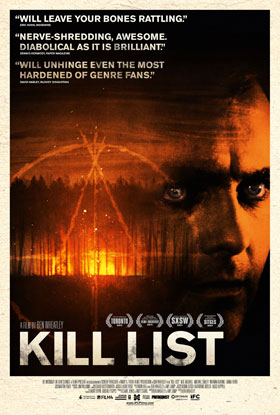
The Yorkshire Horror: Kill List

Contract killing is a dirty business that irreparably clouds the moral compass. Two working class Yorkshire hitmen ought to have sensed there was something especially wrong about their latest job, but they are unable to pick up on the bad mojo until it is far too late in Ben Wheatley’s polarizing genre-straddler Kill List (trailer here), which opens this Friday in New York at the IFC Center.

Jay and Gal’s last job in Kiev was so horrendous they can only refer to it obliquely. The schlubby Jay is particularly gun shy, but his out-of-his-league looking wife Shel keeps nagging him over money. As fate would have it, Gal has a too good to be true gig: three easy hits for a major payday. The meeting with the client is a rather strange, but the first job is easy enough. Things get a bit messy after that.

List does not really pull off the Scooby Doo mask and announce itself as an outright horror movie until the third act. However, Wheatley masterfully builds a sense of mounting unease throughout the first two thirds of the film that compounds rather wickedly. Something is definitely not right here, but he never really spells out the details for the audience, until we are knee deep in it all.

Frankly, Wheatley flips the switch a bit too quickly. List goes from cerebral naturalism to gory Grand Guignol in about ten seconds flat. Many viewers who are still thoughtfully parsing all the little clues will be put off by the jarring descent into mayhem.

Jay’s banality is actually part of the point and Neil Maskell certainly expresses it convincingly. In contrast, most of the character seasoning comes from Michael Smiley’s Gal, who is fascinating to watch throughout. The best supporting actor winner at the 2011 British Independent Film Awards, he keeps the audience off balance while piecing together strange parts of the puzzle.

One definitely has to be a bit cagey when writing about a film like List. It will not be everyone’s cup of tea, but it is the first horror movie in years that could inspire heated debates. A strange mixture of occult, domestic, and existential horror, it is unquestionably destined to be a cult classic. Creepily effective, List is recommended for high-end genre fans when it opens tomorrow (2/3) at the IFC Center in the West Village.