Showing posts with label Great Performances. Show all posts

Wednesday, November 24, 2021

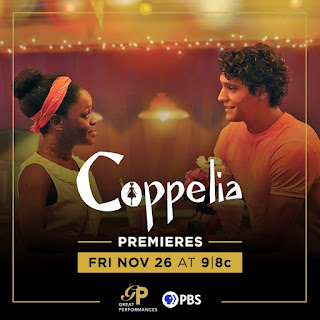
Great Performances: Coppelia


Anyone who remembers Bugs Bunny and Elmer Fudd belting out Wagner in What’s Opera Doc? knows classical music and animation are a match made in heaven. Chuck Jones may have brought some opera into cartoons, but directors Jeff Tudor, Steven De Beul, and Ben Tesseur managed to fully integrate live ballet with animation in their hybrid production of Coppéllia (based on a previous Dutch National Ballet staging), which premieres Friday on PBS, as part of the current season of Great Performances.

Obviously, this is not a traditional production of
Coppéllia, starting with the new music composed by Maurizio Malagnini. You can still see the Tales of Hoffman source material easily enough, but this Coppéllia is much less dark. In fact, it is downright sunny and vibrantly colorful.

Swanilda now goes by Swan, but you have to read the credits to know. It turns out she and Franz are both quite smitten with each other, but so far, they have been too shy to act on their attraction. He works in the bike shop and she is a barrista, which means she keeps busy, because the whole town’s social life and economy seem to revolve around afternoon coffee. However, things start to change when the mysterious Dr. Coppelius opens his factory. Ostensibly, he is selling haute couture, but he is really manufacturing female automatons. To bring his favorite to android life, he needs to steal the life force of the villagers—and Franz’s mojo is particularly potent.

Although the tone is generally bright and upbeat, many of the production’s retro science fiction visuals look like they were inspired by
Metropolis, which makes sense, since the dialogue-free ballet largely functions like a silent film. Malagnini’s score maybe isn’t especially memorable after the fact, but it mostly quite peppy and buoyant. There is even a hint of Raymond Scott-ish whimsy here and there (but just a hint).

The animation (both 2D and 3D) is also quite impressive. Frankly, there are times when it is hard to distinguish the background animation from the cartoon-styled set and prop design, which is actually a great compliment to both.

Monday, March 30, 2015

Annie Lennox: Nostalgia Live (Including Three by Hoagey)

Recently, Annie Lennox, OBE took performers like Beyonce Knowles to task, making the obvious but inevitably controversial point: “twerking is not feminism . . . It’s not liberating. It’s not empowering. It’s a sexual thing that you’re doing on a stage.” It probably needed to be said. It is therefore not so shocking Ms. Lennox was a little conflicted when her cover of Screamin’ Jay Hawkins’ “I Put a Spell on You” was requested for the Fifty Shades of Grey soundtrack, but she had to admit it fit the film like a glove, so to speak. Now millions of creepy fans are familiar with the unclassifiable R&B classic. On paper, it also stands out as the ringer in Nostalgia, Lennox’s new CD of American Songbook standards, but once again it just fits neatly into the program. Lennox performs nearly the entire album live at the Orpheum Theatre in a concert recorded for Great Performances, which premieres on PBS this Friday.

Lennox must be hip, because she obviously has an affinity for Hoagey Carmichael. The set opening “Memphis in June” is okay, but it is followed by a stirring “Georgia on My Mind,” given a Ray Charles-ish arrangement with strings. Wisely, she does not keep new fans waiting for “I Put a Spell on You.” Lennox is particularly attuned to the song’s eerie subtext, which is why it works so well over the film’s opening credits. (You now have an excuse to watch the first three and a half minutes when the film comes on cable.)

For jazz fans, the arrangement of “I Cover the Waterfront” provides some of the tastiest moments, including an evocative solo trumpet introduction. It is a great tune from the strangely under-recognized Johnny Green, still probably best known for “Body and Soul.”

Lennox also pays tribute Billie Holiday, which is about as jazz as you can get. However, she also demonstrates the pitfalls of covering “Strange Fruit.” You have to give her credit for trying, but it is a profoundly unforgiving song that only really seems to work with the sparsest of arrangements. Indeed, the string section is far too prominent here and having a back-up vocalist echoing Lennox is bizarrely counter-productive. You really have to lay it all out there in nakedly revealing way to do “Strange Fruit” justice, which is why only a select handful, such as Holiday and Nina Simone, have been able to successfully integrate it into their regular sets.

Happily, “God Bless the Child” is a different matter entirely. Lennox performs it in a gospel bag, giving the lyrics a surprisingly sassy interpretation. It is a bit of a departure from tradition, but it sounds great, in a swinging kind of way. “September in the Rain” also has a pleasant jazz-with-strings vibe, featuring some nice piano seasoning. Lennox also nails the aching romanticism of “The Nearness of You,” another Carmichael tune that never goes out of style.

Fittingly, Lennox saves the best (and her third wardrobe change) for the final Nostalgia song, the Ellington standard, “Mood Indigo,” which features a slightly reggae-ish vibe, a second lining brass combo, and some old school New Orleans plunger mute work. Lennox really embraces the bluesiness of the lyrics and brings it all home.

Of course, you do not survive in show business as long as Lennox has without giving fans what they want, so as an encore she accompanies herself on piano for solo renditions of “Here Comes the Rain” and “Why.” Both are shrewd selections well suited to the stripped down performance (she probably should have approached “Strange Fruit” in a similar manner, but it is hard to blame her for seeking a bit of cover for that song).

It is cool to see PBS nationally following the lead of NJTV and WNET Thirteen with their American Songbook programming. Lennox’s concert is one of the best yet. She has a good feeling for the tunes and she is still a very charismatic performer. Recommended for fans of Lennox and the American Songbook, Nostalgia Live airs on most PBS outlets this Friday (4/3), as part of the current season of Great Performances.

(Photos: Robert Sebree)

Wednesday, February 19, 2014

Sting’s Last Ship

Capital—malign it all you want, but you’ll miss it when its gone. The Wallsend Shipyard is a case in point. After decades of strikes and work stoppages, work stopped there for good. Maybe the workers were supposed to inherit control of all means of production, but they just wound up unemployed. Sting still remembers when there were laboring jobs to be found in the northern British city and the massive ships that towered over his boyhood home. The former Police frontman’s childhood memories have inspired his forthcoming Broadway book musical, which he performs as a special concert preview in Sting: The Last Ship (promo here), debuting on most PBS outlets this Friday as part of the current season of Great Performances.

Since hundred dollar-plus Broadway tickets are intended for the proletariat, Last Ship is naturally centered around the shipyard, focusing on the angst caused by its imminent closure. To keep the men’s spirits up, the parish priest inspires them to “occupy” the shipyard and build themselves one last ship. Cool, then what?

As a concert presentation, there is no acting per se in the Last Ship performed last year at the Public Theater. However, prospective cast member Jimmy Nails is on-hand to spell Sting on the vocals. A fixture of British television and recording charts, Nails’ casting is probably considered something of a coup on the other side of the Atlantic. He certainly understands the working class theatricality of Sting’s tunes.  However, the greater hook for American audiences will be back-up singer Jo Lawry, who is featured in 20 Feet from Stardom, the consensus favorite to win best documentary at this year’s Oscars. In fact, she has a lovely duet with Sting on “Practical Arrangement.”

The music itself definitely has that book musical vibe, but the Northumbrian musicians give it a distinctive Celtic-ish twist. The title tune has the right overture quality to it, yet it sounds vaguely familiar. Likewise, “Shipyard” is an effective role call for the cast of characters, including the overtly Marxist union rep (and also includes another brief but appealing solo spotlight for Lawry).  Similarly, “Dead Man’s Boots” establishes much of the show’s driving conflict, poignantly addressing the emerging generational divide.

In contrast, “Sky Hooks and Tartan Paint” is a bit of a novelty number in terms of lyrics (albeit a jaunty one), but Kathyn Tickell’s violin solo is the real deal.  Arguably, the concert’s highpoint also goes for laughs. The Rockabilly “Jock the Singing Welder” finally lets Sting unleash his strutting inner rockstar. It is catchy as all get out and loaded with attitude.

There is a reason why fans will probably latch on to “Jock.” Frankly, many of us would rather remember Sting as the shirtless villain in Dune kicking Kyle MacLachlan’s butt than as the sensitive memory play-book musical composer. Still, there is no denying his affection and empathy for the rough diamonds of his formative years.

Time passes on though, which is probably why audience shots are relatively few and far between. Let’s just say it is an older looking crowd than you would have seen in the Police’s CBGB heyday.  Regardless, it is still worth hearing Sting in an intimate setting with musicians of the caliber of Tickell and Lawry.  Recommended for those who enjoy a good labor chantey, The Last Ship premieres on PBS’s Great Performances this Friday night (2/21).

Sunday, September 15, 2013

Hollow Crown: Shakespeare’s Henriad

The House of Plantagenet had a good run, but their dynasty would not last forever.  You can blame Richard II.  His fall and the rise of his Lancaster cousins provided ample inspiration for Shakespeare’s three king-four play cycle known as the Henriad.  Executive producer Sam Mendes and three of Britain’s leading stage directors adapted the Richard and Henry plays for television as The Hollow Crown (promo here), which premieres on PBS this Friday as part of the current season of Great Performances.

Richard II begins with the title monarch on the throne, but that may soon change.  Callous and erratic, Richard is a sad excuse for king.  Nonetheless, the nobility has maintained their loyalty.  Richard’s own actions will drive many lords into rebellion, starting with the precipitous banishment of Henry Bolingbroke.  When the King confiscates the estate of his late uncle, Bolingbroke’s father, John of Gaunt, he pushes the Earl of Northumberland and his associates into rebellious conspiracy.

A bit of a slow starter, Richard II might be the weakest link of the Crown.  However, it exceeds viewer expectations for one of the marquee Henriad highlights, when Patrick Stewart knocks John of Gaunt’s “This England” soliloquy out of the park.  The stout Rory Kinnear and David Morrissey also bring an appropriately Shakespearean physicality to Bolingbroke and Northumberland, respectively.  Unfortunately, Ben Whishaw’s sickly, petulant presence poorly serves the villainous Richard.  Even more problematic is Richard II director Rupert Goold’s depiction of the deposed tyrant through Christ-like imagery.

Bolingbroke is now Henry IV, but he plays more of a supporting role in the two plays that bear his name: Henry IV Parts 1 and 2.  The King has an heir to succeed him, but has little confidence in the free-spirited Prince Hal.  The future Henry V would rather carouse with the disreputable Sir John Falstaff than worry about affairs of state.

Succeeding Kinnear as Henry IV, Jeremy Irons gives one of his best performances in years, acutely conveying the burdens of guilt, command, and fatherhood.  Likewise, Tom Hiddleston relishes the roguishness of Prince Hal, while also convincingly growing in stature once Henry V ascends the throne.  As director of both parts of Henry IV, Richard Eyre makes amends for misfiring with The Other Man.  He seems to love Falstaff even more than Welles did, but Simon Russell Beale looks so haggard and dissipated as the jolly fellow, viewers will fear he might keel over, well before his character’s spirit is broken.

Renouncing his wild past, Henry V turns his attention towards France in the Henriad’s conclusion, which should particularly interest Francophiles because of the presence of Lambert Wilson as the King of France and Mélanie Thierry as his daughter, Princess Katherine.  Hiddleston’s courtship scene with Thierry has considerable charm, but Henry V director Thea Sharrock strangely underplays the St. Crispin’s Day speech, perhaps hoping to avoid comparison with Branagh’s rendition.

Shot on some notably picturesque locations, Hollow Crown opens up Shakespeare quite cinematically.  While there is a considerable editorial hand at work, the language is never dumbed down.  It is a smart way to present the Bard on television, with discrete productions that still have the continuity of a mini-series.  The all-star cast should be of particular interest to fans of Downton Abbey (due to the too briefly seen Michelle Dockery and Glen).  It is a great looking period piece, buttressed by a number of fine performances.  Recommended for patrons of classical theater and fans of British television, The Hollow begins this Friday (9/20) and continues for the next three Fridays on most PBS outlets nationwide.

Monday, December 10, 2012

Get Back on the Bus: The Magical Mystery Tour Returns


It was a film produced in psychedelic color that debuted on BBC1 at a time when most British televisions were black and white.  It was programmed for Boxing Day, a traditional evening of family television viewing, guaranteeing those least inclined to appreciate a spot of hippy goofiness were most likely to see it.  Due to its disastrous reception, many Beatles fans only know The Magical Mystery Tour as the bestselling album.  After years of obscurity, the film has been re-released for public consumption, even returning to broadcast television with a special presentation this Friday on PBS’s Great Performances (promo here) to be followed by the premiere of Francis Hanly’s behind-the-scenes documentary Magical Mystery Tour Revisited.

The plot, such as it is, will hardly matter to diehard Beatles fans.  The real attraction is the music, including the band’s only video performance of “I Am the Walrus,” done in precisely the style one might expect.  The audience follows the day-glo tour bus as it makes a series of surprise stops throughout the English countryside.  Ringo Starr plays Richard Starkey who takes his recently bereaved Aunt Jessie on the tour, bickering like cats and dogs every step of the way.  The other three lads are also on the tour, essentially playing unnamed versions of themselves, as well as a pack of trickster wizards.  Stops will include a visit to an army recruiting station, a chaotic marathon, a brief swing through a London strip club, with a number of wacky dream interludes in between.

Seen with contemporary eyes, MMT, directed by the Fab Four with the assistance of former Hitchcock collaborator Bernard Knowles, looks exactly like the trippy jokiness we would expect from the post-Pepper Beatles.  Sort of like a series of Python sketches stitched together, but not nearly as consistently funny, it makes perfect sense to find Terry Gilliam singing its praises in Revisited.  Still, the film itself very definitely feels like a giddy time-capsule from a more innocent age when Postmodernism was little more than glint in the eye of the French intelligentsia.

At just under an hour’s running time, MMT offers viewers the title song, “Fool on the Hill,” “Your Mother Should Know,” and the Bonzo Dog Doo-Dah Band performing “Death Cab for Cutie” amidst its improvised tomfoolery.  Frankly, the latter number might be the most memorable, since it accompanies a PBS-safe striptease.  Ironically, the making-of-program clocks in at almost exactly the same length.  We hear from both surviving Beatles as well as Martin Scorsese, who evidently saw every movie ever made when he was a teenager and influenced by everyone of them.  Hanly also incorporates some archival footage of John Lennon and George Harrison.  Everyone seems to credit or blame Paul McCartney with the original concept for MMT, but that hardly makes any sense, since “Revolution #9” played backwards clearly implies he died before 1967.

MMT is neither the affront to good taste many argued at the time, nor the lost masterpiece most fans will be hoping for.  It is the product of its time, well in keeping with the playful personas carefully crafted by the Beatles.  An amusing but minor film, it is certainly worth fans’ time for the music and to satisfy their curiosity when it airs on free TV this Friday (12/14), along with Hanly’s companion film, as part of the current season of Great Performances.

Saturday, February 18, 2012

Memphis on Great Performances

Celebrity casting might sell tickets initially, but their commitment to a production is usually limited. However, if a show hires Broadway actors by virtue of their talent, they stand a chance of keeping the original cast together for a long run. Happily such has been the case for Broadway’s Memphis, the Tony Award winning book musical that may no longer qualify as “new” but still remains fresh. Viewers can find out for themselves, either by visiting New York where it continues its crowd pleasing run or by tuning into PBS’s Great Performances, which broadcasts Memphis recorded live in performance with its original cast this coming Friday.

Huey Calhoun is one of the few white residents of Memphis who is either gutsy or innocent enough to frequent the African American clubs on Beale Street. While his presence makes club owner Delray Farrell understandably uneasy, everyone generally accepts the goofy kid because of his obvious affinity for their music. Smitten with Farrell’s sister Felicia, the big talker promises to get her on a major Memphis radio station. Commandeering the broadcast booth of the station owned by the upright and uptight Mr. Simmons, Calhoun lights up the proverbial phone lines spinning R&B for appreciative white teenagers. Suddenly, Calhoun has a steady job.

For a while, Calhoun actually has it all, including a relationship with Farrell. Yet he just does not understand how things really work in Memphis, whereas she is all too aware of reality. Although their love might be impossible in that specific time and place, their music is the future and it is quite catchy indeed.

Though the score by David Bryan (best known as a member of Bon Jovi, but also the composer of the Toxic Avenger musical) is a bit more orchestrated and well, Broadway-sounding than the genuine R&B and rock & roll of the period, it really delivers the goods. “Someday,” Felicia’s first hit in the context of the show, really does sound like it could have been a chart-topper, perhaps for Etta James. Ironically, one of the show’s highlight comes from Derrick Baskin as the mostly silent Gator, who blows everyone away with “Say a Prayer,” the riveting gospel-derived first act closer. However, the standout song is arguably Calhoun’s feature, “Memphis Lives in Me.” It is actually a twofer: musically it is a legitimate showstopper, but it also explains Calhoun’s character better than any of the previous dialogue.

Granted, Joe DiPietro’s book is not exactly the most original treatment of themes and issues that drive Memphis. Of course, clichés become clichés because they work, and audiences will most likely find themselves charmed by Memphis’s likable and vocally talented leads. Frankly, Chad Kimball’s weird affected, nasally accent and rabble rousing man-child demeanor suggests a pronounced Jerry Lee Lewis influence. Sounding totally Beale Street, Montego Glover takes a star-making turn as Felicia, displaying dramatic poise and powerhouse vocal chops. In supporting roles as Calhoun’s Beale Street friends, Baskin and James Monroe Iglehart also make a strong musical impression.

Memphis boasts far more memorable songs than nearly any of its Broadway contemporaries (most of whom have since come and gone), which is the ultimate measure of a musical. Slickly produced and tightly paced, Memphis looks great and sounds soulful. Christopher Ashley’s stage direction holds up well for those of us who saw it in-person during its early months and veteran television director Don Roy King effectively captures the spirit of the show through Broadway Worldwide’s multiple high def cameras. Recorded in January of last year and briefly seen in movie theaters for four days, King’s live-recorded Memphis is highly recommended for both fans and first time audiences when it airs this Friday (2/24) as part of the current season of Great Performances on PBS.

(Photos: Broadway Worldwide)

Tuesday, January 03, 2012

The Symphonic Gershwin with Hancock, Dudamel, and the L.A. Phil

In the 1920’s Paul Whiteman was the biggest so-called “jazz” bandleader in the country. Today, he is largely ignored. He had many hot soloists, but his sound was more sweet than swinging. His name pretty much said it all. However, the sort-of concerto he commissioned from George Gershwin would become arguably the most recognizable American classical composition of all time. Appropriately, the jazz inspired Rhapsody in Blue is the centerpiece of a L.A. Philharmonic concert of Gershwin’s music featuring NEA Jazz Master Herbie Hancock, which airs on PBS’s Great Performances this Friday (preview here).

The evening starts with An American in Paris as a feature for the Philharmonic under the direction of Gustavo Dudamel. It is fitting companion piece to the Blue, including some nice solos for muted and hatted trumpet as well as some vaguely jazzish passages. With its diverse movements and crowd-pleasing car horn effects, it is definitely a money’s-worth selection.

The second selection of the televised concert is Hancock’s solo piano rendition of “Someone to Watch Over Me.” Perhaps inspired by the setting, he gives it a rather rhapsodic introduction, before settling into a more contemplative mood. Indeed, he approaches the melody quite obliquely, which is something of a surprise given the venue. After all, “Watch” is one of those songs nearly everyone with any musical literacy sings along with in their head.

The main event though, is undeniably Rhapsody in Blue performed with a traditional arrangement, but allowing Hancock considerably greater interpretive space. Yet, all the magic moments are still there, including the ever beautiful clarinet introduction, perhaps the instrument’s finest classical moment (though not necessarily in jazz, thanks to Woody Herman, Sidney Bechet, and Benny Goodman, among others).

According to Hancock, this is his premiere appearance with a symphony performing any sort of classical-jazz symphonic hybrid. Once known as the “kid” Blue Note Records signed, the seventy-one year old pianist looks at least twenty years younger. He clearly has not lost a step either, attacking Blue with a much wider dynamic range than typical, while even throwing in a legit improvisation here and there.

It is always worth hearing a new version of Rhapsody in Blue, particularly from musicians of the L.A. Philharmonic’s caliber. As an acknowledged master and the L.A. Phil’s current Creative Chair for Jazz, Hancock also provides some tasty moments, even if jazz piano with orchestra is not as natural a fit for him as for a Dave Brubeck or John Lewis. Classy entertainment (if not absolutely epochal), the L.A. Philharmonic’s Gershwin program is a nice way for Great Performances to start the year. It premieres this Friday (1/6) on most PBS outlets.

Sunday, September 25, 2011

House of Blues: Hugh Laurie’s Let Them Talk

If you have spent much time in Starbuck’s lately, you have surely heard a good portion of British actor Hugh Laurie’s new CD, a tribute to the music of New Orleans. Though undeniably the beneficiary of a considerable marketing campaign, the man known as Dr. House can definitely carry a tune in his medical kit and has an agreeable touch on the ivories. Laurie explains his love for those Crescent City sounds and performs a set of jazz and blues standards in Great PerformancesHugh Laurie: Let Them Talk (preview here), which premieres on most PBS stations this Friday.

In his introductory voice-over, Laurie tells viewers every man is entitled to one pilgrimage in his life. Laurie had the good taste to take his in NOLA. He took the scenic route getting there though, stopping off at bluesy-rootsy roadside attractions, like Euclid Records, whose mail-order operations are well beloved by many of us, and sitting in at Maggie Mae’s in Austen, Texas, with Miss Lavelle White, who can vocalize a mean harmonica.

Granted, just about anyone would sound okay fronting a band assembled by New Orleans R&B maestro Allen Toussaint, performing with special guests Irma Thomas and Sir Tom Jones. In truth though, Laurie is at least pretty good in his own right on vocals, piano, and a spot of guitar. He offers the appropriate support to Thomas, “The Soul Queen of New Orleans," on “John Henry” and backs up Jones nicely during “Baby Please Make a Change,” a soul shouter perfectly suited to the Welsh icon. Laurie also has a surprisingly strong left on the ivories, opening a real can of barrelhouse on “Swanee River” and gamely tackling the Professor Longhair classic “Tiptina.”

As a vocalist, Laurie has a strong, clear tone that expresses the plaintiveness of “St. James Infirmary” quite strikingly. Arranged with stately funkiness by Toussaint, it is obviously positioned as the concert’s showcase number, and rightly so. The highlight of the set, it is here that Laurie really puts his stamp on an old school New Orleans classic. It ought to be the title track, but it might have confused some of his House fans (though it sounds medical).

Mostly, Let Them Talk is a respectfully traditional celebration of the NOLA songbook, (though Laurie earns further credit for capturing Jelly Roll Morton’s idiosyncratic attitude in “Buddy Bolden’s Blues”). Much like the still vital local music scene one can find in the small clubs on Frenchmen Street, Laurie and Toussaint effortlessly blend jazz, blues, and R&B throughout the set. It is quite pleasant, but if it rocks your world, just wait until you check out the original recordings from Toussaint, Louis Armstrong, James Black, and ‘Fess Longhair.

While some of Laurie’s narration is a bit hokey, the music will remind many of us once again why we fell in love with New Orleans, which is what good valentines are supposed to do. There is one glaring misstep though: Toussaint’s band is never introduced on camera or allowed to take the bow they earned. An enjoyable love letter nonetheless, Laurie’s Let Them Talk airs on most PBS outlets this Friday (9/30), including New York’s Thirteen, as part of the current season of Great Performances.