During the Vietnam War, Sen. John McCain received even harsher treatment then his
fellow POW’s when their North Vietnamese Communist captors learned his father
was a very senior Admiral. Unfortunately, Mikael Forss, the son of the Swedish
Defense Minister, finds himself in a similar position when his squad is
captured during the UN’s 1993 Bosnia “peace-keeping” deployment. Supposedly,
their mission is re-opening the Mario Road supply line, but their day-to-day
objectives are dangerously vague in writer-creators Mona Masri & Oliver
Dixon’s six-episode A Life’s Worth, based on Magnus Ernstrom’s
autobiographical novel, which is now streaming on Viaplay.
The
military is only supposed to be a stepping stone for Forss, on his way to a
position in the diplomatic corps and then a political career. At least that is
what his father tells him. However, service in Bosnia is much more difficult than
he or anyone else expected, except maybe their strict but conscientious commander,
Col. Andreasson. Shocked by the death of their APC leader on their first mission,
Forss reluctantly accepts the promotion to be his successor, even though he
lacks confidence. Frankly, Andreasson probably should have picked the
Serbian-speaking Babic. He usually does not make decisions based on politics,
and he certainly resist such thinking in later episodes.
Regardless,
Forss has his hands full with his APC crew. Kilpinen gets hooked on morphine self-medicating
his injuries, but he seeks redemption by helping Eldin, a Muslim father, find
his daughter lost after the Croatian HVO’s massacre of their Stupni Do village.
Meanwhile, Strand falls for Alma, a Croatian cafeteria worker, whose family
will be menaced by both Serbian militias and Bosniak paramilitaries augmented
by Mujahideen.
It is
painfully clear the combatants have little fear of the peacekeepers and no
respect. They call them “Smurfs”’ in [dis]honor of their blue helmets. Viewers
quickly see why. The first time Forss’s APC encounters war crimes in progress, HQ
tells him to act on his own discretion. This is clearly a coded invitation to
retreat, without using so many words.
Indeed,
Life’s Worth suggests there is good reason the American military rarely
places ground troops under UN command (but we sometimes contribute advisors and
staff officers). Neither the objectives or the rules of engagement are ever
clearly established for any of the APC crew’s operations, except perhaps
Andreasson’s Stupni Do rescue mission, which they volunteer for. “Going out and
just doing your best” is not something you can wargame and that’s a long-term problem.
Indeed,
Masri, Dixon, and series director Ahmed Abdullahi do an excellent job
portraying the Swedish military, up and down the chain of command. Much of the
Balkan characterization is more simplistic. There appears to be a conscious
effort to depict atrocities on all three sides. Yet, the Bosnian Muslims
probably emerge with the least to answer for, while the Croatians, like Alma,
are arguably the easiest former Yugoslavian characters to relate to.
Radovan Jakovic was sort of the Swedish Whitey Bulger. Det. Gunn Thorngren rather ill-advisedly
facilitated his criminal ascension by arresting the rivals he informed on. At
least she realized the extent of her mishandled informant-handling earlier than
the FBI. Arguably, Jakovic was also a Serbian government employee, because they
supplied the contraband he smuggled into Sweden. Balkan wars complicate Swedish
organized crime in lead writer Axel Stjarne’s six-episode Mafia, which
premiers today on Viaplay.
Before
the fall of Communism, the Yugoslav government offered its criminals a choice, domestic
prison or immigration to Sweden (where many Iron Curtain defectors re-settled),
to work for the Yugoslav mob. In exchange for carry out assassinations at the
request of the UDBA secret police, the state supplied contraband cigarettes,
which were very profitable on the Swedish black and gray markets.
Jakovic
correctly identified an opportunity to move into this lucrative business. However,
Valter Sokol, an ardent Croation nationalist, controls the distribution. “Boris,”
the local UDBA station chief, would like to cut him out of the business, but he
needs someone with sufficient standing, like Jakovic’s reckless boss Drago. However,
if Drago gets caught red-handed, Jakovic’s childhood friend Goran would
naturally succeed him.
Unfolding
over the course of the 1990s, Mafia compounds the organized crime
intrigue with the unfolding power struggle and tragedy in the Balkans.
Ironically, it also exposes the folly of the sin taxes passed by Sweden’s
failing socialist government, which raised the price of cigarettes
exponentially (and passed with behind-the-scenes lobbying support from Jakovic’s
organization).
The
Yugoslavian UDBA angle definitely differentiates Mafia from other mob dramas.
However, the portrayal of Jakovic searching and failing to find family through
his mafia ties evokes familiar Godfather-esque themes, but Stjarne and
lead actor Peshang Rad execute them with intelligence and conviction.
In the
late Eighteenth Century, Norrkoping was one of three Swedish cities where Jews
were allowed to live (along with Stockholm and Gothenburg). In recent years,
there has been a dark side to the harbor city’s openness, as the authorities
have struggled with illegal immigration and human trafficking. Perhaps
something like that happened to Jana Berzelius, who has recently followed in
the footsteps of her adoptive father, into the prosecutorial service. However,
her first case might be her last, when she participates in an investigation involving
child assassins who literally bear the same markings she still carries on he
back of her neck in co-creators Felix Herngren & Henrik Bjorn’s six-episode
Jana, Marked for Life, which premieres tomorrow on Viaplay.
Hans
Juhlen was the director of the local government migrant agency, who was known
to get a little “hands on” with some of his cases. As fate would have it, he
helped facilitate Karl and Margarethe Berzelius’s adoption of Jana, after she
mysteriously washed up in the harbor. However, she was so prone to rage,
paranoia, and violence, they sent her to a psychiatrist privy to questionable
trauma research, who basically drugged Jana’s bad memories away.
Of
course, they were not really gone. They always returned in dreams and now start
surfacing in sudden flashes prompted by Berzelius’s first case: Juhlen’s
murder, apparently committed by a child. Even though Juhlen approached Berzelius
at her father’s retirement party, on the night of his death, she minimizes her
connection, so she can still work the case. To put it bluntly, she lies to Peer
Bruckner, the senior prosecutor assigned to the case (and perhaps her potential
love-interest) and she keeps deceiving him as she gets pulled more deeply into
her dangerous past.
It is
hard to say who makes worse decisions, the erratic, half-cocked Berzelius, or
her law enforcement rival, police officer Mia Bolander, whose class-conscious
resentment of the new prosecutor also acts like an antidote to her common
sense. However, their horrendous decision-making at least earns credit for
advancing the plot. Without them blundering into crime scenes, most of the
series would probably consist of Bruckner filling out forms in triplicate.
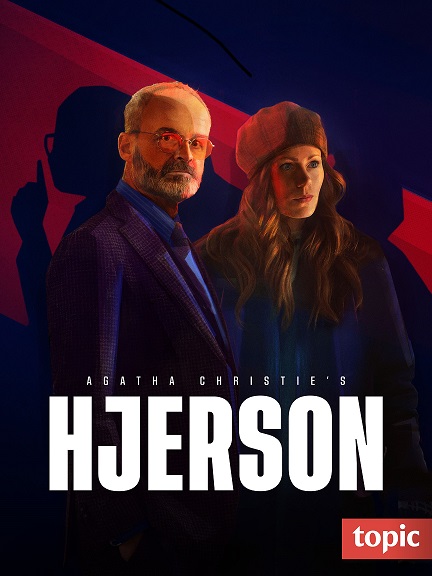
Sven Hjerson is to Agatha Christie’s novels what Beebo is to DC Comics. He is
a fictional character within a fictional world. Several of Dame Agatha’s stories
featured Ariadne Oliver, a mystery writer not completely unlike herself, whose
fictional detective was the fastidious Hjerson, who is not radically different
from Hercule Poirot. Rather shrewdly, Swedish television capitalizes on the
sleuth’s local potential in the eight-episode Agatha Christie’s Hjerson,
which premieres Thursday on Topic.
Technically,
the series should probably be called Agatha Christie’s Ariadne Oliver’s
Hjerson, since it all presumably unfolds in the pages of her novels, but
creator Patrik Gyllstrom (perhaps wisely) ignores the meta implications. It
turns out Hjerson is actually Finnish, from the Swedish-speaking autonomous archipelago
of Åland, but his professional career was spent solving crimes for the Swedish
police, until his spectacular fall from grace.
However,
his notoriety and brilliance are assets to freelance TV producer Klara
Sandberg, who wants to escape her MILF Hotel program, with a
crime-solving show, starring Hjerson. Contacting the misanthropic recluse is
tricky by design, but she knows she can corner him on an over-night ferry to Åland.
There also happens to be a muck-raking journalist on-board, who meets an
untimely death. Obviously, that will be their first case [sort of] together.
Each
case lasts two episodes and they vary in degree of mysteriousness. The shipbound
opener is about as twisty as a 1970s Quinn Martin two-parter. Fortunately, the
subsequent mystery in Åland is considerably more involving. It starts with the strange
disappearance of a man in chicken suit and features Bjorn Andresen (who played
the teen Dirk Bogarde obsesses over in Death in Venice) as Hjerson’s old
crony Oscar (seeing the grey, wrinkly Andresen now should totally freak out anyone
who saw Visconti’s film in theaters).
About
the time Hjerson finally agrees to Sandberg’s proposal, at least in very
general terms, they are approached by Ronda Svensson (a mystery novelist in the
world created by mystery novelist Ariadne Oliver, who was created by mystery
novelist Agatha Christie) to investigate a murder that was committed in a
manner precisely like one in her unpublished manuscript. Thematically, it is
sort of like “Captive Audience,” the James Mason episode of The Alfred
Hitchcock Hour, but Gyllstrom and co-screenwriter Bjorn Paqualin take it in
an interesting direction.
Impressively,
Gyllstrom isn’t afraid to riff on Alec Baldwin’s negligent shooting incident
(and make reference to it) in the concluding mystery-arc. However, in this instance,
it is the jerky arrogant actor who gets shot. Obviously, this is a good case
for the gossip-obsessed Hjerson, even though playing it coy with Sandberg. Again,
this mystery isn’t bad, considering Gyllstrom has to wrap it up in ninety
minutes, give or take.