For twenty years the Village Vanguard Jazz Orchestra held court at the storied jazz club every Monday night. Tonight they played Carnegie Hall instead, as part of the JVC Jazz Festival’s salute to the Village Vanguard and Loraine Gordon, in the words of leader John Mosca: “in violation of their contract by playing above sidewalk level.”
Lorraine Gordon, the widow of founder Max Gordon, took over the reins of the Vanguard in 1989. Beloved by musicians, particularly those like The Bad Plus playing last night, Lorraine Gordon also has a reputation for running a tight ship.
Both Gordons exemplify the adventurous spirit of jazz entrepreneurs. Having prime west village space and a liquor license, the Vanguard presents jazz instead of trendy cocktails and DJ’s. German émigrés and jazz fans Alfred Lion and Francis Wolff started Blue Note Records to document the music they loved. Blue Note became the signature label of modern jazz, producing some of the most beloved LPs in jazz history. Lion and Wolff never got rich for their efforts, but they befriended many of the musicians they recorded. Other label founder-producers like Lester Koenig at Contemporary and Nat Hentoff at Candid recorded music they deemed important, regardless of commercial concerns.
Impresario and producer Norman Granz put his money where his mouth was as producer of Jazz at the Philharmonic. Granz insisted on integrated audiences at his shows. He would refund disgruntled audience members, but would not reseat them to placate their prejudices. He also insisted his integrated troupe stay together at the same hotels, often integrating them through the strength of his economic argument. In many cases JATP would have several floors, or even the entire hotel reserved through their performances—quite a financial hit to turn away Granz and company.
One of the great things about capitalism is that nobody can tell an entrepreneur not to waste their money on a crazy enterprise, if their mind is dead set on doing so. Jazz has certainly been fortunate that the Gordons, Granz, Lion, and Wolff have been free to pursue speculate ventures on behalf of the music.
The concert itself featured great music. Opening the evening with some traditional flair was Dr. Michael White’s Original Liberty Jazz Band, who usually swing the Vanguard every New Year’s Eve. Roy Hargrove led an excellent quintet, including veteran jazz artists Bobby Hutcherson and Ronnie Matthews. The Bad Plus closed their set with a unique rendition of Bacharach’s “This Guy’s in Love with You” dedicated to Gordon, and fittingly the Vanguard Orchestra closed with a rousing set, featuring guest soloist Joe Lovano.
Next Monday the Vanguard Jazz Orchestra will be back in their regular digs, below sidewalk level. Of course, any night of the year in New York you can count on hearing some great music at the Vanguard.
Tuesday, June 20, 2006
Monday, June 19, 2006
Help Needed: Coalition Builders
Vision Fest, the East Village festival of avant-garde jazz, had a panel discussion on New Orleans Sat. prior to the evening concert. Many of the comments, though well received East of Ave. A, would be considered divisive and counter-productive throughout most of America.
One panelist predicted America is poised for large scale rioting on one hand versus a Fascist-state crack down on the other. He blamed the “Bush Oil Cartel” for pulling there management facilities out of New Orleans in the 1970’s despite his later admission that Napoleonic regulations at that time made it difficult to do business across Parish lines. Corporations were attacked, as was our involvement in Operation Iraqi Freedom.
Much was said that was divisive and would push away would-be allies from Red State America. Instead of building coalitions, there was talk of large-scale demonstrations, the spectacle of which would make average constituents around the country more skeptical of the efficacy of spending to rebuild New Orleans. Most Americans are compassionate, but do not want to see their tax money go to organizations marching around with “Bush is Hitler” signs. Many panelists and people attending genuinely want to help the people of New Orleans rebuild. However, I have become convinced there are many on the left who want to keep New Orleans in a state of perpetual martyrdom.
After 9-11, the response was productive and unifying: we were not Republicans or Democrats, but Americans. That was productive. After Katrina, there was a mad dash on the part of the extreme left and their water-carriers in the media to assign blame. Horror stories peddled by the media, like that of snipers firing at medical helicopters, arguably cost lives by grounding needed emergency flights. That was not productive, and it’s the musicians and citizens of the Crescent City, who will suffer for such excesses.
One panelist predicted America is poised for large scale rioting on one hand versus a Fascist-state crack down on the other. He blamed the “Bush Oil Cartel” for pulling there management facilities out of New Orleans in the 1970’s despite his later admission that Napoleonic regulations at that time made it difficult to do business across Parish lines. Corporations were attacked, as was our involvement in Operation Iraqi Freedom.
Much was said that was divisive and would push away would-be allies from Red State America. Instead of building coalitions, there was talk of large-scale demonstrations, the spectacle of which would make average constituents around the country more skeptical of the efficacy of spending to rebuild New Orleans. Most Americans are compassionate, but do not want to see their tax money go to organizations marching around with “Bush is Hitler” signs. Many panelists and people attending genuinely want to help the people of New Orleans rebuild. However, I have become convinced there are many on the left who want to keep New Orleans in a state of perpetual martyrdom.
After 9-11, the response was productive and unifying: we were not Republicans or Democrats, but Americans. That was productive. After Katrina, there was a mad dash on the part of the extreme left and their water-carriers in the media to assign blame. Horror stories peddled by the media, like that of snipers firing at medical helicopters, arguably cost lives by grounding needed emergency flights. That was not productive, and it’s the musicians and citizens of the Crescent City, who will suffer for such excesses.

Sunday, June 18, 2006
Grandt’s Kinds of Blue
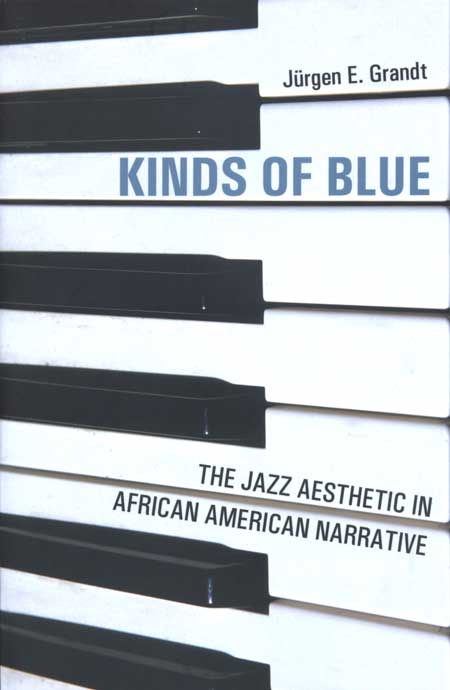
Kinds of Blue: the Jazz Aesthetic in African American Narrative
By Jurgen E. Grandt
Ohio State University Press
0-8142-5132-3
Jazz artists have often been compared to literary figures, usually for their storytelling talents, while some acquire mythic status for their larger than life exploits. In Kinds of Blue, Grandt conversely argues that literary artists like Anne Petry and Toni Morrison exhibit jazz qualities in their own field of art.
Grandt starts his analysis with an actual jazz musician and memoirist, Sidney Bechet, who “links not only music and storytelling, but also history and memory, the past and the present.” (p. 3) In his autobiography Treat It Gentle, Bechet creates a fictional grandfather Omar, a freed slave who meets his tragic fate as a result of pursuing his love for Marie, Bechet’s grandmother, herself a slave still held in bondage. Bechet’s Omar becomes a touchstone for Grandt throughout the book, who while a fictional construct, expresses truth through jazz technique, arguing:
“As a jazz musician, Sidney Bechet improvises over the fixed melody and chord progression of a song; that is, he superimposes a new melody (fiction) on an already existing melody (fact) . . . Bechet improvises the fictitious tale of Omar over the historical fact of chattel slavery in America.” (p.8-9)
Grandt handles issues of race largely with scholarly reserve. While trying to avoid the provocative, he is forced to deal honestly with the extremism of Amiri Baraka’s “many transformations—from Bohemian Beatnik to Black Nationalist to crude Marxist-Leninist.” (p. 67) Baraka, who gained notoriety for the poem “Somebody Blew Up America,” with its infamous anti-Semitic libel that Jews were warned to by Israel to avoid the World Trade Center on September 11th, is analyzed for his revolutionary story “Answers in Progress.” Grandt provides historical perspective on Baraka’s chaotic life, including the break-up his marriage, getting a young dancer named Bumi pregnant, and then moving on to another lover. According to Grandt:
“He even attempted to persuade the two women of the righteousness of a polygamous marriage, justified, so he claimed, by the tenets of Maulana Karenga’s Kawaida ersatz-religion that he had espoused. Conveniently for Baraka, already the disinterested father of three children, Bumi fell suddenly ill and died in the hospital. Even though this freed him to marry Robinson, who adopted the name Amina, later that same year, their relationship, too, would prove to be calamitous at times, mostly due to Baraka’s virulent sexism.” (p. 75)
While that might be brutally honest context, it is not inappropriate, in that it certainly makes Grandt’s case that much of the story, particularly the domestic bliss of the narrator, is wish-fulfillment on the part of Baraka. The one part of the book that shows some confusion is his comparison of novels by Toni Morrison and Hans Janowitz, both named Jazz. Grandt argues that in ways both reflect jazz elements in the structure of their language. It seems that Grandt goes back and forth as to whether Janowitz’s Jazz can really be considered a jazz novel, ultimately (I think) deciding no, because it lacked the historical perspective to truly grasp the music. However, it was a heck of a good try for a German in 1927.
Ultimately, this shows some of the pitfalls in the act of classification. British jazzman Johnny Dankworth would probably assume, if nothing else, his memoir Jazz in Revolution is a jazz narrative. However, as the product of a white European, who relates the events of his jazz career with unembellished honesty (as far as I know), but in straight forward language, would probably not be so-classified by Grandt.
Despite its title, Kinds of Blue makes only incidental references to Miles Davis, and no mention of his Kind of Blue album. Grandt does make effective and informed comparisons of literary works and recorded jazz sessions, Toni Morrison's Jazz and “The Chase” by Dexter Gordon and Wardell Gray, for instance. Those unaccustomed to recent academic writing however, may have difficulty with the frequent use of binary opposites and other such terms. Grandt is well versed in jazz, but Kinds of Blue is really written for an audience steeped more in critical theory, than the music itself. General readers interested in the relationship between jazz and literature would probably find David Yaffe’s Fascinating Rhythm more accessible.
Friday, June 16, 2006
Screening the Door
The Door
Directed by Bruce Wood
Soundtrack by Brian Citro & Charles Gorczynski
www.dreamfastcinema.com
Writing about Bruce Wood’s film The Door presents a challenge in avoiding spoilers. An independent film in the tradition of M. Night Shyamalan’s films, The Door explores the boundaries of dream and reality, but even that brief description could be a spoiler. To synopsize briefly, free spirit Ori introduces his heartbroken friend Kent Cole to three of his acquaintances. As each becomes involved with Cole, they begin to realize he is not what he seems, and the consequences are disastrous.
The Door’s surreal mood is abetted by an effective jazz soundtrack by Brian Citro and Charles Gorczynski. Many tunes are effective when heard apart from the film, particularly striking being the “Circle” tracks. Indeed, I would recommend the soundtrack on its own merits. As evidence, The Door won best soundtrack at the Lake County Film Festival, which I’ve never heard of, but must count for something. Having taught a “jazz and film” at SCPS, I’m always happy see more jazz scores, and one hopes The Door will prove to be an effective showcase for it’s composers.
I’m assuming The Door was shot on digital video, and it is actually quite effective. Wood consistently conveys a sense of mystery throughout the film, even though many viewers will tweak to what is going on when they think about the commonality binding the three friends together. Some of the cast are not exactly professional grade, but nobody is bad enough to sabotage the mood of the film. Indeed, Bill Ferris as Cole and Ryan Martin as Ori hit the right notes as the friends with radically different temperaments, in strong performances.
There is gay content, which in a way it acts a decoy when characters discuss their “true nature.” Regardless, it shouldn’t scare timid viewers away from an interesting film and soundtrack. Both are quite intelligent and entertaining. See the trailer here.
Thursday, June 15, 2006
His Career Certainly Caused the Blues
Charley Patton. Robert Johnson. John Lee Hooker. Steven Seagall . . . ?
I don’t think so. Of course, he’s certainly caused a lot of blues with his movies, particularly with On Dangerous Ground.
I don’t think so. Of course, he’s certainly caused a lot of blues with his movies, particularly with On Dangerous Ground.
Wednesday, June 14, 2006
St. Bono?
El Chapultepec is a great little no-cover jazz venue in Denver’s Lo-Do neighborhood, where many of the city’s best jazz musicians like Ellyn Rucker, often play. It is deservedly profiled in the June 2006 issue of Denver’s glossy 5280 magazine (“Remebering the Pec” not available on-line). However it includes an odd little celebrity story, referred to as the “Legend of Bono.” Mike Kessler writes:
As the story goes, the U2 frontman and a pal attempted to bring two underage girls into the club, sometime during the ‘Pec’s glory years, before Bono took on Africa’s problems. The girls couldn’t provide ID, which prompted Bono and his buddy to cop an attitude and play the rock star-card. Finally, owner Jerry Krantz was summoned to the door. Says KUVO’s Lando: “Jerry told Bono and his friend, ‘You and your pal can come in. But the girls, well, sorry—but U2s will have to go.’”
Bono’s self-righteousness is getting tired, and so is the media’s fawning coverage of him. Next time he lectures American policy makers, remember this episode. If the legend is true, while not Jerry Lee Lewis territory, bringing under-age girls to a bar shows questionable judgment. Could the media temper the absolute moral authority they have tried to invest in him? Let’s hold off on the Sainthood, he’s still just a rock-singer who was evidently capable of stupid rock-star stuff. His choosing the ‘Pec as his after-hours hang did show good taste though.
As the story goes, the U2 frontman and a pal attempted to bring two underage girls into the club, sometime during the ‘Pec’s glory years, before Bono took on Africa’s problems. The girls couldn’t provide ID, which prompted Bono and his buddy to cop an attitude and play the rock star-card. Finally, owner Jerry Krantz was summoned to the door. Says KUVO’s Lando: “Jerry told Bono and his friend, ‘You and your pal can come in. But the girls, well, sorry—but U2s will have to go.’”
Bono’s self-righteousness is getting tired, and so is the media’s fawning coverage of him. Next time he lectures American policy makers, remember this episode. If the legend is true, while not Jerry Lee Lewis territory, bringing under-age girls to a bar shows questionable judgment. Could the media temper the absolute moral authority they have tried to invest in him? Let’s hold off on the Sainthood, he’s still just a rock-singer who was evidently capable of stupid rock-star stuff. His choosing the ‘Pec as his after-hours hang did show good taste though.
Tuesday, June 13, 2006
Burns’ Keeping the Beat on the Street

Keeping the Beat on the Street: the New Orleans Brass Band Renaissance
By Mick Burns
Louisiana State University Press
0-8071-3048-6
Brass bands, jazz funerals, second line dancers. These are the enduring images of the city of New Orleans. In the recently published Keeping the Beat on the Street Mick Burns has assembled interviews he conducted before Katrina, to chronicle the continuing development of the NOLA brass band scene. Burns has captured the important voices of this tradition, in his worthy book.
Much of the resurgence of interest in the brass band scene can be attributed to traditional jazzman and educator Danny Barker, who founded the Fairview Baptist Church Brass Band. Many of the future leaders of the brass band scene came up through the Fairview band. However, the local musicians’ union forced him to scale back his involvement with the predominantly non-union youth band. As Leroy Jones remembered:
“Danny had to stop being associated with us because of the flak from the union. A false rumor was generated by some musicians who were jealous of what was going on, and it made it difficult for Danny.” (p. 24-25)
It was a tradition that faced adversity from other quarters. As local broadcaster Jerry Brock told Burns:
“In the 1960’s, the NAACP tried to stop the second lines. It wasn’t that they had bad intentions; it’s just that they felt it was a bit of a throwback, and it was time to move on. Harold Dejan and Danny Barker stood up to them and said, “This is valuable. This is a part of the history of our people.” (p. 102)
By incorporating elements of funk and so-called “street music,” a new generation represented by the breakthrough Dirty Dozen Brass Band and the Rebirth Brass Band, revived interest in parading, and brought their music to audiences around the world.
Keeping the Beat is particularly valuable, because it helps dispel the notion that recent years have seen no fresh musical developments in New Orleans. There is a preconception that only museum-piece style traditional jazz is performed for unappreciative tourists. However, there was clearly a vibrant brass band scene that had a strong local following. As Brice Miller told Burns: “When I say traditional, some people think we’re trying to hold on to something that’s gone, but that’s not it. We’re bringing our own identity to it.” (p. 180)
Of course, Katrina now represents an even greater challenge for the bands. The Jazz Foundation has been tireless in their efforts to help scores of New Orleans musicians, many of whom have been leaders in the brass band scene, rebuild their lives and careers. To support their efforts, go here.
Monday, June 12, 2006
Ultra What?
Song for My Father's, Thomas Sancton’s New Orleans memoir, is well written, and often quite poignant. There was however, one throwaway line I wanted to address separately from the overall very positive review below. As Sancton was being initiated into the world of traditional jazz, he met other jazz pilgrims from Europe, drawn to the Crescent City. Sancton briefly wrote of one:
“Tom Bethell, an Oxford graduate, was a poor trumpet player, but proved to be a better writer, turning out an excellent biography of George Lewis before he moved to Washington and became an ultraconservative political columnist.” (p. 107)
I’ll take Sancton’s word regarding Bethell’s trumpet talent, but the term “ultraconservative” is questionable. For years I read his American Spectator column, and found it smartly written and well within the tradition of American Conservative thought. It might look “ultra” to someone who worked for Time magazine for 22 years, as Sancton has, but its mainstream center-right to most Americans.
There have been countless studies of how often the antique media labels conservatives as “ultra” or “arch” conservatives, and how little they use such adjectives for liberals. Vanity Fair’s Graydon Carter, who blurbed Song of My Fathers, might well be called an ultra or extremist liberal, for casting his lot with the Bush Derangement crowd, but don’t look for such terms in the old media.
Happily, the old media’s leftwing biases matter less and less. It is a new world. In the past, if democrat NY State Comptroller Alan Hevesi would make a comment he would later describe as “beyond dumb” calling for the President to be shot between the eyes, he could count on the media ignoring the story. Same for Francine “You-Don’t-Need-Papers-for-Voting” Busby. Now, the truth will out through the blogosphere. However, a casual line here and there betraying a political bias should not deter readers from enjoying Sancton's elegy for the New Orleans he knew in his youth.
“Tom Bethell, an Oxford graduate, was a poor trumpet player, but proved to be a better writer, turning out an excellent biography of George Lewis before he moved to Washington and became an ultraconservative political columnist.” (p. 107)
I’ll take Sancton’s word regarding Bethell’s trumpet talent, but the term “ultraconservative” is questionable. For years I read his American Spectator column, and found it smartly written and well within the tradition of American Conservative thought. It might look “ultra” to someone who worked for Time magazine for 22 years, as Sancton has, but its mainstream center-right to most Americans.
There have been countless studies of how often the antique media labels conservatives as “ultra” or “arch” conservatives, and how little they use such adjectives for liberals. Vanity Fair’s Graydon Carter, who blurbed Song of My Fathers, might well be called an ultra or extremist liberal, for casting his lot with the Bush Derangement crowd, but don’t look for such terms in the old media.
Happily, the old media’s leftwing biases matter less and less. It is a new world. In the past, if democrat NY State Comptroller Alan Hevesi would make a comment he would later describe as “beyond dumb” calling for the President to be shot between the eyes, he could count on the media ignoring the story. Same for Francine “You-Don’t-Need-Papers-for-Voting” Busby. Now, the truth will out through the blogosphere. However, a casual line here and there betraying a political bias should not deter readers from enjoying Sancton's elegy for the New Orleans he knew in his youth.
Friday, June 09, 2006
Sancton’s Song for My Fathers

Song for My Fathers
By Thomas Sancton
Other Press
1-59051-243-X
There has always been an apostolic element to jazz history. Louis Armstrong apprenticed with King Oliver. John Coltrane honed his art as a sideman with Miles Davis. In his memoir Song for My Fathers: a New Orleans Story in Black and White, journalist and sometime clarinetist Thomas Sancton recounts the experience of learning to play traditional New Orleans jazz as a teenager from some of the giants who played at Preservation Hall, foremost of whom was George Lewis.
Sancton writes of many fathers, his often difficult biological father, Thomas Sr., and the musicians of Preservation Hall, the metaphorical fathers who taught him about the music they pioneered. The legendary clarinetist George Lewis was his hero and first music teacher, whose lessons were often more about intangibles than theory. At one point, Lewis told Sancton about one of his signature songs, “Burgundy Street Blues:”
“I guess one reason I made it,” he said, “is because every time I went on the stage in one of them big halls I prayed—like I always do everywhere—that God would stick with me and help me play my very best for these folks who’d been so good to me.” (p. 88)
Other New Orleans giants would teach Sancton more practical musical instruction. Punch Miller gave early instructions on improvisation in his Saturday afternoon jam sessions, and George Guesnon opened the white teenager’s eyes to New Orleans race relations in general, and particularly the complex relations between Creoles and African Americans.
As New Orleans funerals offered ample employment for musicians, Sancton often marched with Harold Dejan’s Olympia Brass Band. Dejan explained:
“This is the only town in the world where funerals make people happy . . . that’s the way it’s supposed to be—it’s like the Bible say, ‘Cry when you born, rejoice when you die.’ That’s why we pick up the tempo comin’ out the graveyard. That New Orleans music make everybody happy, man” (p. 107-108)
Indeed, funeral marches are a constant presence in Song for My Fathers, eerily reminding us many of these New Orleans musicians would have little time left on Earth, and that a terrible fate would befall their city in 2005. In the wake of the storm, the city that had always found joy in loss, was suddenly bereft of the healing power of its music.
Sancton is an excellent writer, and his affectionate portrayal of “the mens” is absorbing. His accounts of his family, particularly his complex relationship with his father are also surprisingly compelling, sometimes even bordering on Southern Gothic. Written before Katrina, Sancton added a preface about his return to his parents’ storm ravaged home, adding an additional chapter of frustration to his family history.
Throughout Song it is impossible to forget the fate waiting for New Orleans. Fortunately, Preservation Hall, a true musical shrine that hosted legends like George Lewis, was spared by Katrina. Let us hope there will be another generation of New Orleans musicians to play there and continue the tradition that inspired Sancton.
Note: Sancton has a book signing at Preservation Hall on June 24th.
Thursday, June 08, 2006
Previte and the Chic of Terror
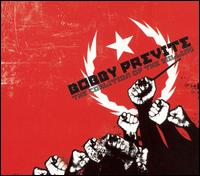
Jazz may stand accused as being elitist music, but it is sometimes better not to be too closely tethered to every popular trend. A case in point has been the Commie Chic we have seen emblazoned on t-shirts and caps recently, often in the form of hammer & sickles, or portraits of Cuban terrorist Che Guevara. Now Bobby Previte’s new CD cover art, with its raised fists and white star against a crimson background, shows at least the influence of the Commie Chic aesthetic.
Coalition of the Willing, namesake of Previte’s current band, and the Operation Iraqi Freedom coalition partners, certainly looks like a politically charged statement, with tunes like “The Ministry of Truth,” “Airstrip One,” “The Ministry of Love,” and “Oceania” (Winston Smith’s homeland in 1984). Previte’s website and most online reviews however, eschew mention of the Iraq war, and politics in general. Some funky audio samples are available on his myspace page here. For some perspective, press materials say he is currently working on “an evening length piece dealing with the Separation of Church and State, for early music choir and band.”
Being realistic, Bush and the Iraq war are not going to be much more popular in the jazz community than they are in the wider creative community, but jazz artists should be shrewder about Che and his reign of terror. With 180 executions definitively attributed to Che Guevara from 1957-1959, and with the blood over 4,000 on his hands as the director of the new regime’s firing squad kangaroo courts, Che is an icon of terror and death. Previte’s fellow jazz artist, the great Paquito D’Rivera wrote an open letter to Carlos Santana taking the guitarist to task for wearing Che garb and a cross on the Oscar telecast. D’Rivera wrote (quoted by Vargas Llosa):
“One of those Cubans [at La Cabaña] was my cousin Bebo, who was imprisoned there precisely for being a Christian. He recounts to me with infinite bitterness how he could hear from his cell in the early hours of dawn the executions, without trial or process of law, of the many who died shouting, ‘Long live Christ the King!”
There is nothing romantic about the killing and terrorism of Che and other Communist monsters. I imagine D’Rivera and his countryman Arturo Sandoval would be happy to explain it to Previte.
Wednesday, June 07, 2006
Castro Picks Up Rangel’s Tab
In yet another instance proving New York has the worst Congressional delegation in America, Rep. Charlie Rangel is now facing ethical questions over a trip to Cuba. The Center for Public Integrity reports Rangel accepted reimbursement from the Cuban government for himself, his wife and son to tour the island gulag in April 2002, even though House rules only allow for one comped relative on such trips. Rangel has stroked a check to Cuban government to cover his son Steve. Rangel also filed an amended travel report with the House, because his original disclosure forms only listed an environmental organization, the Sian Ka'an Conservation Foundation, as the sole sponsor of the tour.
Of course the New York media can’t work up much enthusiasm for covering ethical lapses of a powerful Democrat. The Times buries the story of Rangel’s trip halfway through a story on junkets, below the travels of Rep. Thomas Bliley, a Republican from Virginia.
Rangel is the dean of the New York delegation. Someone of his stature inappropriately accepting travel funds from a foreign government should be a front page story. The fact that it was an oppressive government, hostile to American interests is even more scandalous.
Rangel has long been an advocate of normalization with Cuba. He should know better. Rangel, to his credit, has been a longtime supporter of jazz. He briefly appeared at the Jazz Foundation’s Apollo benefit concert in May. If he actually talked to musicians who endured Castro’s rule, like Paquito D’Rivera and Arturo Sandoval, he would have a clearer picture of the realities of Cuba, than what he saw as a “fully hosted” guest of the regime.
Of course the New York media can’t work up much enthusiasm for covering ethical lapses of a powerful Democrat. The Times buries the story of Rangel’s trip halfway through a story on junkets, below the travels of Rep. Thomas Bliley, a Republican from Virginia.
Rangel is the dean of the New York delegation. Someone of his stature inappropriately accepting travel funds from a foreign government should be a front page story. The fact that it was an oppressive government, hostile to American interests is even more scandalous.
Rangel has long been an advocate of normalization with Cuba. He should know better. Rangel, to his credit, has been a longtime supporter of jazz. He briefly appeared at the Jazz Foundation’s Apollo benefit concert in May. If he actually talked to musicians who endured Castro’s rule, like Paquito D’Rivera and Arturo Sandoval, he would have a clearer picture of the realities of Cuba, than what he saw as a “fully hosted” guest of the regime.
Tuesday, June 06, 2006
Typical Tuesday Blues


Walking through the East Village, one can’t help be bombarded by all the posters hyping horror films, hard rock CDs, and club parties trying to tie into today’s date with a Satanic theme. Just for the record, it is 06-06-06, which is 60,606 or in post-Y2K parlance 06-06-2006 for 6,062,006. But why let numerical accuracy stand in the way of a marketing gimmick? Frankly, my company spent too much energy selling 01-01-00 books at the turn of the millennium for people to start nonchalantly dropping integers at this late date. Even Tim LaHaye says today is just another typical Tuesday, so we should all get over it.
If you really want to “celebrate” the date anyway, skip the lame metal bands and spin some Robert Johnson or Peetie Wheastraw. Known as “the Devil’s Son-in-Law,” Wheatstraw, who encouraged stories that he had sold his soul to become the top bluesman, could eat Satanic hair-bands for breakfast, and then dash off a blues about how bland they tasted. His luck ran out the night he and some friends attempted to out-race an oncoming train through an inter-section.
Wheatstraw was something of a precursor to Robert Johnson in terms of rumored bargains with Old Scratch, and their dark, apocalyptic lyrics. Johnson however, would become the towering legend of Blues, in a way no other musician’s life has ever dominated their genre.
It remains difficult to parse truth from legend in accounts of Johnson’s life. Many are familiar with the story that he went to meet the Devil at a crossroads one night. Johnson handed him his guitar, the Devil tuned it and handed it back. Bargain sealed. For the remainder of his short life, Johnson was a blues guitar phenomenon, constantly in motion, singing of “Hell Hounds on his trail.”
Again details about his death are sketchy. It seems fairly well accepted that he was slipped some poisoned whiskey by a jealous husband. There are many dramatic accounts of his death involving fevered hallucinations of Hell Hounds. His frequent traveling mate Johnny Shines heard that Johnson “crawled on his hands and knees and barked like a dog before he died.” Reportedly his final words were: “I pray that my redeemer will come and take me from my grave.”
Johnson’s life remains obscured by mystery, but if there is any accuracy in such reports of his demise, his rumored Faustian bargain, though granting him tremendous mystique, may have contributed to his mental anguish during his final moments. The purveyors of schlocky horror movies and cheesy metal bands trying to play the Devil card today might want to consider his experience. Even if they don’t believe in it, doing business with the Devil may extract a psychic price. Unlike Johnson they will have scant chance of immortality from beyond the grave.
Monday, June 05, 2006
Hilton Ruiz Benefit
Yet another musical heartache came from New Orleans when Latin jazz pianist was the victim of either an apparent attack or a freak accident on Bourbon Street, reports seem to vary widely. Tomorrow there will be a fundraiser for the Ruiz family to help defray medical expenses. According to World Music Central, confirmed guests include Robert Glasper, Andy Gonzalez, Grady Tate, Mark Whitfield, and Gary Bartz.
Saturday, June 03, 2006
Isolating or Celebrating Extremists
Last week David Tate in his Guardian UK blog called for the British left to disassociate itself with Israeli-born radical “anti-Zionist” jazz musician Gilad Atzmon. The Marxist reedman had a history of making provocative statements that either flirt with Anti-Semitism, or explicitly cross the line into hate speech. Here’s some background. Tate criticizes the British Socialist Workers’ Party, and challenges its umbrella organization Unite Against Fascism, writing:
“The SWP invites Atzmon to speak because it is a party which actively and openly promotes racist conspiracy theories as part of its failed Respect strategy, including the notion that "Israel has been formulating and directing UK and US foreign policy".
The Socialist Workers' Party makes a great play of its anti-racist credentials and its prominent role, through its involvement in Unite Against Fascism, in opposing racism.
If Unite Against Fascism is a truly independent organisation, they will have no difficulty in condemning Atzmon's participation in Marxism2006, and will call for his invitation to be withdrawn."
Tate is certainly correct in his contention that involvement with Atzmon will only further discredit the British left. Oddly, the American liberal media seems to encourage the participation of such extremists, as evidenced by the Los Angeles Times and San Francisco Chronicle endorsing the long-shot Congressional bid of former Rep. Pete McCloskey.
McCloskey served in the House from 1967-1983, and has become an easy sound-bite whenever the media needs someone with Republican credentials to criticize the national GOP. He also enjoys speaking to groups like the Institute for Historical Review, whose raison d’être is Holocaust denial. In one such speech, he referred to the “so-called Holocaust.” Incidentally, on Thur., he returned a $2,100 political donation to an individual linked to al-Qaeda.
In a dark parallel, both McCloskey and Aztmon seem inclined to quibble over historical details and actual numbers killed, in the hope that each caveat or downward revision will help de-legitimize Israel. At one point McCloskey, signing his full name, Paul N., suggested to IHR:
I want to make a polite suggestion. So many of my friends and relations personally saw the Nazi death camps during the last days of World War II that I myself am convinced that there was a deliberate policy of extermination of Jews, Poles, gypsies, and homosexuals by the Nazi leadership. Numbers of the specific events can be challenged, but it is my personal view that the IHR would be far more effective if it were to concede that a holocaust did occur and focus on the ADL’s distortions of truth.
Likewise, Atzmon wants to raise issues about historical accuracy in how we remember the Holocaust (page 9):
“Few people in Germany, in Israel or anywhere else know about the extensive collaboration between the Zionists and the Nazis before and during WWII. I am not a historian and the question of whether 6 million or rather 5,500,000 Jewsdied in the Holocaust is not really my major concern."
While the Guardian urges the isolation of Atzmon, the LATimes and SF Chronicle see fit to embrace a McCloskey if he is willing to criticize the current Republican Congress. Is it any wonder American newspaper readership keeps falling?
“The SWP invites Atzmon to speak because it is a party which actively and openly promotes racist conspiracy theories as part of its failed Respect strategy, including the notion that "Israel has been formulating and directing UK and US foreign policy".
The Socialist Workers' Party makes a great play of its anti-racist credentials and its prominent role, through its involvement in Unite Against Fascism, in opposing racism.
If Unite Against Fascism is a truly independent organisation, they will have no difficulty in condemning Atzmon's participation in Marxism2006, and will call for his invitation to be withdrawn."
Tate is certainly correct in his contention that involvement with Atzmon will only further discredit the British left. Oddly, the American liberal media seems to encourage the participation of such extremists, as evidenced by the Los Angeles Times and San Francisco Chronicle endorsing the long-shot Congressional bid of former Rep. Pete McCloskey.
McCloskey served in the House from 1967-1983, and has become an easy sound-bite whenever the media needs someone with Republican credentials to criticize the national GOP. He also enjoys speaking to groups like the Institute for Historical Review, whose raison d’être is Holocaust denial. In one such speech, he referred to the “so-called Holocaust.” Incidentally, on Thur., he returned a $2,100 political donation to an individual linked to al-Qaeda.
In a dark parallel, both McCloskey and Aztmon seem inclined to quibble over historical details and actual numbers killed, in the hope that each caveat or downward revision will help de-legitimize Israel. At one point McCloskey, signing his full name, Paul N., suggested to IHR:
I want to make a polite suggestion. So many of my friends and relations personally saw the Nazi death camps during the last days of World War II that I myself am convinced that there was a deliberate policy of extermination of Jews, Poles, gypsies, and homosexuals by the Nazi leadership. Numbers of the specific events can be challenged, but it is my personal view that the IHR would be far more effective if it were to concede that a holocaust did occur and focus on the ADL’s distortions of truth.
Likewise, Atzmon wants to raise issues about historical accuracy in how we remember the Holocaust (page 9):
“Few people in Germany, in Israel or anywhere else know about the extensive collaboration between the Zionists and the Nazis before and during WWII. I am not a historian and the question of whether 6 million or rather 5,500,000 Jewsdied in the Holocaust is not really my major concern."
While the Guardian urges the isolation of Atzmon, the LATimes and SF Chronicle see fit to embrace a McCloskey if he is willing to criticize the current Republican Congress. Is it any wonder American newspaper readership keeps falling?
Friday, June 02, 2006
Artifacts
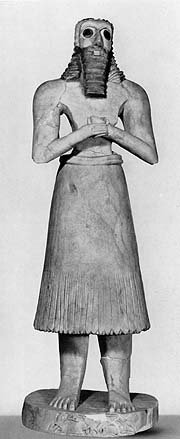
Remember all the hand-wringing in the liberal media about the plundering of the Baghdad Museum and the incalculable loss to humanity? Once it became evident how exaggerated the Museum’s losses were, the media quickly lost interest.
It might not be a good media whipping-boy story anymore, but there are items still missing. (Of course, whenever ancient antiquities are stolen, the logical suspects must be the Knights Templar or Opus Dei.) If you frequent sketchier antiquities dealers, it might be worth while to visit Interpol’s page of missing Iraqi artifacts here. You would think the media would be publicizing these pictures, given the outrage they initially expressed.
Unquestionably, the theft of these artifacts is a loss for humanity. Many who bemoaned the loudest never asked what was the cultural cost of Saddam’s brutal reign of terror. How many great artistic works were never created because a potentially great artist was killed, dumped into one of Saddam’s mass graves? As Iraqi artists begin to express themselves again, we will be able to see the cost to humanity had we not removed his regime from power.
Thursday, June 01, 2006
Daniels’ One O’clock Jump
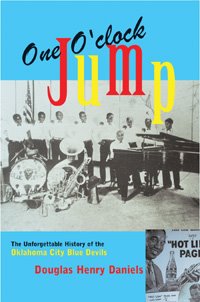
One O’clock Jump: the Unforgettable History of the Oklahoma City Blue Devils
By Douglas Henry Daniels
Beacon Press
0-8070-7136-6
Jazz is closely identified with several American cities, particularly New Orleans, Kansas City, Chicago, and New York. One overlooked jazz municipality is Oklahoma City, the original home of the Blue Devils, a transitional early swing band, rivaling Bennie Moten’s Kansas City band.
Daniels’ One O’clock Jump tells the story of the Blue Devils, a band often assumed to be from Kansas City. Though they toured far and wide, Oklahoma City took civic pride in the ensemble when they returned home. During a low point in their history, a consortium of local African-American business leaders met with bassist Walter Page, one of whom agreed: “Because of the group’s roots in the capitol city and the services they provided to Blacks over the years ‘one of the men put them up in a large room and fed them all’ until they were self-supporting again.” (p. 31)
Some legendary names paid early dues with the Blue Devils, including Lester Young, Jimmy Rushing, Count Basie, Eddie Durham, and a young Ralph Ellison, sitting-in to a limited extent. Indeed, there was something of a revolving door between the Blue Devils and the Moten Band, with many ultimately joining Basie’s band and making history with the Count.
Daniels profiles many of the better known Devils, shedding light on aspects of their lives and careers that might not be well known. Eddie Durham, is generally acclaimed for his early innovations with electrically amplified guitars, but he was also instrumental in the success of Glenn Miller, as the arranger of his signature tune “In the Mood.” Jimmy Rushing is well known as a jazz and blues vocalist, but his religious faith is not as widely reported. According to Daniels, his step-son William Staton “recalled his stepfather reading the Bible all the time, and he blessed the food at mealtime. Rushing ‘was very sincere, and very honest . . . and we went to church once in a while as a group.’” (p. 213)
Obviously, these qualities of Rushing and other Blue Devils explain how this band of jazz musicians was able to forge such ties with their hometown of Oklahoma City, despite the fact that many originally hailed from other Southwestern cities. Although Daniels initially shows too much interest in census data and the early Oklahoma City forefathers, his history of the Blue Devils is a story well worth reading.
Tuesday, May 30, 2006
Entrapment Blues
There was bad news last week for Tarik Shah, the jazz bassist facing charges for conspiring to aid al-Qaeda. Although there was no news in his case, or at least none receiving coverage in the media, there was a verdict in a case with some similarities.
Shahawar Matin Siraj was convicted on May 24th of conspiring to blow-up the Herald Square subway station. Siraj’s defense claimed entrapment on the part the government and their confidential informants, as Shah’s defense seems likely to do. Unfortunately, the jury rejected that defense in just two days, coming in with a guilty verdict.
Interestingly, Siraj’s attorney Martin Stolar, though disappointed by the verdict, refused to see any anti-Muslim bias on the part of the jury, telling NY1 News:
“That they did not convict my client merely because he’s a Muslim accused of terrorism, that they convicted him because they believe the evidence did not make out the defensive entrapment and they followed the law, and I’m satisfied as a professional with that.”
If you remove the entrapment card and the Muslim persecution card from their hand, one wonders what Shah’s defense has left to play. Regardless, I continue to argue in these cases, entrapment is not a moral defense. These are not nebbish losers seduced by bombshell undercover vice-cops. Siraj was convicted of plotting mass murder. Shah stands accused of aiding and abetting mass murderers, namely the perpetrators of 9-11, al-Qaeda. To be “entrapped” into doing so requires an evil viciousness in one’s heart, and a murderous disregard for human life. We do not yet know if Shah is guilty as charged, but in the case of Siraj, the jury has spoken.
Shahawar Matin Siraj was convicted on May 24th of conspiring to blow-up the Herald Square subway station. Siraj’s defense claimed entrapment on the part the government and their confidential informants, as Shah’s defense seems likely to do. Unfortunately, the jury rejected that defense in just two days, coming in with a guilty verdict.
Interestingly, Siraj’s attorney Martin Stolar, though disappointed by the verdict, refused to see any anti-Muslim bias on the part of the jury, telling NY1 News:
“That they did not convict my client merely because he’s a Muslim accused of terrorism, that they convicted him because they believe the evidence did not make out the defensive entrapment and they followed the law, and I’m satisfied as a professional with that.”
If you remove the entrapment card and the Muslim persecution card from their hand, one wonders what Shah’s defense has left to play. Regardless, I continue to argue in these cases, entrapment is not a moral defense. These are not nebbish losers seduced by bombshell undercover vice-cops. Siraj was convicted of plotting mass murder. Shah stands accused of aiding and abetting mass murderers, namely the perpetrators of 9-11, al-Qaeda. To be “entrapped” into doing so requires an evil viciousness in one’s heart, and a murderous disregard for human life. We do not yet know if Shah is guilty as charged, but in the case of Siraj, the jury has spoken.
Friday, May 26, 2006
Congratulations Postcard
Basin Street Record’s Mark Samuels has been outspoken on the subject of the Katrina disaster and plans to rebuild New Orleans. He has been most critical of FEMA, but he was not exactly over-joyed about Mayor Nagin’s re-election. As the president of an independent label, Samuels was less than thrilled with the following quote from Nagin via the AP:
"Business people are predators, and if the economic opportunities are here, they're going to stay. If not, they are going to leave," said Mayor Nagin, in his now-famous vernacular. "I think there's enough interest around the country that we're going to attract top businesses ... God bless them. I hope they stay but if they don't, I'll send them a postcard."
Way to bring people together. Business people like Samuels will be the engine of New Orleans economic recovery. Rather than demonize them, the newly re-elected Mayor should try to create a more conducive environment for economic growth, making it easier for small businesses to hire new employees. Samuels writes to his Mayor: “My children and I hope to be a part of the solution, but please stop making the problems worse.”
Basin Street Records, home of Irvin Mayfield and Henry Butler, is definitely a good thing for New Orleans. Mayor Nagin however, will have to work diligently over the next four years for his redemption in history’s eyes.
"Business people are predators, and if the economic opportunities are here, they're going to stay. If not, they are going to leave," said Mayor Nagin, in his now-famous vernacular. "I think there's enough interest around the country that we're going to attract top businesses ... God bless them. I hope they stay but if they don't, I'll send them a postcard."
Way to bring people together. Business people like Samuels will be the engine of New Orleans economic recovery. Rather than demonize them, the newly re-elected Mayor should try to create a more conducive environment for economic growth, making it easier for small businesses to hire new employees. Samuels writes to his Mayor: “My children and I hope to be a part of the solution, but please stop making the problems worse.”
Basin Street Records, home of Irvin Mayfield and Henry Butler, is definitely a good thing for New Orleans. Mayor Nagin however, will have to work diligently over the next four years for his redemption in history’s eyes.
The State of Jazz Publishing
Speaking of Nat Hentoff, his latest Jazz Times column discusses the commercial outlook for jazz book publishing. Hentoff points to the successful publicity campaign for Peter Levinson’s biography of Tommy Dorsey. He takes publishers to task for their lack of faith in jazz publishing:
Another alleged fact is that “jazz books don’t sell.” As I can attest, this is an increasing reaction from book editors, including some of those who used to be more welcoming to jazz proposals but now go back to their in-house committees for approval and are told to offer minimal advances if any. My response, out of my own frustrating experiences with some of my published books, is that jazz books indeed don’t sell if they’re not promoted with knowledgeable skill and determination as others of mine have proved.
Having seen the numbers on some jazz books published by our sister companies, I can look at this issue realistically. Sell-throughs are usually not bad, but you never really see large quantities shipped on jazz books. They are often profitable, but only marginally so. Of course, as a vanguard art form, jazz does not have a lot of constituents in publishing companies, to build in-house buzz and to provide insight into the potential audience.
Obviously, I believe jazz is important, so jazz writing in books and magazines is important as well. That’s why I have started reviewing recent jazz books from this year, and I will try to catch up with some from last year. Many thanks to cooperative publishers, because from what I have read, and the look of what I received in the mail, I can report there is much vitality in the current state of jazz writing. One can hope commercial appeal will follow.
Another alleged fact is that “jazz books don’t sell.” As I can attest, this is an increasing reaction from book editors, including some of those who used to be more welcoming to jazz proposals but now go back to their in-house committees for approval and are told to offer minimal advances if any. My response, out of my own frustrating experiences with some of my published books, is that jazz books indeed don’t sell if they’re not promoted with knowledgeable skill and determination as others of mine have proved.
Having seen the numbers on some jazz books published by our sister companies, I can look at this issue realistically. Sell-throughs are usually not bad, but you never really see large quantities shipped on jazz books. They are often profitable, but only marginally so. Of course, as a vanguard art form, jazz does not have a lot of constituents in publishing companies, to build in-house buzz and to provide insight into the potential audience.
Obviously, I believe jazz is important, so jazz writing in books and magazines is important as well. That’s why I have started reviewing recent jazz books from this year, and I will try to catch up with some from last year. Many thanks to cooperative publishers, because from what I have read, and the look of what I received in the mail, I can report there is much vitality in the current state of jazz writing. One can hope commercial appeal will follow.
Thursday, May 25, 2006
Cuba: Jazz Without Freedom
Jazz is synonymous with freedom, but sometimes you find one without the other. As in Cuba. A recent posting of Cuban jazz travelogue on allaboutjazz.com, fails to take that into account. Willard Manus’s “Jazz in Cuba” has some useful tips on clubs to frequent should you visit, but when he does touch on politics, he seems to have bought into Castro’s ever present propaganda. Discussing pianist Roberto Fonseca and alto Roberto Martinez he writes: “Both of these up-and-coming stars studied at the government-sponsored Fine Arts Institute and are proud children of the revolution.”
Of course, they don’t have any choice in how to feel about the revolution. Any critical sentiment can lead to Castro’s prisons, torture, or worse. Nat Hentoff visited Cuba with open eyes, and was disturbed by what he saw:
Hentoff is someone I don’t always agree with, but I respect his consistently principled positions. Both he and I would surely enjoy hearing Fonseca and Martinez play, but the realities of Cuban life would dampen the pleasure of the experience. When jazz and freedom both exist on Cuba, then that will be a tour worth taking.
Of course, they don’t have any choice in how to feel about the revolution. Any critical sentiment can lead to Castro’s prisons, torture, or worse. Nat Hentoff visited Cuba with open eyes, and was disturbed by what he saw:
In his Jazz Times column Hentoff wrote of many Cubans who are suffering because they dared to stand up for the freedoms many of us take for granted:I was there a couple of years after the Revolution and was impressed by the universal health-care system—and not surprised by Castro's filling of his gulags, including some former supporters who had realized too late that freedom of expression can be a high crime in a dictatorship.
Hector Palacios, an organizer and leader of the Varela Project, has been sentenced to 25 years in prison. A number of the prisoners of conscience suffer from illnesses that are not likely to be treated behind bars. Raúl Rivero, for example, among other ailments, is afflicted with phlebitis. Among the independent librarians put away during the crackdown is Julio Antonio Valdes Guevara, suffering from high blood pressure and renal insufficiency. Amnesty International reports that he "is not receiving any medication." Guevara is in for 20 years.
Hentoff is someone I don’t always agree with, but I respect his consistently principled positions. Both he and I would surely enjoy hearing Fonseca and Martinez play, but the realities of Cuban life would dampen the pleasure of the experience. When jazz and freedom both exist on Cuba, then that will be a tour worth taking.
Wednesday, May 24, 2006
Q Sees No Evil

Quincy Jones, one-time jazz big band leader, multi-genre producer, film scorer and Democratic Party contributor has been “seduced by China on his first visit,” according to Reuters. “The inspiration of the strong leadership in preparing the 2008 Olympic Games and the theme ‘One world, One dream’ has led me to offer everything I can possibly bring . . . to this fantastic event,” Jones said.
I suppose you could say the Chinese government is known for strong leadership. Iron-fisted the Tibetans might even say. Tiananmen Square is probably quite charming without all those protestors cluttering up. Evidently, Q was also dazzled by “the beautiful women—some of the most beautiful I’ve ever seen, whoah,” but didn’t see anything amiss on the human right front.
Tuesday, May 23, 2006
Children’s Book Writer Needs to Grow Up
In what passes for a hot controversy in the publishing industry, Patricia Polacco continues to milk her speaking engagement termination by McGraw-Hill for all the publicity she can muster. One place she posted her statement was truthout.org, the dubious website that still insists Karl Rove has been indicted, although no other media outlet has been able to confirm (and surely not from a lack of desire). There she modestly brags about her insistence to deliver a partisan speech which she admits McGraw-Hill did not contract her for: “I have to admit that I have a certain amount of pride in taking this stand on your behalf.” A venue that Howard Kurtz finds lacking in credibility is about right for her immature hysterics.
Yes immature is a harsh term, but it is sadly fitting in the case of some of her statements. From her website:
The overly dramatic capitalization and exclamation points would likely embarrass the average pre-teen. Polacco admits she signed a contract for a non-partisan speech she had no intention of giving. She tries to gloss over this unprofessional act with forced “cuteness:”
As far as the SRA/McGraw Hill contract is concerned, obviously I signed it January of 2006. I have never disputed this. I am, however, ashamed to admit that I did not read this contract, nor do I have any memory of ever signing it. Especially in view of the fact that Buchannan and Associates was the ONLY entity that my staff was dealing with concerning the IRA appearance. They assumed, as did I, that Buchannan and Associates represented the IRA.
If this makes me a complete idiot…then I will take the heat on this. I sign a stack of documents every single day. In the interest of saving time, my assistant simply puts the stack of documents, letters, and missives in front of me, leafs through, exposing only the signature pages, points at the signature line, and I simply sign them period. I never see any of these contracts with the exception of only the signature page. I do them so quickly that I pay no attention…I just sign my name. Appearance contracts are usually so straight-forward and uncomplicated that they don’t warrant severe scrutiny…again, if this makes me a blithering, drooling idiot, I take the hit again.
Indeed. Polacco wants to pretend she is the victim of censorship, but as she volubly demonstrates, that clearly is not the case. Censorship involves forcibly suppressing speech. However, the First Amendment no more guarantees her a paid podium to grind her political axe at the expense of McGraw-Hill, than it entitles me to be paid to bore the same audience with a gloriously detailed history of jazz discography.
In truth it seems money is what really motivates Polacco in all this, as she spends a great deal of time in her statement claiming McGraw-Hill owes her $5,000. So much for principles. Whether she collects is a matter for the lawyers. As for her disingenuous claims of censorship, Polacco should just grow up.
Yes immature is a harsh term, but it is sadly fitting in the case of some of her statements. From her website:
Their official position is: “Patricia Polacco did not fulfill her contract to us, therefore her programs were cancelled” ”the company cancelled Polacco’s speaking engagements only after officials learned that she wasn’t willing to keep her remarks limited to the subjects covered in her contract””Patricia Polacco CHOSE not to honor her contract”
I CHOSE??? HOW COULD I CHOOSE NOT TO APPEAR WHEN MY CHOICE WAS TAKEN FROM ME BY SRA/McGRAW HILL’S CANCELATION? I WAS NOT GIVEN THE OPPORTUNITY TO FULFILL THE CONTRACT. IT WAS CANCELLED OUT FROM UNDER ME!!!! SRA/McGRAW HILL MADE ALL OF THE CHOICES HERE! THEY EFFECTIVELY REMOVED ANY OF MY CHOICES WHEN THEY ACTED AND CANCELLED THE APPEARANCE.
The overly dramatic capitalization and exclamation points would likely embarrass the average pre-teen. Polacco admits she signed a contract for a non-partisan speech she had no intention of giving. She tries to gloss over this unprofessional act with forced “cuteness:”
As far as the SRA/McGraw Hill contract is concerned, obviously I signed it January of 2006. I have never disputed this. I am, however, ashamed to admit that I did not read this contract, nor do I have any memory of ever signing it. Especially in view of the fact that Buchannan and Associates was the ONLY entity that my staff was dealing with concerning the IRA appearance. They assumed, as did I, that Buchannan and Associates represented the IRA.
If this makes me a complete idiot…then I will take the heat on this. I sign a stack of documents every single day. In the interest of saving time, my assistant simply puts the stack of documents, letters, and missives in front of me, leafs through, exposing only the signature pages, points at the signature line, and I simply sign them period. I never see any of these contracts with the exception of only the signature page. I do them so quickly that I pay no attention…I just sign my name. Appearance contracts are usually so straight-forward and uncomplicated that they don’t warrant severe scrutiny…again, if this makes me a blithering, drooling idiot, I take the hit again.
Indeed. Polacco wants to pretend she is the victim of censorship, but as she volubly demonstrates, that clearly is not the case. Censorship involves forcibly suppressing speech. However, the First Amendment no more guarantees her a paid podium to grind her political axe at the expense of McGraw-Hill, than it entitles me to be paid to bore the same audience with a gloriously detailed history of jazz discography.
In truth it seems money is what really motivates Polacco in all this, as she spends a great deal of time in her statement claiming McGraw-Hill owes her $5,000. So much for principles. Whether she collects is a matter for the lawyers. As for her disingenuous claims of censorship, Polacco should just grow up.
Monday, May 22, 2006
Williams’ Me and My Father’s Shadow
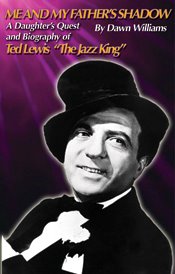
Me and My Father’s Shadow
By Dawn Williams
Sunrise House
0-9770783-1-0
A career in music can take a toll. Sometimes it is family members who pay it. Recent biographies about Oscar Brown, Jr. and Jackie Paris include notable revelations about love children, the result of life on the road. Dawn Williams’ book Me and My Father’s Shadow: A Daughter’s Quest and Biography of Ted Lewis “the Jazz King” tells a similar story.
Williams has two narratives to tell. One is her personal story culminating with her response to the revelation that her father was actually the early jazz band leader Ted Lewis, best known for his “Me and My Shadow” number. The other is the story of her father, the popular bandleader, who worked steadily from the 1920’s through the early 1960’s, but is largely forgotten today.
Many jazz fans might bridle at the description of Lewis as “the Jazz King,” but Lewis was a much more worthy monarch than the man he dethroned, Original Dixieland Jazz Band leader Nick LaRocca. LaRocca held the distinction as the leader of the first recorded jazz band. Although his music was appropriated from the African-American bands of New Orleans, LaRocca was a virulent racist, who dismissed non-white contributions to music in the crudest of terms. LaRocca’s ODJB had made Reisenweber’s restaurant the top nightspot in Manhattan. Rectors, a competitor, was looking for a jazz band to cut into their action. When Lewis was hired:
“Ted and his new band not only gave Rectors audience the jazz George Rector sought, but also sights and sounds it never heard before. The trombones laughed, clarinets sobbed, and hat-muted instruments, with their ‘wah-wah-wah’s,’ talked to an audience that seemed to understand every word.” (p. 157)
Many swing purists might dismiss Lewis for his comedic effects. Lewis was a dedicated showman more than a musician, famous for his catch-phrase: “is everybody happy?” He did however, have quite an ear when hiring sidemen. Important figures like the Dorseys, Mugsy Spanier, and his apostolic successors to the Jazz King title, Paul Whiteman and Benny Goodman, served early apprenticeships in Lewis’ band. In 1931 Lewis even recorded “I’m Crazy ‘Bout My Baby” with Fats Waller, in act of musical integration that would prefigure Goodman’s racially integrated quartet with Lionel Hampton and Teddy Wilson.
In Williams’ book, Williams comes off sympathetically. From what she has been able to piece together, it seems Williams tried to do right for the daughter he never met on several occasions. Williams was popular enough to be the subject of two films in the 1920’s and 1930’s, but his music would eventually fall out of popular favor. More than anything, he was an entertainer. Lewis said:
“My shows are always clean and entertaining. What most people want are lyrics that come straight from the heart. People want to see the same show and hear me play the way I’ve always played.” (p. 199)
Shadow performs a valuable service by preserving an important chapter in big band history.
Friday, May 19, 2006
Da Vinci Mythos
After last night’s Da Vinci Code screening, it’s difficult to fully sum up my reaction. Elements of the film I enjoyed quite a bit. The film’s puzzle solving is quite entertaining. You also have to appreciate a film whose characters have passion for history, religion, art, and mathematics. It is beautifully filmed, making a great tourism commercial for the European locations. On the downside, the Hanks and Tautou characters seem wooden on screen. In terms of its biases against the Church, the sins of the film are essentially the original sins of source novel.
I was told the book is actually much more didactic and frequent in its attacks on Christianity’s role in history. In the film, Hanks’ character often provides some skepticism of the anti-Church monologues of Sir Ian McKellan’s Grail enthusiast. Indeed, the villainous “Teacher” as actually played by McKellan is an unhinged anti-Christian bigot (spoiler, by the way).
I haven’t read The Da Vinci Code, but I have read several books in the loose Da Vinci-esque genre for my publishing work. In some of these books there is the reoccurring myth that Pope Pius XII was blackmailed by the National Socialists to ignore the holocaust with the threat of the exposure of a dark secret that would shake Christendom to its foundation. In actuality, Pius worked to save hundreds of thousands from the death camps, as Rabbi David G. Dalin illustrates in his book The Myth of Hitler’s Pope. Unfortunately, this historical libel seems to be accepted as fact by many.
Da Vinci Code and its imitators show how myths are created. The notion of the Church suppressing Mary Magdalene’s role as wife and disciple has probably gained much popular acceptance, through its repetition in the stories we hear and tell. Whether it is The Iliad, the Loch Ness Monster, urban legends, or Joe Wilson’s account of his trip to Niger, some fiction becomes accepted as fact through the power of story-telling. Fortunately, there seem to be no lack of books decoding, debunking, and pouring cold water on the Da Vinci Code to set the historical record straight.
As for the film, it is uneven, but entertaining. I enjoyed it, but ultimately, the sum of its parts might be greater than its whole.
Thursday, May 18, 2006
Rebuilding Crescent Cities
The June Jazz Times brings news of an upcoming documentary, New Orleans Music in Exile from filmmaker Robert Mugge, funded by the Starz channel. Mugge has made many jazz and blues films, including Saxophone Colossus, a portrait of the legendary Sonny Rollins. According to Bill Milkowski’s “After the Storm” (currently not available on-line), Mugge filmed in Memphis, Houston, Austin, Lafayette, and wrapped in New Orleans. I’ve talked to many such musical exiles and I know how important it is to tell their stories right.
Mugge obviously has passion for this music, and I’m sure his intentions are good. I look forward to seeing his film, but I am frustrated by one of his quotes in Milkowski’s piece: “If they ever find that they have any money left for restoring New Orleans and the rest of the region, after totally dismantling the nation’s budget through the war in Iraq, maybe there will be some good reasons for optimism. But right now it’s just a mess down there.”
New Orleans was hit by a hurricane, a devastating natural disaster. Iraq, one of the oldest civilizations on Earth, was in effect, hit by a daily hurricane under the Saddam’s oppressive rule. As WATIV reported on allaboutjazz.com in “Baghdad, New Orleans . . . Crescent Cities,” like in New Orleans, music played an enormous role in the region’s cultural history, but most of Iraq’s musicians were forced to take refuge in Egypt. As Katrina cut off power and supplies from New Orleans, Hussein deliberately imposed blackouts and privations on Baghdad and other Iraqi cities, and silenced their music.
Removing Saddam lifted the hurricane from Iraq, but as in New Orleans, the rebuilding will take a long time. The ideals of civilization demand we assist both NOLA and Iraq, for both have contributed greatly to the cultural wealth of our world. Throwaway lines carping about our involvement in Iraq will not help anyone, anywhere.
To help the Jazz Foundation of America bring back the music to New Orleans, go here. If Starz InBlack is part of your cable package, look for New orleans Music in Exile when it debuts tomorrow.
Mugge obviously has passion for this music, and I’m sure his intentions are good. I look forward to seeing his film, but I am frustrated by one of his quotes in Milkowski’s piece: “If they ever find that they have any money left for restoring New Orleans and the rest of the region, after totally dismantling the nation’s budget through the war in Iraq, maybe there will be some good reasons for optimism. But right now it’s just a mess down there.”
New Orleans was hit by a hurricane, a devastating natural disaster. Iraq, one of the oldest civilizations on Earth, was in effect, hit by a daily hurricane under the Saddam’s oppressive rule. As WATIV reported on allaboutjazz.com in “Baghdad, New Orleans . . . Crescent Cities,” like in New Orleans, music played an enormous role in the region’s cultural history, but most of Iraq’s musicians were forced to take refuge in Egypt. As Katrina cut off power and supplies from New Orleans, Hussein deliberately imposed blackouts and privations on Baghdad and other Iraqi cities, and silenced their music.
Removing Saddam lifted the hurricane from Iraq, but as in New Orleans, the rebuilding will take a long time. The ideals of civilization demand we assist both NOLA and Iraq, for both have contributed greatly to the cultural wealth of our world. Throwaway lines carping about our involvement in Iraq will not help anyone, anywhere.
To help the Jazz Foundation of America bring back the music to New Orleans, go here. If Starz InBlack is part of your cable package, look for New orleans Music in Exile when it debuts tomorrow.
Wednesday, May 17, 2006
Home of the Brave Launches
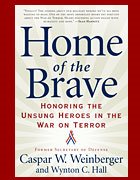
Full disclosure: Home of the Brave: Honoring the Unsung Heroes in the War on Terror is published by the company I work for. It is also a very worthy book in my biased opinion. Co-written by Secretary of Defense Caspar Weinberger, Home profiles heroes from the War on Terror in Iraq and Afghanistan.
Last night Steve Forbes generously hosted a launch party in the Forbes building. Weinberger of course, was a longtime friend and colleague of the Forbes family, and former publisher of Forbes magazine. Also in attendance were four highly decorated genuine heroes, whose stories are told in Home of the Brave: Army National Guard Sergeant Leigh Ann Hester (Silver Star), Air Force Master Sergeant William Markham (Silver Star), Marine Sergeant Marco Martinez (Navy Cross), and Army Lieutenant Colonel Mark Mitchell (Distinguished Service Cross).
When introducing the heroes Mr. Forbes mentioned Sergeant Markham, whose boots were the first on the ground in Afghanistan, had another project worthy of promotion. Every year he hosts the Whomper Stomper Open golf tournament to benefit the Special Operations Warrior Foundation. This organization provides scholarships and educational counseling to the families of Special operations personnel killed in the line of duty. To learn how to support them, visit their website.
All four heroes were gracious, and we were honored by their presence. Hopefully they will enjoy their stay in New York. In conversation with one, I was struck by the optimism tempered by realism I heard expressed for the situation in Iraq. It’s an optimism that the antique media refuses to convey. During his remarks Mr. Forbes made the point that the heroes in the U.S. military will not lose the War on Terror on the battlefield. It’s on the home front where we are most apt to be defeated. Hopefully, in one of his final acts of service, Sec. Weinberger will help steel our resolve.
Tuesday, May 16, 2006
Happy Birthday, Michael Moore, Bassist
Today is Michael Moore’s birthday. Not the leftwing extremist filmmaker, but the swing-oriented jazz bassist. I have no idea what bassist Moore’s politics are like, but they can’t possibly be any more feverish than his namesake’s. AMG, with perhaps a touch of irony, describes him as a “musical arch-conservative.”
Moore has played with the likes of Dave Brubeck, Marian McPartland, and Bill Charlap. He toured with Woody Herman on behalf of the U.S. State Department. He has led or co-led several sessions of his own. Moore is certainly a talented, in-demand musician.
Michael Moore is hardly an uncommon name, but if bassist Moore’s e-mail address is his name at yahoo or hotmail, I imagine he’s received some bizarre correspondence over recent years. Here’s hoping he has a happy birthday.
Moore has played with the likes of Dave Brubeck, Marian McPartland, and Bill Charlap. He toured with Woody Herman on behalf of the U.S. State Department. He has led or co-led several sessions of his own. Moore is certainly a talented, in-demand musician.
Michael Moore is hardly an uncommon name, but if bassist Moore’s e-mail address is his name at yahoo or hotmail, I imagine he’s received some bizarre correspondence over recent years. Here’s hoping he has a happy birthday.
Monday, May 15, 2006
Author Baits, Switches, Then Cries “Foul”
Suppose you contracted a speaker to talk about the heroes and real life stories which she finds inspiring. Then you learn she was planning to deliver a partisan harangue directed at the No Child Left Behind policy, for which you publish a line of books. You might understandably say thanks, but no thanks. Would it surprise you if you then found yourself accused of censorship in the columns of PW Daily? That’s exactly what happened to McGraw-Hill after they decided Patricia Polacco’s services were no longer needed.
It’s interesting to see how PW played the story. Under a Friday (5/12) headline “Author Shouts Foul Over Cancelled Appearance,” PW tells their concerned readers: “Patricia Polacco is scared.” The dark specter of fascism looms larger when we read:
Scary times we live in. Bush using McGraw-Hill as his puppet, and what-not. However today, in a brief clarification under pieces about the wholesaler AMS, repackaging Agatha Christie books, and titles going on-sale next week, PW adds a note on the Polacco story (keep scrolling, it’s buried deep below the fold):
I guess it’s a mere detail to PW that Polacco seemed to be engaging in a bait and switch. Either she fraudulently accepted the engagement with the intent of delivering an entirely different speech, or at the very least, she runs a very careless organization that does not pay attention to pesky details, like contracts. It’s quite understandable that McGraw-Hill wasn’t inclined to pick up the tab for that.
Update: the original PW Daily story on-line now carries the note of clarification beneath it, effectively undercutting the preceding article. PW's odd editorial choices have clearly played up Polacco's sense of victimhood, however it is hard to share those sentiments after learning the terms of the agreement.
It’s interesting to see how PW played the story. Under a Friday (5/12) headline “Author Shouts Foul Over Cancelled Appearance,” PW tells their concerned readers: “Patricia Polacco is scared.” The dark specter of fascism looms larger when we read:
Polacco, who told PW that McGraw-Hill lawyers had spoken "aggressively" with a lawyer friend of hers, said the publisher threatened to sue if they lost sales as a result of the potential negative publicity she had had drummed up. This, Polacco, said made her very uneasy. "The problem is, if this went to a lawsuit, they're Goliath and I'm David. Just to defend it, they could wipe me out." Polacco also insisted that, despite appearances, McGraw-Hill was not the bad guy. "It's No Child Left Behind that I'm gunning for," she said.
Scary times we live in. Bush using McGraw-Hill as his puppet, and what-not. However today, in a brief clarification under pieces about the wholesaler AMS, repackaging Agatha Christie books, and titles going on-sale next week, PW adds a note on the Polacco story (keep scrolling, it’s buried deep below the fold):
Clarifying Friday's Daily story about the sparring between children's author Patricia Polacco and SRA/McGraw-Hill (click here to read)—in which the author claimed she was censored by the publisher after she tried to craft a speech, to be given at an event sponsored by McGraw-Hill, railing against the No Child Left Behind policy. The contract Polacco signed, which she told PW she did not read, clearly stated the two topics which she was to address: the "heroes" who've impacted her life and the real life stories that inspired certain titles she wrote.
I guess it’s a mere detail to PW that Polacco seemed to be engaging in a bait and switch. Either she fraudulently accepted the engagement with the intent of delivering an entirely different speech, or at the very least, she runs a very careless organization that does not pay attention to pesky details, like contracts. It’s quite understandable that McGraw-Hill wasn’t inclined to pick up the tab for that.
Update: the original PW Daily story on-line now carries the note of clarification beneath it, effectively undercutting the preceding article. PW's odd editorial choices have clearly played up Polacco's sense of victimhood, however it is hard to share those sentiments after learning the terms of the agreement.
Harlem of the West
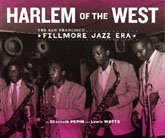 Harlem of the West: the San Francisco Fillmore Jazz Era
By Elizabeth Pepin and Lewis Watts
Chronicle Books
Tradepaper with extensive photos
0-8118-4548-6
The cover alone should convince readers of Harlem of the West: the San Francisco Fillmore Jazz Era's contention that an important time and place in the history of jazz was lost and nearly forgotten when city planners gutted the neighborhood. The first three musicians seen pictured from the left are John Handy, Pony Poindexter, and John Coltrane, sufficient evidence the Fillmore jazz scene was for real. Written by Elizabeth Pepin, with assistance from Lewis Watts, Harlem of the West is a well put together illustrated book that recaptures a forgotten chapter in jazz history.
In the 1940’s, 1950’s and 1960’s the Fillmore neighborhood of San Francisco was a thriving home to scores of jazz and blues clubs. Now the Fillmore Auditorium, transformed by Bill Graham into a legendary rock venue, is one of few surviving buildings from that era. Given Graham’s reputation, it might sound like exaggeration when Pepin writes:
“Most people only know about the Fillmore because of its auditorium, made famous by Bill Graham in the late 1960’s. Few are aware of its more important musical period in the decades preceeding.” (p. 13)
Yet, Pepin began her Fillmore research as an employee of Graham. The fact that clubs and establishments which hosted some of the finest jazz and blues entertainers could be so thoroughly removed from the neighborhood, and largely from memory, is a tragedy.
The photos collected in Harlem of the West, many recently discovered, are a time capsule from a different time. It was an era when people dressed up for a night on the town, and music was a major part of their plans. A number of great musicians, like Handy, Poindexter, Teddy Edwards, and Jerome Richardson, gigged in Fillmore clubs early in their careers, and there are wonderful images of them in this book.
There is a villain in Harlem of the West: the faceless bureaucrats who destroyed the neighborhood in the name of urban renewal. This is a book Justice Souter ought to read, as it makes clear the human price for eminent domain run amok.
John Handy told Pepin: “There wasn’t a Fillmore sound per say.” (p. 152) However, a tremendous about of excellent music was performed for appreciative audiences there. Sadly, that music was silenced by urban renewal policies, but Harlem of the West preserves the memories of that vibrant music scene.
Friday, May 12, 2006
Jazz Poems
 Jazz Poems
Edited by Kevin Young
Everyman/Knopf
1-4000-4251-8
Capturing jazz performance in words is a difficult challenge. It often requires poetic expression more than simple descriptive prose. Many such attempts have been collected in Jazz Poems a collection finely edited by Kevin Young in a new Everyman gift edition.
Often jazz poems are elegiac, written on the passing of great artists like Frank O’Hara’s “The Day Lady Died,” in which he recalls:
leaning on the john door in the FIVE SPOT
while she whispered a song along the keyboard
to Mal Waldron and everyone and I stopped breathing.
Some poets are able to capture the ephemeral nature of music, like current NEA Chairman Dana Gioia in “Bix Beiderbecke (1903-1931):”
He dreamed he played the notes so slowly that
they hovered in the air above the crowd
and shimmered like a neon sign.
Certain themes reoccur, like the classless nature of jazz. Langston Hughes’ “Jazz Band in a Parisian Cabaret” exhorts:
Play it for the lords and ladies,
For the dukes and counts,
For the whores and gigolos
For the American millionaires,
And the school teachers
Out for a spree.
Jazz Poems is a consistently rewarding collection. It was a handy volume to refer to while reading Yaffe’s Fascinating Rhythm, since it anthologizes many of the poems that book analyzes. While many of the selected poems are darker than what you might expect to find in a small trim size gift book, it is appropriate. Jazz is a music that demands honesty and integrity in all things, including editorial choice.
Thursday, May 11, 2006
Fusion Warriors and the “S” Word
This month’s Downbeat (limited content on-line) features “Fusion Warriors” by Willard Jenkins, a “Behind the Music” style look at Chick Corea’s 1970’s fusion super-group Return to Forever. While Jenkins does discuss the tensions arising from members’ solo projects, as well arguments over money, one subject seems to be missing. The “S” word: Scientology.
Supposedly, the name Return to Forever was inspired by L. Ron Hubbard’s writings. For his part, Corea has been an active proponent and recruiter for Hubbard’s church. According to his Wikipedia entry, one-time RTF band member Joe Farrell told Corea “not to ‘lay that Scientology shit’ on him.” Longtime RTF bassist Stanley Clarke was involved with Scientology as well, but he has reportedly broken with the Church. One can also see RTF concept albums like Romantic Warrior as being precursors to Corea’s recent CDs inspired by Hubbard novels, which feature some excellent music.
“Fusion Warriors” expresses criticism of Corea, particularly for not agreeing to a reunion tour. According to Al DiMeola: “Three years ago we were on the verge of a reunion, but Chick had a change of heart, with no explanation why. It’s so sad to deny a whole new generation—and our past fans the chance to see us one more time.” It just seems like DB is missing part of the story here, regardless of how you feel about Scientology, pro or con.
Wednesday, May 10, 2006
al-Jaz Covers Jazz Fest
English al-Jazeera isn’t exactly flooding the zone with jazz coverage. When it does cover jazz, it’s usually to promote an agenda through someone like Gilad Atzmon. On May 1st, they wrote up the first weekend of the New Orleans’ Jazz & Heritage Festival. While briefly noting the presence of great NOLA musicians like Terence Blanchard, the NewBirth Brass Band, Dr. John, and Allen Toussaint, al-Jazeera gave the most ink to a non-jazz musician from New Jersey: Bruce Springsteen. Al-Jazeera reported at one point Springsteen “launched into a song titled How Can A Poor Man Stand Such Times and Live? and dedicated the song to ‘President Bystander.”
No word if he made a dedication to “Mayor Hiding in the Bathroom.” Last week musicians like the NewBirth Brass Band, Dr. Michael White, and Henry Butler were shuttling to and from NY and NOLA to play both Jazz Fest and the Jazz Foundation’s benefit concert. While they were looking to bring people together to rebuild their city, evidently Springsteen stuck to the extremist left’s game plan of dividing people. At least he played well on al-Jazeera.
No word if he made a dedication to “Mayor Hiding in the Bathroom.” Last week musicians like the NewBirth Brass Band, Dr. Michael White, and Henry Butler were shuttling to and from NY and NOLA to play both Jazz Fest and the Jazz Foundation’s benefit concert. While they were looking to bring people together to rebuild their city, evidently Springsteen stuck to the extremist left’s game plan of dividing people. At least he played well on al-Jazeera.
Tuesday, May 09, 2006
WATIV in STN
Interesting piece Signal to Noise Magazine (no content on-line), “A Soldier’s Story,” about William A. Thompson IV (WATIV), a New Orleans jazz pianist turned electronic music composer during his recent tour of duty in Iraq. Composed and assembled with “iPod mike, sampler, Apple G4 and 88-weighted-keyboard,” Baghdad Music Journal clearly conveys the turmoil of his wartime experiences. The samples on his myspace page are certainly dark in tone. Of course, most of the electronic music I’ve heard has been dark or moody. Article writer Howard Mandel is only too eager to read political statements into WATIV’s music. Too be fair Thompson did express frustration when his tour was extended, but he seems to take pains to avoid outright political statements, preferring to let the music speak for itself. (Mandel has also written on behalf of Tarik Shah, the jazz bassist accused of conspiring to aid al-Qaeda, calling the government's case "shameful" according to Shah supporter Margaret Davis.)
It sounds like Thompson’s feelings about his service in Iraq are actually somewhat ambiguous. Thompson reported from Iraq for allaboutjazz.com that he “had several students since I’ve been in country. Most recently I have taken on an eager jazz bass student.” While underplaying the impact of his work, it certainly sounds like Thompson was part of the good news from Iraq. In terms of the impact of Iraq on himself, Thompson told Mandel: “this experience was one that very few other artists are going to have. I feel lucky for having it. I felt opposed at having to go, but nobody else can say they’ve done what I’ve done.” Whatever his politics, one has to have gratitude for Thompson’s service, and wish him well as he finishes his studies at the University of New Orleans and helps rebuild the music scene in America’s Crescent City.
It sounds like Thompson’s feelings about his service in Iraq are actually somewhat ambiguous. Thompson reported from Iraq for allaboutjazz.com that he “had several students since I’ve been in country. Most recently I have taken on an eager jazz bass student.” While underplaying the impact of his work, it certainly sounds like Thompson was part of the good news from Iraq. In terms of the impact of Iraq on himself, Thompson told Mandel: “this experience was one that very few other artists are going to have. I feel lucky for having it. I felt opposed at having to go, but nobody else can say they’ve done what I’ve done.” Whatever his politics, one has to have gratitude for Thompson’s service, and wish him well as he finishes his studies at the University of New Orleans and helps rebuild the music scene in America’s Crescent City.
Monday, May 08, 2006
Blue Notes on the Silver Screen
It seems like there’s a mini-boom of jazz movies on the horizon. Andy Garcia’s Lost City, featuring a great Afro-Cuban jazz soundtrack is currently playing in select cities. Rumors are swirling about Chet Baker and Miles Davis bio-pics. A film about Duke Ellington’s tour of Iraq on behalf of the U.S. State Dept. is in development at New Line.
On the documentary front, the Oscar Brown Jr. film Music is My Life, Politics is My Mistress screened at the Harlem Film Festival. 'Tis Autumn, a film on vocalist Jackie Paris debuted to great acclaim at Sundance, and This is Gary McFarland, a doc. about the musician-arranger-composer is also starting to make the festival circuit. At an IAJE panel in January, attendees saw a sneak preview of the nearly complete film Trumpetistically Clora Bryant, about the under-recognized bop trumpeter. On the further horizon, a doc on jazz violinist Billy Bang is in the works.
Perhaps the most intriguing film in the works is Crazy, the life story of Hank Garland. One of the top Nashville session men, guitarist Garland stunned the country music world by recording some excellent jazz sessions. Shortly thereafter he suffered an injury in a car crash that derailed his career for years. Presumably, green-lighted to capitalize on the success of Walk the Line, and starring Waylon Payne who played Jerry Lee Lewis in that film, Garland’s life seems like an unlikely choice to dramatize. If nothing else, it will certainly be interesting to see how Hollywood handles Garland’s jazz interlude.
Ironically, these films confirm the artistic advantage of a free market society. Labor of love documentaries would have a difficult time finding support from bureaucrats who control the state film resources under socialism. In our system, dedicated filmmakers, now frequently using digital video, can bring personal stories to audiences without the approval of any governing entity. It is often more costly in terms of time than resources. Free markets and free expression can lead to eccentric visions or crass commercialism. As consumers however, we can be the ultimate arbiters.
For now, I recommend Lost City, and Music is My Life if they happen to screen at a theater near you. From what I saw of the Clora Bryant film, I’m definitely looking forward to seeing the finished film. Maybe the near future will bring a minor golden age of jazz on the silver screen.
On the documentary front, the Oscar Brown Jr. film Music is My Life, Politics is My Mistress screened at the Harlem Film Festival. 'Tis Autumn, a film on vocalist Jackie Paris debuted to great acclaim at Sundance, and This is Gary McFarland, a doc. about the musician-arranger-composer is also starting to make the festival circuit. At an IAJE panel in January, attendees saw a sneak preview of the nearly complete film Trumpetistically Clora Bryant, about the under-recognized bop trumpeter. On the further horizon, a doc on jazz violinist Billy Bang is in the works.
Perhaps the most intriguing film in the works is Crazy, the life story of Hank Garland. One of the top Nashville session men, guitarist Garland stunned the country music world by recording some excellent jazz sessions. Shortly thereafter he suffered an injury in a car crash that derailed his career for years. Presumably, green-lighted to capitalize on the success of Walk the Line, and starring Waylon Payne who played Jerry Lee Lewis in that film, Garland’s life seems like an unlikely choice to dramatize. If nothing else, it will certainly be interesting to see how Hollywood handles Garland’s jazz interlude.
Ironically, these films confirm the artistic advantage of a free market society. Labor of love documentaries would have a difficult time finding support from bureaucrats who control the state film resources under socialism. In our system, dedicated filmmakers, now frequently using digital video, can bring personal stories to audiences without the approval of any governing entity. It is often more costly in terms of time than resources. Free markets and free expression can lead to eccentric visions or crass commercialism. As consumers however, we can be the ultimate arbiters.
For now, I recommend Lost City, and Music is My Life if they happen to screen at a theater near you. From what I saw of the Clora Bryant film, I’m definitely looking forward to seeing the finished film. Maybe the near future will bring a minor golden age of jazz on the silver screen.
Sunday, May 07, 2006
Lloyd’s Eugene Bullard

Eugene Bullard: Black Expatriate in Jazz-Age Paris
By Craig Lloyd
University of Georgia Press
Tradepaper edition with new preface
0-8203-2818-9
At one point in his biography Eugene Bullard: Black Expatriate in Jazz-Age Paris, Craig Lloyd sums up his subject writing: “His had been the rough company of gypsies, sailors, boxers, soldiers, and jazzmen.” (p. 97) In short, our kind of people. Sadly Bullard, recipient of the Croix de Guerre and Legion of Honor Medal, never received proper recognition during his lifetime in the country of his birth.
Born into the tragedy of Southern segregation, Bullard never resigned himself to his circumstances. As teenager, he ran away from home, ultimately stowing away aboard a ship bound for Europe. Once there, he began to thrive in an environment of freedom, finding work as boxer. He would be a friendly colleague of champion in exile Jack Johnson, jazz’s favorite pugilist.
Eventually settling in Paris, Bullard would enlist with the French before America’s entry into WWI. Decorated for valor at Verdun, Bullard would transfer to the French aviation corps, where he would earn the distinction of being the first African-American combat pilot. It was a distinction American officers did not appreciate when the American military, newly engaged in the Great War, absorbed the Yank expatriates fighting for France. Lloyd’s new preface includes further examples of this disgraceful treatment of Bullard.
After the war, the decorated Bullard stayed in his adopted Paris to become a leading figure in the budding night club business of Montmartre, first as a musician. Lloyd describes Bullard “becoming proficient enough as a drummer (he admits several times he was never more than that)” (p. 77) Bullard’s real importance to the French jazz scene was as a club manager and eventually owner. He would befriend and assist legendary musicians like Noble Sissle, Sidney Bechet, and Louis Armstrong. He would even return to Europe with Armstrong in 1952 to translate and assist with logistics on a continental tour.
As National Socialism started to conquer Europe, Bullard once again answered the French call to service, assisting French intelligence collect information on German agents. When France was over-run by the German war machine, Bullard was forced to make a tortuous flight back to his American homeland. Although nearly anonymous as a resident of Harlem, Bullard was still held in high esteem by the French, receiving the Legion of Honor Medal in 1959.
Bullard’s story is fascinating, and at times infuriating. Although his prose is a bit rough at times, Lloyd’s research is solid and his account of Bullard’s life is authoritative. Despite a few clunky passages, it is a biography well worth reading. Like his contemporary James Reese Europe, Bullard’s cinematic life seems to cry out for dramatization on screen.
Friday, May 05, 2006
Great Night in Harlem
The Jazz Foundation of America’s benefit concert was a big success last night. Much needed funds were raised, and some great music was heard. No political statements were made, as Foundation president Jarrett Lillien made the point that when faced with a tragedy like Katrina, it is easy to point the finger of blame, but much more difficult to do something constructive in response.
There was much NOLA flavor heard, from traditional musicians like the New Birth Brass Band and Dr. Michael White Original Liberty Band. James Blood Ulmer performed a spooky solo blues for hurricane survivors, and surprise guest Elvis Costello performed “The River in Reverse,” the title song from his upcoming collaboration with Allen Toussant. Ending with some rousing up-tempo blues, at one point featuring Wendy on harmonica, it was a very successful night. However, the Foundation still has much work ahead. To support their work, go here.
There was much NOLA flavor heard, from traditional musicians like the New Birth Brass Band and Dr. Michael White Original Liberty Band. James Blood Ulmer performed a spooky solo blues for hurricane survivors, and surprise guest Elvis Costello performed “The River in Reverse,” the title song from his upcoming collaboration with Allen Toussant. Ending with some rousing up-tempo blues, at one point featuring Wendy on harmonica, it was a very successful night. However, the Foundation still has much work ahead. To support their work, go here.
Thursday, May 04, 2006
The Ellington Ideology
Duke Ellington’s birthday was this weekend, and while there wasn’t the same level of hype as there had been for his 1999 Centennial of somewhat recent memory, the occasion was marked by events here in the City.
Getting a handle on Ellington’s politics is difficult due to his deliberate ambiguity. Once when asked in the 1960’s if he supported the Black Power movement, he replied that he was the composer of “Black Beauty.” Of course, that song had been written for an African American dancer, not as a political statement. As a verbal parry, it was classic Ellington, sounding like a satisfactory answer, yet revealing little.
In the 1940’s Ellington performed at benefit concerts for groups that were identified as Communist front groups. However, it is unclear how much should be read into this. Most were groups whose ostensible purpose was to support the war effort, or sounded deceptively benign, like the Hollywood Democratic Committee. Also, many of these events offered the opportunity to perform at venues which at that time would have been off-limits for African-American performers.
In September 1950, if Duke had ever been a fellow traveler, he clearly broke from the Party. The Daily Worker had falsely claimed Ellington had signed the Stockholm Peace Petition, a Communist sponsored propaganda effort. Ellington repeatedly denied it, and threatened legal actions. Ellington stated: “The only ‘Communism’ I know of is that of Jesus Christ. I don’t know of any other.” (Reminiscing in Tempo p. 280)
Perhaps awakened by this propaganda effort, Ellington became staunchly anti-Communist. He enthusiastically toured non-aligned countries on behalf of the U.S. State Department and performed for American troops during Viet Nam, even though his health was then failing.
The other constant of Ellington’s philosophy was the depth of his Christianity. While most jazz fans would only become aware of the fact in the late sixties with the great Sacred Concerts, his first musical expression of this faith premiered in 1943, as part of the classic Black, Brown and Beige Suite—“Come Sunday.”
In apparent bipartisanship, Ellington’s company would be cultivated by two U.S. Presidents. LBJ invited him to the White House seven times, and would appoint him to the National Council on the Arts.
In 1969, Ellington celebrated his 70th birthday in style, returning to the White House for a gala at which he received the Medal of Freedom. Nixon was reportedly more relaxed that night than he would be any nearly any other formal White House occasion. In addressing the crowd he stated:
“When we think of freedom, we think of many things. But Duke Ellington is one who has carried the message of freedom to all the nations of the world through music, through understanding, understanding that reaches over all national boundaries and over all boundaries of prejudice and over all boundaries of language.”
That night would forge a friendship between the President and the Duke. According to Leonard Garment’s Crazy Rhythm, one of the many tragedies of Watergate was that it derailed plans to intercede on Ellington’s behalf with the IRS, which would have made his final years much more pleasant. The newly exiled President would call Ellington on his deathbed in a gesture that impressed many of Ellington’s Nixon-despising friends.
Ellington Medal of Freedom citation stated: “In the royalty of American music, no man swings more or stands higher than the Duke.” While his politics were ambiguous, his principles were clear and rock solid.
Wednesday, May 03, 2006
TR, Lincoln & W.
 Those who were unable to attend the TR/Gramercy Park Republican Club Rough Rider Award Ceremony missed a nice night out. Charles and Barbara Drew were gracious recipients and former State Senator Roy Goodman gave a very well received speech which favorably compared wartime Presidents George W. Bush and Abraham Lincoln. While he’s not the first to liken Bush’s leadership during the War on Terror with Lincoln’s leadership during the Civil War, his comparison may have come as a surprise to some who like to consider Sen. Goodman a “Rockefeller Republican.” Goodman has always been a moderate on many issues, particularly social issues, but people forget he is also a “Reagan Republican,” having been appointed by the Gipper to the National Commission of Fine Arts. (Incidentally, he was also a longtime friend of Lionel Hampton, at one point making Hamp Vice-Chair of the Manhattan GOP when he was Chairman.)
Sen. Goodman also expressed his enthusiasm for Rudy Giuliani as a potential presidential nominee. He’s probably right in predicting good things for the NY GOP if the former mayor were to be the nominee in 2008. NY is one blue state where Republicans could use some extra momentum.
Tuesday, May 02, 2006
Yaffe’s Fascinating Rhythm
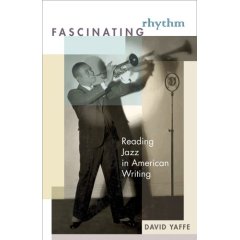
Fascinating Rhythm: Reading Jazz in American Writing
By David Yaffe
Princeton University Press
0-691-12357-8
David Yaffe’s Fascinating Rhythm: Reading Jazz in American Writing is written by an academic for academics, but it avoids the excesses of such writing. Despite the close readings of poems by Hart Crane Wallace Stevens, and Frank O’Hara, it is actually quite readable.
Refreshingly, Yaffe is willing to offer criticism of some well known figures of the left. He places radical poet Amiri Baraka in a fever swamp context for his hateful poem “Somebody Blew Up America” for the slanderous contention that: “Israeli forces were somehow complicit in the terrorist attacks of September 11, 2001; knowing ‘the World Trade Center was gonna get bombed’ beforehand and warning ‘4000 Israeli workers at the Twin Towers/To Stay home that day.’” (p.15). Yaffe laments “It is unfortunate that Baraka is now better known as the conspiracy theorist who wrote those lines than he is as the music critic.” (p.16)
Yaffe also shows little patience with Norman Mailer for being obsessed with the outward trappings of jazz, but completely failing to relate to the inner soul of the music. He skewers Mailer for having “rented a saxophone to play along with Monk’s music despite his complete inability to play the instrument. Indiscriminately honking along with Monk’s music was ‘hip’ to Mailer.” (p.38)
Yaffe’s strength throughout Rhythm is that he clearly writes about great literature and great jazz in a way that suggests both art forms are important to him. This is particularly clear when he argues for a critical reappraisal of Richard Powers’ The Time of Our Singing. On the strength of his advocacy, I’m convinced I should catch up with this novel sometime.
Rhythm is not perfect. Yaffe, a little too offhandedly (albeit in a footnote) tosses off the standard charges of bigotry against T.S. Eliot, in an otherwise interesting discussion of the poet’s influence on Ralph Ellison. Overall, it is a readable, if not exhaustive look at jazz in American literature. Clearly, Yaffe is able to appreciate the music and the literature it inspires much more successfully than the honking Norman Mailer.
Monday, May 01, 2006
$10K Per Screen
The Lost City took in $10,000 per screen this weekend, according to Box Office Mojo. Although its total weekend gross was dwarfed by the big studio vehicles, it had the second highest per screen take, with $18,000 coming from 18 screens. Only Fox Searchlight’s Water had a higher per screen average this weekend with $12,080, but it played on a very limited five screens. By comparison United 93 did $6,465 per screen, RV $4,506 per screen, and Stick It $5,522 per screen. Hopefully the relatively strong per screen numbers will keep City held over on its current 18 screens, as it expands to other cities.
Incidentally, The Lost City and United 93 are currently the highest graded debuts this week, scoring a solid B and B+ respectively from Mojo users. I haven’t seen United 93 yet, but I certainly recommend The Lost City.
Incidentally, The Lost City and United 93 are currently the highest graded debuts this week, scoring a solid B and B+ respectively from Mojo users. I haven’t seen United 93 yet, but I certainly recommend The Lost City.
Felt or Garment

Reviews are coming in for Mark “Deep Throat” Felt’s A G-Man’s Life, but they are not particularly enthusiastic. Not surprisingly, since Felt himself reportedly no longer remembers the events of his life for which history will associate him with. G-Man is actually Felt’s The FBI Pyramid co-written with Ralph de Toledano, recycled with supplemental material from John O’Connor. According to the WAPost’s review by Richard Gid Powers, the book reads schizophrenically, as Felt’s 1979 passages deny his role as Deep Throat, while O’Connor passages affirms his historic leaks to Woodward.
Powers in his review speculates on the Felt family’s decision to uncloak the elderly G-Man as the most famous leaker in American history. He argues for “pride” in “their father’s signal service to the nation” as motivation. He scoffs at “The uncharitable, of whom there is never any shortage, immediately assumed that financial considerations had been paramount—that the family was, to borrow a phrase from Holbrook’s Deep Throat, following the money.”
Yet there is the inconvenient fact of the first co-writer conservative columnist and jazz critic Ralph de Toledano, who was brought in to make The F.B.I. Pyramid readable in the first place. Just before unveiling Felt’s secret identity, they bought out de Toledano’s share of Pyramid for $5,000. Follow the money indeed. Evidently, de Toledano and the Felts were never close. As he told CNBC (keep scrolling down): “he was not very happy about having somebody come in and say your book stinks. This guy is going to write it for you.” Now Toledano’s words are bizarrely repackaged. Big shock, I’m sympathetic to the conservative jazz writer.
If you want to read about Watergate, I recommend instead Leonard Garment’s Crazy Rhythm. Garment, a one-time member of Woody Herman’s band, was Nixon’s closest associate at Mudge Nixon, when both men were in private practice. Despite being a Democrat, Garment was a member of Nixon’s inner circle. In the White House he organized the 70th Birthday party celebration for Duke Ellington, and served as acting White House Counsel during the darkest days of Watergate. Although Garment was not privy to Deep Throat’s identity, his insights into the Nixon administration’s meltdown are fascinating. If you’re buying books this May Day, De Toledano’s Jazz Frontiers is still available, but for Watergate reading chose Garment over Felt.
Subscribe to:
Posts (Atom)