Sometimes, you get worse in hospitals, because that is where all the sick people
are. That is especially true of hospital movies that have ominous titles, like Inoperable
or Fractured. Hold onto your proof of insurance, because a fresh
accident victim is about to check into director-screenwriter Michael Winnick’s Disquiet,
which opens releases tomorrow on VOD.
Sam
was broadsided by a drunk driver, but he wakes up in intensive care feeling
relatively okay, except for the coma patient who keeps trying to strangle him. The
crazy old man just keeps coming, but this doesn’t feel like a zombie
apocalypse. Yet, that is the best guess Monica can come up with. She is the
first normal acting fellow patient Sam comes across. She went in for elective
cosmetic surgery and woke up with three weird harpy-like psychopaths trying to
kill her.
For
some reason, the hospital is completely shut off from the world. There are several
crazies roaming the halls, but they get sane-sounding, but contradictory advice
from the eerily calm, but wheelchair-bound Virgil and the intense Dr. Lily. He
recommends going up to the roof to try to find a cell signal, whereas she argues
they should try to exit through the lower parking levels.
The
big fantastical thing going is indeed not unlike that of the aforementioned Inoperable
and Fractured. In this case, Disquiet is better than the
latter, but not as good as the former. The time-looping of Inoperable were
surprisingly intense, but the bickering contrast between Virgil and Dr. Lily definitely
elevates Disquiet above Brad Anderson’s disappointing Netflix film.
"Good" people are usually bad in horror, like “Goodey” Brown in “Young Goodman
Brown.” Nurse Agatha Good is even worse. She is dead, but not dead enough,
especially after the foolish teen counselors at Camp Briarbrook raise her
malevolent spirit during their season-ending party. That kind of “Bloody Mary”
business never ends well. It ends really badly in Erik Bloomquist’s She Came
from the Woods, which opens this Friday.
Years
ago, Heather McAlister was a camper at her father Gilbert’s camp, when the camp
nurse, Agatha Good, did some rather terrible things to the kids, including
Heather. Old Man McAlister thought he had fixed Nurse Good permanently, but the
legend of Agatha and her possession of the kids persisted, handed down from
camper to camper. Every year, Heather’s slacker son Peter tries to invoke Good
during their annual closing night blowout. This time around, Peter has them
sweeten the deal with a little needle stick—wounds for Nurse Good to tend to—which
she does in her horrifying way.
The
basic idea of Came from the Woods is not entirely unprecedented, but the
execution is definitely energetic. The press copy might also be over-selling it
as a “horror comedy,” but a lot of the dialogue, especially that of the rowdy
counselors, has a snappy Kevin Williamson-esque edge. In fact, Dylan, the
borderline delinquent counselor is spectacularly awful and loathsome, like the
horror film equivalent of a Seinfeld character.
Bloomquist
and his co-screenwriter brother Carson Bloomquist start by somewhat zigging
instead of zagging by making their camp-bound horror yarn supernatural in
nature, rather than focused on a slasher. They continue adding small but clever
wrinkles to the tale of undead witchery and zombie-like possession, which keeps
the film fresh.
They are making lame live-action remakes of beloved Disney animated films, so
why shouldn’t Ghibli classics get the same treatment? In this case, they go
back to the original source manga for an ostensive sequel that is about as
faithful as the acclaimed 1995 film written by the great Hayao Miyazaki. In
this case, the new film might even be sweeter and more sentimental than the
Ghibli animation. However, young love still never runs smooth in
screenwriter-director Yuiichiro Hirakawa’s Whisper of the Heart, which
is now playing in New York.
Supposedly
set ten years after the events of the Ghibli film, Hirakawa once again separates
Shizuku Tsukishima and Seiji Amasawa, but this time it is for ten long years.
Amasawa is perfecting his musical chops in Italy, while Tsukishima works as a
junior editor, while collecting rejection slips for her own writing. From her
perspective, Amasawa is living his dream, but she hardly knows, since she has
not seen him in ten years and they rarely talk. Nevertheless, he still
considers her his girlfriend—even though she does not know that for certain.
As
the two young lovers struggle with their relationship and their own day-to-day
frustrations, Hirakawa flashes back to the events from high school that fans
will know. The Baron, the cat statuette in the curio shop owned by Amasawa’s
grandfather, definitely gets his screentime, but he never walks around talking,
like he does in Ghibli’s meta-sequel, The Cat Returns.
This
Whisper of the Heart is lovely to look at and sweet as Shoo-fly pie. It
is also overly melodramatic and inescapably inconsequential. Yet, perhaps most
importantly, it never disrespects the spirit of the original film, so fans who
want to revisit the two lead characters in a different context can do so
without fear their childhood memories will be violated.
As a society, we are more diligent about vetting prospective Jeopardy hosts
and superhero actors than presidential candidates. Maybe if the media that has
spent so much time digging into Jeopardy’s Mike Richards and Ezra Miller
had devoted a little more attention to Biden’s Afghanistan plans (or lack thereof),
we could have avoided a humiliating debacle. So, what if the next movie Flash
will be played by a weirdo with legal problems? Still, moralizing fans have a
point: there already is a perfectly competent TV Flash. Season Nine might be
the end of the line for his series, but the season premiere happens to stand
alone relatively sturdily. It is time to do the time loop again in “Wednesday
Ever After,” which premieres tonight on the CW.
Evidently,
The Flash and his wife, Iris West-Allen, survived a lot of crazy time-related
chaos in the previous season, so they have just finished a week of recuperation.
Of course, the series’ new super-villain, Captain Boomerang, choses this
inopportune time to strike. However, his nuclear shenanigans inadvertently trap
The Flash and West-Allen together in a time loop.
There
have already been a whole heck of a lot of time loops in film and television, including
recently the “Leap, Die, Repeat” episode of Quantum Leap. However, “Wednesday”
still manages to come up with some fresh wrinkles. In fact, it rather
effectively uses the loop to contrast the married couple’s very different
approaches to the future. Allen has meticulously assembled all his notes from
the future into a blueprint for their lives together, whereas West-Allen
steadfastly insists on the right to make her own choices—sort of the super-heroic
time-travelling version of the free will versus predestination debate.
This film could have been an inspiration to the New French Extremity and
other fringe Francophone filmmakers, but it was discarded prior to its
completion due to filmmaker Jean-Denis Bonan’s prior difficulties with French
film censors. How cult could it have been? Consider this: erotic vampire auteur
Jean Rollin has a small role as a cop. For real film lovers, it is fascinating
to finally watch it, but it arrives at a precarious time, given its provocative
subject matter. Ready or not, Bonan’s A Woman Kills releases today, in
all its raw glory, as a limited edition BluRay.
Helene
Picard has been executed for the murder of a young street woman, but rather embarrassingly
a fresh body has turned up, killed in an identical fashion. Picard seemed like
a logical suspect, because she had a long history of anti-social behavior—awkwardly
including lesbianism. Yet, it certainly seems it wasn’t her.
The
cops are baffled, but the minister of justice still assigns his assistant,
Solange Lebas, to investigate Louis Guilbeau, a ministerial bureaucrat exhibiting
alarming signs of paranoia. At first, she suspects he is mad as a hatter, but somehow
Guilbeau still manages to seduce her. Perhaps, they share an affinity as
children of Algerian Colonialists (which was highly significant for a film made
in 1968).
A
Woman Kills is
vintage anarchist cinema through and through, especially the instrumental soundtrack
composed by French Free Jazz pioneer Bernard Vitet. If nothing else, the way
Vitet’s roiling discordant score mirrors the characters’ disturbed state of
mind perfectly illustrates how horror movie makers have been missing the boat
on Free Jazz.
Arguably,
Bonan’s film is even more subversive now than when it was shot. It should be
quite a site to see critics twist themselves into pretzels addressing aspects
of A Woman Kills, for many of the same reasons they are so uncomfortable
discussing De Palma’s Dressed to Kill, particularly because of the way
both films present transvestism.
Before Wakanda, Angela Bassett had an early career appearance in one of the
various DC universes, playing true royalty: a jazz vocalist partly inspired by
Billie Holiday (judging by the flower she conspicuously wears in her hair). Linda
Lake is also presumed to be dead, murdered by her tenor player husband, Wayne
Cotrell. However, she is alive, secretly held captive by her brother-in-law
producer. Barry Allen, avid jazz listener, CSI tech, and secretly the Flash,
has less than an hour to find her before Cotrell’s execution, but fortunately
he is as speedy as ever in the “Beat the Clock” episode the original series The
Flash, worth revisiting in light of Bassett’s Oscar nomination and tomorrow night’s
season premiere of CW’s The Flash.
Allen
is the jazz fan, whereas his colleague Julio Mendez is not, but he knew Cotrell
from the old neighborhood, so he never accepted the guilty verdict. An hour
before his date with the electric chair, Allen takes a message from another
jazz musician, Dave Buell, asking him to tell Mendez he has a tape that will
prove Cotrell’s innocence. Unfortunately, the bad guys get to him while he is
still on the line. By the time the Flash gets there, Buell is gone, but he finds
the smashed tape, which their CSI colleague Christina McGee tries to
reconstruct.
As
The Flash snoops around Elliott Cotrell’s jazz club, he discovers the producer
has secretly held Lake doped-up, somewhat bringing her out of it from time to
time, so she can record “newly discovered” sessions. Unfortunately, Cotrell’s
muscle, a former vocalist known as “Whispers” might have the drop on the Flash’s
CSI team.
For
jazz fans, it has been amazing to see how many vintage recordings have been posthumously
discovered (like the Mingus Cornell 1964 concert, just as an example). “Beat
the Clock” offers a rather nefarious explanation for the proliferation of “new”
recordings from deceased artists. This episode never drops any real jazz names,
but it suggests a reasonable level of familiarity with the music. It also has a
very cool neon noir look going on, reminiscent of Warren Beatty’s Dick Tracy
movie, which released about six months before this episode first aired.
Mike Fallon is a talented fighter, but his preferred method for
assassinations is arranging “convenient accidents” that the police never
investigate with much thoroughness. It therefore makes sense that he would live
to see another day of misadventures after the carnage of his first movie. It
turns out Malta is a great place for a hitman to work, given its handy proximity
to Europe, the Middle East, and Northern Africa. However, trouble still finds
him there in the Kirby Brothers’ Accident Man: Hitman’s Holiday, which
releases tomorrow on DVD.
Fallon
still feels bad about killing all his colleagues in Big Ray’s hitman guild
during the first film, but what can you do? What’s done is done. He wanted to
lay low in Malta, but he soon found himself busier than ever. That is hardly
surprising, considering former Maltese Labour Party Prime Minister Joseph Muscat (or his
associates) hired a hitman to assassinate investigative journalist Daphne
Caruana Galizia. Talk about a friendly business environment—for hired killers.
Still,
Fallon carries a heavy load of guilt over what happened. Technically, he was
the good guy, saving his ex, but there is no getting around the fact he killed
a lot of his friends. That is why he is uncharacteristically welcoming when his
old mate, tinkering hitman Finicky Fred shows up in Valetta, looking for the
internet girlfriend (whom Fallon assumes scammed him). Soon, they are teaming
up on jobs, until Mrs. Zuzzer, a legendarily ruthless crime family matriarch
kidnaps Fred. If Fallon wants him back, he will have to eliminate all the
international assassins who have accepted the non-exclusive contract on her
idiot son Dante, awkwardly including Big Ray. Ordinarily, Fallon would tell her
to go pound sand, but that guilt still has a hold on him.
Like
the first film, Hitman’s Holiday is a terrific showcase for Scott Adkins’
martial arts skills. He also shows off solid comedic chops, but never at the
expense of the action. To Adkins’ credit, generously shares the screen with
Sarah Chang, who definitely deserves breakout action stardom for her work as
Wong Siu-ling. Essentially, Fallon has hired her to be like Burt Kwouk in the Pink
Panther movies, attacking him once a week to keep him sharp. Of course,
they team-up against some imposing martial artists and a psychotic
killer-clown, who can’t feel pain.
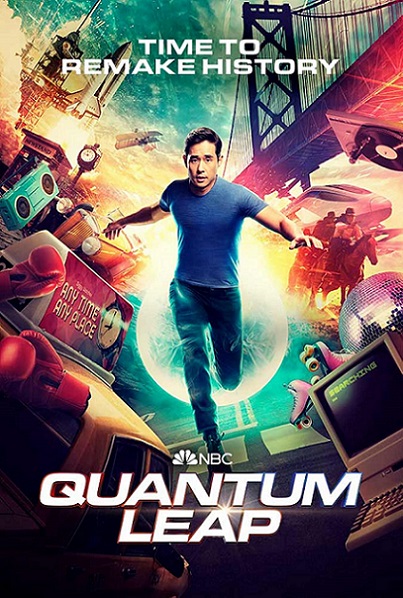
Star Trek was
remarkably clever in the ways it addressed current social issues of its time in
a science fiction context, without seeming to. That was almost sixty years ago,
but a lot of TV writers working today can clearly still learn lessons from that
show. In contrast, almost every line of dialogue blatantly tries to teach
viewers a lesson in “Let Them Play,” this week’s episode of Quantum Leap,
which airs tonight on NBC.
Kids vanish from camps all the time in TV series and movies (looking at you
Camp Crystal Lake). The weirdly similar sounding Camp Silverpoint is a little
different. Four kids reportedly disappeared in the nearby woods twenty-five
years ago, before Bea’s parents, Daniel and Steph, established their summer
camp. Every year, they sternly insist the campers never venture outside the perimeter
fence. Of course, that is where the group of camp misfits finds the “artefact”
that causes all the chaos in creator Lee Walters’ 13-episode Silverpoint,
which premieres on BYUtv today.
Kaz
is a rebellious foster kid, who tries to run away from Silverpoint. Not wanting
to get in trouble, the rest of her “Dragonfly Tribe” follow after her. Louis is
the sci-fi geek. Kaz is the pudgy South Asian kid and Meg is scared of
everything. When they catch up with Kaz, they stumble over the thing. First,
they pick up on the energy that seems to surround it. Then they discover it has
the power to transmit matter.
Despite
their issues and mistrust, they are all sufficiently intrigued to agree they
will revisit and study the artefact. They are all acting so weird, Bea starts
to suspect they are up to something. It is not easy being the daughter of the
camp counselors. Nevertheless, she has gotten close to several returning campers.
Unfortunately, she just discovered her friend Alice has been secretly hooking
up with Finn, her not so-secret crush. As a result, she might be in the mood
for a new circle of friends, like the clearly smitten Louis. However, the
Dragonflies are determined to keep the artefact a secret between themselves,
especially when they start experimenting with its matter transference. Unfortunately,
they are not the only ones keeping an eye on the thing.
If
a lot of sf fans had seen Silverpoint when they were twelve, it probably
would have been their favorite show. It is still possible to watch Silverpoint
a vicariously appreciate its youthful sense of camaraderie and mystery. Waters
and a battery of co-writers smoothly incorporate a whole lot of genre motifs,
including Men in Black, “big dumb objects,” time travel, “the Matrix,” and
matter transference in a brisk, engaging narrative.
Each
half-hour (if that) episode advances the story considerably and ends in a
cliffhanger, while still nicely developing nearly dozen characters. It is
definitely economical story-telling. A few of the visual effects are also
economical, in the wrong kind of way, but for older viewers, that gives it further
nostalgic appeal (remember, the BBC original conceived Doctor Who as a
children’s show).
The great controversy of Jack Roland Murphy’s life remains whether his
prison conversion to Christianity was legitimate or opportunistic. Documentary
filmmaker R.J. Cutler fully explores that question, but ignores the second
lingering debate surrounding Murphy: should his nickname be spelled “Murf the
Surf” or “Murph the Surf.” Either way, he led a colorful life and largely
succeeded reinventing himself on multiple occasions. Cutler documents his life
and crimes in the four-part Murf the Surf: Jewels, Jesus and Mayhem in the
USA (with an “f,” but troublingly, no Oxford comma), which premieres tomorrow
on MGM+.
Murphy
was the ultimate Florida criminal of his time, who probably helped pave the way
for Miami Vice and Carl Hiaasen novels. He was a champion surfer
(eventually inducted into the Hall of Fame), who developed a lucrative side-gig
as a jewel thief (which quickly became his main line of work). He and his buddy
pulled off the infamous theft of the Star of India from the American Museum of
Natural History, more or less as an improvised lark. When they were arrested
for the crime, their good looks and cool demeanor made them media sensations.
The
Star of India heist was later dramatized in the 1975 movie Murph the Surf (with
a “p” and “h”), which Cutler and company scrupulously ignore. (It obviously could
not encompass Murphy’s second act conversion, but Phillip Lambro’s jazzy
soundtrack, featuring Bud Shank and Buddy Collette, grooves nicely.) It is
rather convenient to end Murphy’s story when it did, but the truth is, he found
himself serving a life-sentence for murder. According to the jury, Murphy and
his accomplice Jack Griffith viciously killed Annelie Mohn and Terry Rae Frank
in what became known as the infamous “Whiskey Creek Murders,” because they
threatened to expose a stolen securities racket they were all involved in.
That
temporarily put a damper on Murf/ph’s legend, but he managed to reinvent
himself as a prison convert and outreach minister. It will surely be “triggering”
for a lot of insecure people to see Rev. Pat Robertson show up in the
docu-series, but like him or hate him, he really did do a lot of prison ministering.
Maybe he was taken in by Murphy, or maybe not, but Robertson was one of many
faith leaders whose testimonials helped Murf secure an early parole.
Supposedly, groups of four have power, like the Beatles, Seinfeld cast-members, Horsemen
of the Apocalypse, and the home invaders of M. Night Shyamalan’s latest film. For
the latter, that might not be a coincidence. The creepy foursome is obsessed with Armageddon, but they claim they
want to avert doomsday rather than herald it. Their proselytizing techniques could use
some work, but their conviction is intense, as a vacationing family learns in Shyamalan’s
heavy-handed Knock at the Cabin, which opens today nationwide.
Little
Wen was enjoying her cabin holiday with her two dads, Eric and Andrew, until
the hulking Leonard showed up. His demeanor is gentle, but in an ominous way.
However, his three friends with their Medieval-looking makeshift weapons are obviously
bad news, especially the mean-spirited Redmond. They explain they have come to
offer the tight-knit family a Sophie’s Choice from Hell, with the fate of humanity
depending on their answer.
Supposedly,
the four intruders were rather surprised to discover the two men were a gay
couple (who pretended to be brothers-in-law while adopting Wen in homophobic
China). That must be especially true of Leonard, since he is played by Dave Bautista
(who removed a tattoo of Manny Pacquiao tattoo, because of the boxer-turned-politician’s
unfortunate comments on same sex couples). However, Andrew, the lawyer and a
former victim of an intolerant attack, is not so sure. Regardless, he is
extremely skeptical of the trespassers’ crazy apocalyptic talk.
With
Cabin, Shyamalan’s forgoes his signature big twists, adopting a “binary”
approach. Either it is or it isn’t. Andrew is sure that it isn’t, whereas Eric
is maybe starting to entertain their outlandish claims, perhaps partly due to
his concussion. There will be no third alternative, arriving out of left field,
which makes the ending so disappointing. It just proceeds in an orderly
straight line from the original premise, with no deviations.
In some ways, Terry Pratchett was a more up-scale Piers Anthony, who
created a funny fantasy world that satirized genre tropes (he had a solid
fandom here, but nothing like his popularity in the UK). Technically, this big
orange cat is part of his Diskworld universe, but you do not have to be
familiar with any of those books to appreciate his fairy tale misadventures.
The Pied Piper legend gets mashed-up and riffed on, but the rats themselves are
his friends, at least the talking ones are, in Toby Genkel’s animated The
Amazing Maurice (with Florian Westermann also credited as “co-director”),
which opens tomorrow in New York.
Maurice
acts as the advance-pitch-man for the Pied Piper scam he worked up with Keith,
the naïve human piccolo player, and their talking rat friends. Needless to say,
his piping always manages to lead the rats out of town—for a fee. The rodents
became conscious and gained the ability to talk after munching the trash thrown
out by the Unseen University, a school of wizardry that will mean something to
Pratchett fans. How Maurice gained that ability too is an awkward subject he
tries to avoid.
After
their latest Piper-scam, Maurice and Keith enter a town that mysteriously has
no rats. It is also depressingly low on food. Somehow, the shadowy Rat Catchers
League seems to be involved. The mayor’s daughter is Malicia is determined to
get to the bottom of things. She is an avid reader with a thirst for adventurer,
so she takes her discovery of Keith’s talking animal friends in stride.
However, her fairy tale binging may have built-up unreasonable expectations for
heroics that Keith will have difficulty fulfilling.
The
Amazing Maurice is
definitely Shrek-like. It was even adapted by Shrek franchise screenwriter
Terry Rossio. Indeed, Genkel’s animation is colorful and unflaggingly energetic,
while the humor is mischievously droll. Yet, it is hard to overstate how much Hugh
Laurie’s roguish voice performance enriches the film. Thanks to him, there’s no
mistaking Maurice for Garfield.
For Josephine, the lifestyle influencer, pregnancy is just another way to
show off her elegance. However, when her new-born daughter arrives, she will
learn the hard way who is the real center of attention. It turns out babies are
demanding little crying machines. Schizophrenic post-partum depression gets
dressed up as a horror movie in director-screenwriter Bess Wohl’s Baby Ruby,
which opens tomorrow in New York.
For
“Jo,” pregnancy has been all about smug Instagram posts. However, during
childbirth, she feels like her “fetus” is actively trying to hurt her body. The
delivery is exhausting, but her first days at home are even more draining. She experiences
flashes of paranoia (did her husband Spencer really put Ruby in a boiling pot?
Answer: no). Ruby’s constant crying means Jo gets even less sleep than her
infant. Spencer and his pushy mother Doris try to be patient, but they just don’t
get it. She turns to a local mommy circle for support, but they are weirdly Stepford-ish,
including the creepy-friendly Shelly.
In
many ways, Baby Ruby is a perfect example of what is wrong with the
horror genre, as it is now being defined. In this case, Wohl is too busy exploring
the uncomfortable dark side of motherhood to take care of genre business. Frankly,
Baby Ruby is often rather dull, because we are constantly cued to doubt
Jo’s perspective.
Post-partum
mental issues are a serious topic, but they are not done justice here. The subversive
examination of the new motherhood experience, which is clearly the film’s
reason for being, is hardly original. Ray Bradbury staked out this territory in
his 1946 short story “The Small Assassin,” (nicely adapted in a short film and
Bradbury’s own anthology series). Plus, there are numerous films like, you
know, Rosemary’s Baby.
They were surrounded by a healthy spirit of community and crushed by sinister
ideologies. The Jewish villages known as Shtetls that were once spread throughout
Russia and former Captive Nations like Ukraine and Moldova hardly exist
anymore, but they are still remembered. Documentarian Katia Ustinova records
the memories of former shtetl residents and their Orthodox neighbors in Shtetlers,
which releases this Friday on VOD.
In
many cases, the modest homes are still there, or at least their remnants.
Ustinova talks to several remaining neighbors, like the haberdasher, who
apprenticed under a Jewish craftsman, whom he still reveres. Watching Shtetlers
somewhat contradicts the notion that Shtetl residents faced constant, unremitting
antagonism from their gentile neighbors.
This
is particularly true of Vladimir Gorbulsky, whose Orthodox mother saved dozens
of Jewish neighbors during WWII. Now a convert to Judaism, his visit to Yad Vashem,
where his mother is memorialized, is one of the film’s emotional highpoints.
This series rips crimes from the headlines, but the resulting drama that unfolds
is much more tragic than the average episode of Law & Order or Dragnet.
They are also set in the independent nation of Taiwan. The Taiwanese government
has made tremendous progress, but there remains a legacy of corruption from the
old regime (which now favors cozier ties with the CCP). Four crimes and the devastating
consequences that follow are explored from multiple perspectives in the
12-episode Taiwan Crime Stories, executive produced by Ron Howard and
Brian Glazer (yes, them), which premieres today on Hulu.
The
first three-episode arc, “Derailed” (written by Liu Tsun-han and directed by Aozaru
Shiao), is a bit of a riff on Double Indemnity, but much angstier. A
mysterious saboteur who has repeatedly targeted Taipei’s train rails has struck
again, but this time he finally caused fatalities. One man is dead and Qiu Wen
Qing’s husband has been rendered comatose, with a grim prognosis for recovery.
As fate would have it, she works as an insurance inspector for the company,
where the deceased just took out a suspiciously large accidental death policy. Her
former boyfriend, Yu Chen Lang, also happens to be the prosecutor assigned to
the case.
Despite
their obvious glaring conflicts of interest, Qiu and Yu will dig into the incident,
uncovering the ostensive victim’s alarming debts to “underground” banks and
their past connections to the rail service. It is hard to believe either of
them would be allowed to work this case, but it makes for pretty good
television. Allison Lin and Welsh-Chinese Rhydian Vaughan are both highly
compelling navigating the noir intrigue and their guilt-ridden mutual
attraction.
“A
Matter of Life and Death” (written by Shih Hong-ruh and directed by Hung
Tzu-hsuan) is an old school gangster payback thriller, in the best way
possible. Shen Chang Rong was supposed to be the bodyguard of a mobbed-up
financier, but he was convicted of massacring the man and almost his entire
family. Only the young son survived. Something about the official accounts do
not add up, so journalist Lee Po Sheng wants to pry the truth out of Chen. Of
course, his old gangster-colleagues want to keep him quiet.
“Matter”
is a wild ride, filled with beat-downs, prison fights, and double-crosses. As Chen,
Frederick Ming Zhong Lee is massively cool and steely. Frankly, these three
episodes are as satisfying as any genre gangster movie, but Shih and Hung invest
it with an elevated sense of grand tragedy.
Tragedy
does not even begin to describe “Gravity of Sin” (written by Lin Yu Chen and
David R. Liu and directed by Yang Chung Fan). Shockingly, we witness two
socially shunned middle school students brutally murder their popular teacher. Then
we follow her devastated father, police detective Wang Ying Min, as he tries to
solve the increasingly cold case. These three episodes are agonizingly hard to
watch, but Chen Yi-wen is absolutely terrific as Detective Wang and Vivian Sung
is maybe even more remarkable as the victim, Wang Yu Xuan and her grieving twin
sister, Zhong Hui, giving two very distinct and powerful portrayals.
Crimes
Stories takes
a turn into A Few Good Men territory with “Dark Currents,” in which Zhang
Ming Cheng, a rebellious young soldier serving his mandatory enlistment, finds
himself accused of a grisly child murder. Unfortunately, he fails to the
polygraph, because he is protecting his fugitive brother, Zhang Ming Jie, whom
he sheltered in the base’s abandoned barracks. Political War Officer (PWO) Gao
Yan Zhen has an ominous sounding rank, dating back to the Taiwanese Army’s
Mainland days, but she is the most progressive officer on-bass and the only one
willing to consider Zhang’s innocence.
How often have you wished cloying juvenile fantasies like the Harry Potter movies would
turn into horror films instead. It sort of happens here, but not really. It is the Arthur series
that started with Arthur and the Invisibles (Minimoys) that gets transformed.
That film bombed in America, but it was a huge hit in Europe. Director Luc
Besson blamed Harvey Weinstein for re-cutting it (always a safe strategy).
Regardless, those kiddie fantasies meant a lot to Alex and his friends, so they
set out in search of the original shooting locations, where they find trouble
in Barthelemy Grossmann’s Arthur, Malediction, written by Besson, which releases
on VOD this Friday.
This horror
film takes a long time to embrace its genre. First, there is a long “cute”
flashback to Alex’s slumber parties, devoted to watching the Arthur films.
Then, we endure the festivities for his eighteenth birthday party, which is
largely spent the same way. The only difference is his budding romantic
attraction to his formerly platonic Arthur pal, Samantha (played by
Besson’s daughter, Thalia). However, for part two of the celebration, the gang
takes a road trip to the original Arthur house.
Despite
previously published reports of an American shoot, the house is right there, in
the Deliverance region of France. The locals are not welcoming, but they
ignore the bad vibes. They also miss the clearly audible sounds of people
scampering through the woods, up to no good, during the night. Finally, the predators
start to make their move the next day.
The
supposed “meta-ness” of Malediction is wildly overblown. This is really
about as related to the Arthur series as Point Break is to
Richard Nixon. However, it certainly says something that Besson would openly
pursue the association. (Disney isn’t exactly the same family-friendly company
anymore, but it is still hard to imagine them releasing a slasher film
featuring a psycho wearing a Mickey Mouse mask.)
Basically,
the film abruptly shifts from treacle to so-so survival horror. What really distinguishes
the film is the disparity of the two halves. If you really know the Arthur films,
the design of dilapidated is probably quite impressive. Even if you don’t, the
film has a distinctive sense of place. Unfortunately, the vividness does not
extend to the characterization.
How do you adapt Henry James’ Turn of the Screw for Brazil? You make Peter
Quint look somewhat like Coffin Joe and give him the name “Da Silva.” It truly
is a scary combination. As you would hope and expect, a naïve governess finds problem
children and gothic horror in Walter Lima Jr.’s Brazilian coffee plantation
take on Henry James in Through the Shadow (Atraves da Sombra),
which airs tomorrow night on Brazilian Globo.
Laura is an
innocent convent-trained teacher, who has seen little of the world. She is a
bit freaked out by Afonso, the uncle and absentee-guardian of his brother’s two
children, but she still accepts the position as their guardian. Elisa
still lives in their late parents’ remote plantation manor, while Antonio is
enrolled in a prestigious boarding school, but we can all predict an imminent
expulsion in his future, right?
Although
Elisa is welcoming, the newly returned Antonio is seriously bratty. He is a bit
younger than many film versions of brother Miles. However, he is a serious Hellion,
especially since there seem to be a sexual component to his mischievous gaze.
It turns out he had a close relationship with Bento Da Silva, the former
groundskeeper, who corrupted Laura’s predecessor. Rather alarmingly, Laura
seems to be seeing the top hat-wearing cad on the roof and in the shadows, but
only she seems to see him. The isolation and her weird behavior give the other
servants cause to start questioning her sanity.
The James
novella inspired scores of adaptations, including Jack Clayton’s classic The
Innocents, Dan Curtis’s popular TV movie, and the not-so memorable The Turning, so there is always room for one more, especially from Brazil. In
this case, the coffee plantation, with its heat and the openly lusty field
hands, make for an appropriately evocative setting.
Monsters are supposed to come back from the dead, especially when their movies are hits.
Frankly, only two Blacula films never seemed like enough for fans. As the 50th
anniversary of the sequel, Scream, Blacula, Scream approaches, there is
reboot talk, but it could never be as good as the original. To satisfy that
thirst, an original Blacula plays was released regionally a few years
ago. Now, there is finally a direct sequel, but in graphic novel form. Blacula
rises again, understandably for vengeance, in Rodney Barnes’ Blacula:
Return of the King, illustrated by Jason Shawn Alexander, which releases
today.
Prince Mamuwalde
had tragically bad luck. He sought the assistance of Count Dracula in
liberating his people, but discovered the vampire was an undead racist. The Count
killed his beloved Princess and imprisoned him in a coffin for centuries, after
turning him undead as well. He did as vampires do in the first two films, but
with a sense of guilt and a social conscience.
For the
crimes he involuntarily committed, Mamuwalde has been condemned to Hell, where
he enjoyed the ultimate Prince of Darkness’s grudging respect. Of course, you
cannot keep a vampire as angry as Mamuwalde buried for long. So, he rises from
the grave once again, in search of Dracula. However, a contemporary group of
urban vampire hunters (most of whom have lost loved ones to the undead) will
team up with an aspiring paranormal YouTuber to find and kill the legendary
Blacula for good.
This spaceship carries no livestock, just grains and agricultural supplies. However, the crew
can be fairly animalistic. It is not exactly Lord of the Flies on-board.
Only the senior officers die in a freak interstellar accident, leaving behind
three lieutenants and all the worker bees. Somehow, they must all find a way to
work and flock together, in order to survive in showrunners Dean Devlin & Jonathan Glassner’s The
Ark, which premieres Wednesday on SyFy.
Events takes
place one hundred years from now. Things are apparently bad on Earth, yet the
crew of Ark-1 expects the people they left behind will still be there when they
reach the planet they set out to colonize. Unfortunately, something unexpectedly
struck the Ark mid-course, while everyone was in their cryo-genic chambers. As
luck would have it, the officer’s bay was completely destroyed, but the general
populations’ wing largely survived, except for another senior officer, slumming
with the proles.
That leaves
Lieutenants Sharon Garnett, James Brice, and Spencer Lane as the remaining
officer corps. Somewhat controversially, Garnet “takes charge,” due to her more
broadly-based operations experience. Brice is an action-oriented Kirk or Riker
type, so he basically goes along with her, but Lane seethes with resentment—and
keeps seething.
The “good
news” is there will be some opportunities for advancement. The bad news is plentiful
and it just keeps coming. Obviously, food and water will be the most pressing.
Their food will run out unless young “4-H Boy” Angus Medford can retro-fit his
super crops. However, that will take water, which is also running low. The
Ark-1 is huge, but it was only intended for a few weeks on-board living before
and after the crew went into suspended animation.
Obviously,
Devlin took inspiration from the original Star Trek (on which his mother
Pilar Seurat guest-starred in the “Wolf in the Fold” episode), Space: 1999,
and the original Battlestar. The best thing about The Ark, at
least based on the first four episodes provided for review, is the crew
dynamics—especially the triumvirate of Garnett, Brice, and Lane. They must also
deal with Felix Strickland, the head of ship security, who is outside the chain
of military command, allowing him to act independently. He is given a woke-ish
identity, but that helps explain his resistance to the charms of station “influencer,”
Cat Brandice. Regardless, his no-nonsense persona is a positive for the show’s
chemistry.
Unfortunately,
the youthful Heinlein-esque characters are a mixed bag. As played by Ryan Adams
and Stacey Read, 4-H Boy and the motor-mouthed Alicia Nevins are aggressively
and unremittingly annoying. However, Miles Barrow adds a lot to the show as Nevins’
likable but mysterious prospective boyfriend, Baylor Trent, who had a rather
complicated Summer of ’42-ish relationship with one of the late senior
officers.
In many ways, JFK was the “Nuclear President.” He was partly elected due to the
supposed “missile gap.” He also mentioned the potential of nuclear energy in
his “We choose to go to the moon” speech. That is exactly the day Dr. Ben Song
leaps to, finding himself in an experimental reactor about to have an accident
requiring a major government cover-up in “Leap, Die, Repeat,” tonight’s episode
of the new Quantum Leap, which airs tonight on NBC.
Initially,
Dr. Song feels like he is in his element, with science geeks like Dr. Edwin
Woolsey. However, his enthusiasm dampens when the entire place explodes. Ordinarily,
that would be that, but he and the Quantum Leap team are somewhat relieved to
discover he is actually in a time loop, but only somewhat. To save everyone and
leap on, he will have to figure out who sabotaged the facility.
“Leap, Die,
Repeat” is a clever way to break format without really breaking format. Instead
of simply riffing on Groundhog Day and other similar films, it offers a
fresh take on time-looping. However, this episode has a terrible sense of the
era’s history. Song and his holographic guide, Addison Augustine, roll their
eyes when Col. Parker tells him his job is to guard the facility against
Communists, but the Cuban Missile Crisis would happen just one month and four
days after JFK’s “Moon Speech,” so it was a totally valid concern. Also, the
janitor says he reads science fiction novels like Solaris, but Lem’s classic
Polish sf novel was not published in English until 1970 (secret plot twist,
maybe?).