Showing posts with label Ann Hui. Show all posts

Tuesday, March 15, 2022

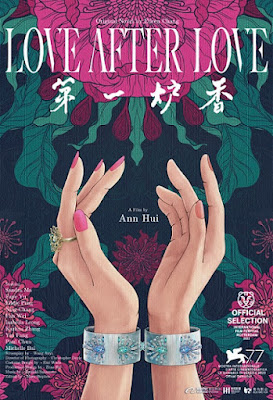
Ann Hui’s Love After Love

The CCP refuses to admit Hong Kong was once a colony, because that would entitle it to special consideration under the rules of the United Nations. Of course, the UN is compliant, asking “how high” when the CCP says “jump.” Yet, the era recreated in Ann Hui’s latest film is as decadent and colonial as the bad behavior of British settlers dramatized in White Mischief. The main characters are not even British, but the scandalous Hongkongers definitely believe in doing things “the British way” in Hui’s Love After Love, which premieres Friday on MUBi.

Ge Weilong is bright, pretty, but not the least bit worldly. Nevertheless, the Shanghai native will approach her disgraced and disgraceful Aunt Liang, requesting shelter in her stately home, so she can finish her studies in Hong Kong. Essentially, Liang is a self-styled courtesan, who inherited the wealth of her late lover. She is still a player in colonial society, mostly for her own amusement (the carnal kind, first and foremost).

Recognizing Ge could be useful, Liang takes her in and slowly starts grooming her in the indulgent customs of colonial society. Ge is a better translator than her, but she is slow to pick up on all the gameplaying around her. In fact, she even falls in love with George Chiao, a playboy, who stands to inherit little from his wealthy father, due to the many other heirs in-line ahead of him, both legitimate and illegitimate.

The film looks lovely and the cast is all very pretty, including Eddie Peng as the caddish Chiao, but it is mostly surface beauty. Although adapted from an Eileen Chang novella,
Love After Love was probably envisioned as a film in the tradition of Dangerous Liaisons, but as a Chinese-approved production, it is never able to generate sufficient sexual heat. It is also problematically low on the scheming and manipulation. If you want to see a Republican Era take on Valmont and company, check out Hur Jin-ho’s Dangerous Liaisons instead.

Wednesday, September 27, 2017

HK Cinema at SFFS ’17: Boat People

It was criticized by the Village Voice for being anti-Communist propaganda, even though it was the first Honk Kong film allowed to shoot on PRC territory. Of course, the Communists depicted in the film were from Vietnam, a country that had just spanked Mainland China in a war that is hard for us to imagine today. Regardless, as a humanist who always values human dignity over ideology (in stark contrast to the Voice), Ann Hui scrupulously depicts how the powerless struggle to survive in her 1982 classic Boat People, which screens during the San Francisco Film Society’s annual Hong Kong Cinema series.

During the Vietnam War, left-wing Japanese photo-journalist Shiomi Akutagawa consciously sided Viet Cong, so they are happy to invite him back for a propagandistic life-after-Liberation photo-essay. At least, his minder and her superior in the Cultural Bureau, the French-educated Nguyen, intend it to be propaganda. They carefully orchestrate his visits to Potemkin “New Economic Zones.” Yet, despite their efforts, Akutagawa starts to see cracks in the façade.

When they reluctantly allow him free unescorted passage through the streets of Danang, he starts to see the real Vietnam, including the execution of dissidents, the “registration” of ethnic Chinese, and widespread hunger. He also befriends Cam Nuong, a resilient fourteen-year-old who works odd jobs to support her two brothers and grief-stricken part-time prostitute mother.

Akutagawa tries to help Cam Nuong’s family monetarily, but his attention also brings government scrutiny. However, it is the experiences of To Minh, the lover of the French-style bistro-proprietress that Akutagawa meets through Nguyen who really opens the photojournalist’s eyes. On leave from a more representative New Economic Zone (N.E.Z.), To Minh has been desperately raising boat passage for himself, his mistress, and his best friend. Akutagawa will understand why, when he invites himself along on To Minh’s transport back to his concentration camp-like N.E.Z.

Boat People was not just Ann Hui’s international breakout, it was also one of the first roles to really generate recognition for Andy Lau. As To Minh, he actually looks reasonably Vietnamese. The dangerous charisma and brooding intensity are also already evident. George Lam similarly passes for Japanese quite convincingly, yet the way he quietly but compellingly portrays Akutagawa’s mounting disillusionment and moral outrage is even more impressive. Cora Miao and Shi Mengqi greatly humanize the film as To Minh’s mistress and the world-weary Nguyen, but Season Ma’s Cam Nuong really supplies the film’s heart, soul, and bitter hemlock.

Throughout the film, we can see Hui’s knack for eliciting sensitive performances. It was a big hit in HK, but it was way more truth than the world was ready for. For instance, Cannes rather gutlessly moved it out of competition to placate critics. However, Boat People would not be silenced or spiked.

In fact, its reputation has continued to appreciate over time, for good reason. It is a great film from a master filmmaker. Its screening is particularly timely, coming in the midst of PBS’s seventy-part The Vietnam War mini-series. Like ghostly voices, Boat People’s characters remind us the decision to abandon our allies to a vengeful, oppressive regime had dire moral repercussions. Spend five minutes with Cam Nuong and it will alter your perspective forever. Very highly recommended, Boat People screens this Sunday (10/1) as part of the SFFS’s Hong Kong Cinema.

Monday, July 03, 2017

Ann Hui’s Our Time Will Come

Fong Lan is a schoolteacher and Blackie Lau is an outlaw, but they work well together on missions for the Dongjiang resistance to Imperial Japanese occupation. However, those are only short-term assignments. Over the long-term, Fong will endure the occupation and the stress of her clandestine work thanks to the support of her caustic mother. Ann Hui takes viewers behind enemy lines, but she is even more interested in life on the home front. She is admittedly not one to wave the bloody shirt, which is why some speculate her film was precipitously replaced as the opening night film of this Shanghai International Film Festival. Regardless, Ann’s Our Time Will Come released in Chinese-language markets just in time for the official Handover anniversary celebrations and opens this Friday in New York, soon after our own Independence Day (trailer here).

Poet and future PRC Minister of Culture is renting a room from Fong’s mother (she will be called Mrs. Fong, period), but they can sense he is primed to bolt. Fong herself will help facilitate his flight as part of an underground Varian Fry-like operation to smuggle intellectuals out of occupied Hong Kong. Her grace under pressure is definitely noticed by Lau. He is still relatively new to the resistance, but not to living a shadowy underground existence. Soon, Lau returns to recruit her to lead their urban division. There will definitely be sparks passing between them, but they will not have time for that until after victory.

Both Fong and Lau will become very, very good at what they do. Mrs. Fong is troubled by the risks her daughter takes, but she starts to worm her way into low level resistance activities, to maintain a connection with her. Meanwhile, Fong’s ex, Gam-wing accepts a white-collar office position with the Imperial government. However, he is not a collaborator. Instead, he is an independent mole, looking for an opportunity to do some serious damage on his own initiative.

Frankly, the time has come for an Ann Hui career retrospective, considering how consistent and prolific her work has been, especially as she approaches 70. Arguably, the long, almost self-contained Mao Dun sub-plot gives the film a somewhat episodic feel, but it is still a rich cinematic feast. Zhou Xun and Eddie Peng have terrific chemistry together as colleagues-not-lovers, Fong and Lau. Zhou is still one of the most expressive actresses on the planet, while Peng has developed some tremendous action chops that Hui periodically allows him to show-off. Honestly, Peng has become the movie-star Tom Cruise mistakenly thinks he still is.

Wallace Huo (who has back-to-back New York releases, following Reset) is also terrifically suave and intriguing as Gam-wing—a heroically roguish performance in the tradition of George Sanders in B-movies like Appointment in Berlin. However, Deannie Ip truly takes command of the film in the third act as the unlikely and tragically valiant Mrs. Fong.

As cool as it is to see “Big” Tony Leung Kar-fai playing an elderly Dongjiang veteran chronicling the exploits of Fong and Lau to an interviewer (played by Hui), those modern-day segments mostly take us out of the film rather than pulling us in. This film brings out the armchair editor in us, making us want to tighten it up and tweak the structure precisely because the superstar cast is so fantastic in it. The period production details are also spot-on and the action sequences are brief, but muscular and adrenaline-charged. Ultimately, it is a touching film about family and sacrifice. In other words, it is an Ann Hui film. Quite highly recommended overall, Our Time Will Come opens this Friday (7/7) in New York, at the AMC Empire.

Sunday, June 19, 2016

Mark Lee Ping-Bing at MoMA: Eighteen Springs

Many suspect Eileen Chang was snubbed by the Nobel committee due to fear of angering Communist China. After all, she emigrated first to Hong Kong and then to America, having done some translation work for the U.S. Information Service along the way. However, her novels were rather apolitical, focusing instead on universal themes like love, loss, and even more of each. It is therefore rather logical that Hong Kong auteur Ann Hui (one of the most accomplished women filmmakers of any nationality) and Taiwanese cinematographer Mark Lee Ping-Bing would have an affinity for her work. The resulting adaptation of Eighteen Springs (trailer here) appropriately screens as part of Luminosity, MoMA’s retrospective tribute to Lee.

In the serialized novel, the lovers are star-crossed and separated for eighteen years. Chang shortened that span to fourteen years for the bound-up novel, but that still constituted roughly half a lifetime in Republican era Shanghai, as the new title suggested. It was a rough and tumble place, but there were also opportunities for educated men and women to find professional work and maybe fall in love. Such is the case for Gu Manjing and Shen Shijun, a junior manager and an engineer working for one of the city’s widget factories.

Shen is almost painfully shy, but he comes from a well to do family. Gu is also somewhat reserved but comparatively more outgoing. She is also a proper young woman, but her sister is decidedly not. To support their large extended family, Gu Manlu has worked as a ballroom hostess. Supposedly, she never truly did anything untoward in that capacity, but those reassurances have the ring of protesting too much. Regardless, the elder Gu sister will continue to be an issue for Shen’s uptight family if Manjing ever consents to his marriage proposal. Of course, fate and the machinations of family and rivals will conspire to cleave them apart and rather desperate developments will keep them separated and out of communication.

Hui and Lee deliberately tried to emulate the looks of 1930s and 1940s Chinese melodramas, going for an almost dogme-like hazy, dark visual style. Nevertheless, the print might be due for some restorative work, because it looks a little too dim in spots, but never to the point of breaking the film’s spell.

Regardless, Eighteen Springs is an exquisitely romantic tragedy that takes an almost gothic left turn, before bringing it home to a wise and mature resolution. Jacklyn Wu Chien-lien anchors the film in a career performance as Manjing, spanning the complete emotional gamut, but with rigorous discipline and tremendous nuance. Leon Lai tries to keep up as best he can, but he has trouble comparably projecting past Shen’s protective shell. Frankly, Huang Lei often out-shines him as the couple’s mutual friend, Xu Shuhui. However, nobody upstages Anita Mui’s diva-turn as the diva-ish Gu Manlu.

It is a credit to Hui, Chang, Wu, and even Lee that Eighteen Springs always feels like the earnest literary story of a star-crossed couple rather than a melodrama. They are plenty of potentially lurid excesses lurking in the narrative, but the filmmakers and cast keep it all scrupulously grounded and psychologically real. Very highly recommended, Eighteen Springs screens just the one night this Wednesday (6/22), as part of MoMa’s Luminosity.

Monday, October 13, 2014

Ann Hui’s The Golden Era

Xiao Hong became a patron literary saint for Chinese leftists, but she was often done wrong by her comrades, particularly those she was romantically involved with. She was one of the first to give voice to China’s peasantry, but her later work became increasingly less political, despite the wars ravaging Republican China. Her short life and problematic loves are dramatized in Ann Hui’s intimate epic The Golden Era (trailer here), which opens this Friday in New York.

Xiao never had an easy existence, despite being born into a land-owning family. Her mother died at an early age, leaving her and her protective grandfather at the mercy of her physically and emotionally abusive father. Rebelling against an arranged marriage, Xiao tried to elope with the man she thought she loved, only to find herself abandoned in a financial lurch. This pattern will repeat itself, but with subtle variations.

Soon, Xiao takes up with her colleague and savior Xiao Jun, who is initially quite taken with her beauty and talent. Yet, the latter becomes an issue when she is recognized as the superior writer. They will come together and break apart several times, while great macro-geopolitical forces sweep across China.

Like most of their milieu, the unrelated but profoundly linked Xiaos are drawn to Mao’s Reds, but for different reasons. Xiao Jun seeks to compensate for his literary failings as a revolutionary, whereas Xiao Hong feels personal loyalties to comrades such as the thoroughly radicalized Ding Ling. Of course, since Xiao announces her ultimate death right at the start of the film, her ever declining health obviously portends a suitably tragic end, but she will experience the Japanese invasion and yet another ill-fated love affair first.

Considering the politicization of Xiao’s legacy, the ideological agnosticism of Hui’s film is rather remarkable. In fact, it comes at a particularly interesting time, with students and capitalists alike taking to Hong Kong’s streets to protest for genuine democracy. Nevertheless, it has been chosen as Hong Kong’s official Academy submission for foreign language film (appropriately it will also screen next month as part of the San Francisco Film Society’s annual Hong Kong Cinema series).

More than anything, Golden Era is a deeply personal woman’s story that happens to be set against a sweeping historical backdrop. In many ways, it is reminiscent of Stanley Kwan’s Center Stage, covering a similar time period and periodically using characters as third wall-breaking commentators. The film even takes on further meta-significance with the casting of Tang Wei as the “scandalous” Xiao, given the Chinese film authorities’ rumored obstructions to her career in the wake of her controversial sex scenes in Ang Lee’s Lust, Caution.

Regardless, Tang perfectly balances Xiao’s delicate sensitivity and pseudo-proletarian grit. There are plenty of screen actresses who could supply her beauty, but she also credibly conveys Xiao’s intelligence. It is her film and she makes it work from start to finish. Still, Feng Shaofeng delivers some of his best work yet, bringing out real human dimensions in Xiao Jun, rather than playing him as a simple cad or a revolutionary stock figure. However, amongst the large cast of supporting characters, only Ding Jiali stands out as their stately literary benefactor, Lu Xun.


Clocking in sixty seconds under the three hour mark, Golden Era could arguably stand a bit of trim, yet the third act still feels a bit rushed. Frankly, it just seems like the dramatic spark dims when Xiao and Xiao separate. Nevertheless, they supply the guts of the film and they are definitely worth seeing. Recommended for fans of historical dramas, The Golden Era opens this Friday (10/17) in New York at the AMC Empire, via China Lion 

Tuesday, April 10, 2012

Ann Hui’s A Simple Life

Nursing homes are a booming business in Hong Kong, yet you still hear seniors referred to as “uncles” and “aunties.” The terms “sir” and “ma’am” just are not the same—and even those are heard less and less often here. Social and generational change might be sweeping Hong Kong (and the Mainland), but one dutiful film producer still tends to his family’s ailing servant in Ann Hui’s A Simple Life (trailer here), which opens this Friday in New York and San Francisco.

Chung Chun To, preferably known as Ah To, has worked for the Leung family since the Japanese Occupation. She is content to serve Roger, her favorite of the Leung children and the only one remaining in Hong Kong. It is a quiet, uneventful life for them both, when he is not traveling to the Mainland to negotiate deals. Returning late one night he finds Ah To collapsed after a stroke. Suddenly, it will be Leung taking care of Ah To.

There are no melodramatics in Hui’s refreshingly down-to-earth and true-to-life film. Leung is a cold fish, but he requires no clichéd awakening of his conscience, immediately understanding he will have to step up to the plate for Ah To. Yet, there are plenty of awkward moments and difficult choices in store for him, such as the nursing home he places her in. Again, it is not great, but it is not a standard movie horror show. Rather, it is much like the average facility one might reluctantly accept anywhere in Hong Kong or America (and at least it is overseen by the attractive Nurse Choi, played by the up-and-coming Qin Hailu, scratching something out of the seemingly thankless role).

Instead, A Simple Life works quietly, depicting the role reversal with patience and honesty. Superstar Andy Lau’s work as Leung is remarkably assured and restrained. In a way, Deannie Ip has it easier, because she has room to “act” when portraying Ah To’s slow physical decline, but again she scrupulously maintains her dignified reserve.

Despite the serious subject matter, A Simple Life will also interest fans of Asian genre cinema, featuring many big name stars in cameo roles. In an extended sequence, Sammo Hung and Tsui Hark play themselves, hashing out a production budget with Leung. Anthony Wong also appears in a small supporting role, getting perhaps five minutes of screen time, but it is a cool five minutes.

Reportedly based co-producer-co-writer Roger Lee’s real life family retainer, A Simple Life is like a tear-jerker with too much self-respect to jerk tears. That is exactly why the payoff hits home so hard. Officially submitted by Hong Kong as its recent best foreign language Oscar contender, it might well have caught on with the Academy in a less competitive year. (Unfortunately, those are the breaks.) Happily, audiences can catch up with it now. Highly accessible, it is definitely recommended for mainstream audiences when it opens this Friday (4/13) in New York at the AMC Empire and in San Francisco at the AMC Metreon, courtesy of China Lion Entertainment.