Showing posts with label Tang Wei. Show all posts

Friday, October 14, 2022

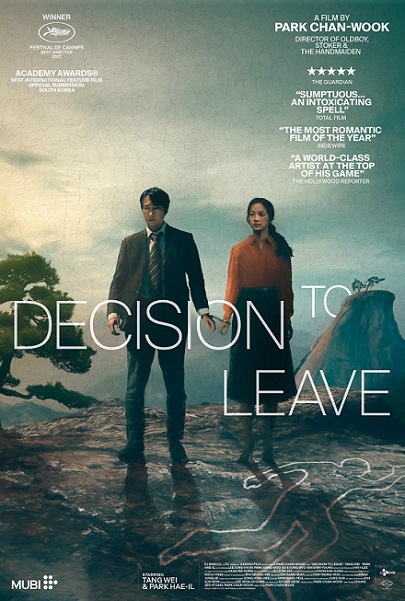
Park Chan-wook’s Decision to Leave

Hae-joon is the kind of relentlessly diligent detective, who might be a little too professional for his fellow cops—the kind that prefer to wrap cases up quickly. Seo-rae is such a composed widow, Hae-joon’s colleagues automatically suspect the worst of her, even though there is no direct evidence implicating her. The prospect of Hae-joon investigating Seo-rae is a potentially perfect storm of frustration for the Busan police, especially as the cop and suspect start to recognize their mutual attraction in Park Chan-wook’s Decision to Leave, which opens today in New York.

Seo-rae’s husband was an experienced climber, but apparently, he took a wrong step after summitting his favorite nearby mountain. He met Seo-rae through his work with the Korean immigration service, where he was known for his greasy palm, but Seo-rae already had an advantage over other asylum-seekers. Her Manchurian grandfather had served in the Korean resistance army, battling the Japanese occupation. That is one of the reasons Hae-joon feels sympathy for her, besides her striking looks and dignified reserve. He even orders an expensive (and somewhat romantic) sushi meal for two, during their initial interview.

Even though Hae-joon already has an extractive wife at home, he often volunteers for stakeouts, because of his persistent insomnia. As a result, he finds himself watching Seo-rae late at night, which leads to a weird voyeuristic intimacy between them, since she also knows he’s there. Soon, they just so happen to meet and share real meals together. Consciously or unconsciously, Hae-joon leads the investigation away from her. Frankly, his other murder case has a much higher priority, but it will reflect ironic insights on the death of Seo-rae’s husband. Then, rather masterfully, Park orchestrates another meeting between Hae-joon and Seo-rae, several years later and under weirdly familiar circumstances.

Decision to Leave
is an extraordinarily subtle and self-disciplined thriller, but it is absolutely enthralling. You can make it superficially sound like a murder-mystery with “black widow” thriller potential, but it runs much deeper than that. It is about inconveniently coming to terms with love and the things it makes people do.

Tang Wei should really think about re-locating to Korea, because playing a Chinese immigrant who voluntarily and enthusiastically opts for a new life in the ROK is not likely to endear her to Xi’s super-trolls (the same breed who attacked her after the release of Ang Lee’s
Lust, Caution). Without question, it is her best role since Ann Hui’s The Golden Era. Given her previous Korean film, Kim Tae-yong’s Late Autumn, Tang clearly gets better parts from Korean filmmakers. In the case of Decision, she simply amazing as Seo-rae. She is one of the most seductive femme fatales maybe ever, yet she is also arrestingly tragic and altogether haunting as Seo-reo.

Thursday, December 26, 2019

Contenders: Long Day’s Journey into Night


Can a big-screen romance also incorporate elements of film noir and experimental cinema? New Yorkers said “yes,” making Bi Gan’s sophomore feature an arthouse hit that was held over week after week. Mainlanders begged to differ—vehemently and angrily. Admittedly, the clever marketing campaign was a bit of a bait-and-switch, inviting couples to smooch along with the co-leads on opening night, New Year’s Eve 2018, according to the western calendar. Apparently, they were not as enraptured with the nearly hour-long 3-D tracking shot that forms the film’s second half as were international critics. New Yorkers can see it on the big screen [again] when Bi’s Long Day’s Journey into Night, which screens today as part of MoMA’s annual Contenders series.

Luo Hongwu has a sketchy past, but he has returned to Kaili City at some risk, to find his former lover. It will be difficult, because he never really knew her name. She simply called herself Wan Qiwen, just like the [fictional] actress. They used to meet in an abandoned house that would flood when it rained. Wan wanted to escape from her abusive underworld husband, but she disappeared from his life as well.

In addition to his search for Wan, Luo is also carrying karmic baggage leftover from the murder of his childhood best friend Wildcat. Of course, Wan is foremost on his mind, even though he claims to have trouble remembering her. In fact, his memories somewhat intrude into his present, until he steps into a dingy movie theater and puts on a pair of 3D glasses, at which point the film completely dives down the rabbit hole into a noir wonderland. Suddenly, Luo finds himself pursuing Wan’s doppelganger as he takes a Dante-esque journey through a surreal analog of Kaili City.

Simply on a technical level, the dreamy possible dream-sequence tracking shot is quite a feat, involving multiple locations and a great deal of movement, even including aerial shots. Yet, it is also here where the film really starts to pay off on an emotional level, as Luo and Wan-not-Wan seductively circle each other and verbally spar.

Wednesday, September 16, 2015

Johnnie To’s Office

It is the corporate headquarters of Jones & Sunn, a large Mainland financial services conglomerate, but it looks like it exists in the world of Chaplin’s Modern Times. Never has the white collar workplace been so surreal, yet so uncomfortably credible in a Bloomberg bullpen kind of way. The impending IPO represents a heck of a payday for everyone, if by everyone you mean the charismatic chairman and his not so secret lover, the CEO, but Lehman Brothers complicates everything in Johnnie To’s musical adaptation of Sylvia Chang’s zeitgeisty play, Office (trailer here), which opens this Friday in New York, after premiering at this year’s TIFF.

Yes, Johnnie To has made a movie musical—and why not? It is one more cinematic peak he summited. The music is not bad, but the design is simply extraordinary. Note there is no article before this Office. It is a strictly serious, high stakes environment. Ambitious junior managers like Sophie understand they have to move up or out, but there is not a lot of room above her. She has the ambiguous “support” of VP David Wang, who in turn is the “favorite” of CEO Winnie Chang. She is a somewhat scandalous figure for openly carrying on with the chairman, Ho Chung-ping while his wife remains in a persistent coma.

Into this thorny nest of office politics come two fresh-faced management trainees. Li Xiang is a guileless go-getter, who somewhat charms Chang in spite of herself. Yet, the mysterious Kat probably has the inside track being the chairman’s daughter, working under an assumed name to avoid improper appearances. Frankly though, nepotism will be the least of everyone’s worries.

At the risk of excessive repetition, it should be emphasized just how incredible designer William Chang’s sets look. They brilliantly blend the austerity of postmodernism with the expressionism of Fritz Lang’s Metropolis. Sylvia’s Chang’s narrative is unusually complex, but it is nice to see a film refrain from dumbing down the content. Of course, some themes are universal, like the corporate equivalent of the aging diva and naïve ingénue struggling to hold onto their piece of the pie. However, her source play resonated with Chinese audiences newly coming to terms with the salaryman blues in ways that will feel familiar to American viewers. Welcome to the party, its spectacular, isn’t it?

In all honesty, the tunes are just okay, but Eason Chan demonstrates major vocal chops as David Wang. On the other hand, Tang Wei looks like she just wants to get through her numbers as quickly as possible, but in all other respects, her work as Sophie is sensitively rendered and deeply affecting. Still, Sylvia Chang clearly saved the prime cuts for herself, digging into Winnie Chang’s Joan Crawfordness with relish we can all share. She also develops some charmingly undefinable chemistry with Wang Ziyi’s Li Xiang. It is also cool to watch Chow Yun-fat strut his stuff as the chairman of the board, because that is basically what he is to Hong Kong cinema.

When Johnnie To does a musical, you have to see it. It sounds fine, but Tang, Sylvia Chang, and William Chang’s eye-popping corporate HQ give the audience plenty to watch. Recommended for To faithful ready for his next departure and fans of the all-star cast, Office opens this Friday (9/18) in New York, at the AMC Empire.

Wednesday, July 22, 2015

Only You: Remaking Norman Jewison in China

Whether you live in Pittsburgh or Shanghai, Italy still represents the land of romance. Evidently, in 1994, Venice was the place to be, but now Milan is the in romantic getaway. There are other differences, but this Chinese remake of the Norman Jewison romantic comedy is pretty faithful to its inspiration. Once again, a smitten man will fight against fate and his own name to win the woman he falls for in Zhang Hao’s Only You (trailer here), which opens this Friday in New York.

On two separate occasions, fortune tellers predicted Fang Yuan would marry a man named Song Kunming. Such a specific prophecy would be great if she knew anyone named Song Kunming, but she doesn’t. After years of waiting for him to show up, she finally decides to settle for Xie  Wei, a boring dentist. However, tens days before their wedding, she happens to take a phone message from Xei Wei’s old school chum, Song Kunming, who is en route to Milan.

With her BFF in tow, Fang Yuan impulsively rushes off to Italy (conveniently having a couple soon-to-expire visas burning a hole in her pocket), to track down her man of destiny. On their first night, they follow the trail from their hotel to a man claiming to be Song Kunming. He is perfect her in every way, except he eventually admits he is not really Song Kunming. Attempting a Hail Mary, he offers to help her find the real Song, in hopes of besting him for her affections.

You hardly need to have seen the original Marisa Tomei-Robert Downey, Jr. vehicle to know how it will all end. Admittedly, Only You seems like a rather odd remake candidate, but it is apparently the sort of film that has grown in popular affection during its video and DVD life, following its ho-hum initial box-office. Of course, there are also probably a lot of us out there who can come to China Lion’s Only You unburdened with indelible images of Downey, Jr. in a gondola.

There is no question the scenery is just as lovely this time around and the cast is even more attractive. There is a little bit of shtick, but it is decidedly mild compared to rom-com norms. Granted, nobody does a lot of heavy lifting here, but Tang Wei pouts quite effectively as Fang Yuan (if you want to see her in a deeper, darker romantic drama, check out the elegant Late Autumn). Liao Fan tries to keep his cool as best he can as someone not named Song Kunming, but Su Yan kind of steals the show as the tough but sensitive (and sultry) best friend.

Fully capitalizing on Milan’s picturesque public squares and the verdant surrounding countryside, the new Only You definitely makes you want to visit Italy—with Tang Wei—or Su Yan—or if you prefer, Liao Fan. Obviously the end is predetermined (unless you think both Liao and Downey, Jr. might come up empty romantically), but it is a pleasant, low stress trip. Recommended as a date movie, Only You opens this Friday (7/24) in New York, at the AMC Empire.

Monday, October 13, 2014

Ann Hui’s The Golden Era

Xiao Hong became a patron literary saint for Chinese leftists, but she was often done wrong by her comrades, particularly those she was romantically involved with. She was one of the first to give voice to China’s peasantry, but her later work became increasingly less political, despite the wars ravaging Republican China. Her short life and problematic loves are dramatized in Ann Hui’s intimate epic The Golden Era (trailer here), which opens this Friday in New York.

Xiao never had an easy existence, despite being born into a land-owning family. Her mother died at an early age, leaving her and her protective grandfather at the mercy of her physically and emotionally abusive father. Rebelling against an arranged marriage, Xiao tried to elope with the man she thought she loved, only to find herself abandoned in a financial lurch. This pattern will repeat itself, but with subtle variations.

Soon, Xiao takes up with her colleague and savior Xiao Jun, who is initially quite taken with her beauty and talent. Yet, the latter becomes an issue when she is recognized as the superior writer. They will come together and break apart several times, while great macro-geopolitical forces sweep across China.

Like most of their milieu, the unrelated but profoundly linked Xiaos are drawn to Mao’s Reds, but for different reasons. Xiao Jun seeks to compensate for his literary failings as a revolutionary, whereas Xiao Hong feels personal loyalties to comrades such as the thoroughly radicalized Ding Ling. Of course, since Xiao announces her ultimate death right at the start of the film, her ever declining health obviously portends a suitably tragic end, but she will experience the Japanese invasion and yet another ill-fated love affair first.

Considering the politicization of Xiao’s legacy, the ideological agnosticism of Hui’s film is rather remarkable. In fact, it comes at a particularly interesting time, with students and capitalists alike taking to Hong Kong’s streets to protest for genuine democracy. Nevertheless, it has been chosen as Hong Kong’s official Academy submission for foreign language film (appropriately it will also screen next month as part of the San Francisco Film Society’s annual Hong Kong Cinema series).

More than anything, Golden Era is a deeply personal woman’s story that happens to be set against a sweeping historical backdrop. In many ways, it is reminiscent of Stanley Kwan’s Center Stage, covering a similar time period and periodically using characters as third wall-breaking commentators. The film even takes on further meta-significance with the casting of Tang Wei as the “scandalous” Xiao, given the Chinese film authorities’ rumored obstructions to her career in the wake of her controversial sex scenes in Ang Lee’s Lust, Caution.

Regardless, Tang perfectly balances Xiao’s delicate sensitivity and pseudo-proletarian grit. There are plenty of screen actresses who could supply her beauty, but she also credibly conveys Xiao’s intelligence. It is her film and she makes it work from start to finish. Still, Feng Shaofeng delivers some of his best work yet, bringing out real human dimensions in Xiao Jun, rather than playing him as a simple cad or a revolutionary stock figure. However, amongst the large cast of supporting characters, only Ding Jiali stands out as their stately literary benefactor, Lu Xun.


Clocking in sixty seconds under the three hour mark, Golden Era could arguably stand a bit of trim, yet the third act still feels a bit rushed. Frankly, it just seems like the dramatic spark dims when Xiao and Xiao separate. Nevertheless, they supply the guts of the film and they are definitely worth seeing. Recommended for fans of historical dramas, The Golden Era opens this Friday (10/17) in New York at the AMC Empire, via China Lion 

Tuesday, November 27, 2012

Dragon (or Wu Xia): Whatever it’s Called, Donnie Yen Will Kick Some


China is a big country.  In 1917, a man could get lost there if he had a reason to.  A court investigator suspects an unassuming paper-mill worker is such a person in Peter Ho-sun Chan’s martial arts historical-procedural Dragon (a.k.a. Wu Xia, trailer here), which opens this Friday in New York.

One day, Liu Jin-xi wandered into town, catching the eye of Ayu, a single mother deserted by her husband.  Liu married her, adopting her clan name and providing the sort of stability she yearned for.  Then one day, two escaped convicts start terrorizing the community.  Liu dispatches them with a series of “lucky shots” in an unlikely melee that could have been choreographed by one of the great silent film comedians.  Or perhaps not.

Xu Bai-jiu is not buying it.  Highly skilled in arcane knowledge, the investigator can practically see Liu radiating chi.  Putting two and two together, Xu deduces Liu is actually Tang Long, the presumptive heir of the ruthless 72 Demons criminal clan.  Unfortunately, Xu’s efforts with the corrupt judiciary attract the attention of the 72 Demons, who come reclaim their turncoat brother, one way or another.

Considering Wu Xia (as it was then known) broke Michael Jackson’s record for largest public billboard, one might expect it to be a big sprawling epic.  Yet, Dragon is a moody character driven piece, dominated by the cat-and-mouse game played by Donnie Yen’s Liu and Takeshi Kaneshiro’s Xu.  Of course, action director Yen does his thing when the Demons show up, including late 1970’s Shaw Brothers superstar Kara Hui, appearing as the Demon Master’s lethal wife.  Fans will be happy to hear he stages some great smack-down action, including a super finale smartly incorporating the film’s holistic themes.

Yen has the right mix of affability and earnestness for Tang-trying-to-be-Liu.  Yet, it is Xu who emerges as the film’s truly tragic figure.  Cerebral and intense to the point of snapping, Kaneshiro makes a great movie anti-hero.  A man who uses acupuncture to deaden his emotions and holds regular dialogues with his subconscious, Xu’s unyielding fealty to the letter of the law bears bitter fruit for everyone, most definitely including himself.  Tang Wei is also right on the money as the sensitive Ayu, still struggling with abandonment issues.

Chan knows his way around the set of a large scale action film, having helmed The Warlords and produced Teddy Chen’s high octane Bodyguards and Assassins.  He certainly delivers the martial arts goods, but it is his early scenes establishing Liu as a family man, filmed with a pastoral beauty by Jake Pollock or Lai Yiu-fai, that set-up the film’s dramatic essence so effectively.  It is a life viewers will agree is worth fighting for.  Smarter and more emotionally engaging than most wuxia period action films, Dragon (or Wu Xia) is highly recommended for genre fans when it opens this Friday (11/30) in New York at the Village East.

Tuesday, February 28, 2012

NYKFF ’12: Late Autumn

The setting is Seattle and the lead actress is Chinese, but it is based on a classic 1961 Korean film. Yet, this is a universal story that might remind viewers of films like Brief Encounter and Before Sunrise. Two not-lovers’ abbreviated relationship will be ambiguous but deeply meaningful in Kim Tae-yong’s Late Autumn (trailer here), which screened at the recently wrapped 2012 New York Korean Film Festival.

Kim’s Late Autumn and Lee Man-hee’s before it should not be confused with Yasujiro Ozu’s classic film of them same name. Still, they are similarly distinguished by their wistful tone and humanistic sympathy for their flawed characters. Anna is serving a seven year prison term for killing her abusive husband. Released on a seventy-two hour furlough for her mother’s funeral, she shares a long bus ride with the caddish Hoon. Initially, the “escort” thinks she might be a soft touch, but she is not impressed with his act. Ironically, she is the one who makes an impression on him.

Stifled by the awkwardness of her homecoming, Anna prefers the solitude of walking through Seattle’s historic downtown area, but her path keeps crossing Hoon’s. As they spend guarded time together, something develops between them. Yet, whatever it is, cannot last, which is the delicate beauty of the film.

Yes, we have been told before, time is fleeting. Yet, it is quite exquisitely expressed in Autumn. However, Kim’s film has a dark side unlike the David Lean classic or a host of sentimental copycats. In addition to Anna’s tragic past, Hoon is running away from something rather ugly. Time may or may not be quite fleeting indeed.

Tang Wei is achingly vulnerable as Anna, showing a remarkable range of emotions while maintaining her frozen façade. Best known for her breakout turn in Ang Lee’s erotically charged Lust, Caution, she was to have appeared in the Chinese Communist Party creation myth propaganda film The Founding of a Party, but reportedly Mao’s grandson had her scenes cut for reasons of ideological philistinism. It is not much of a recommendation for Founding, but another good reason to keep an eye out for Autumn.  Tang is a beautiful and remarkably talented actress, who has worked in Chinese cinema since the Founding debacle. Hopefully, Korean and American productions will continue to be an option for her as she contends with the Party’s institutionalized dogma.

A true multinational South Korean-American-Chinese-HK coproduction, Late Autumn is an elegantly simple story, even if its funding is head-spinningly complex. Heart-felt and emotionally mature, it is an assured work highly recommended for those who missed its opening night screening at the tenth annual NYKFF. After a double-secret theatrical release, it seems like a strong programming candidate for one of the Asian film showcases in New York. For those eager for more Korean film on the heels of the festival, the Korean Cultural Service hosts their regular free screening tonight (2/28) at the Tribeca Cinemas, featuring Park Shin-woo’s sinister film noir White Night.