Showing posts with label Body Horror. Show all posts

Friday, May 22, 2026

Saccharine: Australian Body Horror

Hana's parasite is more dangerous than a tapeworm, because it is literally a hungry ghost. Ill-advisedly, she deliberately ingested it of her own free-will. Of course, she did not foresee the side effects. On the plus side, her weight loss is dramatic in director-screenwriter Natalie Erika James’ Saccharine, which opens today in New York.

Despite her medical studies, Hana suffers from low self-esteem, exacerbated by family issues. Therefore, she tries one of the diet pills given to her by a formerly obese childhood friend, who now looks unbelievably slim. It works, but the price per pill is prohibitively steep. Applying her training, Hana analyzes the substance, finding it identical to human ash. As “luck” would have it, Hana and her loyal friend Josie are dissecting a human cadaver this semester. Rather enterprisingly, Hana stays behind after class to pack a doggy bag of the remains they left for disposal.

Of course, her bootleg pills similarly work, to a shocking degree. Even her crush, Alanya, the trainer who overseeing her bootcamp-style fitness regimen, is impressed—and eventually concerned. Hana also starts to worry when realizes the cadaver’s ghost has been watching and menacing her. She only comes when Hana’s blood sugar falls below a certain level. Once the med student binges, the terrors subside. However, the pattern quickly grows disruptive and alarming to bystanders.

Larry Van Duynhoven’s prosthetic design work for the “before” Hana is remarkably convincing. However, Midori Francis must still sell Hana’s transformation, which indeed she does. Indeed, she delivers an unusually sensitive and emotionally complex performance, by conventional horror movie standards.

Thursday, October 09, 2025

Solvent: Body-Horror with National Socialist Origins

According to his grandson, old Wolfgang Zinggi was assigned to a concentration camp during WWII. After the war, he basically substituted “Zionists” for “Jews” in his anti-Semitic rants, peppering them with references to “the poor Palestinians,” because he knew he could get away with it. Zinggi disappeared and was declared dead several years ago, so a team of researchers hope to find some illuminating documents in his mold-infested Austrian house of horrors. Instead, they discover evil of another nature in Johannes Grenzfurthner’s Solvent, which releases tomorrow on VOD.

Krystyna Szczepanska is a Polish historian specializing in forensic fieldwork. She has used Gunner S. Holbrook’s recovery firm several times previously. They also happen to be on-again-off-again lovers. They will excavate with the permission of Zinggi’s grandson, Ernst Bartholdi, who hopes to use the footage from Holbrook’s helmet cam for some kind of ill-conceived publicity film. However, he will not want the world to see what transpires.

Szczepanska hopes to unearth concentration camp records. Instead, they find some kind of extremely contagious and invasive sludge, that might somehow be related to the mad scientist experiments at Zinggi’s camp. Regardless, tragedy soon strikes, killing one team-member and strangely debilitating Szczepanska. Months later, Holbrook still wants answers, so he returns for an unauthorized look-see.

Solvent
is a hard film to fully get your head around. It is shot entirely from Holbrook’s perspective, found footage style, which ironically has a distancing effect. Not only does it directly address the Holocaust, which obviously entails considerable risks, it also incorporates a subplot involving war crimes in Bosnia. Those are heavy themes for a gross-out body-horror movie.

Nevertheless, Grenzfurthner and co-screenwriter Benjamin Roberts do their best to respect the sensitivities of potential viewers. It is also worth noting Holbrook’s dishonorable discharge from the American military was due to rather pedestrian larceny charges. The really scandalous stuff came from a later gig as a merc working for a Croatian militia.

Be that as it may,
Solvent is a very strange and often extremely disgusting film. There are not a lot of obvious comparisons to the thing plaguing Holbrook and Szczepanska. The Zinggi farmhouse and related cellars and outhouses are also wildly creepy. Ordinarily, the production design team would deserve a lot of credit, but Grenzfurthner shot on-location, in his real-life late grandfather’s condemned property, which apparently truly was in the state suggested in the film, even including the toxic mold.

Thursday, January 23, 2025

Grafted, on Shudder

If it were up to the filmmakers who write and direct horror movies, there would be no medical research whatsoever. Want to develop new skin-grafting techniques to treat the disfigured? Oh, the hubris. Haven’t you seen Rabid? Wei’s father is doubly asking for it, because both he and she stand to benefit from the revolutionary technique he tries and fails to develop. Despite his spectacularly gruesome fate, she continues his research in Sasha Rainbow’s Grafted, which premieres tomorrow on Shudder.

Let’s just say Wei’s dad regenerated a little too much skin. Unfortunately, as the world knows from experience, dangerous, unpredictable experiments have a habit of escaping labs in China. In this case, Wei takes his notes to New Zealand, where her aunt has enrolled her in college. Auntie travels most of the time for her dodgy business, so that means the highly self-conscious Wei must deal with her entitled and resentful cousin Angela on her own. It also means she must endure Angela’s friends, Jasmine (who has a good heart, but is too passive to stand up to Angela) and Eve, the campus queen bee, who also happens to be sleeping with Wei’s biology professor, Paul Featherstone.

When Dr. Featherstone sees the potential of the experiments Wei runs in her spare time, he offers to collaborate, with the intention of stealing her father’s work. However, he never anticipated some of its applications. For instance, if Wei were to accidentally kill one of her bullying frienemies, she can use the newly developed serum to regenerate and graft the dead girl’s face onto her own.

Wednesday, September 18, 2024

The Substance, Starring Demi Moore & Dennis Quaid

A lot of people might want to be like Dorian Gray, but few would care to be the portrait. Yet, a fading celebrity accepts a Faustian bargain that functions quite similarly. She is the “primary,” but her “better self” gets to have all the fun in director-screenwriter Coralie Forgeat’s The Substance, which opens this Friday in New York.

Elizabeth Sparkle is sort of like Jane Fonda, if she never stopped doing aerobics videos. At one point, she was a top actress, but for many years, she paid her bills hosting a daytime exercise show. Unfortunately, the odious network executive Harvey (whose Weinstein-ish name cannot be a coincidence) fired her for being insufficiently young and hot. While recovering from a subsequent minor fender-bender, a dodgy orderly slips her a card for a mysterious service that promises to bring out her best self, through the injection of a “substance.”

The titular substance produces what it promises quite literally, when her more alluring shadow self emerges from Sparkle’s back. She and “Sue” as her offspring calls herself, must scrupulously respect their symbiotic relationship. To maintain balance, each gets seven days out in the world, while the other remains in stasis, before they switch. Without a timely switch, Sparkle cannot safely generate the spinal fluid Sue needs to sustain herself.

Of course, Sue quickly replaces Sparkle on her former show, immediately igniting the ratings. Predictably, she resents the time she must concede to Sparkle, so she starts to cheat. When that causes Sparkle irreversible physical damage, it launches a cold war between the two linked selves.

To a large extent, the first hour of
The Substance plays like a better episode of Black Mirror, but the closing half-hour is a relentlessly gory assault on the senses (and some would say good taste). Weirdly, the film revisits some themes of Fargeat’s less extreme short Reality+, in which a chip allowed users to project an idealized image of themselves for twelve hours, but she completely immerses her latest feature in grisly body-horror.

Friday, October 20, 2023

The Fifth Thoracic Vertebra: A Fungus Story

Nothing scares a new home-owner like mold. Fungi is also becoming a growing preoccupation of world health authorities. With that in mind, since we have already had the Blob, so why not a killer fungus? However, screenwriter-director-cinematographer Park Sye-young takes a more experimental approach in The Fifth Thoracic Vertebra, which premieres today on IndiePix Unlimited.

It first formed in the ratty mattress of an unhappy couple. He was rather irresponsible and lazy, so maybe it is fitting he becomes the first victim of the fungus. Despite the conspicuous black rot-like fungus, their former mattress gets passed around. At one point, it even ends up at a love hotel, where it attacks another unhappy couple. Ironically, it forms an affectionate bond with one of his victims, who remains bed-ridden on the offending mattress, presumably to prevent further contamination.

Since the film unfolds from the POV of the fungus, it is necessarily fragmented. As a result, it very definitely has an avant-garde vibe, but there are still vividly disgusting elements of body horror. Perhaps this is more interesting as a concept than an executed film. Even at an economical 65 minutes, it is a bit of a challenge to sit through a film dedicated to a toxic fungus.

Park deliberately frames the film from off-kilter and oblique perspectives, in a hazy, gauzy style. Yet, somehow, the performances of Park Ji-hyeon and Moon Hye-in are strangely, perhaps shockingly, emotionally resonant as two of the women most directly affected by the noxious, semi-sentient fungus.

Thursday, February 10, 2022

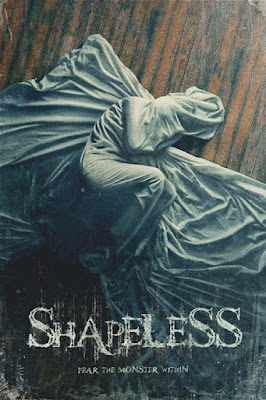
Shapeless, Filmed in New Orleans

New Orleans would be a terrible place to suffer from an eating disorder, because good food is everywhere: muffulettas, po boys, beignets, Zapp’s, etc. Of course, nobody really has a choice in the matter. New Orleans is also known for great music. That is what Ivy is focusing on. The aspiring vocalist wants to focus on her career to the exclusion of just about everything else, but her bulimic impulses take on truly monstrous dimensions in Samantha Aldana’s body horror-ish Shapeless, written and produced by lead thesp Kellly Murtagh, which opens today in select theaters.

Ivy has talent, but she always keeps her trio and her few friends at arm length, except occasionally Oscar, her bassist (a hat-tip to Pettiford?) and once-in-a-blue-moon hook-up. She simply cannot allow anyone to see her secrets demons. Essentially, her eating compulsion manifests itself as Cronenbergian outbreaks all over her body that can only be staved off through binging. Subsequently, purges to maintain her frighteningly slim figure.

Shapeless
is the sort of horror film where the horror probably isn’t really happening. Most likely, it is really more of a projection of Ivy’s inner demons. Frankly, a lot of fans are getting tired of the serious issue, after-school-special trend in horror, so there might be some fatigue for Shapeless’s experimental style and sober themes. The truth is Shapeless would have been better served if it muted its genre claims and billed itself as a dark drama about compulsion set in New Orleans. It delivers a frequently harrowing viewing experience, but it is not “scary,” per se.

However, it understands the pressures of life as a musician pretty darned well. Murtagh uses “St. James Infirmary” as a touchstone tune throughout the film, which is a shrewd choice, because it must be one of the most achingly mournful jazz standards ever. Both she and Zardis Nichols (playing Marion, a NOLA singer Ivy idolizes) perform excellent renditions. In fact, there is a lot of terrific sounding music heard as part of Ivy’s world. While cast-members portray her trio on-screen, much of the musical combo duties are handled by Shea Pierre on piano, Gerald Watkins Jr. on drums, and Amina Scott on bass. They always sound great. Unfortunately, there is also a lot of dissonant freakout music that is not nearly as distinctive.

Wednesday, July 18, 2018

Japan Cuts ’18: Violence Voyager

As a blond American boy, Bobby already stood out in rural Japan, even before he got trapped in a sinister amusement park of body horror. Even if it were called Cronenberg Gardens, it still wouldn’t give fair warning of the heinous crimes against nature that happen there. There will be a lot of mutated kids in Ujicha’s unbelievably weird cut-out “geki-mation” animated feature Violence Voyager (trailer here), which screens during the 2018 Japan Cuts Festival of New Japanese Film.

Bobby and his pal Akkun want to visit a former schoolmate who moved to the other side of the mountain, so they head off along a sketchy trail, despite the warnings of responsible adults, like the hermit, Old Man Lucky-Monkey. Alas, they take a fateful detour when they start following the faded signs for the mysterious amusement park, Violence Voyager. Although the park looks abandoned, it is still functioning and the proprietor will even let them in for free.

Initially, they enjoy the role-playing adventure of fighting mutant cyborgs until it gets totally and painfully real. Soon, they connect with other young survivors, some of whom have been badly disfigured by the robot monsters’ noxious secretions. Eventually they learn (the hard way) the real purpose of the park is to either use them as food or convert them into more distorted cyborg creatures.

There are probably more dead or deformed children in VV than any other animated film in the history of recorded civilization, but as the old saying goes: “you can’t make an omelet, without breaking a few twelve-year-olds.” In fact, Ujicha gleefully revels in gore, bad taste, and disregard for propriety. It is so over the top, you cannot take it too seriously. Yet, there is something about the Violence Voyager park that hits us on an archetypal meadow, like it could be nestled in the Hudson Valley of one of Washington Irving’s tales, albeit one that was warmed up in Hell and drizzled with viscous bodily fluids.

Regardless of taste, you have to give Ujicha credit for being the contemporary master of geki-mation—a form of cut-out animation that also utilizes zooms and pan-and-scans for effect, as well as some highly practical effects, like blood and slime. He is sort of like Lotte Reiniger crossed with Tom Six. It sounds crazy, because it is, but there is still something indescribably unsettling about his figures.

Pound for pound, Ujicha’s previous film, Burning Buddha Man was probably more bizarre, but VV will burrow deeper under viewers’ skin, because it is a lot like seeing the kids from Stranger Things get deposited into the Cabin Fever franchise. It’s not for everyone. Frankly, it is the sort of film that separates real cult cineastes from the pretenders. However, if you want to see something truly deranged, it is all that and then some. Recommended accordingly, Violence Voyager screens Friday night (7/20) at the Japan Society, as part of this year’s Japan Cuts.

Friday, February 23, 2018

Are We Not Cats


This is one semi-rom-com that should definitely carry a “don’t try this at home” warning. Seriously kids, drinking antifreeze is bad for you and eating hair is even worse. Yet, two potential lovers share that feline habit in Xander Robin’s Are We Not Cats (trailer here), which opens today in New York.

Even shaggy-haired Eli would call himself a luckless loser. When his father decides to pick up stakes for Arizona, he leaves Eli a cargo cube truck that becomes his home and only source of irregular employment. One haul upstate connects him with Kyle, a born user, who drags him to a club, where the nebbish sad sack is thunderstroke by the jerk’s girlfriend, Anya.

She is an ultra-hipster, who wears a wig, because she has chowed down on all her hair. (In contrast, Eli just nibbles on his mane a little, as a nervous tic.) She is unusually sweet for a club kid, but she is unhealthily codependent on the abusive Kyle. Nevertheless, Eli will take his shot, thereby inflaming Kyle’s jealousy. However, puncturing Eli’s tires, leaving him stranded at Anya’s place as a result, probably is probably not the most effective way of lashing out. Then potential tragedy strikes, testing Eli’s judgement and our stomachs.

AWNC earned a lot of admirers for its sudden detour into body horror, but it takes a long time getting there. For a good deal of the film, viewers will just feel like they are standing around watching Eli being awkward and uncomfortable. We respect Robin’s interest for these extremely marginalized characters, but he makes us work pretty hard for it. Also, the big shocking sequence totally strains credulity, which is a legit issue, considering how gritty and grimy the film is most of the time.

Still, Chelsea Lopez really announces herself as a talent to watch with her performance as Anya. She clearly has a remarkable knack for expressing much with very few words. Michael Patrick Nicholson also makes a compelling sad sack and develops some earnestly engaging chemistry with Lopez.

This is the kind of film you will want to like more, especially if you have heard the raves coming out of genre festivals. The tone is somewhat uneven, with weird dashes of Wes Anderson and Shinya Tsukamoto (of Tetsuo fame) thrown in, but it is always grungy to a fault. Still somewhat worth seeing, but more as sign of promising things to come than a film to love and get swept up in, Are We Not Cats opens today (2/23) in New York, at the Cinema Village.

Saturday, July 09, 2016

Tabloid Vivant: Yes, but is it Art?

Artists used to labor to attain immortality. Nowadays, there is a new breed out to make the most of their fifteen minutes. Maximilien Klinkau wants his fame both ways: fast and long-lasting. Yet, he still wants to be left alone to brood. Art critic Sara Speed believes she can score some reflected glory by breaking the news of his new technique, but she might be slightly biased. Not only is she Klinkau’s latest lover and model, Speed also just might be sliding into lunacy with him in Kyle Broom’s Tabloid Vivant (trailer here), which screens free tonight at the University of Chicago’s Doc Films.

Klinkau’s paintings are like a sinister Yakov Smirnoff joke. You don’t just look into them. His paintings also look into you—deep into your soul—and rip a part of it out. In retrospect, the temperamental and secretive Klinkau might not be such a good fit for a Black Dahlia-obsessed aspiring journalist, but they both seem convinced about his brilliance. Retreating to a friend’s country home, Speed starts sitting for the portrait intended to be the cornerstone of her article.

However, their relationship takes a dark turn, almost as if Klinkau’s canvases are driving them mad. Speed and Klinkau will briefly clean up their act when her editor pays a visit, but she can still sense something is off (it doesn’t require much intuition). With cabin fever setting in, the film segues into Polanski-esque territory before evolving into outright body horror.

Vivant is a strange film that earns points riffing on Nietzsche and incorporating big band standards and Susie Ibarra percussion tracks on its soundtrack. However, it mirrors the overheated untidiness of Klinkau’s mind to a fault. We never believe Klinkau and Speed could be a couple, because Broom never bothers to sell us. Also rather problematically, Klinkau’s supposedly mind-blowing paintings look anything but. Frankly, the one the audience most frequently sees resembles Shepard Fairey’s infamous propaganda poster pixelated to protect the guilty.

Nevertheless, it should be readily established, Jesse Woodrow and Tamzin Brown go nuts quite impressively. When they reach the third act, they both look like emaciated heroin addicts who have been rolled in florescent paint, which is pretty on target for Broom’s needs. Amber Friendly also has the right sort of clearly intelligent screen presence to deliver a much needed reality check.

Arguably, Vivant is most effective when Broom unleashes his postmodern sense of humor. There are some very funny visual gags executed almost subliminally through rapid-fire editing. The deliberately conspicuous rear-projection driving sequence is also a nice, nostalgic touch, but Klinkau’s actual system is underwhelming, which is disproportionately problematic in a picture like this. It is a messy film that does not always nail down the connections it thinks it makes, but it is never dull. Earning a mixed recommendation for philosophically-inclined and aesthetically adventurous genre fans, Tabloid Vivant screens tonight (7/9) in Chicago at Doc Films/University of Chicago.

Sunday, April 10, 2016

Decay: Love Comes on Rotting Fingers

Like most serial killers, Jonathan the amusement park maintenance man is handy around the house, but he is not so well versed in embalming techniques and taxidermy. To be fair, he might not exactly be a serial killer, per se, but he is deeply disturbed and profoundly antisocial. When an attractive intruder accidentally dies in his basement, the damaged young man rather starts to enjoy her company, but the natural breakdown of her body threatens to end their quality time in Joseph Wartnerchaney’s Decay (trailer here), which is now playing in Los Angeles.

Don’t jump to sicko conclusions. As far as we ever see, Jonathan is quite chaste in his affection for Katlyn Kelly. She and her friend assumed the horticultural paraphernalia they spied in his basement were the stuff of a marijuana grow. Alas, it was orchids. Startled by the deer-in-the-headlights Jonathan, Kelly takes a fatal fall, while her BFF runs headlong into oncoming traffic. However, rather than trying to explain the awkward circumstances, Jonathan keeps Kelly in his basement, trying to preserve her for the sake of the delusional romance he creates in his mind.

Sadly, this might just be the healthiest relationship of his life. As any horror fan will assume, his Mommie Dearest was a controlling, hyper-righteous nightmare. She does her best to twist him into knots during the regular flashback sequences. Unfortunately, his mother’s busybody neighbor friend and his lecherous co-worker are not exactly stabilizing influences. All things considered, it is hard to judge him harshly for the macabre business that ensures, even though we suspect his POV might not be entirely sound.

Frankly, it is quite remarkable how un-exploitative Decay is, given the potentially lurid nature of its subject matter. Nor is there much blood, but there are plenty of wormy parasites that start to come out of the not so well preserved corpse. Indeed, this is not the sort of film that helps boost popcorn sales.

As Jonathan, Rob Zabrecky has a sort of quietly edgy Nick Chinlund thing going on, which mostly suits the film’s tone. He clearly projects a sense of Jonathan’s stunted development, without ever letting viewers feel at ease with him. However, he is regularly upstaged by the outrageously tart-tongued Jackie Hoffman as the scoldy neighbor constantly trying to motivate him to better himself. Elisha Yaffe is also rather nutty as his boastful co-worker, but he pales in comparison to Hoffman. Unfortunately, the soon-to-be-deceased Katlyn Kelly is a tough role for Hannah Barron to make her screen debut, but she is a good sport when it comes to the layered on make-up effects.

Wartnerchaney’s execution is quite impressive, but it is hard to really get who Decay is intended for. It is never really scary, nor does it venture into transgressive sexual territory. It works as an extreme character study and a showcase for some distinctive supporting turns, but non-genre indie patrons are likely to be put off by the cockroaches and mealworms oozing in and out of the pivotal corpse. Hopefully, the right viewers will find it, because Wartnerchaney’s command of mood and the creepily tacky mise-en-scene deserves an audience. Recommended for disciplined cult cinema fans, Decay is now playing at the Monica Film Center.

Friday, October 23, 2015

CIFF ’15: Bite

Oozing pus is generally white, so it should be perfectly fine for a wedding. Casey sure has a lot of it going on, but if truth be told, the bride-to-be already had serious cold feet before leaving on her bachelorette getaway. Unfortunately, she came back with a nasty case of body horror in Chad Archibald’s Bite (trailer here), which screens during the 2015 Chicago International Film Festival.

While carousing in Costa Rica, Jill constantly films everything, but not because this is a found footage movie. She is just annoying. However, the source of her passive aggression quickly becomes apparent. She has long carried a torch for Jared Kennedy, the fiancé Casey is considering jilting. Still, they have plenty of Latin American fun, despite the mysterious whatever that bit Casey while she was bobbing in a secluded swimming hole. In fact, she had so much fun, she even lost her wedding ring.

Obviously, things are awkward for Casey when she gets home, especially since she feels like death warmed over. She comes close to breaking it off, which seems like an even better idea after a frosty encounter with her prospective mother-in-law, who also happens to be her landlord. However, her body starts to change before she can do anything decisive. Her bite wound festers something fierce, leaking grossness everywhere. Her skin gets scaly and her behavior takes a belligerent, anti-social turn. Suddenly, there are red mutant caviar eggs from Hell all over the apartment. Yet, we are told the smell is the worst of all.

So yeah, body horror. Yet, Bite is way grabbier than most Kafka knockoffs because of Casey’s sharply drawn relationships with her friends, “cool chick” Kirsten and uber-bitch Jill. In fact, Archibald and screenwriter Jayme LaForest depict their conversations and interactions with a lot of truth and attitude.

Of course Bite is first and foremost about goo and disturbingly colored bodily fluids. Clearly, special makeup artist Jason Derushie had a field day crafting one freaky effect after another, the grossness of each should well please genre fans. Still, Elma Begovic gives a really solid performance under all that gook. Denise Yuen is also refreshingly down-to-earth and sensitively engaging as Kirsten. On the other hand, it is hard to understand why anyone would be interested in a shrinking violet like Jordan Gray’s Kennedy, with his anemic Justin Bieber facial hair.


Although Bite does not reinvent body horror, it executes the Cronenbergian subgenre with superior characterization and gross-out effects. Frankly, it might be Archibald’s best film to date, representing a major improvement over Ejecta and The Drownsman. Recommended for horror fans in the mood for some claustrophobic grotesqueness, Bite screens tonight (10/23) and tomorrow night (10/24), as part of this year’s Chicago International Film Festival.

Thursday, September 03, 2015

Contracted Phase 2: More Body Horror

His unfortunate name is BJ and he makes Typhoid Mary look socially responsible. He infected Samantha with the zombie pathogen in the first film, most definitely against her will. Subsequently, she passed it on to the horny torch-carrying Riley, before he realized how grotesque she had become. She will not make it past the prologue of the sequel, but he spends most of the second film experiencing what she went through in the first. However, he will be a little more concerned with the macro picture in Josh Forbes’ Contracted: Phase 2 (trailer here), which screens midnight-ish this weekend at the IFC Center.

Picking up immediately where the first film left off, Phase 2 reveals it really is curtains for Samantha and her mom. Riley is pretty much done for too, but he does not realize it yet. However, his rashes and strange growth thingys do not look good. The periodic projectile vomiting of blood is also a bad sign. He is definitely changing, undergoing what will be an ugly and painful process. However, old BJ will get a kick out of it while watching from somewhat afar.

Det. Crystal Young wants to get to BJ through Samantha’s social circle, but Riley is in denial and therefore unwilling to come clean. Of all possible times, his feisty grandmother finally decides to fix him up with Harper, her impossibly tolerant visiting care nurse. For their first date, Riley takes her to Samantha’s memorial service, because he knows how to show a lady a good time. At least there is a little bit of humor when one of their hipster friends performs a perfectly dreadful tribute song (that is supposed to be embarrassingly awful).

Even by sequel standards, Phase 2 seems like a pedestrian repackaging of genre movie elements. The big deal about the first film was the way it applied Cabin Feverish body horror to the zombie, so Forbes wisely never stints on the slimy, pus-oozing transformation scenes. Narrative logic might not be a priority but he certainly knows what he needs to do.

If you have been pining for a sequel to the first Contracted, your enthusiasm might be tempered by writer-director Eric England noninvolvement in any capacity on Phase 2. It also might be a bummer screenwriter Simon Barrett (You’re Next, The Guest) does not return as BJ, but the evil Patient Zero really does not have a lot of interesting stuff to do this time around. On the other hand, Matt Mercer shivers and wretches as well as anyone could ask as the ill-fated Riley. Anna Lore’s Harper is also nicely down-to-earth and engaging.

Based on the near complete lack of resolution, it is safe to assume there are already plans or at least hopes for a Phase 3. They need not rush into production, because Phase 2 ought to hold even the most rabid body horror consumers a good long while. Still, if that’s your bag, than Phase 2 is just dripping with delightful offal. Mere mortals should be wary when Contracted: Phase 2 screens Friday (9/4) and Saturday (9/5) nights at the IFC Center in the West Village.

Saturday, January 31, 2015

Sundance ’15: The Hallow

Blame the Euro. Since Ireland no longer controls its own monetary policy, it has been forced to sell off its national forest to pay down its budget deficit. To facilitate the sale to a lumber concern, a young forester has temporarily relocated his wife and infant son to remote cabin in the woods. The fae people are none too happy about it, but they would probably be after their baby anyway, because that’s what they do. Dread runs like thick goey sap in Corin Hardy’s The Hallow, which screens during the 2015 Sundance Film Festival.

The forest is deep, dark, and verdant. Adam Hitchens thinks he is in his element, so he has no qualms about tromping about with his rug rat strapped to his back. Gee, that dropped pacifier sure looks ominous though. Seriously, why doesn’t he just put in ad in the Faery Times that says: “plump baby available for abduction.”

Hitchens hardly has time to toke up at home before things start going bump in the night. Initially, he and his wife Claire assume it is the work of angry farmer Colm Donnelly, who bitterly resents Hitchens’ reason for being there. However, things escalate to a level that is difficult to ascribe to a human agency. Of course, by this point, Claire has already pried the iron bars off the windows. You might wonder why the previous tenant of Victim Cottage felt compelled to put them up in the first place, but not these Londoners. Similarly, he does not think twice about bringing some cool “zombie” tree fungus into hearth and home.

Hardy and cinematographer Martijn van Broekhuizen are strong on atmosphere, so it is a bit of shame the film rushes so quickly into supernatural bedlam. A slower build would have yielded stronger results. He and co-screenwriter Felipe Marino promise a lot of ancient archetypal folklore, but aside from some changeling business, they keep the night terrors relatively conventional. Hardy is also a bit too frugal with Michael Smiley, whose craggy badassery livens up his one scene as Davey, the local Garda (“I’m from Belfast, we had a different sort of bogeyman there”).

Still, the locations and set design are massively creepy and the ectoplasmic body horror is suitably grotesque. As the Hitchens, Game of Thrones alumnus Joseph Mawle comes across as a bit of a pathetically underwhelming environmental hipster (is there any other kind?), while Bojana Novakovic flashes some welcome assertiveness. Much like Smiley, Michael McElhatton also adds some memorably cranky local color as the sour Donnelly.

For genre fans, The Hallow gets the job done, but it raises expectations early on that it will be somewhat more than it is. Ticket holders should note, rather than a stinger per se, a long parting sequence runs throughout the closing credits, building to a final, quiet gotcha shot. An okay excursion into the evil woods, The Hallow is recommended for those who want to maximize the “Park City at Midnight” experience when it screens tonight (1/31) in Salt Lake, as part of this year’s Sundance Film Festival.

Friday, November 14, 2014

Starry Eyes: Ready for Her Close-Up?

If only Astraeus Pictures employed the traditional Hollywood casting couch, Sarah Walker would be much better off. Instead, they will play sadistic games with her head and her life in Kevin Kölsch & Dennis Widmyer’s Starry Eyes (trailer here), which opens today in New York.

Show business is a tough racket. Walker is reasonably talented and attractive, but she just cannot catch a break. It hardly helps when one of her so-called friends steals a gig out from under. Frankly, they are not really her friends, they are her roommate’s friends. Her life is already like the darkside of Melrose Place and it will get steadily darker when she auditions for Astraeus.

Even though the indie studio has been somewhat off their game lately, scoring the lead in their latest horror movie would be a career-making coup. Unfortunately, Walker bombs during the weirdly confrontational audition, but when the casting director happens to witness her massively self-loathing breakdown in the ladies room, complete with hair-pulling and paroxysms, Astraeus is suddenly interested again.

Nonetheless, they will hardly fulfill all her dreams just like that. The callbacks will be truly sinister. Yet, each time Walker draws a line in the sand, she inevitably comes crawling back. Indeed, one of the most disturbing aspects of Starry is her willing complicity in her own damnation (for lack of a better word).

While there are teases of demonic horror in Starry (that the one-sheet duly capitalizes on), its first two thirds are more closely akin to a claustrophobic Polanski psycho-thriller. However, when the gloves come off in the final act, it gets spectacularly gory. Yet, in a way it comes as a relief, finally providing a break from the more realistically grounded and disturbing mental cat-and-mouse game that came before. It might even earn a laugh or two if you have a particularly evil sense of humor.

Starry will not be to everyone’s tastes (boy, is that safe to say), but the way it eviscerates Hollywood fakeness certainly sets it apart from the field. Being an insincere frenemy will get you painfully dead in Starry. As disturbing as Walker’s arc gets, Kölsch & Widmyer’s screenplay is a lot like a vintage E.C. comic—everybody who gets it probably had it coming.

As Walker, Alex Essoe absolutely goes for broke. She has moments that rival Isabel Adjani’s epic freak-out in Å»uÅ‚awski’s Possession. However, she cannot be accused of overly excessive histrionics (like say, Meryl Streep in Osage County, since we’re still not ready to let that one go), because the film’s dramatic context truly demands something viscerally explosive—and Essoe delivers in spades.

Although the who’s-and-what’s of Astraeus remain murky, Louis Dezseran makes a distinctively sleazy patrician villain as the producer and implied studio boss, admirably gnawing on scenery in the old school Hammer tradition. Emerging indie genre star Pat Healy (Cheap Thrills, Compliance, The Innkeepers) also takes a memorable turn Carl, Walker’s boss at a Hooter’s style scarf-and-barf, who might be what passes for a likable character in Starry.

When Starry finally lowers the curtain, you are likely to hear loud exhaling throughout the theater. It is a darkly intense film, but also unusually well executed by genre standards. Arguably, there is even an element of Bergman-esque angst buried amid the body horror and bloody carnage. Recommended for adventurous cult cinema fans, Starry Eyes opens today (11/14) in New York at the Village East.

Wednesday, October 29, 2014

Horns: Supernatural Growths

Ig Perrish is in for some Kafkaesque body horror, but at least there will be productive side effects. Those horns he finds growing from his temples are like paranormal sodium pentothal when it comes to getting people to reveal their hidden secrets—the darker and more shocking the better. Sadly, he will employ his grim new talent to find the murder of his lifelong girlfriend in Alexandre Aja’s Horns (trailer here), which opens this Friday in New York.

Perrish was a pariah in his Twin Peaks-ish Pacific Northwest town, even before the horns. Nearly everyone assumes he murdered Merrin Williams, the love of his life, who had just thrown him over. Unfortunately, he does not have one of those alibi thingamajigs, but there is no direct evidence tying him to the murder. The situation just continues fester until his wakes up with the mother of all scarlet letters sprouting from his head.

Strangely, most people hardly notice the horns and promptly forget them shortly thereafter. Nonetheless, when talking to Perrish in-the-moment, everyone develops a wicked case of TMI, answering his questions with brutally revealing honesty. Weaker characters can also be somewhat susceptible to suggestion. Only a handful of people appear immune to Perrish’s power, including Merrin Williams’ utterly bereft father and their mutual childhood friend, Lee Tourneau, who now represents Perrish as the local public defender.

Based on a novel by Joe Hill (Stephen King’s son), Horns is definitely a genre film, featuring plenty of macabre and outlandish scenes. However, it is surprisingly engaging on an emotional level, especially for a horror film, but even by the standards of conventionally square drama. Viewers will really care what happens to Perrish and mourn the pure-hearted romance that was violently cut short.

Given the horns and all, it is not surprising to find so much religious symbolism and subtext, but the film’s deep moral center comes as another pleasant surprise. While Perrish’s uncanny growths erupt after he spurns God (following an encounter with a highly judgmental clergyman) his salvation will come (if indeed it does) through the honest fate of Williams and her father Dale.

That’s all great, but Horns genre mechanics are also quite strong. Perrish’s supernaturally enhanced interrogations are quite cleverly written and often darkly comic. Yet, Aja still takes care of horror movie business, steadily building the sense of foreboding and genuine suspense.

Daniel Radcliffe, who used to make kiddie movies, is terrific as Perrish, convincingly getting at his deep-as-the-marrow pain and angst, rather than hiding behind hipster bravado. David Morse manages to be even rawer, providing the film’s moral touchstone as Dale Williams. Juno Temple is almost too spritely for Merrin Williams, but Max Minghella’s Tourneau has some memorable moments too complicated to explain here.

It is debatable whether Horns is really a horror film or a dark urban fantasy, but it should thoroughly satisfy fans of both. It is a strangely powerful film that hits a heck of a lot of bases. Highly recommended, Horns opens Halloween Friday (10/31) in New York at the Village East.