You might assume that if we knew the date the world will end, we could do something
to stop it, but apparently not. Apparently, to understand, you need to be an
apocalyptologist like Abel Ferrara, who even identified the exact time the end
would toll in 4:44 Last Day on Earth. At least his characters were only
haunted by their own regrets. Aubrey and Tom’s friends will be haunted by an actual
ghost. That is sort of the reason the couple invited them for a reckoning
before the reckoning in Brothers Brett & Jason Butler’s The Last
Anniversary, which is now playing in Toronto.
It
turns out Aubrey and Tom did not select an auspicious date for their wedding.
As fate would have it, their anniversary falls on Judgement Day. Their wedding
night was also the last time they saw her sister Brenda, who mysteriously
disappeared after the reception.
As the
rest of the world hunkers down, the couple invited the surviving wedding party
members to the very same mountain resort hotel (now abandoned), for a supposedly
cathartic reunion. However, the couple has something more Old Testament in mind.
Unbeknownst to them, Brenda has similar ideas. Her ghost still haunts the
hotel, so she starts terrorizing the returning wedding guests, showing herself
at dramatic moments and even physically choking them.
The
Butler Brothers sustain a strange tone throughout the film, which either evokes
the best of 1970s Eurohorror, or the worst. It also intentionally pays homage
to The Shining, with its endless spooky corridors and the room everyone
shuns like a cruise ship carrying the Hantavirus.
The
results are just odd. Films that take big metaphysical swings risk falling flat
on their face. To the Butlers’ estimable credit, that does not happen here.
They also maintain enough horror business to preserve the film’s genre
viability. Yet, there are frequent “what the heck” moments that will baffle conventional
horror fans, but those parts are clearly what were most important to the Butlers.
When the original Blair Witch Project released, it inspired teenaged
Matthew Nichols and his friend Jordan Reimer to make their own DIY horror movies.
Judging by the small army of found footage films reviewed here, they were
clearly not the only ones. Unfortunately, instead of earning a quick pay day,
they fell into a ravine and died. At least that is what the provincial
Vancouver Island police say, but they never discovered the bodies. Two decades
later, his sister Tara and a documentary film crew set out to uncover their
true fate. In the process, they produce another found footage horror movie:
Markian Tarasiuk’s independently produced and released Hunting Matthew
Nichols, which releases today in theaters.
Way
up in northern Vancouver, there isn’t much for teens to do except watch horror movies
and go hiking. Consequently, everyone hoped Nichols and Reimer would be found,
considering how well they knew the woods (the Canadians call it “bush,” but
same difference). Yet, the police only recovered Nichols’ video camera.
Tara
Nichols wants answers and director Markian Tarasiuk and cameraman Ryan
Alexander McDonald—playing themselves—want to help her at least reach some
closure. Regardless, they get some pretty good footage when they discover the
missing teens were preoccupied with the local not-so-urban legend of Roy McKenzie,
a reputed cult leader, who may or may not have eaten the residents of his
commune. McKenzie can definitely hang with the Blair Witch. Nichols and Reimer
thought so too, judging from the totem the police turn over to his sister.
There
is no getting around the fact Tarasiuk’s film looks and plays very much like Chris
Stuckmann’s Shelby Oaks, but the Roy McKenzie lore helps somewhat set it
apart. It also has some of the best performances you will find in the found footage
sub-genre. Miranda MacDougall shows potential star-power as Tara Nichols.
Ali ought to be respected by Turkish society, because he is a literature
professor, who was educated in the United States. Unfortunately, neither literature
nor Western educations are much valued under the Islamist Erdogan regime. Yet,
instead of creating a sheltering social structures, his contemporary Turkey
fostered a cutthroat environment that seems to have it in for him. Returning
from America might have been a mistake, but he worried about his soon-to-be
late mother, Sakine. The circumstances of her passing ignites Ali’s rage in Alireza
Khatami’s multi-national co-production, The Things You Kill, Canada’s international
Oscar submission, which screens as part of the 2026 Palm Springs International Film Festival.
Ali has
been concerned about Sakine. Her living conditions have so deteriorated, she
must use an outhouse, rather than the indoor plumbing, despite her bad knee and
rickety walker. Yet, whenever he visits, his father Hamit turns up to quarrel and
belittle him. Then one night, the father informs the family of her death,
whisking away Sakine’s body before anyone else arrives.
At this
point, Ali’s resentment boils over. His university discontinued his English
translation class and his fertility specialist determined his potency was
virtually nil. Tired of smiling through humiliations, Ali hatches a plan to
punish his father, with the help of Reza, a drifter he hires, ostensibly to
work on his “garden,” which is more like a small hardscrabble tree farm located
in the desert foothills outside of town.
Khatami
co-directed the brilliant Terrestrial Verses in his native Iran, but The
Things You Kill isn’t quite as viscerally intense. Admittedly, the contemporary
Iranian experience translates regrettably easily to the increasingly Islamist
Turkey. Consequently, Khatami persuasively and bracingly indicts the misogynistic
exploitation Sakine suffered. However, Ali’s payback scheme is rather predictable,
despite the filmmaker’s surreal flourishes.
Perhaps
Things You Kill also suffers from unfortunate timing, since it arrives while
memories of Jafar Panahi’s somewhat thematically similar but vastly superior It was Just an Accident are still fresh. Ekin Koc and Ercan Kesal are both explosively
forceful as Ali and Hamit and there is a palpable sense of tragedy compounding.
It
hardly seems accidental that two of Pete Scriver’s dozen or so dogs are
affectionately named “Cheech” and “Chong.” They appear in an animated
“documentary” that very definitely reflects a stoner aesthetic. Trippy things
happen all the time and pizza will be discussed at great length. However,
family and community hold greater importance for the half-brother filmmakers.
Together they chronicle and animate their Scriver family lore in Seth &
Peter Striver’s Endless Cookie, which screens during MoMA’s 2025 Documentary Fortnight.
Somehow,
Seth Striver convinced Canadian Telefilm to give him a grant for his next
animation project, even though the concept sounds a little vague. Basically, he
plans to fly up to Shamattawa in northern Manitoba (because it is inaccessible
by road), to record his indigenous half-brother Pete’s stories, which he later
intends to animate, or something sort of like that.
However,
other family members and even the fluctuating number of family dogs keep
interrupting, so they soon part of the film too. Obviously, Pete’s daughter
Cookie, whom Uncle Seth somewhat logically depicts as a chocolate chip cookie,
takes a leading role, often serving as the film’s (heavy-handed) social
conscience.
Frankly,
Seth has already heard most of Pete’s stories before, but he laughs just as
hard listening to them again—because they are part of their shared family
fabric. On the surface, they might seem very different. Seth is the nebbish
white guy. Pete is a semi-reformed hard-partier and half-indigenous. They have
a father in common, who might be a bit eccentric (that’s a shocker, right?),
but he remains part of both their lives. Regardless, they clearly share an
affectionate bond, which serves as the foundation for their film.
Indeed,
those warm, happy family vibes make Endless Cookie a pleasant
experience, even though Pete’s reminiscences not infrequently detour into surreal
flights of fancy. Frankly, viewers digging Scriver’s grounded family history
must often wait for the film to come back down to Earth. Admittedly, these
sequences can be a lot—perhaps a little too much for more conventional viewers,
who do not have a solid grounding in underground comix and indie animation
auteurs like Bill Plympton. (Frankly, it could be quite a show just watching
the responses of older patrons when Endless Cookie screens at
MoMA.)
Nevertheless,
the relaxed hang vibe and the half-brothers’ easygoing chemistry are pleasantly
entertaining. Most viewers will chuckle listening to the Strivers laughing and
scratching. Sometimes, they even bring to mind Beavis and Butthead, in a way
that is meant as a compliment.
The Clueless on social media like to pretend harrowing stories of forced migration
are a recent phenomenon. The surviving “Boat People” of South Vietnam could quickly
set them straight. They have always been a forgotten people, because their
plight was made possible by the New Left’s selective “anti-war” “activism.” However,
the fall of the South was far from peaceful for many South Vietnamese civilians,
including Canadian-Vietnamese children’s book author Thao Lam’s mother and her parents.
Lam and Canadian animator Kjell Boersma tell her family’s story in the Oscar-qualified
animated short film, Boat People (supported by the National Film Board
of Canada), which streams via PBS’s POV.
To
many, ants are a symbol of industry, but Lam draws inspiring parallels to their
resiliency. Like the ants, her family survives great hardships as a unit.
Sadly, that also means some sacrificed themselves for the good of the family.
Yet, there was an important reason that justified all their suffering and
sacrifice. In fact, that is the film’s big payoff. It is a huge emotional
moment, but it also subtly expresses the importance of freedom.
Visually,
Boersma and the animators nicely retain the illustrated vibe of its original source,
Lam’s children’s book, The Paper Bat, even though they rendered the animation
in color. However, the muted palette still reflects the influence of wood-cuts,
water color, charcoal, and other traditional Eastern art forms and media.
Korney Chukovsky's Doctor Aybolit is a beloved icon of Russian children’s lit,
but his similarities to Doctor Doolittle are so striking, it caused a scandal when
Lofting’s earlier work was finally translated into Russian in the 1990s. It
seems pretty clear Chukovsky ripped off Doolittle, so it is only fair that
Canada plundered Aybolit right back in 1971. Filmmaker Gerald Potterton
literally put new words in Dr. Aybolit’s mouth by redubbed the garish-looking Soviet
children’s movie Aybolit-66, much in the tradition of What’s Up Tiger
Lily or Fractured Flickers. Yet, that wasn’t even the weirdest part
of Gerald Potterton’s animated-hybrid freak-out Tiki Tiki, which screens
in its freshly restored weirdness at this year’s Fantasia International Film Festival.
In
a way, Tiki Tiki is like Planet of the Apes, if primates had
evolved to control the film industry. J.J. is a gorilla who runs the studio
founded by K.K. (do those initials mean anything to you?). The mogul signed
Dennis McShane, an up-and-coming hipster screenwriter (who is sort of equal
parts George Carlin, Dennis Hopper, and Kinky Friedman), to make a picture for
the studio. So far, he has spent a lot of money, but has no dailies yet to show
for it.
McShane
also has an experimental idea that scares J.J. He wants to use humans to play
apes. The crazy thing is Aybolit-66 features a lot of people playing
monkeys. The level of costuming is roughly on par with Santa Claus Conquers
the Martians and their respective color palettes are comparable.
Reluctantly, J.J. tags along with McShane in his special flying movie-camera
airship, to film the humans as they embark on improvised sea voyage to Tiki
Tiki, which is supposedly in Africa, even though the name evokes Polynesian
associations.
Frankly,
the Aybolit-66 footage is often painful to watch, like the toughest
films the ‘bots riff on in MST3K. However, the animated segments are
pretty cool, despite their counter-culture perspective. You can definitely see
stylistic similarities with Heavy Metal, which Potterton directed, as
well as Yellow Submarine and the bizarre Raggedy Ann & Andy movie,
on which he served as an animator. He also incorporates baroque interludes that
might remind fans of Terry Gilliams animated sequences for Monty Python.
The CCP is not the only oppressive regime engaging in the extraterritorial
harassment of their critics. Iranian agents have already been indictment for
the attempted kidnapping of democracy advocate Masih Alinejad—on American soil.
She is a prominent activist, but the brutal Islamist regime has also targeted average
people too. Consequently, Sahar has good reasons to worry about herself and her
family when she is photographed at a Canadian demonstration in support of the
Woman, Life, Freedom movement in director-screenwriter Sepideh Yadegar’s One
Must Wash Eyes, which premieres tonight at the 2024 Oakville Film Festival.
To
remain in Canada on her student visa Sahar must pay her overdue tuition.
Unfortunately, her mother has been unable to transfer the money, because her
Uncle Hekmat has yet to buy out her late father’s share of their business. Her
mother is trusting, but Sahar is justifiably suspicious. Things go from bad to
worse when she is clearly and identifiably photographed at a Woman, Life,
Freedom demonstration.
Immediately,
her boss at the Persian grocery store fires her, fearing his association with
her will jeopardize his frequent visits home. (Frankly, his shocking lack of
sympathy for the democracy cries out for fuller exploration.) Shortly
thereafter, Sahar gets a call from her mother, informing her the family
received a threatening visit from the Basiji morals police.
Even
though rational people would consider Sahar the smallest of small fries,
viewers need to understand there nothing far-fetched in Yadegar’s screenplay.
In fact, the authoritarian regime comes after everyday people like her all the
time. If anything, Yadegar shows tremendous restraint in her depiction of their
extraterritorial repression.
Despite the necessarily heavy political themes, One Must Wash Eyes (an
awkward title, almost guaranteed to change that refers to Persian poet Sohrab
Sepehri’s verse) is still more of a character study, examining the impact of extreme
stress and alienation on the increasingly desperate Sahar.
Pegah
Ghafoori (from From) is terrific as Sahar. She is an almost painfully
realistic character, who makes a lot of mistakes, but they are all only too
believable. Throughout it all, Ghafoori keeps her performance honest and
grounded. Remember when you finished your degree? Now try to imagine going
through that time while fearing for your safety and that of your family, but
not trusting anyone enough to ask for help.
Here is another reminder goths are annoying and Gen Z’ers are helpless. As if
we could forget, right? In this case, it is true for the undead as well. Sasha
is a young vampire, but she refuses to feed herself, because she of her
unusually acute empathy. She is sort of like a vampire vegan, but the bags of
blood that sustain her obviously comes from someone. Sasha must figure out her
diet in Ariane Louis-Seize’s Humanist Vampire Seeking Consenting Suicidal
Person, which opens today in New York.
Sasha
immediately demonstrated prodigious musical talent, but her fangs were late coming
in. Even now, they only come out under extreme stress. She refuses to hunt, so her
parents send her to live with her cousin Denise, who behaves like a vampire on
a CW series. Cut off from bagged blood, Sasha considers killing herself, but
she wanders into a suicidal support group instead. That is where she meets
Paul.
Figuring
out Sasha’s secret, the bullied teenager assures her that he would be just fine
letting her drain his body of blood. Ethically, Sasha thinks she could maybe
handle that, but first she wants Paul to enjoy a little karmic payback.
Humanist
Vampire Etc is
probably the moodiest vampire film since Ana Lily Amirpour’s A Girl Walks Home Alone at Night, but it is not nearly as stylish. Amirpour’s film has a
noir vibe entirely missing from this French-Canadian tale of undead angst. It
also lacks the quietly expressive charisma of Sheila Vand.
Instead,
both Sara Montpetit and Felix-Antoine Benard are relentlessly sullen and sulky.
Frankly, they are more lifeless than undead. Unfortunately, Noemie O’Farrell’s
Cousin Denise is not nearly vampy enough to compensate for their blandness.
“Recently, Dr. Gain-of-Function” Fauci admitted he had no idea where the
recommendations for social distancing came from. He said: “it just sort of
appeared.” That must boil the blood of small business owners like Keith Stata,
whose local Highlands Cinemas in Kinmount, Ontario was not able to reopen any
of its 70-seat screens until 2022, due to social distancing issues. It was
touch-and-go as whether he could repair all the physical damage done during his
involuntary closure, but as he says himself, “the show must go on” in Matt
Finlin’s documentary, The Movie Man, which screens as part of the 2024
Brooklyn Film Festival and it also opens tonight at the Highlands Cinemas.
The
Highlands Cinemas is quite an institution. Stata has amassed a genuine museum
of movie memorabilia, including one of the Xenomorphs Stan Winston created for Alien.
It also stores hundreds of old analog projectors Stata salvaged from old
theaters. Plus, the fortysome cats he adopted and his two dogs essentially have
the run of the place.
It
also shows films, which local residents appreciate, since every other theater
in the Burnt River area had long since shuttered. Grudgingly, Stata made the studio-mandated
switch-over to digital projection in 2012 to stay in the new release business. He
also says something many theater owners are reluctant to admit: the quality of
new films just hasn’t been as good lately, which has noticeably depressed
ticket sales. The last twelve years certainly have not been easy for
independent cinema owners—that much is certainly clear from The Movie Man.
Everyone thinks Canadians are always mild-mannered, but they have had plenty of
violent gangsters. You just can’t mention them anymore, or Justin Trudeau will
send you to jail. While there was still Canadian freedom of speech, Edwin
Alonzo Boyd’s crimes were chronicled in Citizen Gangster and Vincent
Cassel portrayed the notorious French import in Mesrine: Killer Instinct.
Donald Lavoie’s biopic came in just under the wire. He killed a lot of people
for his Quebecois gang, but even he has trouble whacking his own brother in
Raymond St-Jean’s Dusk for a Hitman, which releases Friday on VOD.
Lavoie
has long been estranged from his drunken father, but he somehow tolerates his
messed-up brother Carl. Even though he has a wife and young daughter, he still considers
Claude Dubois and the Dubois gang “like family.” That will be a mistake.
Usually,
Lavoie is the one executing unsuspecting gang-members Dubois deems liabilities.
However, Lavoie (not to be confused with the accomplished Austrian School
economist, Don Lavoie) is in for a rough patch. First, due to bang-bang circumstances,
he and his questionable partner kill a witness in an especially gruesome manner.
Then his deadbeat brother starts making trouble for him. To make matters worse,
organized crime investigator Roger Burns keeps coming around, asking if he
wants to have a friendly chat.
Dusk
for a Hitman is
a super-grungy late-1970s-early-1980s period gangster movie, but it also has
some style. St-Jean’s screenplay, co-written with Martin Girard, is pretty
predictable, but in the way of almost every other hitman and mobster movie.
Even
though Eric Bruneau has frequently worked with French Canadian auteurs like
Xavier Dolan and Denys Arcand, he does not well-established image with most
American audiences, but that serves the film well in Dusk. He definitely
puts the “anti” in antihero with his more-than-slightly unhinged lead
performance.
Poor Adam seems to have a mutant case of puberty. Whenever he finds himself
in a socially awkward situation, his body visibly alters, especially his “long
torso.” Unfortunately, that means his lower belly is hanging out there pretty
much throughout Joel Vaudreuil’s animated feature, When Adam Changes,
which screens today as part of this year’s Animation First.
In
1990s Quebec, Adam gets bullied a lot for his stooped shoulders, pudgy midrift,
and that darned torso (which keeps growing with each callous remark), particularly
by his “beloved” grandmother, Ange. Her death hits his mother hard, but it
leaves him confused about how he should feel and react. Adam is not a bad guy,
so his older sister really ought to have his back more. Unfortunately, she is
distracted by her toxic relationship with her unfaithful boyfriend.
Adam
obviously carries a torch for a pretty girl, who maybe recognizes he is smarter
than most of their classmates, but whenever he tries to engage with her, she
always seems to disappoint him. It also seems like he is the only teen in the entire
school who must work over the summer. Much to his chagrin, his father committed
him for two jobs. One is a house-sitting gig that isn’t bad. However, mowing
the lawn of a crazy grass-obsessed neighbor is a miserable experience.
Maybe science fiction has done us a disservice, filling our heads with unnecessarily
dire warnings regarding the space-time continuum and time paradoxes. Perhaps if
we ever achieve the means to time-travel, we should just take the opportunity
to see famous bands before they started to suck and load up on collectibles. That
is the approach lunkheaded Casper takes, but there is a decent chance he might
be dangerously moronic in director-editor-screenwriter Luke Higginson’s Relax,
I’m from the Future, which is now playing in New York.
Naïve
Casper has obviously been blessed with good luck rather than brains. When he
arrives through the time-portal thingy, fate delivers him to Holly, a
hard-partying underachiever, who finds his future-talk amusing. Being a
failed-activist millennial, she is sufficiently inconsequential to history,
allowing her to serve as Casper’s front for placing sports bets (a lot of
hockey, since they are in Canada) and buying lottery tickets.
Life
becomes quite enjoyably meaningless for both, at least for a while. Unbeknownst
to them, Doris, an enforcer from the future stationed in the current time-period,
is always on the lookout for potentially disruptive time-travelers like Casper.
Given his knowledge of cataclysmic future events, Casper is fairly confident he
cannot mess things up too badly. However, his obsession with Percy Sullivan, a darkly
cynical cartoonist, leads to trouble. In the future, Sullivan will be a popular
cult icon for fans like Casper, who cannot resist crashing his “celebrated”
suicide. Perversely, all that might change when Sullivan refuses to continue
after Casper’s rude interruption.
The
feature-length Relax grew out of Higginson’s short, which focused on
Casper fateful meeting with Sullivan. In fact, this is the point where the
feature starts getting good. The first act is largely a hodge podge of Casper’s
buffoonery and a lot of radically-charged whining from Holly and her fellow
lesbian friends. In contrast, Casper’s dilemma as to what to do about a
still-living Sullivan constitutes a rather clever and darkly comic time-travel
problem, which continues to compound in increasingly outrageous ways.
Before iPhones and Androids, it was the handheld addiction of choice. They were
pseudo-affectionately called “CrackBerries.” The company that manufactured them
rode their market-share to great heights, but it eventually crashed hard. And
yes, they can partially blame China. The semi-lightly-fictionalized true story
of Research in Motion and its once-popular product unfold in Matt Johnson’s BlackBerry,
somewhat adapted from Jacqie McNish & Sean Silcoff’s Losing the Signal,
which opens Friday in theaters.
Mike
Lazaridis was the tech guy who could figure things out. Jim Balsillie was the
business guy who could get things done. Doug Fregin was the fun guy everyone
else really enjoyed working for. Initially, Balsillie had no interest in Lazaridis’s
pitch, but when his sharp elbows got him fired, he bought into Research in
Motion, thinking he could right the aimless Canadian start-up’s ship.
Unfortunately,
the company is in even worse shape than Balsillie expected, but Lazaridis has a
potentially game-changing device on the drawing board. Of course, he is
reluctant to pitch anything that is not absolutely perfect, but Balsillie is
sure Lazaridis can deliver whatever he has to promise. The fact is they really
do not have any choice, which Lazaridis grudgingly acknowledges. Fregin, on the
other hand, is shocked when his old friend refuses to push back against the
sharky Balsillie’s demands.
Of
course, that product was the BlackBerry, which a lot of former users still
remember with fond nostalgia. For a while, the company could not lose, until
they suddenly lost big. Johnson and co-screenwriter-producer Matthew Miller efficiently
compress the company’s history into a highly compellingly drama, while sort-or
maintaining the quasi-verite style of Johnson’s previous features, The
Dirties and the underwhelming Operation Avalanche. At times, it
resembles an episode of The Office, but the stakes are higher—and everything
we see on-screen, most definitely including the performances, are much more
realistic.
Jay
Baruchel portrays Lazaridis as a twitchy bundle of neuroses, but his performance
is never cartoony or lazily shticky. As Balsillie, Glenn Howerton rivals Michael
Douglas in Wall Street and Alec Baldwin in Glengerry Glen Ross.
When he roars and rages, people better listen, including the audience. Johnson
himself is probably the weakest link playing Fregin, whose goofy behavior is so
abrasively unprofessional, it pushes viewers to identify with Balsillie.
However,
the film gets a huge energy boost from the great Michael Ironside as
back-breaking (or a less polite term) COO Charles Purdy. Ironside also had a
small but significant role in Hulu’s The Dropout—if you enjoyed its depiction
of Elizabeth Holmes’ fall from grace, you should also dig BlackBerry.
Plus, reliable character actor Saul Rubinek makes the most of his appearances
as Woodman, a Verizon executive.
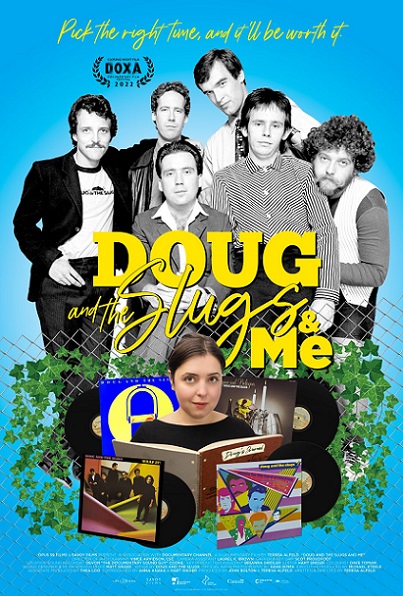
They had a number of top 40 hits in Canada, but Doug and the Slugs’ greatest
exposure in America might have come when their song “Too Bad” was used as the
opening theme of Norm Macdonald’s The Norm Show. (It was a Canadian
connection.) Despite having the original video for “Too Bad” in heavy rotation
on early, music video-playing MTV, they never really caught on down here,
despite their label charging back the costs of several expensive attempts. However,
Teresa Alfeld only thought of lead singer Doug Bennett as her best friend’s
dad, while growing-up next door to the family. Alfeld chronicles the band’s ups
and downs from a half-inside half-outside perspective in Doug and the Slugs
and Me, which airs Sunday night on CBC.
Bennett
didn’t exactly look like Mick Jagger, but he wrote catchy tunes. The Slugs
became known for a brand of pop that combined upbeat melodies with sly humor.
The Barenaked Ladies cite them as an inspiration, which totally follows. Regardless,
to Alfeld, Bennett just seemed like another suburban dad, as indeed he was,
even though he still toured pretty regularly while she and her friend were
growing up.
A
lot of the inter-band drama is not unlike so many other Behind the Music stories.
There were jealousies and creative control issues. Alfeld never mentions drugs,
but she certainly documents Bennett’s problems with alcohol. Still, they
managed to stay together nearly forty years, long outliving many of their
contemporaries. Weirdly, Bennett also wrote a terrific Canadian country song, “House
Without a Soul” that he ultimately had Suzanne Gitzi record, but, of course,
that musical detour also ended awkwardly. However, Gitzi is quite gracious
discussing Bennett.
There is no question Captain Pat Hendry and his fellow Air Force officers did
a much better job defending Earth in the original Thing from Another World than
Kurt Russell did in John Carpenter’s remake. These young Inuit girls are cut
more from Hendry’s cloth, because they are hunters. Unfortunately, so is the alien
parasite threatening their community in Nyla Innuksuk’s Slash/Back,
which screened at the 2022 Brooklyn Horror Film Festival.
Maika
and her friends either resent their depressed Nunavut community (like her) or
they are resigned to it (like her best friend Uki). Fortunately, it is the sort
of town that hardly notices a teen like her carrying a hunting rifle down the
street, because she is going to need it.
The
first victim was an American scientist, but the “thing” had to possess and
consume polar bears, until the girls stumbled across it path. Maika manages to
save her tag-along sister from a hive-mind-controlled bear, but the aliens will
follow the scent of its blood back to the community.
For
everyone who thought the ulu was under-utilized in the fight against alien
invaders, Innuksuk and co-screenwriter Ryan Cavan finally come through with the
goods. In this case, the invaded bodies are not the insidious pod people
infiltrating home and hearth, as in Invasion of the Body Snatchers. Instead,
the parasite turns their blood black and their skin starts to sag and get generally
nasty looking. One possessed host even resembles Leatherface.
The
makeup and practical effects are entertainingly gory, in the right kind of way.
Admittedly, the initial rampaging polar bear looks kind of weird and unnatural,
but that makes sense in the full context of the film. It takes a bit of time
for it to get going, but Slash/Back turns into a satisfying
alien-hunting movie.
Who better than Guy Maddin to show us the early days of Canada’s healthcare
system? Fittingly, they were quite absurdist and sometimes macabre. Gimli was
constructed by Icelandic immigrants (much like Maddin’s own ancestors) on the
shore of Lake Winnipeg in Manitoba. Around the turn of the 20th
Century, Gimli was fully staffed with nurses, yet Einar’s suffering really started
when he was admitted. Once again, Maddin shows us the weirdness of Canada that
never was but somehow has always been in the freshly restored Tales from the
Gimli Hospital [Redux], which opens today in New York.
Like
most vintage Maddin, Gimli is a nested tale, being told in the ostensive
present day. In the modern, full-scale Gimli, Amma tries to console her
grandchildren waiting by their mother’s deathbed, by telling them the wildly inappropriate
story of “Einar the Lonely” and his “friend” Gunnar. Both contract smallpox,
but the nurses in the clapboard Gimli Hospital (built above a stable, for the
warmth of the animals) only have eyes for Gunnar. They are charmed by his gifts
as a raconteur and his skill cutting fish from tree bark.
Frankly,
it is like Einar does not even exist, which makes him even more feverish.
However, it turns out they had good sense to ignore him, when Gunnar discovers
his friend’s secret shame. It is so transgressive, it ignites a life-and-death
wedgy-sumo battle between them.
Gimli
was
the film that made Maddin a cult sensation. It is short but it is packed with
Maddinesque dreams and fantasias, as well as visual references ranging from “Our
Gang” to German expressionism. There is also a restored scene that was cut from
the 1988 theatrical version. Gimli is a trip, but it is still an early
work and not the full-blown kaleidoscopes of his more recent masterworks, like The Forbidden Room, Seances, and My Winnipeg.
It is always frustrating to watch a film about a talented but self-destructive
jazz musician. Unfortunately, anyone who has read several jazz biographies
knows the premise is not entirely unrealistic. It is still hard to see Dezi
drive away his ex-lover and his former bandmates in Thyrone Tommy’s Learn to Swim, which opens today in Brooklyn and releases on Netflix this Monday.
Dezi
really has the chops. So do his friends. That is why Selma often sits in with
them, even though she is signed to a record label, whereas they are unsigned.
Unfortunately, one of his choppers is causing him a lot of pain (but apparently
not one that would impact his embouchure, which is sort of a break). Nevertheless,
Dezi prefers to shun human company, so he can revel in his pain and misery by
himself.
During
the course of the film, Tommy and co-screenwriter Marni Van Dyk constantly
flashback, to show why Dezi withdrew into himself. Frankly, the more we learn,
the less we sympathize with him. In some ways, you could read Learn to
Swim (a title that must have woefully frustrated the film’s publicist and
marketers) as a jazz riff on A Star is Born, but Selma isn’t even “jazz-famous”
yet. Tommy and Van Dyk do not end it the same way either.
One
thing they did right is the music, featuring original compositions by Chester
Hansen & Leland Whitty of BadBadNotGood. It sounds legit, especially for a
struggling group that was raised on contemporary music genres (there is an
electric bass in their combo), but still embraces the hardbop tradition. It
also helps a lot that lead actor Thomas Antony Olajide already knew how to play
the saxophone (Tommy even switched his character’s instrument, to capitalize on
that muscle memory), while real deal musicians like Aubrey McGhee recorded the
performances heard during the film.
However,
Emma Ferreira (already an exhibited visual artist with celebrity collectors) is
the standout for her performance as Selma. She nicely conveys the singer’s
complications and artistic temperament, as well as showing off a nice singing
voice. The question is why she puts ups with Dezi’s passive aggressive
belittling.
Despite Canada's reputation for politeness, it turns out many of their satanic
cults are quite inconsiderate. Their nemesis, one-time reality TV star and
self-appointed cult-buster Dale Domazar can even be downright rude. He is also
a total idiot, but Domazar means well, mostly. Regardless, he has a chance to
redeem himself after the People’s Temple-like incident that ended his TV career
in Jesse T. Cook’s Cult Hero, which received the Silver Award for Best
Canadian Feature at the 2022 Fantasia International Film Festival.
Technically,
Domazar was right about Theoren the Shepherd, but as we see in the prologue, he
handled the situation badly. “Karen”-ish realtor Kallie Jones will give him a
chance anyway, because he is the first cult deprogrammer she finds on a Craigslist-like
site, but she is a demanding customer. In fact, her husband Brad was eager to
stay at Master Jagori’s not-so-innocent New Age spa, to get away from her nagging.
Unfortunately,
Jagori has some sort of body-part harvesting operation going on, as Brad comes
to suspect. Yet, he still appreciates the peace and quiet. That is something his
wife and Domazar will have little of, as they hide out in the creepy old Gothic
Victorian house she has been unable to sell.
The
initial sequences of Cult Hero appear as the VHS recordings of his
reality show, but fear not. The rest of the film is presented as a proper
movie. This is not a deliberately distressed-looking retro-grindhouse flick
that tries to make a virtue of its minimal production values. Granted, Cult
Hero is often meatheaded, but it is no Ninja Badass. In fact, under
all the manic acting out, there is a sly sense of humor at work.
The high-flying Miami Vice-style partying of the 1980s crashed back
down to earth during the far-less-fun 1990s. That was especially true for
French Canadian bush pilot and drug-runner Luc Langelier, who fatally wrecked
while flying his regular Colombia-to-Montreal run. Neither his body or his
cargo were ever recovered, but not for a lack of looking (at least for the
drugs). A burned-out journalist (is there any other kind) starts investigating his
cold case in Renaud Gauthier’s Punta Sinistra, which screened at the
2022 Fantasia International Film Festival.
As
a fellow French Canadian, Marcotte feels an affinity with the picaresque
Langelier, or so he claims. Regardless, the boozy wash-out certainly fits the
hazy, debauched atmosphere of Punta Sinistra. Supposedly, he is writing a book
on Langelier, but nobody wants to talk to him, least of all the mysterious Claudine,
who regularly swims the surf around Langelier’s crash site. Marcotte must also
contend with bad tarot readings and frequent beatings from a gang of surfer-thugs.
Fortunately, the shaggy journalist is used to waking up in pain.
Although
it uses genre elements, Gauthier’s film has a trippy, experimental heart, very
much akin to Ossange’s 9 Fingers. It is a druggy, sun-drenched mood
piece and exploration of Marcotte’s psyche—but there isn’t much to the latter
to delve into. There are some clever moments (especially when the soundtrack “pays
homage” to Jan Hammer’s Miami Vice themes), but long, deliberately
baffling scenes of tarot readings and incomprehensible telephone calls really
start to drag, which is a real problem for a film barely longer than an hour.
This will be John Hawkins’ final case as Lone Crow’s chief of police, so you
know it will be a rough one. It is also a pretty interesting one too. Things
get pretty wild along the Porcupine River, an offshoot of the Yukon that eventually
empties into Alaska, but Hawkins usually expects earthly dangers rather than
the uncanny and eldritch that await him in Rodrigo Gudiño’s The Breach,
which screened at the 2022 Fantasia International Film Festival.
The
body that washed downriver aboard a canoe is about as grizzly as they get. It
even shuts up coroner Jacob Redgrave. Typically, he has a lot to say to
Hawkins, knowing the police chief was his ex-girlfriend’s rebound. Since then,
Hawkins broke up with Meg Fulbright, the local charter-boat tour guide.
Super-awkwardly, Hawkins will have to travel with both of them up to the remote
cabin where the extremely-late Dr. Cole Parsons was staying.
The
cabin looks considerably more decrepit and distressed than Fulbright remembers from
ferrying Parsons up a few months ago. It definitely looks like the physicist
was conducting some very strange experiments, under less than pristine
laboratory conditions. However, it is hard for Hawkins to get a full picture,
because a mysterious force is clearly toying with them. It also quickly keys-in
on Redgrave.
The
Breach is
based on an audio-original novel written by Nick Cutter (an open pen-name of
Craig Davidson), which might make it something of a cousin to podcast adaptations,
like Homecoming. Its audio roots make sense, in a good way, given Breach’s
atmospheric setting and intriguing slow-build. Davidson and co-screenwriter
Ian Weir keep revealing eerie genre elements at a steady pace, thoroughly
hooking and creeping out viewers.