When she reaches her teen years, Yinan Wang’s daughter will hate him
because of this documentary (and her toddler nude scenes). For now, he is more
worried she hates him, because she hardly seems to know him, thanks to their
Covid separation, complicated and prolonged by geopolitics. Wang’s documents his
struggles parenting in Decoupling, which is available for online screening
as part of the 2024 Asian American International Film Festival.
Wang
lives in America on a student visa. His Yujing has a resident work visa, but as
your MAGA uncle can easily explain to you, their American-born daughter
Wangwang is a U.S. citizen. Nevertheless, Wang’s parents agreed to take her
back to Mainland China for several months, once his wife’s maternity leave
ended. They were feeling overwhelmed and his parents were eager to help. It
takes a village, right? Then the pandemic hit, canceling all flights between
the United States and China.
Even
when international travel revived, few flights to China were resumed. Many factors
contributed to the decline of bilateral relations, most of which Wang avoids
mentioning, like the draconian “National Security” Law in Hong Kong used to crush
dissent and the ongoing genocide in Xinjiang. Consequently, when Wang hears Trump
discuss the term “decoupling,” he decides to use it as the metaphor for his
film.
Eventually,
Wang finally arranges visas to bring his daughter home, but she is standoffish towards
him. Presumably, most parents will feel Wang’s pain at finding himself a
stranger in his daughter’s eyes. From what they see in Decoupling, viewers
do not need to be child psychologists to understand how ineffective FaceTime
parenting is, especially at that age. However, most parents will also wonder
how in the world Wang and his wife could let things get to that point. In some
ways, they sort of asked for this.
Perhaps
not so ironically, some of the most poignant moments in the film focus on his
mother’s relationship with her uncle (his great uncle), who clearly suffered
enormously during the Cultural Revolution. (Much to his misfortune, the regime
classified him as “landed Gentry,” with predictably dire results.) In fact, a
previous Anti-Rightist Campaign also hit his family hard. Frankly, the affection
and protectiveness Wang’s mother shows for his great-uncle suggests he might
have missed the bigger story. Maybe Wang should not necessarily made himself
the star of his own documentary.
Nobody was more responsible for Covid shutdowns than Donald Trump. He implemented
everything Anthony “Gain of Function” Fauci wanted and then gave his Covid
policy chief an award when he left office. With that in mind, you might call this
Thai hotel a “Trump Hotel,” because during the Wuhan pandemic, it caters to
quarantine business. It definitely houses a public health risk, but the
parasitic monster is much more dangerous than Covid in Chalit Krileadmongkon
& Pakphum Wongjinda’s Creepy Crawly (a.k.a. The One Hundred),
which releases Tuesday on DVD and BluRay.
This
“Trump Hotel” has definitely seen better days, so the quarantine business represents
a lucrative lifeline for the slimy hotel manager Wit, who will sexually harass
anyone wearing a skirt. However, he is a bit alarmed to learn Fame, one of his
reluctant new guests, is a travel influencer, who can ruin the hotel’s
reputation. She also has a rare blood disease she has tried to keep secret from
the clinical staff.
Fame
is traveling with her brother (and video editor) Fiew, but she immediately
develops a bit of chemistry with Leo, a Taekwondo champion traveling with his
little sister and their deaf widowed father. Leo resents the old man for
reasons that will be revealed, but the family will have to come together when
the centipedes start to attack. The creepy-crawly things would be bad enough on
their own, but they are being controlled by a “Tablongplum,” a giant insectoid
monster that apparently has body-snatching powers, sort of like the monster in
John Carpenter’s The Thing.
The
centipedes are really creepy, but the film is never so disgusting it becomes
unwatchable (so dismiss any comparisons to Human Centipede from your
mind). Frankly, the centipede swarms might even be more unnerving than the
monster directing them. The seedy hotel is also an effective setting.
However,
Wit’s jerkweed behavior gets to be a real buzzkill. The guests’ acquiescence is
also the film’s biggest credibility issue—it is hard to believe every single
guest obediently refrains from calling the cops after the first incident—unless
it is all meant as a commentary on society’s compliance during the pandemic—in which
case it is spot on. After all, it is not by coincidence this film is set during
Covid-times.
You know when they lose Blumhouse, the Fauci school of pandemic management
has lost the nation. Maybe they haven’t fully lost the studio chief, but
screenwriter Kevin Williamson has a lot of ironic commentary to offer on the quarantine
lock-down era, while staying true to his slasher roots. Unfortunately, two
millennials can’t quarantine themselves from a home-invading slasher in John
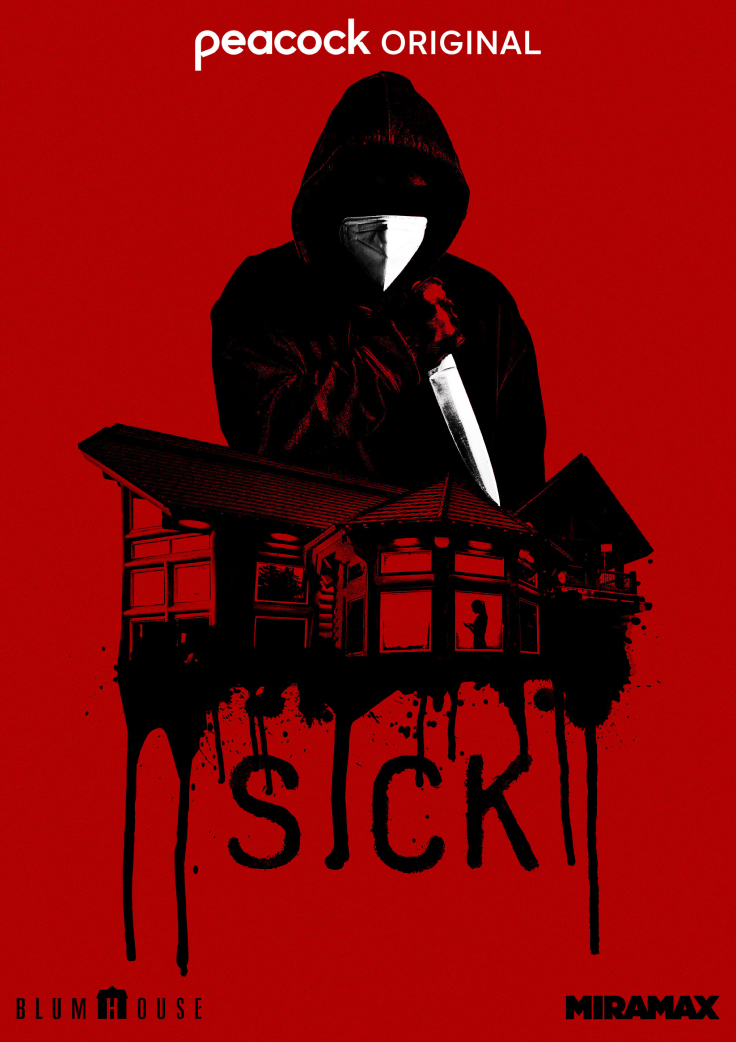
Hyam’s Blumhouse-produced Sick, which is now streaming on Peacock.
With
the economic and educational shutdown of 2020 looming, entitled party girl
Parker Mason and her judgy, strait-laced pal Miri Woodlow decide to quarantine
in the luxury cabin owned by Mason’s dad. Basically, it looks Kevin Costner’s Yellowstone
character might live there, but there do not seem to be any guns in the house,
which stretches credibility.
Of
course, they both announce their every move on social media, so a tech-savvy
stalker can easily follow them to Pop Mason’s cowboy McMansion. We can tell
this psycho is effective, based on the murder he committed during the prologue.
In this case, even Mason’s jealous hook-up, DJ Cole can crash their party. That
means there are three potential victims, waiting to get hacked and slashed.
It
is hard to explain the context without spoiling elements, but Williamson’s
screenplay definitely skewers the compulsive masking experience. It also brings
back embarrassing memories of Clorox wiping your groceries. Perhaps most incisively,
it portrays the weird Covid-Puritanism (sometimes expressed by the likes of
Howard Stern) that blamed victims and carriers. Arguably, the mystery slasher
represents its fullest logical manifestation. However, all of Williamson’s
inspiration is reflected in his razor-sharp dialogue, whereas the
characterization largely falls back on flat stereotypes.
Regardless,
experienced genre director John Hyams skillfully builds the tension and stages
some hair-raising confrontations (even more so than he did in Alone). As
is Scream, the slasher (if there is only one) is definitely a mortal,
who takes bumps and bashes just like the prospective victims. Indeed, each
grisly encounter could go either way, so there is genuine suspense. Among the
cast, the clear standout is Jane Adams as Pamela, whose sinister role would be
spoilery to reveal.