Showing posts with label EPIX. Show all posts

Saturday, October 01, 2022

Blumhouse’s Compendium of Horror, on Epix

In the future, the Blumhouse production company might have their own episode in talking head horror documentaries like this. They do not toot their horn so much in their own survey, but a lot of their comentators’ talking-points sound very much like the same old stuff we’ve heard before. However, Robert Englund’s narration definitely gets you in the mood to rewatch a lot of the films discussed in showrunner James Buddy Day’s five-part Blumhouse’s Compendium of Horror, which premieres tomorrow on Epix.

Blumhouse and Day break down horror by general chronological periods, starting in the 1930s, with the classic Universal monsters. This is generally the best episode, as long as you won’t wonder where the silent German expressionists are. Next, “Atomic Nightmares” episode does a pretty good job chronicling the rise of Japanese kaijus and their low-budget American mutant cousins. However, the pejorative use of the term “red scare” to describe the themes of films like
Invasion of the Body Snatchers is not entirely appropriate, given what we now know about Soviet covert activity at the time. At this point, nobody seriously denies the US Communist Party was wholly controlled by Moscow and actively abetted Soviet agents engaged in espionage.

Bizarrely, Hammer, Universal’s British successor, is almost completely ignored in “Unholy Dreams,” which largely focuses on 1960s and 1970s horror as an expression of the counter-culture’s interest in exoticism and the occult. Even more troubling, it completely misrepresents Friedkin’s classic
The Exorcist as a subversive attack on conventional Christian values. The truth is William Peter Blatty, who adapted the screenplay from his own novel, was a devout Roman Catholic, who believed the Church was our last, best, and possible only defense against evil. If you were to compile a list of the great Catholic films of the 20th Century, The Exorcist would rank towards the top—very possibly #1. To so badly misunderstand and distort its significance reveals the problematic biases of the critics who appear in Compendium.

The next episode is somewhat better, discussing 1980s slasher films in the context of the sensationalistic media coverage of real-life serial killers. The final fifth episode was not yet provided for review, but there is a good chance it misses an important point. As a genre, horror is at a turning point. It has never had greater prestige. Yet, as
Compendium often points out, in the past, horror has often reflected society’s anxieties, sometimes without consciously intending to do so. Recently, many horror films have stopped reflecting widely held fears, opting to tell viewers exactly what they should fear instead. There have been dozens of climate change horror movies, but really none of them amounted to much.

Friday, February 18, 2022

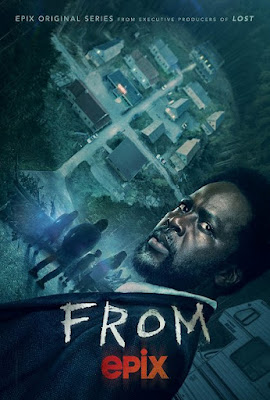
From, on Epix

There is good diner food in this small town, so it is Twin Peaks-ish in that respect. It is also Lost-like in that nobody understands how they got stuck there. Unfortunately, there is not much else there—during the day. At night, it gets considerably worse when the monsters come out. The Matthews family will the latest to find themselves trapped in John Griffin’s From, which premieres this Sunday on Epix.

There was a mysterious tree blocking the road for the Matthews’ RV, so they tried to back up and take a detour. Yet, no matter what turn they take, the road always leads them back to the most depressed small hamlet you have ever seen. That is how it always happens for new arrivals, except the Matthewses also manage to collide with a stoned driver also caught up in the same paranormal phenomenon.

As Sherriff Boyd Stevens and Kristi the doctor (technically, a third year med student) try to explain to the skeptical Jim Matthews, monsters prey on the town at night. Mysterious talismans seem to keep them at bay, unless they trick people into letting them into their homes. Unfortunately, there is not much light left when they reach the crash scene, so everyone might soon see for themselves.

While the set-up definitely fits the
Lost sub-sub-genre (both series also share a couple of producers, including Jack Bender, who helmed the first four episodes provided for review), there are a lot of horror elements added. The show’s first supernatural encounter even echoes a classic scene in the original Salem’s Lot, but at least Griffin and company borrowed a lot of good stuff that worked then—and still works when repurposed now.

In fact, the earlier episodes, wherein everyone only has time to worry about the monsters—essentially, they look and act like an unholy cross between zombies and demons—actually are creepier and more effective than the middle episodes that explore the strange lore and powers that govern the town.

At the center of it all is Harold Perrineau, who is terrific as the reluctant but commanding Sherriff Stevens. He brings all kinds of steely badness to
From, but always helps humanize the show with guilt-ridden backstory and compassionate response to the town screw-up, whose negligence contributes to the initial horrors. Rocky He also provides a strong, human rooting interest as his deputy, Kenny.

Wednesday, December 01, 2021

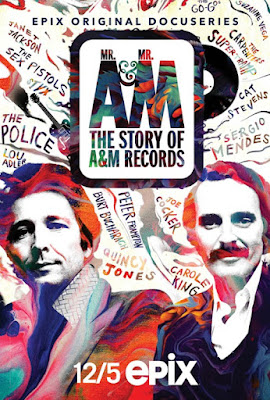
Mr. A & Mr. M: The Story of A&M Records, on EPIX

Like it or not, A&M Records truly shaped the sound of the 1960s and 1970s. They were the record label home to Herb Alpert and the Tijuana Brass, the Carpenters, Captain & Tennille, Carole King, Sergio Mendes, and Burt Bacharach. They also signed 1980s-defining bands like the Police and the Go-Go’s. Even though they are no longer an active label, they have more than enough history to fill the two-part Mr. A & Mr. M: The Story of A&M Records, directed by Ryan Suffern, which premieres this Sunday on EPIX.

Herb Alpert was a scuffling musician when he founded Carnival Records over a hand-shake with Jerry Moss, a relatively green record promoter. Turns out the name was taken, so they simply dubbed themselves A&M. Musician-led labels historically had a hard time of it (arguably, Charles Mingus’s Debut was one of the most prolific at that point, which is saying something), but they had an early breakout hit with Alpert’s Mexican-flavored over-dubbed trumpet stylings on “The Lonely Bull,” which got them off and running.

Instead of talking heads, Suffern uses archival interviews and disembodied voices accompanying footage of the era to tell the labels history (employing the techniques seen in
Ailey and Billie). Ironically, the record label opened their studio complex on the grounds of the old Charlie Chaplin Studio, the one-time home of the silent star (but he did write the tune “Smile”).

Frustratingly, Suffern never discusses the years Creed Taylor’s CTI Records operated as an imprint at A&M. (There are entire art books dedicated to CTI covers, but the history of their association is admittedly complex.) Several important jazz artists are briefly referenced during the two-parter (including Gerry Mulligan and Dave Brubeck), but the only jazz-related artist who gets any serious discussion is A&M’s first big, non-Alpert signing, Sergio Mendes, who came along just in time for the Bossa Nova explosion.

Wednesday, August 18, 2021

Chapelwaite, on Epix

Even though it was originally a 30-page short story in Nightshift, it sort of makes sense “Jerusalem’s Lot” has become a mini-series. Technically, it is a prequel to Salem’s Lot, which still holds bragging rights as best Stephen King miniseries yet (and maybe second best overall adaptation behind the original The Shining). This one isn’t quite that good, but it definitely represents a rebound from the disappointing Lisey’s Story. Maine (circa 1850) gets weird again in creator-writers Peter & Jason Filardi’s 10-part Chapelwaite, which premieres Sunday on Epix.

There has been little happiness in the Boone ancestral home of Chapelwaite, but retired whaler Charles Boone hopes to change that when he inherits the property and the local mill from his estranged cousin, Stephen. Much to his surprise the townsfolk of Preacher’s Corners make no effort to hide their hostility when he arrives. The presence of his mixed-raced children, eldest daughter Honor, troubled middle daughter Loa, and son Tane, the youngest, only fan their prejudice, but he promised their late mother he would provide a stable upbringing for them (on dry land).

Unfortunately, Chapelwaite appears to have a destabilizing effect on Captain Boone. He is constantly unnerved by the sound of rats in the walls that only he can hear, especially in light of the family’s history of insanity. Initially, only their governess, modern-thinking Rebecca Morgan and loyal mill employee Able Stewart befriend the Boones, but as the captain uncovers an unholy cabal centered in the nearby ghost town of Jerusalem’s Lot, the local Constable and deeply flawed parson also side with the pariah family.

Indeed,
Chapelwaite is at its best during its mid-to-later episodes, when the rag-tag Team Boone takes its stand (so to speak) against the infernal forces of Jerusalem’s Lot, led by the ferocious Jakub. There really is a bit of the vibe from It or The Stand, but set against a wonderfully eerie gothic setting. You can see the King-ish themes and motifs, but there are also Hawthorne-like elements. Unfortunately, that also means there is a very King-esque hostility towards fathers and clergymen, even though both Charles Boone and Rev. Martin Burroughs grow in stature and have their grand moments.

Adrien Brody does a terrific job freaking out and brooding hard as Charles Boone. Young thesps, Jennifer Ens, Sirena Gulamgaus, and Ian Ho, are all quite effective as the Boone children, but the Filardis maximize Loa’s petulant acting-out, to a point that becomes tiresome. However, Devante Senior, Gord Rand, and Hugh Thompson really stand-out, adding depth of characterization as Stewart, Rev. Burroughs, and Constable Dennison.

Wednesday, November 06, 2013

Filthy Gorgeous: It’s a Publishing Story

Bob Guccione hired a lot of science and science fiction writers for Omni Magazine. He published other stuff too.  Of course, that is what built his publishing empire and it is why he is now getting the documentary profile treatment in Barry Avrich’s Filthy Gorgeous: the Bob Guccione Story (trailer here), a selection of this year’s Toronto International Film Festival, which premieres this Friday on EPIX.

Originally, painting was Guccione’s calling.  He was more or less content to live the hand-to-mouth life of a struggling artist in Europe, but his first wife—not so much.  Moving to fill a void, Guccione originally conceived Penthouse as the domestic British answer to Playboy, but he quickly recognized the American circulation titan was vulnerable to upstart competition and moved in on its turf.  Guccione initially served as the staff photographer, because he could not afford anyone else, but obviously those duties agreed with him.  Readers (or whatever the correct term might be) seemed to agree, until things started to turn in the 1990s.

Frankly, Filthy is much more interesting when analyzing the collapse of the Guccione empire than celebrating its rise.  An entire film could probably be made on the tempestuous production of Caligula and it would be far more watchable than the train wreck resulting from Guccione’s battles with Tinto Brass.  There were also cash-draining misadventures with a cold fusion reactor scam and an aborted Atlantic City casino.  More costly in the long term, Guccione fundamentally lacked a vision for the whole internet thing, just like his archrival, Hugh Hefner.

There is some fascinating, honest to goodness publishing history in Filthy.  There are also plenty of reminisces about what a progressive gentleman Guccione was in his business dealings and how shy he was in private.  That is all very nice, but it gets repetitive quickly. Likewise, attempts to position Guccione as yet another First Amendment crusader fall flat, notwithstanding the efforts of Alan Dershowitz.  In fact, the lack of critical voices in Filthy is a serious flaw.  There really should be someone somehow associated with Vanessa Williams tearing into him for the nude photo scandal.

Naturally, Avrich periodically gives viewers peaks behind the magazine covers, because duh.  Yet, the sequence that resonates the strongest describe attempts by Guccione, Jr. (a rather candid interview subject) and several of his father’s loyalists to take the magazine in a more demur Men’s Health or Maxim direction.  There is something to their arguments that might have been explored in greater length.  Needless to say, Guccione, Sr. went in the opposite direction with dire financial consequences.

The magnitude of Guccione’s downfall is almost worthy of classical tragedy.  As a posthumous profile, there is no escaping the inevitable, but the closing fifteen minutes or so are surprisingly sad.  Still, there are some worthy object lessons for budding media moguls in Filthy regarding the importance of seizing opportunities and acknowledging seismic shifts in the marketplace.  There are also pictures of naked women, scrupulously selected for their comparative tastefulness.  Conspicuously one-sided but still consistently interesting, Filthy Gorgeous is recommended to mature viewers for the documentary equivalent of its articles when it airs on EPIX this Friday night (11/8).