Showing posts with label Koji Yakusho. Show all posts

Friday, July 28, 2023

Japan Cuts ’23: Father of the Milky Way Railroad

Kenji Miyazawa was poorly served by his publishers in his lifetime, but anime and manga adaptations made him a posthumous giant of Japanese literature. His life was tragically short, but his father believed in his talent, at least most of the time. The Miyazawas’ close but sometimes difficult father-and-son relationship is the focus of Izuru Narushima’s Father of the Milky Way Railroad, which screens tomorrow as part of this year’s Japan Cuts Festival of New Japanese Film.

Masujiro Miyazawa is a reasonably prosperous country pawnbroker, like his grouchier father. He considers himself a contemporary man of the late Meiji Era, but Masujiro still assumes his firstborn son will succeed him in the family business. However, as Kenji grows older and more headstrong, he envisions other destinies for himself, including as an agricultural expert and as acolyte in a severe Buddhist sect.

Of course, writing was his true calling, but it takes a family tragedy to re-awaken his fantastical creativity. Throughout it all, Miyazawa’s father continues to support him, despite often losing patience in his flaky behavior.

In fact, their relationship is surprisingly believable. There is a lot of tear-jerking in Narushima’s film, but he and the cast earn their big emotional pay-offs. Sadly, this is the kind of deeply felt family drama the American film industry cannot be bothered with anymore. There is no secret abuse to expose or power dynamics to subvert. It is just a family, relatively progressive for its time, dealing with the challenges and disappointments of life.

Friday, August 20, 2021

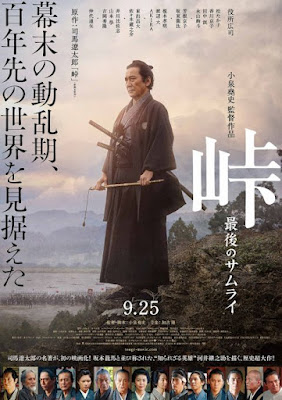
Japan Cuts ’21: The Pass—Last Days of the Samurai

Forget about Tom Cruise. In Japan, Tsuginosuke Kawai is often regarded as the last samurai. At the end of the Shogunat era, his Nagaoka clan found itself caught between forces loyal to the Shogun and the newly restored emperor. He wanted to avoid a fight, but the Boshin War draws him in anyway in Takashi Koizumi’s The Pass: The Last Days of the Samurai, which screens live-and-in-person during the 2021 Japan Cuts Festival of New Japanese Film, at the Japan Society.

Kawai is the Nagaoka Clan’s chief retainer. Given his lord’s advanced years, he is also the de facto strategist and decision-maker. He tries to remain neutral after the Shogun’s abdication, but the two warring factions just won’t have it. Reluctantly, Kawai assumes command of an alliance of smaller clans, even though he suspects their efforts will ultimately prove futile. However, they might have a prayer of survival, if they continue to hold the strategic Enoki Pass. Whoever controls the pass controls Nagaoka Castle.

Pass
is a terrific samurai film that is rife with tragic Shakespearean overtones, which makes sense, given Koizumi was the assistant director on Kurosawa’s Ran. Hardnosed Koji Yakusho (the star of Takashi Miike’s 13 Assassins and Hara-Kiri) is instantly credible and immensely compelling as the shrewd, but world-weary Kawai. In many ways, you could consider this a samurai equivalent to Eastwood’s late-career cowboy movies. He also perfectly personifies Ivan Morris’s conception of the “Nobility of Failure” in Japanese history and culture.

Yakusho also shares some keenly poignant chemistry with Takako Matsu, playing his eternally patient wife, Osuga. Their marriage is not perfect, but it endures. As added bonuses, the legendary Tetsuya Nakadai and Kyoko Kagawa turn up in small parts. However, there is no question Yakusho owns the film, body and soul.

Friday, June 29, 2018

NYAFF ’18: The Blood of Wolves


You do not keep rival Yakuza clans in check by being an apologetic liberal community organizer. You need a cop with a wild streak. That certainly describes Shogo “Gami” Ogami. He has the swagger and he can match any Yakuza drink for drink. Word has it he might be too chummy knocking sake back with Hiroshima’s leading gangsters. Regardless, the young Internal Affairs detective assigned as his undercover partner will get quite a lesson in community policing during the course of Kazuya Shiraishi’s The Blood of Wolves (trailer here), which screens during the 2018 New York Asian Film Festival.

Hiroshima, 1988: a gang war is brewing and only Ogami can stop it, or so he thinks. It is really just a continuation of the previous war that broke out in the early 1970s. Ogami was also involved in that conflict—perhaps too involved, if rumors are true. As goody-two-shoes Shuichi Hioka watches his new partner and secret target extort information from suspects, pop out for quickies with witnesses, and force him into punishing brawls, he decides everything he has heard about Ogami must be true. Yet, he slowly starts to appreciate the method behind Ogami’s madness. In fact, Hioka embraces Ogami’s fast-and-loose tactics just when the top brass, the media, and the largest Yakuza clan all turn against him.

Seriously, you cannot get anymore old school than Blood of Wolves. It is just drenched in atmosphere and attitude. As Ogami, Koji Yakusho channels Ken Takakura on a grain alcohol bender. Yakusho has played his share of hard-nosed characters before, but Ogami can knock the wind out of you with a dismissive glance. Standing next to him is a tough assignment, but Tori Matsuzaka holds his own quite impressively as the tightly wound Hioka. In fact, when he eventually runs off the rails, it is quite a spectacle to behold.

Despite Yakusho’s dominance, Blood is fully loaded with memorable supporting turns, especially Yoko Maki as a club hostess with a deep grudge. It is just a ferociously beautiful performance. Pierre Taki is also quite colorful and almost humanly decent as Ginji Takii, the leader of a minor right-wing party affiliated with the largest Yakuza clan (and Gami’s best bud), while Renji Ishibashi is slime personified as its Mephistophelean chairman.

The 1980s period details are perfectly recreated, while cinematography Takahiro Haibara soaks up the grit and sleaze of the back alleys of Hiroshima and Kure. Frankly, it looks like the film was shot in the 1970s rather than the 1980s (or 2010s), but that is not a bad thing. Wolves is Shiraishi’s best film to date, by far (at least among those that have had New York festival play). It is also a dynamite showcase for Yakusho and half a dozen other prominent Japanese screen thesps. Very highly recommended, The Blood of Wolves screens Monday night (7/2) at the Walter Reade, as part of this year’s NYAFF.

Thursday, June 28, 2018

NYAFF ’18: The Third Murder


This will be an awkward case for hotshot attorney Tomoaki Shigemori. It will remind him guilt and culpability are not necessarily the same thing. The case against Takashi Misumi also illustrates the systemic advantages enjoyed by Japanese prosecutors. Yet, most vividly, the pitched court battle demonstrates how elusive the truth can be, as a tangible, knowable thing. Shigemori will try his best to uncover the truth while obeying his clients instructions—ironically, two objectives that never really concerned him much before—in Hirokazu Koreeda’s The Third Murder (trailer here), which screens during the 2018 New York Asian Film Festival.

Misumi confessed and his lawyers never laid the groundwork to question his culpability. By the time Shigemori is called in, the best he can hope to do is challenge the charge of felony homicide, by separating the alleged murder and robbery of Misumi’s former factory boss into two discrete acts. The way Misumi keeps changing his story makes his task even more difficult. Nevertheless, as Shigemori digs in, he starts to question many of his assumptions.

Frankly, a fact-finding trip to Misumi’s frosty Hokkaido hometown only raises more questions and uncertainty, starting with his previous two murder convictions. During his previous trial, Misumi never denied killing two loan sharks who were preying on the town’s dispossessed blue-collar workers. Shigemori starts to see a pattern emerging when the sins of his latest “victim” become apparent, but his client refuses to give him the confirmation he so earnestly desires.

In the hands of a lesser filmmaker, Third Murder could have been a ridiculously overwrought and symbolically overblown film, but Koreeda exercises rigorous restraint. He only hints obliquely at possible religious and spiritual interpretations, which makes them exponentially more tantalizing. Every step of the way, he focuses on the mundane and absurd bureaucratic rituals of the Japanese legal system, which keeps the film firmly grounded in reality. Yet, there is always a sense of some greater truth just beyond our reach.

Third Murder also proves Koji Yakusho is one of the absolute best in the business. He makes Misumi acutely human but also profoundly inscrutable. He might be a cypher, but he still expresses remorse and compassion, in ways that will hit viewers hard. Suzu Hirose is even more poignant and affecting as Sakie Yamanaka, the dead man’s daughter, who clearly feels a greater emotional connection to Misumi. Masaharu Fukuyama is also terrific subtly portraying Shigemori and the slow re-awakening of his integrity and idealism. He and Yakusho are riveting whenever they face-off together, even though they both usually tack an understated, slow-burning course.

This is the kind of film that will reward periodic revisiting over the course of decades. It chronicles injustice, but it is a deeply, deeply moral film. Thematically, it is a dramatic departure for Koreeda, but it still examines relationships between parents and children through an undeniably humanistic lens. Yet, if you strip away the Christian imagery and potential allegorical readings, you will still have a compelling legal procedural. Very highly recommended, The Third Murder screens Saturday afternoon (6/30) at the Walter Reade, as part of this year’s NYAFF.

Wednesday, June 27, 2018

NYAFF ’18: Sekigahara


It was the big battle the events in James Clavell’s Shogun were leading up to, but this time we do not see them through the eyes of Richard Chamberlain. In 1600 (a nice round year), the Eastern Army commanded by Ieyasu Tokugawa (Toshiro Mifune in Shogun) clashed with the Western Army led by Ishida Mitsunari. The Eastern Army had greater numbers, but the battle still could have gone either way, at least according to the semi-fictionalized chronicle in Masato Harada’s Sekigahara (trailer here), which screens during the 2018 New York Asian Film Festival.

Mitsunari is loyal to Toyotomi Hideyoshi, the great unifying daimyo, even though he chafes under some of the lord’s harsher decisions. When Hideyoshi dies, Mitsunari is determined to preserve his heir’s succession and to institute a more just and humane administration. Tokugawa is less idealistic and more Machiavellian. There is also bad blood between the two samurais.

Initially, Tokugawa holds all the institutional advantages, but Mitsunari scores several coups when it comes to recruiting allies. He sways the legendary leprosy-afflicted samurai Yoshitsugu Ōtani to his side, appoints the physically scarred and battle-tested Sakon Shima as his commander, and accepts the services of stealthy Iga Ninja Hatsume. During the course of her service, Hatsume and her lord will fall in love, but they can never consummate their feelings, due to political considerations.

As you would hope and expect, Sekigahara is jam-packed with tragically epic battle sequences. This is a satisfyingly big film, which might be why the small, quiet subplot involving Mitsunari and Hatsume is so potently poignant. As the two non-lovers, Junichi Okada and Kasumi Arimura do not have a lot of screen time together, but they still develop some lovely chemistry.

In fact, Okada brings Shakespearean dimensions to Mitsunari. When he is arrogant, it will make you wince—and when he is humble, it is downright heroic. The always reliable Koji Yakusho shows he still has a few tricks up his sleeve as the scheming Tokugawa, while Takehiro Hira is spectacularly grizzled and hard-nosed as the serious-as-a-heart-attack Shima.

Sekigahara is exactly the sort of film that made many cineastes fall in love with Japanese cinema in the first place. Harada commandingly manages the numerous battlefield reversals and nicely balances all the complex elements (arguably, two-and-a-half-hours is pretty tight for this genre). It is an elegant work of big screen craftsmanship, but it absolutely takes no prisoners. It is all quite sad, yet still a great deal of fun. Very highly recommended, Sekigahara screens this Friday (6/30) at the Walter Reade, where Harada will receive NYAFF’s Star Asia Lifetime Achievement Award (his past festival selections include Chronicle of My Mother, Climber’s High, and Shadow Spirit).

Thursday, March 01, 2018

Oh Lucy!: The Independent Spirit Award Nominee


American English is different from the Queen’s English. That’s what Setsuko Kawashima’s Yankee English teacher teaches, so it makes sense he has a pedagogy you won’t find in British public schools. John hugs a lot and deep down, she rather digs that. She is profoundly sad, so she might as well start taking risks, even when they are wildly ill-conceived. Free-spiritedness is harder to master than it looks in Atsuko Hirayanagi’s Oh Lucy! (trailer here), which opens tomorrow in New York.

Kawashima is a quietly desperate office lady, whose only consolation is that most of her co-workers’ jokes are directed behind the back of her senior colleague. Her relationship with her drama queen sister is strained at best, because Kawashima still blames Ayako for stealing and marrying her former boyfriend. Generally, Kawashima is okay with her flighty niece Mika, but she is still cautious when asked for a favor. Mika is hoping she will buy out her spot in John’s prepaid English lessons.

John’s “school” is a room in a Yakuza owned love hotel, where he gives his students English names and ridiculous wigs to wear. Yet, somehow, being the blonde Lucy is liberating for Setsuko. Takeshi Komori, or “Tom,” a widowed ex-cop, also enjoys the informality and hugging. Frankly, he could be perfect for Setsuko, but when John and Mika abscond with her lesson fees back to America, she perversely decides to chase after him. To make things even more awkward, Ayako invites herself along to give her daughter a piece of her mind. However, when the arrive at their last known address, they find John has been dumped and abandoned by Mika. Now he is just a pathetic stoner on the verge of eviction, but Setsuko/Lucy is still interested.

Oh Lucy is a fix-up of Hirayanagi’s award-winning short. Basically, she took the crowd-pleasing English lesson gags and added a bunch of tragic reality. The result is a sad and wise character study that shares a distant but legit kinship with Kumiko the Treasure Hunter.

Shinobu Terajima totally deserves her Independent Spirit nomination for her portrayal of Kawashima. She has a tricky tight-rope to walk. She is achingly vulnerable, yet also a little off, but not in a conspicuous way that prompts viewers to keep their guard up. In a way, the role of John represents Josh Harnett’s career arc. At first, he looks hip and handsome, but then he becomes rather sad—yet there are still flashes of the old charm that shine through. Regardless how well he relates to the part, this is some of his best work in years.

Hirayanagi has two more aces up her sleeve. Kaho Minami (currently married to Ken Watanabe) is wonderfully tart as Ayako, but she also plays her smart and self-aware. Of course, Kôji Yakusho is money in the bank as “Tom” Komori, whom he plays with sensitivity and goofiness without compromising his manly screen persona one whit. Megan Mullally kills a brief cameo, but Reiko Aylesworth (Michelle Dessler in 24) is frustratingly under-employed as John’s ex.

Traditionally, it is the salarymen whose angst has been grist for cinema, so it is nice to see the frustrations of office ladies get some equal time. Even with its eccentricities, this is a messily realistic film that deliberately zigs when we want it to zag. That’s life folks. Hirayanagi and Terajima show that it can be both ugly and beautiful. Very highly recommended, Oh Lucy! opens tomorrow (3/2) in New York, at the Landmark 57 West and the Village East.

Monday, November 21, 2016

Mifune: The Last Samurai

It is a story of a film role that got away that rivals Tom Selleck’s nearly appearing as Indiana Jones in Raiders of the Lost Ark. While the regretful Selleck was forced out by contractual obligations beyond his control, Toshiro Mifune could only blame his agent’s bad advice for turning down what would be the iconic role of Obi-won Kenobi. Yet, even without the Star Wars franchise, Mifune has attained legendary status, in great part due to his acclaimed collaborations with Akira Kurosawa. Steven Okazaki surveys the towering actor’s life and work in Mifune: The Last Samurai (trailer here), which opens this Friday in New York.

Obviously, Okazaki had a wealth of historically significant films to draw from, including arguably the greatest death scene ever in Kurosawa’s loose Macbeth adaptation, Throne of Blood. He also found some tremendously illustrative photos, such as the montage of sports cars Mifune wrecked during hard-drinking benders. The working class Mifune essentially fell in acting almost accidentally, but he became the top Japanese box-office draw of his era and one of its most exportable movie stars.

Unfortunately, Mifune acted on a lot of dubious advice during his post-Kurosawa career, particularly a studio boss’s counsel to start his own production company. When times got tough, Mifune was forced into television work to keep his company afloat. None of the footage Okazaki shows from this period will look familiar to most American Mifune fans. It might be a huge step down from his Kurosawa classics, but it is Mifune we haven’t seen—and evidently there is a great deal of it.

Steven Spielberg would probably only talk about 1941 to pay tribute to Mifune, but he does indeed discuss directing the actor in one of his least regarded films. We also hear from Mr. Movie Documentary himself, Martin Scorsese, as well as Mifune’s son Shirô, and Haruo Nakajima, a contemporary now most closely associated with the Godzilla franchise. Kôji Yakusho, perhaps the closest contemporary heir to Mifune’s gruff leading man mantle also provides some context. However, the most endearing moments are spent with the great-in-her-own-right Kyôko Kagawa, who regrets not having the opportunity to play a late-in-life Marigold Hotel-style romance with her co-star from High and Low, The Bad Sleep Well, and Red Beard.

Last Samurai is a classy film that is so unflaggingly respectful, its interview subjects often speak in the hushed tones typically used in church pews and the like. Keanu Reeves’ narration is crystal clear, but sometimes borders on the reverent. Yet, Okazaki and his interview subjects deal forthrightly with Mifune’s conspicuous but readily forgivable character flaws. Most tellingly, the doc puts viewers in the mood to binge watch several dozen Mifune films, which suggests it is ultimately quite effective. Highly recommended for all fans of classic cinema, Mifune: The Last Samurai opens this Friday (11/25) in New York, at the IFC Center.

Monday, October 17, 2016

Juzo Itami’s Tampopo

We call any old instant noodles ramen here in the West, but in Japan, there are very definite rules as to what constitutes ramen and how it should be prepared. It is a deceptively simple but nourishing dish, like many great Japanese films. When it released in 1985, it launched the culinary movie trend best represented by the likes of Babette’s Feast, Le Grand Chef, and Eat Drink Man Woman. It also predates the other great “noodle neo-western,” A Woman, a Gun, and a Noodle Shop. You will learn to respect and crave ramen in Juzo Itami’s newly 4K-restored Tampopo (trailer here), which opens this Friday at Film Forum.

While his partner Gorō drives, Gun reads a book of ramen reminisces that makes both of them hungry. Fatefully, they stop at Tampopo’s ramen restaurant. Frankly, her ramen is not very good, but Gorō rather enjoys her company. In fact, when a thuggish contractor creates a scene, Gorō two-fistedly settles it outside, despite being out-numbered. Thus, an ambiguously romantic friendship is born between Tampopo and her champion. As an unlikely ramen expert, he also starts coaching her in ways to improve her noodles and broth. Soon, he recruits a rag-tag team of specialists to lend their particular expertise and eccentricity.

In between Tampopo’s worst-to-first campaign, Itami intersperses loopy food-related interludes, including a scene involving a grocer stalking a serial produce-squeezer that plays like a send-up of the supermarket scene in Stallone’s Cobra, except Tampopo predates that film as well. Periodically, Itami returns to an unnamed Yakuza in hiding with his lover, whom he sexually relates to through food.

Like so many of the foodie movies that followed it, Tampopo definitely uses food as a metaphor for life and love. However, few films are as willing to be as randomly goofy as Itami’s ramen opera. Clearly, there are things that happen solely because Itami thought they were funny—which they were and still are. Arguably, he raises silliness to a high art form. It is hard to imagine a film like this making it through focus groups and studio note-writing screenings today, so it is enormously refreshing to have it back again.

Amid all the lunacy, Itami’s wife and muse Nobuko Miyamoto shines like an Ozu heroine as the title noodle purveyor. Tsutomu Yamazaki is wonderfully sly and hardnosed as Gorō, like a vintage Clint Eastwood. A ridiculously young looking Ken Watanabe adds earnest vigor as Gun, while a relatively youthful Kôji Yakusho becomes the symbolic face of the film as the Yakuza in the white suit. In fact, Tampopo is absolutely bursting at the seams with fine supporting performances, in both the main narrative and the periodic interludes.

You just can’t see films like this anymore, because screenwriters now all read the same books that tell them how to structure a script, literally beat-for-beat. Tampopo breaks all the rules and it is a much richer viewing experience as a result. The humor is often outrageous, but it holds up quite well over the years and crossing cultures. It is funny, but it is also acutely human. Indeed, there are good reasons why so many ramen restaurants were renamed “Tampopo” after the film released internationally. Highly recommended for culinary movie fans and Nipponophiles, the 4K restoration of Tampopo opens this Friday (10/21) in New York, at Film Forum.

Sunday, March 01, 2015

FCS ’15: The World of Kanako

Showa Fujishima has made just about every parenting mistake a father can make and invented some that are uniquely his own. Not surprisingly, he really hasn’t been around much to see the results. At least that allows him to cling to a few willful misconceptions regarding Kanako. However, when his estranged ex-wife begrudgingly requests the ex-cop’s help finding their missing daughter, he learns far more than he bargained for in Tetsuya Nakashima’s The World of Kanako (trailer here), which screens during the 2015 edition of Film Comment Selects.

Prepare to have your head messed with. Nakashima will fracture his timeline nearly beyond recognition and do his best to represent Fujishima’s warped perspective. The former copper now working as a rent-a-cop always had anger management issues, which directly led to his personal and professional disgrace. He is supposed to take drugs for his temper and mood swings, but they do not seem to be working, even though they might somewhat skew his perception of reality.

Kanako has already been missing for five days before Fujishima’s ex finally asks for his help. Intuitively, he assumes her disappearance is linked to the punky gang kids she has been hanging with, which is largely correct, but his presupposition that Kanako is an innocent victim will be rudely disabused. He soon learns she is up to her neck in drugs and pimping out classmates to well-heeled pedophiles. She was also apparently somehow mixed up in the suicide of her classmate Ogata. We will learn just exactly how so in flashbacks seen through the eyes of Boku, a secondary POV character, whose experiences with Kanako will parallel those of poor Ogata.

Meanwhile, Fujishima’s hostile former colleagues are more than happy to treat him as a suspect in a gangland-style killing perpetrated at the minimart he was ostensibly guarding. It turns out Kanako’s world is a small world when links turn up suggesting a connection between the convenience store massacre and her disappearance. Fujishima is in for a lot of pain and humiliation, but he will deal out plenty more to anyone he considers a potential suspect or accomplice.

Man, Kanako is dark, even by the standard Nakashima set in his previous films, Confessions and Memories of Matsuko. However, unlike the seamlessly constructed escalation of Confessions, WoK is a bit of a rat’s nest, compulsively flashing forward and backwards and liberally tossing unreliable perceptions or downright hallucinations to the point where many viewers will just drop the narrative thread and stop caring altogether, despite the occasional tongue-in-cheek hat-tips to 1970s exploitation cinema. The form of the film is enough to give you a headache, separate and apart from the rampant cruelty it depicts. Based on Akio Fukamachi’s novel, WoK is a nihilistic indictment of just about everything—that’s nihilism spelled with a capital “F” and a capital “U.”

To his credit, Kôji Yakusho doubles down over and over again as the violently erratic Fujishima. It is a messy, let-it-all-hang-out performance, but Yakusho takes it to such dark places, it is ultimately rather soul-scarring. Nana Komatsu is ethereally evil as the deceptively innocent looking Kanako, while Satoshi Tsumabuki chews the scenery with swaggering glee as Det. Asai, the sucker-sucking cop who apparently thinks he’s Kojack. Ai Hashimoto manages to add a thimble full of humanity to the film as Kanako’s estranged and disgusted middle school friend Morishita, but such figures of decency are few and far between in Kanako’s world. Frankly, it is hard to fully judge Kanako’s former homeroom teacher, Rie Higashi, but (Matsuko star) Miki Nakatani’s performance is truly riveting and maybe even redemptive.


If this is what life is really like for Japanese middle and high school students, I would immigrate if I were a parent. It is hard to imagine a more exhausting film than WoK, for reasons of both style and content. It is clearly the work of a genuine auteur, who does not get his just international due, but Nakashima really demands a great deal of indulgence this time around. Lacking the tightness of Confessions and the pure gut-wrenching emotional payoff of Matsuko, it just starts to feel like it is piling it on after a while. For those who enjoyed cult hits like Confessions, Lady Snowblood, Audition, and the real Oldboy, but found them too artificially optimistic, WoK will give you the straight shot of bile you crave. Recommended accordingly for ardent Nakashima admirers, The World of Kanako screens this Thursday (3/5), at the Walter Reade Theater, concluding this year’s Film Comment Selects.

Wednesday, February 13, 2013

Takashi Miike’s Hara-Kiri


Honor is not simply a matter of ritual and technicality.  However, samurai who have only known peace seem to have a tendency to forget the heart and spirit of their code.  A ronin with a mysterious grievance intends to teach a noble house’s conceited retainers a hard lesson in Takeshi Miike’s Hara-Kiri: Death of a Samurai (trailer here), now available on DVD and BluRay from New Video Group.

Yes, there is peace, but the Shogun’s devious maneuverings destroyed a once proud clan, leaving a glut of impoverished ronin (masterless samurai) at loose ends.  The situation has given rise to a phenomenon known as “suicide bluffs,” where ronin ask for the use of the House of Ii’s courtyard to commit ritual seppuku in hopes they might receive a few coins and be sent on their way instead.  Hanshirô Tsugumo has asked duly asked for such a favor from the head retainer Kageyu Saitou, but he seems to have his own agenda.

Hoping to dissuade him, Saitou tells him the pathetic story of the last ronin who came cold calling.  Tired of indulging suicide bluffs, Saitou’s arrogant lieutenants forced the desperate young man to follow-through on his threat, in what quickly becomes a horrific display bearing little resemblance to any notion of honor.  As it happens, Tsugumo already knows the gist of this tale.  In fact, he is well acquainted with the sad young Motome Chiziiwa, as viewers learn in the next series of flashbacks.

Based on the novel famously adapted by Masaki Kobayashi in 1962, Miike’s film is not called Hara-Kiri for no reason.  About the first masterfully tense quarter is largely dedicated to Chiziiwa’s involuntary disembowelment.  While the middle section somewhat suffers in comparison, Miike nonetheless provides all the necessary context to appreciate the first and third acts and fully establishes his central characters as sympathetic, flesh-and-blood figures, particularly Miho, the frail woman linking the two ronin together.

Indeed, Hikari Mitsushima is deeply affecting as the ill-fated (who isn’t in a Miike film?) Miho, a character lightyears removed from the all kinds of scary schoolgirl-cultist she brought to life in Sion Sono’s Love Exposure.  Likewise, Eita is an aching model of pathos as Chiziiwa.  However, Hara-Kiri really belongs to the two steely-eyed old dogs circling each other right from the beginning.

Traditional kabuki actor Ebizo Ichikawa (or Ebizo IX) appropriately simmers and seethes like a seriously hard-nosed, world weary swordsman with a point to make.  He is the real deal, commanding every scene he appears in, which is quite the trick considering he is paired up against Kôji Yakusho, the international paragon of middle-aged badness, as Saitou.  Once again, Yakusho brings gravitas and a sense of ruthlessness to the proceedings.  While not nearly as crowd-pleasing as his lead role in Miike’s hit 13 Assassins, he makes the most of it.

Where Assassins delivers the hack-and-slash, Hara-Kiri offers foreboding and tragedy.  Frankly, the latter was far truer to the heroics of the Samurai era, which Ivan Morris described as the “nobility of failure.”  However, the awesomely action-driven Assassins would have been a more logical candidate to be Miike’s first 3D film, yet that distinction belongs to Hara-Kiri.  Regardless, it translates to 2D viewing just fine.  A stately period production that is amply rewarding on multiple levels, Hara-Kiri is highly recommended for fans of samurai films and historical dramas in general.  It is available at all online retailers from New Video Group.

Friday, July 20, 2012

Japan Cuts ’12: Chronicle of My Mother


Kosaku Igami follows the golden rule for novelists.  He writes about what he knows.  In his case, he knows about abandonment and mother issues.  Nonetheless, he and his dutiful daughters will look after his aging mother in her years of waning lucidity throughout Masato Harada’s Chronicle of My Mother (trailer here), which screens as part of the Focus on Kôji Yakusho tribute at the 2012 Japan Cuts: the New York Festival of Japanese Cinema.

In the post-war years, Igami’s family temporarily immigrated to Taiwan, but he was left behind with “Granny Nui.”  There were reasons for this, but they were never adequately explained to Igami.  The beloved Granny Nui’s rather ambiguous position within the family further stoked his resentment.  Despite his painful childhood memories, Igami became a success, filling novels and stories with thinly disguised characters based on his family.  This in turn has led to some resentment on his daughters’ part.

Though Igami was never close to his mother, her well-being becomes a constant source of concern for the entire family after the death of his father.  She has always been difficult and Igami’s sisters start to suspect she is exploiting her signs of senility to say whatever caustic comment crosses her mind.  She is a handful alright, but Igami’s daughter Kotoko is willing to hold up more than her end.

Predominantly set in the 1960’s, Chronicle stylistically and thematically harkens back to the great films of Yasujiro Ozu, even invoking Tokyo Story by name.  Kotoko is definitely a figure in the tradition of Ozu’s Norikos, as is her sensitive sister, who happens to be named Noriko.

Though he is still working through the psychological baggage of his youth, Igami is gruff, headstrong, and manly, requiring the kind of presence Japan Cuts special guest Yakusho specializes in.  While the story, based on Yasushi Inoue’s autobiographical novel, charts a somewhat predictable course, Yakusho’s big emotional payoff is hard-earned and honest.  Likewise, Aoi Miyazaki’s work as Kotoko is exquisitely expressive and sensitive.  Yet, the key to the film might be Kiki Kirin’s Mother Yae.  Rather than a full-throttle descent into dementia, she maintains an ambiguity regarding the matriarch’s state of mind, giving viewers hope for some form of familial rapprochement.
 
Indeed, Harada’s approach is refreshingly earnest yet disciplined enough to spurn cheap sentimentality.  While certainly reflecting the specifics of Japanese society, its themes are undeniably universal.  Lovingly shot in warm tones by cinematographer Akiko Ashizawa and featuring a complimentary chamber music soundtrack by Harumi Fuki (with an assist from Bach), Chronicle is richly produced period drama.  Recommended for those who appreciate nostalgic family dramas and tearjerkers with a sense of restraint, Chronicle of My Mother screens tomorrow night (7/21) at the Japan Society, as part of this year’s Japan Cuts.

Wednesday, July 18, 2012

Japan Cuts ’12: The Woodsman and the Rain


If you’re wondering where Harrison Ford and Tommy Lee Jones’ fifty-plus mojo went, it’s been in Japan with Kôji Yakusho.  While American audiences might know him best as the salaryman who cuts a rug in Shall We Dance?, nobody working in film today is more credible as a middle-aged man you do not want to mess with.  His hardnosed everyman charm is also perfectly suited to the gently humanistic comedy of Shȗichi Okita’s The Woodsman and the Rain (trailer here), which screens as the centerpiece of this year’s Japan Cuts and a key selection of their Focus on Kôji Yakusho retrospective sidebar.

If you have seen Takashi Miike’s 13 Assassins, you know what a dynamic presence Yakusho can be in an action-driven film.  If you haven’t, the Japan Society will give you an opportunity this Saturday.  It’s kind of awesome, but Woodsman is too, in a very different way.  Here Yakusho plays a sixty year-old lumberjack and you would not want to be a tree in his sites.  He is not a superhero though.  Having survived a health scare, Yatsuhiko Kishi (Yatsu-san) can no longer eat sweets.  The widower’s relationship with his slacker son Koichi is strained at best.  However, he can now predict precipitation with uncanny accuracy.  Given the title, this ability will obviously come into play at some point, but wisely nobody in the film belabors it.

Kishi is pretty set in his routine, until a film crew comes to town.  Much to his own surprise, he finds himself shuttling about a nervous assistant director and a socially awkward twenty-something in search of locations for their zombie film.  That quiet kid turns out to be Koichi Tanabe, the first time director with massive confidence issues.  Yes, he has the same first name as Kishi’s son, but Okita never overplays that card either.

Before you know it, Kishi is deeply involved in the shooting of Tanabe’s dubious b-movie.  Many of these scenes are essentially played for laughs, but in an earthy, understated way.  Still, for genre film fans, how can you resist a film about lumberjacks and movie-zombies?

Woodsman is a perfect film to anchor the Yakusho showcase.  His performance is rich, nuanced, and deeply felt.  He is a good sport, willing to look slightly ridiculous at times, yet he always maintains his dignified bearing.  As the Koichis, both Shun Oguri and Kengo Kora grow on viewers, subtly but convincingly showing their characters grow up as the film progresses.

Not exactly bittersweet, but certainly not compulsively cheerful either, Woodsman is ultimately wholly satisfying, in a rugged, down-to-earth way.  It is a great example of Yakusho’s powerful screen presence as well as a wistfully wise bit of storytelling.  Very highly recommended, The Woodsman and the Rain screens this Saturday at the Japan Society as this year’s Japan Cuts centerpiece (featuring an intro and Q&A with the man himself), but good luck getting in.  It is already sold out, so if you do not have your ticket booked, you’re flying stand-by.  Also very highly recommended, tickets for 13 Assassins and Shall We Dance? are currently available on Saturday (7/21).