Showing posts with label Park Chan-wook. Show all posts

Monday, December 22, 2025

Submitted by Korea: No Other Choice

Yoo Man-su might just become known as the most iconic paper industry executive in cinema history. Of course, there aren’t many movies about the paper industry. It also helps that Yoo is literally killing his competition. Amongst job-seekers, Yoo becomes unusually proactive in Park Chan-wook’s No Other Choice, Korea’s shortlisted International Oscar submission, which opens Christmas Day in New York.

Yoo worked his way up to become a highly paid executive at his paper company, only to be laid off when it is bought out by an American firm. Unfortunately, there has been a lot of this going around, so whenever a paper exec job comes up, he must compete with an army of applicants.

Although he sometimes takes demeaning temp work, Yoo is on the verge of losing his family’s home. The prospect is particularly painful to Yoo, because he grew up there as a child and worked diligently to renovate into his own private paradise. Plus, he suspects his dental hygienist wife’s boss might take advantage of his humiliation to seduce her.

However, Yoo refuses to take his situation laying down. Placing fake recruitment ads, Yoo determines which possible candidates for future openings would have the most competitive qualifications compared to himself. Then, he starts stalking and killing them. However, that is a decidedly messy undertaking for a middle-aged paper exec like Yoo.

Based on Donald E. Westlake’s novel
The Ax, which was previously adapted for film by Costa-Gavras, Park’s No Other Choice, reflects the attitudes and underlying ideologies of recent Korean productions like Parasite and Squid Game. It makes similarly bitterly caustic points regarding economic uncertainty and social insecurity. However, those comparable works maintain a vice-like hold on viewers.

In contrast, Park and co-screenwriters Lee Kyoung-mi and Don McKellar too often allow the message to overwhelm the storytelling. For long stretches, Park belabors his takeaways, very definitely at the expense of tension and suspense. (Perhaps tellingly, the ideologically-charged Gavras family supported the production of Park’s adaptation as producers.)

Friday, October 14, 2022

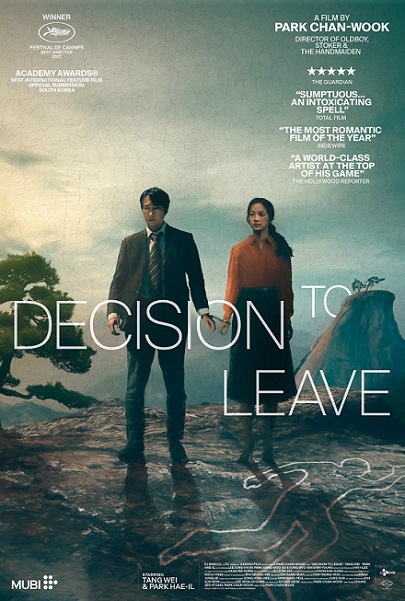
Park Chan-wook’s Decision to Leave

Hae-joon is the kind of relentlessly diligent detective, who might be a little too professional for his fellow cops—the kind that prefer to wrap cases up quickly. Seo-rae is such a composed widow, Hae-joon’s colleagues automatically suspect the worst of her, even though there is no direct evidence implicating her. The prospect of Hae-joon investigating Seo-rae is a potentially perfect storm of frustration for the Busan police, especially as the cop and suspect start to recognize their mutual attraction in Park Chan-wook’s Decision to Leave, which opens today in New York.

Seo-rae’s husband was an experienced climber, but apparently, he took a wrong step after summitting his favorite nearby mountain. He met Seo-rae through his work with the Korean immigration service, where he was known for his greasy palm, but Seo-rae already had an advantage over other asylum-seekers. Her Manchurian grandfather had served in the Korean resistance army, battling the Japanese occupation. That is one of the reasons Hae-joon feels sympathy for her, besides her striking looks and dignified reserve. He even orders an expensive (and somewhat romantic) sushi meal for two, during their initial interview.

Even though Hae-joon already has an extractive wife at home, he often volunteers for stakeouts, because of his persistent insomnia. As a result, he finds himself watching Seo-rae late at night, which leads to a weird voyeuristic intimacy between them, since she also knows he’s there. Soon, they just so happen to meet and share real meals together. Consciously or unconsciously, Hae-joon leads the investigation away from her. Frankly, his other murder case has a much higher priority, but it will reflect ironic insights on the death of Seo-rae’s husband. Then, rather masterfully, Park orchestrates another meeting between Hae-joon and Seo-rae, several years later and under weirdly familiar circumstances.

Decision to Leave
is an extraordinarily subtle and self-disciplined thriller, but it is absolutely enthralling. You can make it superficially sound like a murder-mystery with “black widow” thriller potential, but it runs much deeper than that. It is about inconveniently coming to terms with love and the things it makes people do.

Tang Wei should really think about re-locating to Korea, because playing a Chinese immigrant who voluntarily and enthusiastically opts for a new life in the ROK is not likely to endear her to Xi’s super-trolls (the same breed who attacked her after the release of Ang Lee’s
Lust, Caution). Without question, it is her best role since Ann Hui’s The Golden Era. Given her previous Korean film, Kim Tae-yong’s Late Autumn, Tang clearly gets better parts from Korean filmmakers. In the case of Decision, she simply amazing as Seo-rae. She is one of the most seductive femme fatales maybe ever, yet she is also arrestingly tragic and altogether haunting as Seo-reo.

Wednesday, October 19, 2016

Park Chan-Wook’s The Handmaiden

Domestic service is a full-contact, no-holds-barred endeavor in Korean cinema. It goes back to 1960, when the title character terrorized a middle-class respectability-craving family in Kim Ki-young’s The Housemaid. In 2010, Im Sang-soo turned the tables in favor of the wealthy elite with his in-name-only remake. Now we journey back to occupied 1930 Korea, where a rigid class system is still very much intact. However, viewers should make no assumptions regarding who has the upper hand in Park Chan-wook’s The Handmaiden (trailer here), which opens this Friday in New York.

Sook-hee adapted rather well when she was adopted into an Oliver Twistian family of pickpockets and con artists, so she readily agrees when “Count Fujiwara,” a fake Japanese nobleman, recruits her for a caper. She will go undercover as the cloistered Lady Hideko’s latest maid. After gaining her Lady’s trust, Sook-hee will help Fujiwara seduce and marry her, so he can abscond with her inheritance after committing her to an insane asylum. Yet, much to the surprise of both women, a romantic attraction slowly boils over between them. In fact, Sook-hee considers warning Lady Hideko about her eventual fiancé’s intentions, until she suddenly finds herself committed to the asylum in Hideko’s place.

Furious at their betrayal, Sook-hee vows to avenge herself on her lover and her accomplice. End of part one. There will be two more parts, each featuring plenty of further curve balls. Part two backs up, establishing Lady Hideko’s backstory and showing us the key events of Sook-hee’s downfall from her perspective. By the time we get to part three, all bets are off.

It is fair to say Handmaiden is inspired by Welsh novelist Sarah Waters’ Fingersmith. Part one tracks pretty closely with the source novel, but parts two and three are almost entirely the creation of Park and co-screenwriter Chung Seo-kyung. The twists and counter-twists come faster than the double- and triple-crosses, which makes it all greatly entertaining.

Yet, perhaps the most shocking thing about Handmaiden (especially as a Korean film) is its sexual explicitness. At times, it resembles Blue is the Warmest Color, but with a plot—in this case, one cribbed from Dangerous Liaisons and The Sting. This film will often leave you slack-jawed, but for very different reasons.

Nationwide talent search discovery Kim Tae-ri is indeed quite the find as Sook-hee. She is all kinds of intense, in all the ways you might imagine. Kim Min-hee perfectly counter-balances her with her commanding ice queen presence (when she thaws, the film gets steamy enough to scald the skin). Ha Jung-woo continues to display remarkable range and flexibility, this time around oozing sleaze from every pore as the caddish Fujiwara.

Depending on how you look at it, The Handmaiden is deliciously fun, in spite of, or on top of (so to speak) the extended love-making scenes. This is definitely one of those “you-ain’t-seen-nothing-yet” kind of films. It is also a lush, gorgeous spectacle, thanks to the exquisitely crafted period sets and trappings, as well as Chung Chung-hoon’s rich, painterly cinematography. This is a sweeping, gauntlet-spiking statement from a bold auteur, but it is also a rip-roaring example of storytelling. Very highly recommended for mature audiences, The Handmaiden opens this Friday (10/21) in New York, at the Landmark Sunshine.

Thursday, November 28, 2013

The Original Oldboy, Beware of Cheap Knock-offs

As president of the jury at the 2004 Cannes Film Festival, Quentin Tarantino lobbied hard on behalf of Park Chan-wook’s Oldboy, but his fellow jurors were dead set on giving the Palme d’Or to Fahrenheit 9/11.  You have to wonder how well that politically motivated decision sits with Kathleen Turner and Tilda Swinton, in retrospect.  In contrast, Tarantino’s judgment looks sound as a pound, particularly in light of a once prominent director’s decision to remake Oldboy in a desperate attempt to maintain his relevancy.  Viewers should accept no substitutes when Park’s original Oldboy (trailer here) returns to New York theaters tomorrow.

Oh Dae-sul is completely awful at being a husband, father, and businessman.  Generally, he is an all around despicable human being, but he will pay.  After a drunken bender, Oh wakes up confined to a seedy hotel room, which is actually a cell in an underground prison.  For the next fifteen years, he will remain secretly confined there, while his nemesis frames him for the murder of his wife.

For no apparent reason, Oh is suddenly released, but it quickly becomes clear the shadowy mastermind has simply moved on to the next phase of his scheme.  With his daughter adopted by foreign parents, the solitary pariah crashes with Mi-do, the young sushi chef in the restaurant he passed out in.  As Oh pursues vengeance and answers, the question becomes “why” rather than “who.” Of course, he will be returning to that prison and he’s bringing a hammer (nope, Spike didn’t come up with that bit).

Arguably, Oldboy is the perfect film for Thanksgiving because it features one of the most memorable celebratory meals ever filmed.  You’ll know it when you see it.  Yes, it has its share of graphic violence and shocking subject matter that would be spoilery to reveal.  However, the psychological torment is far more unsettling than the physical beatdowns.  By the time it reaches its climax, Oldboy absolutely strips Oh emotionally bare—and he is not the only one to have his psyche ripped open in the process.

Starting with Oldboy and continuing with Nameless Gangster and New World, Choi Min-sik has staked a claim as one of the world’s preeminent screen actors, doing the sort of work Robert De Niro should have done instead of slumming in dozens of Meet the Parents sequels.  Choi has that sort of magnetic presence and visceral physicality. Thanks to his powerhouse turn, Oldboy rises to the level of classical tragedy.  He is nicely abetted by the ethereal Kang Hye-jung as the disarmingly waifish Mi-do.

Part noir and part fairy tale, Oldboy is defiantly ambiguous at times, but never nihilistic.  It has an indescribable vibe light years removed from most filmmakers’ comfort zones.  Remaking (or re-conceiving or whatever term they might want to use) it is a highly questionable proposition, doomed to failure whenever hipper audiences compare it to the original.  Avoid shoddy counterfeits and check out Park Chan-wook’s Old Boy.  Highly recommended for the adventurous, it opens tomorrow (11/29) in New York at the Quad Cinemas and streams (now with subtitles) on Netflix.

Friday, January 25, 2013

Sundance ’13: Stoker


India Stoker is sort of a female Hamlet.  After her father died under mysterious circumstances, her mother is all eyes for her uncle.  However, Uncle Charlie is more interested in replacing his brother as a pseudo-father-figure for India in Park Chan-wook’s first English language film, Stoker (trailer here), which screens during the 2013 Sundance Film Festival.

India Stoker and her father were always very close, having bonded during their regular hunting trips.  Yes, she is a gothic protagonist who can handle a firearm.  Her relationship with her mother is another matter.  Evelyn “Evie” Stoker is a woman so chilly and severe, by law she has to be played by Nicole Kidman.  When Uncle Charlie shows up after the funeral, the widow turns to him for “comfort.”  India is not impressed, rebuffing all her Uncle’s overtures of friendship.  Kindly Aunt Gin appears quite alarmed by Charlie Stoker’s presence, but she disappears before she can explain why.  People seem to do that around the Stoker family.

Stoker is exactly the sort of film Tim Burton’s Dark Shadows should have been, but totally wasn’t.  Park’s mastery of mood is reflected in every scene, particularly some visually arresting transitions.  While the lurid nature of the material often approaches camp, Park emphasizes the repressed brooding and eerie atmospherics.  It also helps that Wentworth Miller’s screenplay tells a fully fledged story that mostly comes together down the stretch (rather than stringing together a series of gags).

It would be spoilery to explain why, but it is safe to say audiences have never seen Mia Wasikowska like this before.  Yet, in a way, India Stoker is something of a psychologically troubled cousin to Jane Eyre.  Matthew Goode holds up his end, bringing all kinds of creepiness as Uncle Charlie.  Although Kidman is often relegated to the sidelines, she perfectly delivers some scathing Mommie Dearest lines in the pivotal third act confrontation that audience members were quoting immediately after the screening.

Park’s accomplished hands have transformed a V.C. Andrews-ish yarn into an unusually stylish dark fable.  The Oldboy auteur’s admirers should be well pleased with his English debut and it also ought to earn Wasikowska a whole new level of fanboy appreciation.  Elegantly sinister, Stoker is recommended for sophisticated genre patrons when it screens again today (1/25) in Salt Lake and tomorrow (1/26) in Ogden as a Premiere selection of this year’s Sundance Film Festival.

Saturday, July 07, 2012

NYAFF ’12: Korean Short Film Madness


People think it’s so great to get back to nature, but it can be dangerous.  Just ask the luckless fisherman of Park Chan-wook’s groundbreaking short film.   Shot by the Oldboy auteur with his brother Park Chan-kyun entirely on an iPhone4, Night Fishing briefly made the world giddy about the possibility of cell phone cinema, before subsequent experiments brought everyone back down to earth.  A notably strange short of considerable length, the Brothers Park’s sinister tale of angling headlines the Korean Short Film Madness programming block, which screens this coming Tuesday as part of the 2012 New York Asian Film Festival.

Hard to classify, Night Fishing (trailer here) begins with a trippy musical interlude from the UhUhBoo Project, blending alt rock with traditional imagery.  Eventually settling into the story, a man sets up a camp for a spot of fishing.  According to the radio, there is a storm brewing.  There certainly is, but it turns out to be of a more metaphysical variety.  The man’s night starts to go bad when he pulls in a woman’s dead body that further alarms him when it suddenly reanimates.  Then things start getting really weird.

Considering it was shot with a consumer handhold device, the Parks achieve an impressive array of visual effects.  Stylistically, it is quite distinctive and the cast is definitely professional grade, including Park alumnus Oh Kwang-rok as the unhappy man, but it turns out to be a bit of a downer.  Imagine, a dark film from Park.

Though nowhere near as desperate as Night Fishing, it is still not easy being a kid in Choi Shin-choon’s The Lucky Gumboy.  The sad sack protagonist is definitely on the bottom of his school’s social ladder.  While he does not suffer bullying of a King of Pigs magnitude, he must buy Pikachu stickers for the stronger, more popular kids.  When a boy acting slightly off transfers into his class, he accepts responsibility for showing the newby the ropes.  The kid does not talk much, but he is a wizard with gum, blowing fantastically large bubbles.  Ironically, the drooling kid achieves recognition from their peers the awkward protagonist so craves, but he hardly seems to notice.  While it does not say much for the sensitivity of Korea’s teachers, Gumboy has a good heart and Choi displays a nice touch with the elements of magical realism.

At seven minutes, Moon Byoung-gon’s Operis Finis is definitely more of an ironic mood piece than a full fledged story.  An elderly man appears to be engaged in some rather macabre home renovations.  Actually, it is not headed where you think it is, but you might wish it were, even though it concludes on an unusually upbeat note for the Madness block.  By the way, this would be an appropriate point to note the overall program is not entirely suitable for children (but teens and pre-teens might appreciate Gumboy on its own).

Korean Short Film Madness includes two other shorts that are probably well worth seeing.  NYAFF has a good curatorial eye for film in general and they have a tradition of programming Korean shorts, largely drawn from the Mise en Scène Short Film Festival, founded by filmmakers like Park to foster emerging talent.  Recommended for connoisseurs of Korean cinema and moody short films, the Madness program screens this coming Tuesday afternoon (7/10) at the Walter Reade Theater.

Sunday, December 18, 2011

Park Chan-wook’s I’m a Cyborg, but that’s OK

Schizophrenia, violent flights of fancy, and the occasional spot of bloodshed: this is how Park Chan-wook does young innocent love. Set in a mental institution, it is decidedly lighter fare from the Oldboy helmer, but it could still eat Benny & Joon for breakfast. That is a good thing. For fans of Korean cinema in all its varieties, Park offers both edgy genre elements and sentimental romance in I’m a Cyborg, but that’s OK (trailer here), now available on DVD from Pathfinder Entertainment.

Both Cha Young-goon and Park Il-sun had horrible mothers. Largely raised by a loving but slightly unbalanced grandmother (who thought she was a mouse), Cha is convinced she is a cyborg. After Park’s mother abandoned him, he became a kleptomaniac. Exhibiting a host of anti-social tendencies, Park periodically admits himself when he realizes he needs reigning in. In contrast, Cha has been committed against her will, after an attempt to recharge her batteries nearly killed her.

Quite the troublemaker, Park specializes in stealing the powers (i.e. the craziness) of his fellow patients. He has trouble with basic human emotions, like sympathy, but when the distressed Cha arrives, it kindles something inside him. He has trouble applying these new feelings though, which is understandable given the circumstances. One of his most pressing challenges will be figuring out a way to get her to start eating again without fear the food will blow her circuitry.

Aside from the transcendently satisfying Underwater Love, Cyborg is about the sweetest film you can see without jeopardizing your hipster Asian cineaste street cred. This asylum is basically bedlam, allowing its patients to run amok largely unsupervised. Fortunately, they are not violent, though Cha would like to be. Part of her psychosis involves revenge fantasies against the “white ‘uns” (the be-smocked medical staff) for what their brethren did to her grandmother. Yet, the relationship that slowly evolves between her and Park is quite touching.

The waifish Lim Su-jeong is the picture of vulnerability as Cha, conveying her feverish delusions and self-destructive instincts in a way that pulls the audience in towards her, rather than pushing us away. Korean pop-star Rain is also solid enough as Park, credibly portraying his increasing affection for Cha.

There is nothing cheap about Cha and Park’s relationship. In fact, Cyborg has unexpected heft, depicting a troubled young man at a time when love demands he finally grow-up and start emotionally engaging with the world around him. That is some pretty heavy territory, but the genre trappings allow Park Chan-wook to lightly scamper about, while honestly earning his genuinely rewarding payoff. Underappreciated by fans of his relatively darker (as compared to nearly any film) Vengeance Trilogy and Thirst, Cyborg is a finely-tuned, deceptively deep film, highly recommended as your next DVD pick.

Friday, July 31, 2009

Art-House K-Horror: Thirst

Vampires typically do not display a lot of angst. Unlike werewolves in human form, they usually enjoy their undead gigs. However, Sang-hyun is not a normal vampire. For instance, he is a Catholic priest who dearly believes in the sanctity of life. Inevitably, this new supernatural condition leads to considerable difficulties for the good Father in Park Chan-wook’s Thirst (trailer here), which opens today in select cities.

Feeling powerless in the face of the death and suffering he sees everyday as a hospital chaplain, Sang-hyun volunteers as a guinea pig in a risky clinical trial developing a vaccine for a deadly rare virus. When the testing goes awry, the priest receives an emergency transfusion tainted with vampire blood. The transfusion reverses the ravages of the virus, but at a mortal price.

Repulsed by his new appetites, Sang-hyun uses his hospital access to obtain blood without the loss of life. Yet this situation clearly will not last when Sang-hyun’s tenuous equilibrium is upset by the desires stirred by Tae-ju, the apparently innocent, put-upon wife of a childhood friend. (As readers of paranormal romance know full well, drinking blood is only one of the vampire’s compulsions.) Tae-ju represents the perfect storm for Sang-hyun, stimulating his new found darker urges as well as his lifelong instinct to protect the weak and vulnerable.

Winner of the Prix du Jury at the Cannes Film Festival, Thirst is far more stylish and ambitious than the average k-horror film. Frequent Park collaborator Song Kang-ho is convincingly anguished as afflicted priest and Kim Ok-vin is quite the seductive and scary femme fatale.
While there is a fair amount of blood-letting it is not nearly as gory as most American splatter movies. Instead, Park tries to disturb viewers with transgressive imagery that conflates the sacred and the erotic.

Park certainly employs some theologically charged themes, like life after death and the corruption of innocence, but it often seems like he is only playing with them for shock value and never really plumbing their dramatic depth. At times, the tone of the film is also oddly inconsistent, alternating between heavy scenes informed by religious and archetypal motifs, and moments of black comedy, like those involving the ghost of a particular victim that feel like they could have been lifted straight out of John Landis’s An American Werewolf in London. Still, by depicting concepts like sin and sacrifice with absolute sincerity, Park elevates Thirst above more standard vampire fare.

A Cannes favorite with a cult following that includes Quentin Tarantino, Park is known for his arty violence. His diehard fans should be well satisfied with his latest helping of dark mayhem, even if it does not fully live up to its early promise. It opens today in New York at the Sunshine Theater.